
The "just give me copies of the contracts" misconception — the scope of legal DD
Among Japanese companies considering the acquisition of, or a joint venture with, a Vietnamese company, more than a few regard legal due diligence (legal DD) as "the task of gathering copies of contracts from the target company and having a lawyer skim through them." But legal DD in Vietnam does not stop at reviewing documents. Whether the company was lawfully established, whether the permits to conduct that business are properly stacked up, whether rights over land and contracts truly belong to the target company, and whether past disputes or administrative penalties might become future contingent liabilities — it is the work of verifying this "totality of rights and legality."
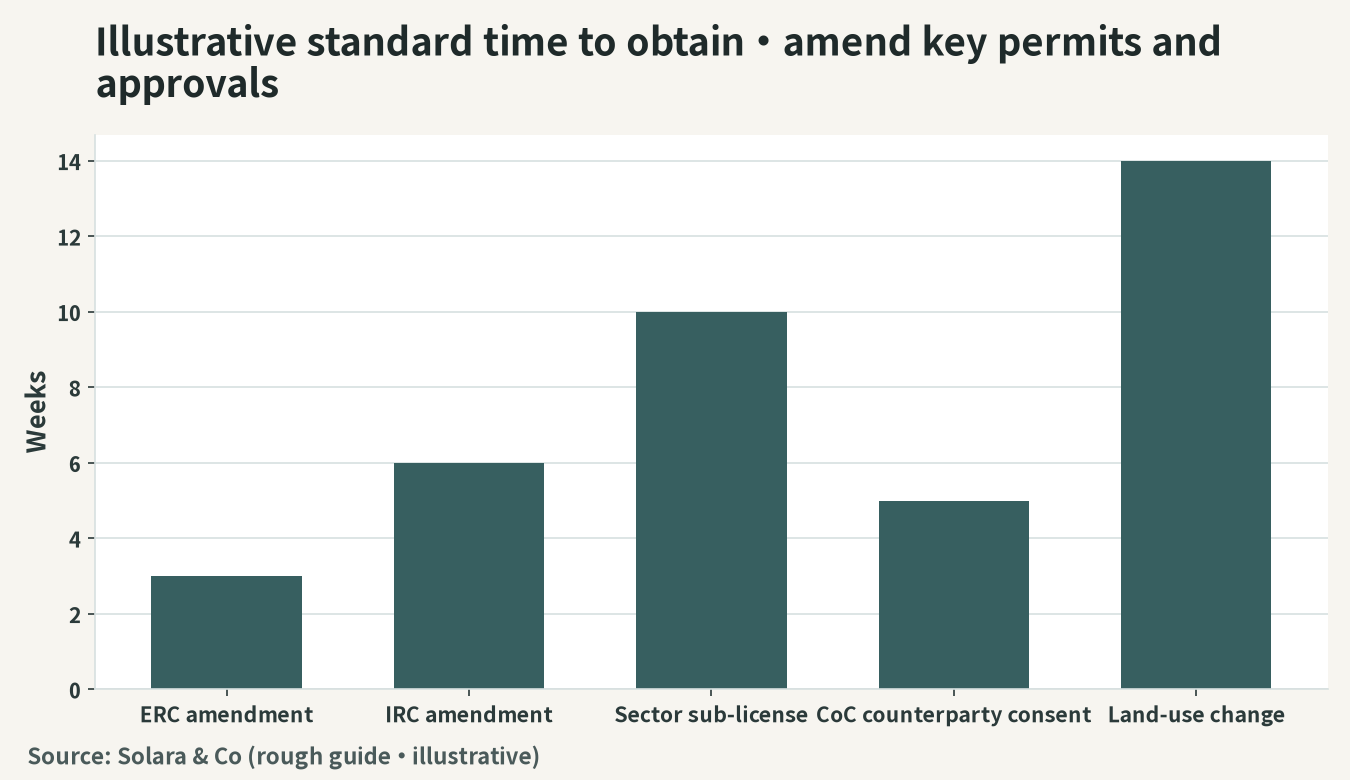
In Vietnam, the basis for doing business is built up in a hierarchical structure of the Enterprise Registration Certificate (ERC), the Investment Registration Certificate (IRC), and industry-specific sub-licenses; the absence of even one of these can render operations illegal. Furthermore, transactions that shift control over shares (change of control) frequently require contractual and administrative approvals, and overlooking these can risk losing key contracts or permits after the acquisition. This article organizes legal DD on a Vietnamese target company by domain, and explains from a practical standpoint how to translate the findings into representations and warranties (rep & warranty), indemnities, conditions precedent (CP), and the acquisition price.
Legal DD is, so to speak, a "hub-and-spoke" exercise of inspecting one by one the multiple legal domains that radiate outward around the target company at the center. First, let us take a bird's-eye view of the overall picture.
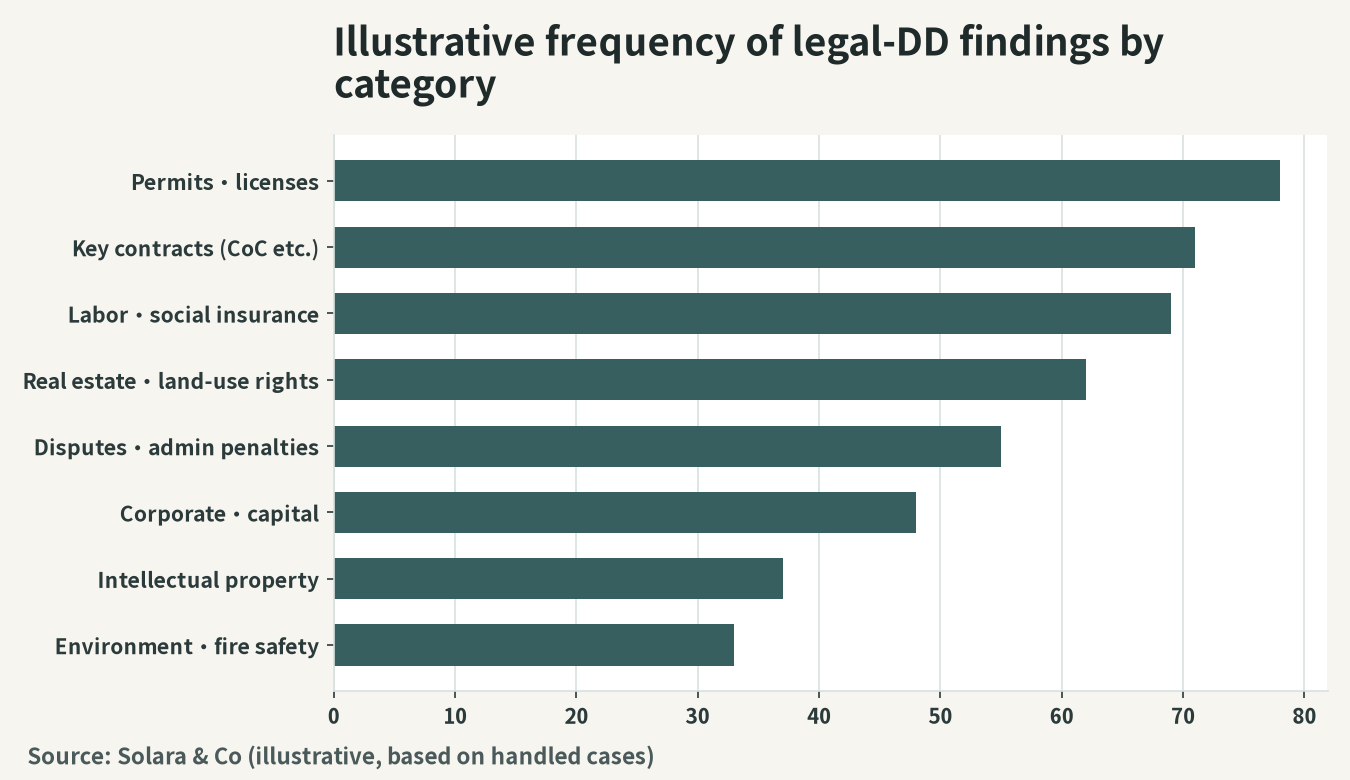
Legal DD domain | Primary documents to verify | Typical red flags |
|---|---|---|
Corporate organization・shareholders/capital | ERC, Charter, shareholder register, evidence of capital contribution | Unpaid capital contribution, nominee shareholders, charter not matching reality |
Permits・licenses | IRC/ERC, industry-specific sub-licenses, certificates of eligibility | Missing・expired permits for conditional business lines |
Key contracts | Customer, supplier, loan, and lease agreements | Change-of-control clauses, unilateral termination rights |
Real estate・land use rights | LURC (Red Book), mortgage registration | Remaining term・mismatched use・mortgage・transfer restrictions |
Labor | Labor contracts, internal labor regulations, social insurance payment records, WP | Unpaid social insurance, invalid labor regulations, WP deficiencies |
Intellectual property | Trademark・patent registration certificates, license agreements | Unregistered key trademarks, ownership of work-made inventions |
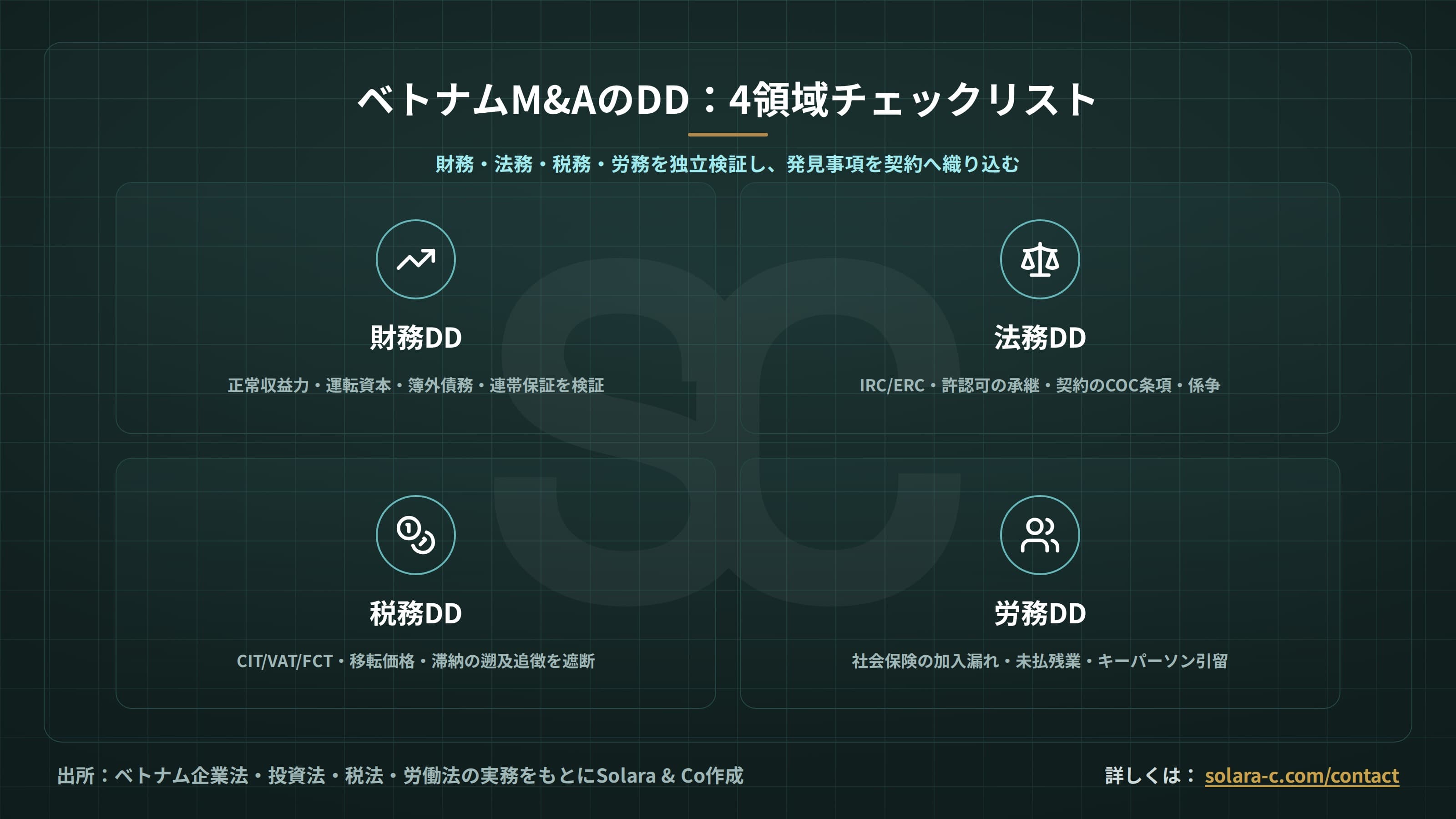
Disputes・tax litigation・administrative penalties | Court records, tax decisions, penalty notices | Pending lawsuits, history of back-tax assessments, remediation orders |
Environment・fire prevention (PCCC) | EIA, wastewater permits, fire inspection certificates | Unpermitted extensions, incomplete inspection, remediation orders |
The authenticity of corporate organization・shareholders・capital
The starting point of legal DD is confirming whether the target company "lawfully exists, and whether the shares to be acquired have been genuinely issued." If this foundation collapses, all the verification of contracts and permits stacked on top of it becomes a castle in the air.
Consistency among ERC・Charter・shareholder register
The Enterprise Registration Certificate (ERC) is the equivalent of a company's family register, recording the trade name, head office, legal representative, charter capital, and the composition of contributors. We cross-check this against the Charter, the member/shareholder register, and the list of contributors to confirm whether the recorded contents match. In Vietnam, there are cases where the registered particulars on the ERC diverge from internal documents, or where past capital increases・equity transfers have been left unregistered, and this gives rise to doubts about the authenticity of the shares.
Performance of capital contribution (payment) and the authenticity of shares
Under Vietnam's Law on Enterprises 2020, there is an obligation to pay in the registered charter capital within a certain period after establishment. In practice, one not infrequently sees target companies operating with part of the contribution against the registered capital still unpaid, or with the valuation of in-kind contributions left opaque. If the contribution is unpaid, doubts arise as to the validity of that equity interest and its voting rights, and after the acquisition the buyer may be pressed into a capital reduction or an additional contribution. It is necessary to verify the actual existence of the payment through bank deposit records and capital-account evidence, and to flush out whether there are nominee shareholders or trust-like holdings.
The stacked structure of permits・licenses
Business permits in Vietnam are even more hierarchical than in Japan, structured so that one can operate lawfully only when multiple permits are stacked together. In legal DD we inspect whether there is any hole somewhere in this "stacking."
IRC・ERC and industry-specific sub-licenses
For businesses involving foreign investment, the Investment Registration Certificate (IRC) forms the basis of the investment project, and on top of it sits the ERC, which is the basis for incorporating the company. Furthermore, for conditional business lines — food and beverage, logistics, education, healthcare, real estate, certain manufacturing sectors, and so on — separate, industry-specific permits (sub-licenses) are additionally required. Even if the IRC and ERC are in place, if the crucial industry-specific permit is unobtained or expired, that business is in an illegal state. We catalog the holder name・validity period・conditions・ancillary obligations of each permit, and flush out any omissions and lapsed renewals.
Compliance with foreign-investment regulations
Against the WTO services commitments, the CPTPP, and the negative list (market-access-restricted sectors) of the Law on Investment 2020, we verify whether the target company's business and foreign-ownership ratio are compliant. Even if, on the surface, permits have been obtained as a Vietnamese company, where in substance there is "round-tripping investment" controlled by foreign capital, the acquisition can bring the illegal state to the surface, leading directly to the risk of permit revocation.
Key contracts and change-of-control clauses
Key contracts that are the source of business value — with customers, suppliers, lenders, and landlords — raise the question of whether they will continue to function intact after the acquisition.
Change-of-control (transfer of control) clauses
In Vietnamese practice as well, bank loan agreements and contracts with major customers・suppliers may contain change-of-control clauses such as "if the controlling shareholder changes, prior consent is required" or "treats the change as grounds for termination." Overlooking these invites situations where, simultaneously with executing the share transfer, key financing loses the benefit of its term, or sales contracts that are the pillar of revenue are terminated by the counterparty. It is indispensable to extract the key contracts and confirm, one by one, whether consent is required・notification obligations・where the termination right lies.
Termination・non-compete・exclusivity clauses
We also scrutinize long-term exclusive supply obligations, unfavorable price-revision clauses, unilateral termination rights, excessive penalty fees, and whether there is a non-compete obligation on the departing owner. In particular, if the departing founding owner is not bound by a non-compete, there is a risk that after the acquisition they will launch a similar business and poach customers and personnel, which requires handling in the contracts and the SPA.
Real estate・land use rights (LURC)
In Vietnam, land belongs to the State, and what a company can hold is only the "Land Use Right." Believing in the target company's "land assets" with a Japanese sense of ownership gives rise to a fatal misconception.
Holder・use・remaining term
On the Land Use Right Certificate (LURC, the so-called Red Book), we confirm whether the holder is the target company itself, whether the use (industrial・commercial・residential) matches the business, and how many years of the use term remain. Land use rights under annual-payment leases are restricted in transfer and pledging as collateral, and if the remaining term is short, the premise of the business plan collapses.
Mortgage・transfer restrictions
It is common in Vietnam for land use rights or factory buildings to be mortgaged as collateral for bank loans, but this is not always accurately reflected in the disclosure materials. We directly query the mortgage registration and establish, from primary information, the security interests established・double pledging・whether there are transfer restrictions.
Labor・intellectual property
Legality relating to people and intangible assets is also a key domain that leads directly to contingent liabilities after the acquisition.
Labor contracts・internal labor regulations・social insurance
We confirm the legality of the type of labor contract (indefinite-term・fixed-term), the internal labor regulations (registration obligatory at 10 or more employees), and the wage rules. In particular, payment of social insurance・health insurance・unemployment insurance tends to accumulate into arrears from the gap between the declared headcount and the actual headcount, and in a share transfer it is inherited by the buyer together with the whole company. We cross-check the payment records against the payroll ledger to quantify the risk of arrears and back-assessment.
Foreign employment (WP) and intellectual property
The existence and validity period of Work Permits (WP) and Temporary Residence Cards (TRC) for foreign employees are also subjects of confirmation. In intellectual property, we scrutinize whether the key trademarks・patents are correctly registered in Vietnam and in the target company's name, whether the rights to work-made inventions and software belong to the company, and whether license agreements would lapse upon a change of control. An unregistered flagship brand carries the danger of becoming unusable due to a third party's prior registration.
Disputes・administrative penalties and environmental・fire-prevention compliance
Past and present disputes・administrative penalties are contingent liabilities that lead directly to future cash outflows. At the same time, for target companies that have factories・warehouses・stores, the legality of environment and fire prevention is the lifeline of continued operation. Rather than relying solely on the target company's self-declaration, we combine in queries of external records.
Methods for querying litigation records
For the existence of pending・past civil lawsuits, labor disputes, and commercial arbitration, in addition to the disclosure from the target company, we corroborate through queries of court records and investigation via local networks. We grasp the dispute amounts・prospects of winning or losing・status of settlement, and build the material ones into the acquisition price or the scope of indemnity.
History of tax litigation・administrative penalties
We confirm the history of litigation with the tax authorities, the record of back-tax assessments, indications relating to transfer pricing, and the history of administrative penalties・remediation orders relating to labor. If a matter that received a remediation order in the past remains incomplete, the buyer who inherited it after the acquisition will be held liable.
Environmental (EIA・wastewater) legality
We confirm whether the environmental impact assessment (EIA) or environmental permit, and the wastewater・waste-treatment permits, match the actual state of the business, and whether the authorized production capacity is not being exceeded. Unpermitted extensions or off-purpose use surface after the acquisition as an operation-suspension order or as a substantial remediation cost.
Fire-prevention (PCCC) inspection
The existence of fire-prevention (PCCC) design review・inspection certificates is an area where enforcement has been strengthened in Vietnam in recent years. Incomplete inspection or a neglected remediation order is treated as a serious red flag leading directly to a suspension of operations.
Reflecting findings in representations and warranties・indemnities・CP・price
The findings of legal DD are not finished by listing them in a report. Only by translating the discovered risks into transaction terms do they become protection for the buyer.
Working findings into representations and warranties・indemnities・conditions precedent (CP)
Matters that cannot be fully verified or latent risks are covered by the seller's representations and warranties (rep & warranty), and the indemnity clause・indemnity cap・survival period for breaches are designed. Obtaining・renewing key permits, obtaining change-of-control approvals, and responding to remediation orders are set as conditions precedent (CP) to closing, requiring satisfaction before completion. To secure recovery, escrow, retention of part of the payment, or an earn-out may also be combined.
Reflection in price・structure
Quantifiable contingent liabilities (unpaid social insurance, back taxes, remediation costs) are reflected in a reduction of the acquisition price, and where the risk one wishes to wall off is large, one considers a design that limits the scope of inheritance via an asset transfer rather than a share transfer. The true value of legal DD lies in showing not only "whether to buy this company" but also "under what conditions・in what form it can be bought safely."
Solara & Co's end-to-end support — rights and legality, all the way to the back side
Legal DD in Vietnam comes with Vietnam-specific difficulties such as the stacked structure of permits, change-of-control approvals, the institutional differences of land use rights, and litigation queries that rely on external records. Judging, with a Japanese sense, that "looking at the contracts is enough" is the greatest pitfall.
Solara & Co has bases and a network of specialists in both Japan and Vietnam, and provides end-to-end support from verifying the authenticity of corporate organization・shareholders, through the inspection of permits・contracts・real estate・labor・intellectual property, queries of disputes・administrative penalties, and working the findings into representations and warranties・indemnities・CP・price. Fully mapping out not "whether it can be bought" but "how to buy it safely" is what divides success and failure in Vietnam M&A. We will accompany you, starting from the single step of verifying the rights and legality of the target company.