
Deal sourcing is not "hunting for a company to buy" — it is the starting point of a continuous "line"
The first question Japanese companies considering the acquisition of a Vietnamese business almost invariably ask is, "Where are the good deals?" Yet if you treat deal sourcing as "the task of listing companies you can buy," you lose your axis of judgment during the subsequent due diligence (DD) and negotiation. That is because sourcing is the starting point of a continuous "line" — where an entire sequence of design work begins, encompassing the acquisition objective, screening criteria, and initial risk assessment — and the precision of the hypothesis formed here determines the success or failure of the deal as a whole.
What makes M&A sourcing in Vietnam decisively different from in Japan is that targets are concentrated among owner-dominated small and mid-sized enterprises (SMEs) and family-run businesses, reliable corporate databases are scarce, and even financial information is fragmentary. Good deals never surface on the open market; they arise only from local human networks and from steady, persistent outreach. This article explains — from a perspective grounded in Vietnam's specific realities — everything from articulating the deal rationale, to choosing sourcing channels, designing the longlist and shortlist, the anonymous teaser and NDA, initial contact and management interviews, and early credit checks before full-scale DD. For a bird's-eye view of the whole picture from sourcing to closing, see The full M&A process in Vietnam.
The starting point: why buy (the deal rationale)
Articulate the acquisition objective in a single sentence
If you begin sourcing while holding the stance "we'll consider it if a good deal comes along," you have no criteria for declining the deals brought to you, and your time and effort become diffuse. Accelerating market entry, securing a manufacturing base, acquiring a sales network and customer base, or obtaining a license (permit) — articulating the acquisition objective (the deal rationale) in a single sentence is the very first task of sourcing. This one sentence works consistently and coherently all the way through to the later longlist criteria, the assumptions behind valuation, and even the evaluation axes of PMI (post-merger integration).
The objective determines the screening criteria and the channels
Once the acquisition objective is set, the industry, scale, region, and presence or absence of licenses you should be looking for naturally take shape, and which sourcing channel to use also comes into view. For example, if your objective is "a company near Hanoi with export-oriented manufacturing capabilities," you should target the industrial-park networks of the north and industry intermediaries — blindly collecting deal information from across the entire country would be meaningless. If you act while your objective remains low-resolution, you fall into the textbook failure of amassing the "quantity" of deals without the accompanying "quality."
Two routes to sourcing: via intermediaries and direct approach
Deals brought in via intermediaries / FAs
Deal origination in Vietnam can be broadly divided into two routes. One consists of deals brought in through an FA (financial advisor), brokerage firm, accounting firm, bank, and the like. The advantages are a fast start and a seller whose intent to sell is firm, but you must watch out for multiple buyers easily competing with one another, for hurried selling, and for biased information (only information favorable to the seller is disclosed). Brokerage fees also arise.
Buyer-led direct approach (proprietary sourcing)
The other route is the direct approach, in which the buyer narrows down the industry and contacts target candidates directly (proprietary sourcing). In Vietnam, the importance of this direct approach is even greater than in Japan. That is because the more excellent an owner-run company is, the more it is in a "not for sale" state, and a point of contact arises only from introductions and relationship-building through local networks. It takes time, but the chances of encountering a high-quality deal with little competition are high, and it is also easier to build a relationship of trust with the seller.
Which to make the main axis
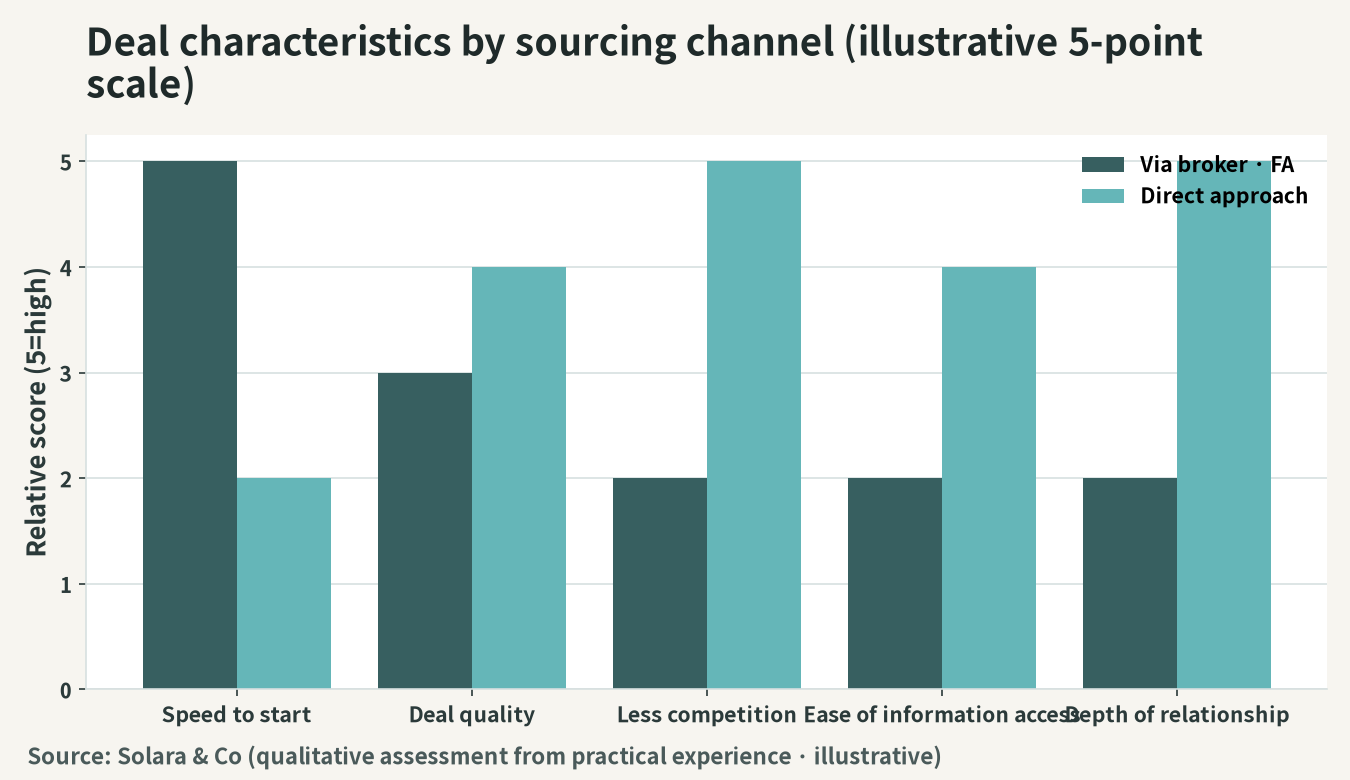
In practice, running both routes in parallel is the standard playbook. Grasp the market's pulse via intermediaries while, in your priority industries, digging up high-quality candidates through the direct approach — this two-tiered formation reconciles both the "quantity" and the "quality" of deals. The characteristics of the two can be organized as follows.
Aspect | Deals via intermediary / FA | Deals via direct approach |
|---|---|---|
Speed of starting | Fast (clear intent to sell) | Slow (begins with relationship-building) |
Deal quality | Wide variability | Tends to be high |
Presence of competition | Much competition (auction-like) | Little competition |
Cost | Brokerage fees arise | Mainly search and labor costs |
Information bias | Tends to lean toward the seller | Easier to obtain primary information |
Relationship with the seller | Thin, mediated by an intermediary | Thick, built directly |
Understanding Vietnam's distinctive sourcing environment
Reliable databases are scarce
In Vietnam, apart from listed companies, no comprehensive and reliable corporate financial database exists. Even if you can obtain basic information from the Enterprise Registration Certificate (ERC), the actual earning power and debt situation cannot be seen from the outside. The mindset of building a longlist starting from credit information — as one would with something like Teikoku Databank in Japan — does not apply; local industry knowledge and human networks form the core of your information sources.
The owner / family-run structure
Most targets are companies dominated by an owner or founding family, and decision-making is concentrated in the owner as an individual. The motive for selling, too, is often rooted in personal circumstances such as the absence of a successor, business succession, funding needs, or discord with a partner. Sourcing is therefore as much the work of "understanding the person who is the owner" as it is "hunting for a company." If you envisage staged involvement through a joint venture, the perspective of Selecting a joint venture (JV) partner in Vietnam also begins to overlap from the earliest stage.
Gaps in language, relationships, and expectations
Negotiations proceed in Vietnamese, and contract culture and negotiation etiquette also differ from Japan. In particular, rushing to talk price at the first meeting easily breeds wariness; building a relationship and then getting to the main subject is the standard approach. Moreover, an "expectations gap" — where the owner's desired price diverges sharply from the market rate — occurs frequently. Unless you align on a rough price orientation at an early stage, the deal can fall apart even after progressing to DD. The thinking behind valuation is detailed in Valuation in Vietnam M&A.
From longlist to shortlist
Building the longlist
In line with the acquisition objective, cast a wide net for candidates using objective criteria such as industry, scale (revenue, headcount), region, presence or absence of licenses, and export ratio, and build a longlist. In Vietnam, bundling together multiple information sources here — industry associations, local partners, existing business counterparts, industrial-park operators — is the key to compensating for the lack of databases.
Narrowing down to the shortlist
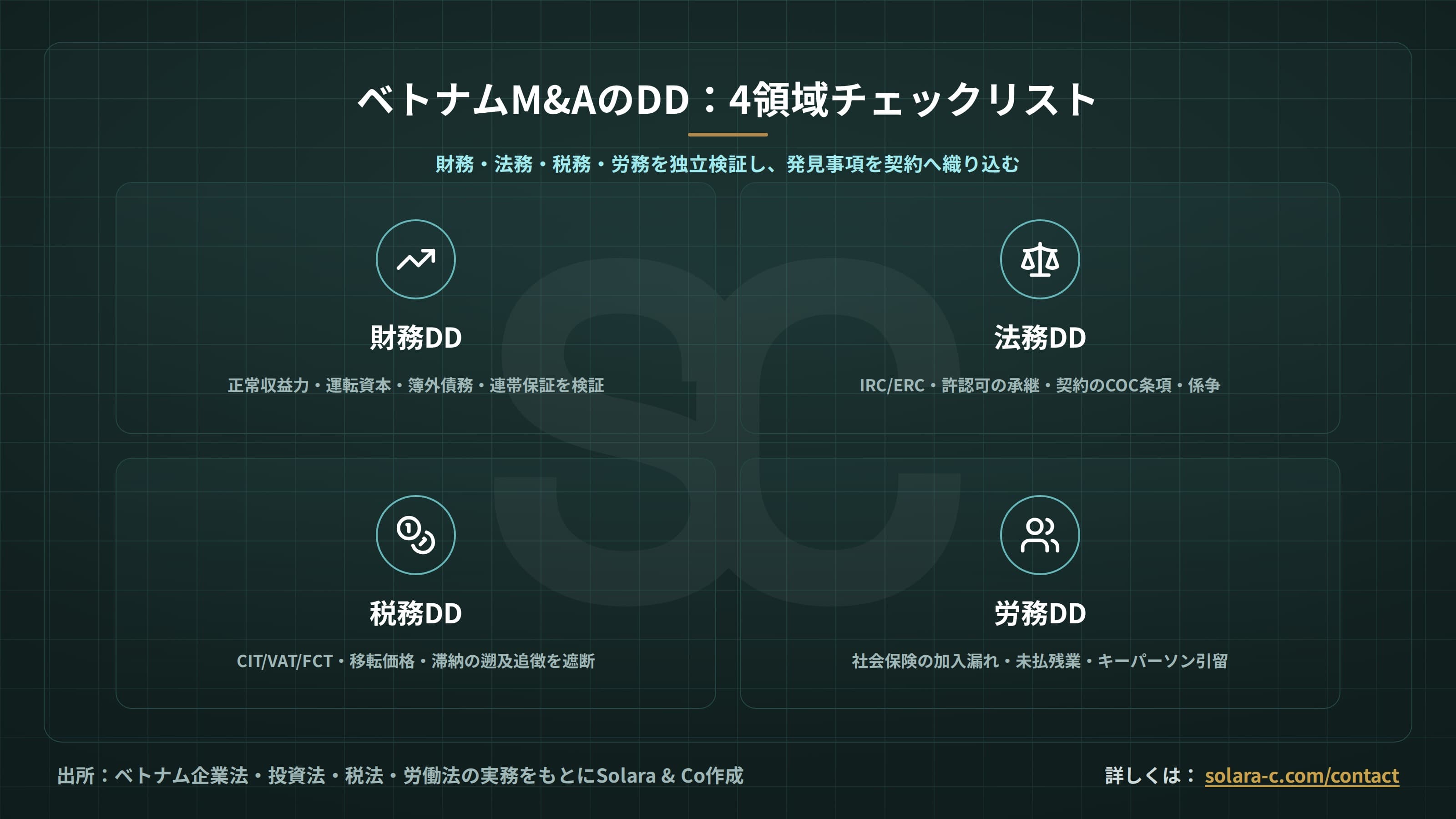
Evaluate the longlist along two axes — strategic fit (degree of alignment with the acquisition objective) and feasibility (likelihood of a sale, scale, accessibility) — and narrow it down to a shortlist of several companies. What matters at this stage is to run, in advance, a simple credit check and red-flag check on the target candidates before making contact. This lets you avoid the situation of being sent back to square one because a serious red flag (enormous off-balance-sheet debt, litigation, tax risk) is discovered later. Why credit checks should be performed right at the entrance is treated in detail in Vietnam M&A: why you should run a credit check first.
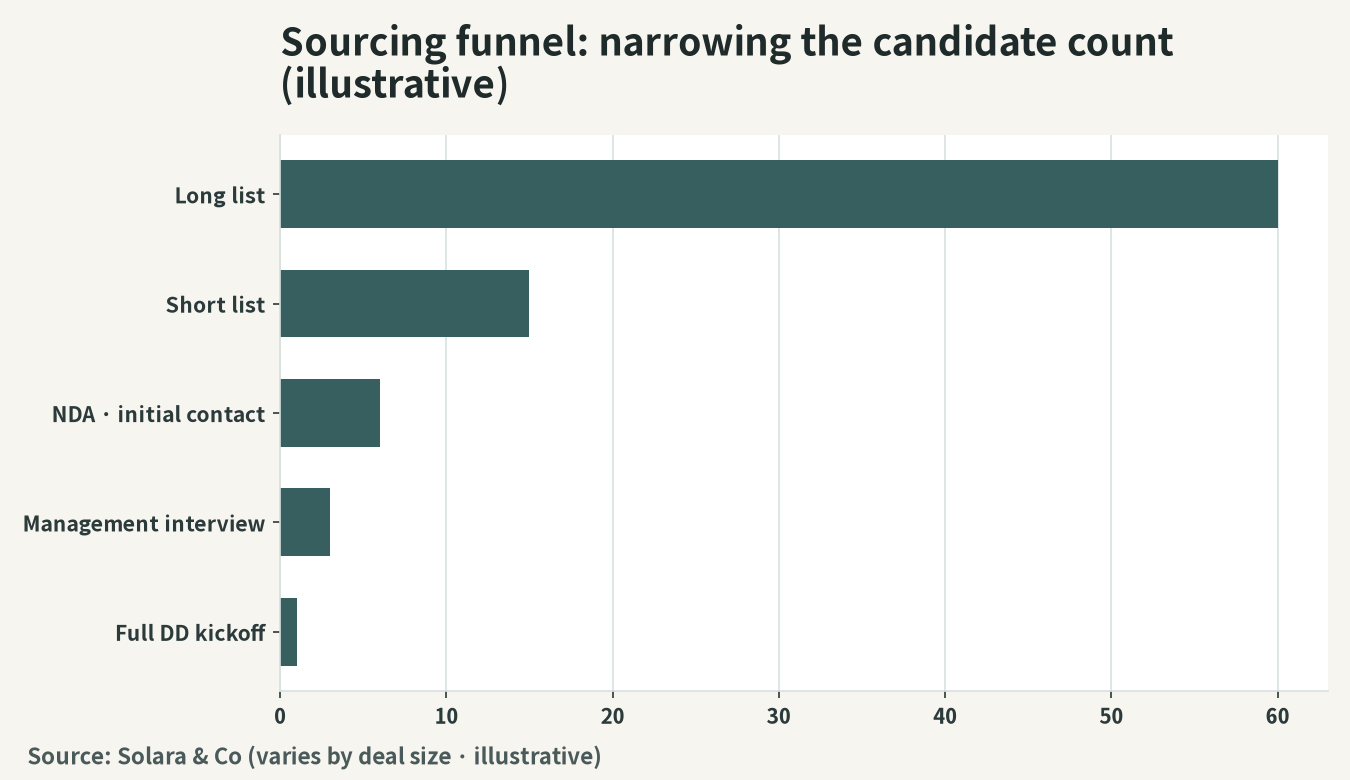
Narrow by "quality that connects to the line," not by "quantity"
You must not be satisfied with gathering many candidates at the top of the funnel. What matters is the perspective of whether each company on the shortlist rides on the "line" that is the acquisition objective, and whether it can be designed through all the way to DD, negotiation, and PMI. No matter how many candidates lacking quality you line up, it only increases the burden on the downstream stages.
Anonymous teaser, NDA, and initial contact
Gauge interest with an anonymous teaser
In the direct approach, use an anonymous teaser (a no-name overview) that does not identify the target, or a concise letter expressing the buyer's interest, to first gauge whether there is intent to sell and how warm the temperature is. Owner-run companies in Vietnam are sensitive about confidentiality and strongly dislike word leaking to employees or business counterparts that a sale is under consideration. Demonstrating regard for confidentiality from the very first move of contact is the gateway to trust.
NDA and limited disclosure
If the seller is receptive, conclude a non-disclosure agreement (NDA) and proceed to limited disclosure. An NDA is not only about preventing information leakage; it is the practical starting point that stipulates the purpose, duration, and return obligations regarding the disclosed information. Because Vietnamese companies are strongly owner-dominated and often release only fragmentary information at the early stage, it is important to lock down in writing what is to be disclosed and by when.
From initial contact to LOI/MOU
If interest firms up after the initial review, you proceed to a basic agreement (LOI / MOU) that sets out the acquisition intent, an approximate price range, exclusive negotiation rights, and the schedule. The price at this stage is no more than an estimate, and it is usual to keep its legal binding force limited. How to proceed from initial contact to the LOI is explained concretely in Negotiation and the LOI in Vietnam M&A.
Management interviews and early risk assessment
Grasp the "true picture" through management interviews
In Vietnam, where written information is scarce, dialogue with the owner and management (the management interview) becomes the most important information source for grasping the business's true picture. The business model, relationships with key customers, the status of license maintenance, the comings and goings of key personnel, and the genuine motive behind the sale — these can be drawn out only from dialogue, not from documents. Even when working through an interpreter, local insight that can accurately read nuance is indispensable.
Early credit checks and red-flag checks before full-scale DD
Because full-scale DD takes time and money, it is wise to insert beforehand an early credit check and red-flag check to verify the target company's background. Querying public records, checking for litigation and arrears, related-party transactions, the owner's personal credit — if you detect serious risks early through this initial screening, you can avoid pointless deep-dive DD. How to view the credit risks lurking in a target company is detailed in Credit risk in acquiring Vietnamese companies. Red flags that can be detected early become material not only for the decision to walk away but also for price negotiation and structure design.
Carrying findings from the sourcing stage over into DD
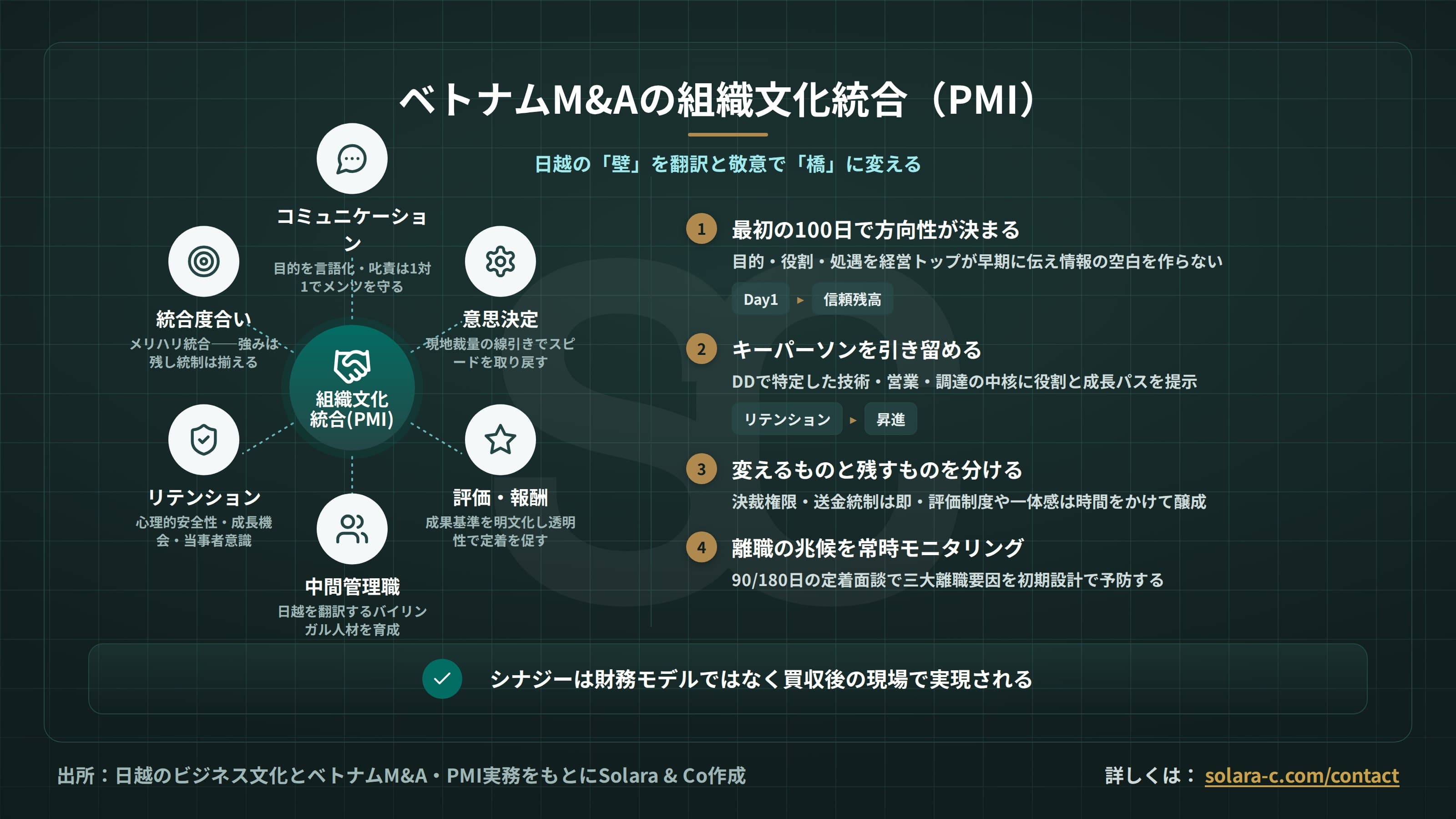
The hypotheses and points of concern obtained through sourcing and the management interview are translated directly into the investigation items (scope) of full-scale DD. The question here is whether the "line" is connected into a single line. Verify the hypothesis you drew at the entrance, then translate the findings into price, terms, and structure — this very continuity is the design philosophy that leads Vietnam M&A to success.
Solara & Co's integrated support — making the deal a "line" from the design of the entrance
The success or failure of Vietnam M&A hinges on how strategically you can design the entrance that is deal sourcing. Articulating the acquisition objective in a single sentence, running the intermediary route and the direct approach in parallel, digging up high-quality candidates from local networks in a Vietnam scarce in databases, and assessing credit risk in advance before making contact — the precision of this entrance determines the efficiency and outcome of all the subsequent DD, negotiation, closing, and PMI.
Solara & Co has bases and human networks in both Japan and Vietnam, and provides integrated support — from organizing the deal rationale, to deal origination via the direct approach, the anonymous teaser, NDA, and initial contact, management interviews, and early credit checks before full-scale DD. Not letting sourcing end as a one-off "deal hunt," but designing it as a single "line" that looks ahead all the way to closing and PMI — that is the key to succeeding at M&A in the Vietnamese market, where information is fragmentary and the owner-dominated character runs deep. We will support you starting from the very first step: organizing, together, "for what purpose, and which company, to buy."