
Exiting Vietnam is harder than "entering"
There are countless articles discussing entry into Vietnam, but few address "how to exit" head-on. In practice, however, no small number of Japanese companies consider exiting Vietnam or scaling back operations for reasons such as winding down unprofitable businesses, group restructuring, or changes in the business environment. And what many companies confront is the reality that "in Vietnam, getting out takes far more time and effort than getting in."
There is more than one way to exit. Depending on the situation, the options branch out: an M&A exit through selling the business to another company (share transfer or business transfer), the procedure of dissolving and liquidating the local subsidiary, or closing a branch or representative office. In particular, the dissolution and liquidation of a local subsidiary is dominated by tax closure by the tax authorities as its greatest hurdle, which can require many times the anticipated period. This article organizes the procedures and costs for each exit option, along with the key points for not misjudging the timeline.
Identifying your exit options
Once you have decided to exit, the first step is to determine whether to "sell and leave, or wind down and leave." This is decided by the going-concern value of the business, the existence of off-balance-sheet liabilities, the presence of a buyer, and time constraints.
M&A exit (sale)
If the business or company has going-concern value and a buyer can be found, selling through a share transfer or business transfer is the smoothest exit. It avoids lengthy administrative procedures like liquidation and also allows you to recover consideration. However, because the buyer will scrutinize the target company's off-balance-sheet liabilities, licenses, and land-use rights, the seller too must put its own affairs in order and reach a state that can withstand due diligence. The M&A sale process shares many issues in common with our explanation of the overall M&A process in Vietnam.
Dissolution and liquidation (winding down)
If no buyer can be found, or when fully terminating the business, the company enters the procedure of dissolving and liquidating the local subsidiary. This requires proceeding in sequence through stages prescribed by law, and it takes time. In particular, tax closure tends to drag on, greatly affecting the total cost and duration of the exit.
The dissolution and liquidation process
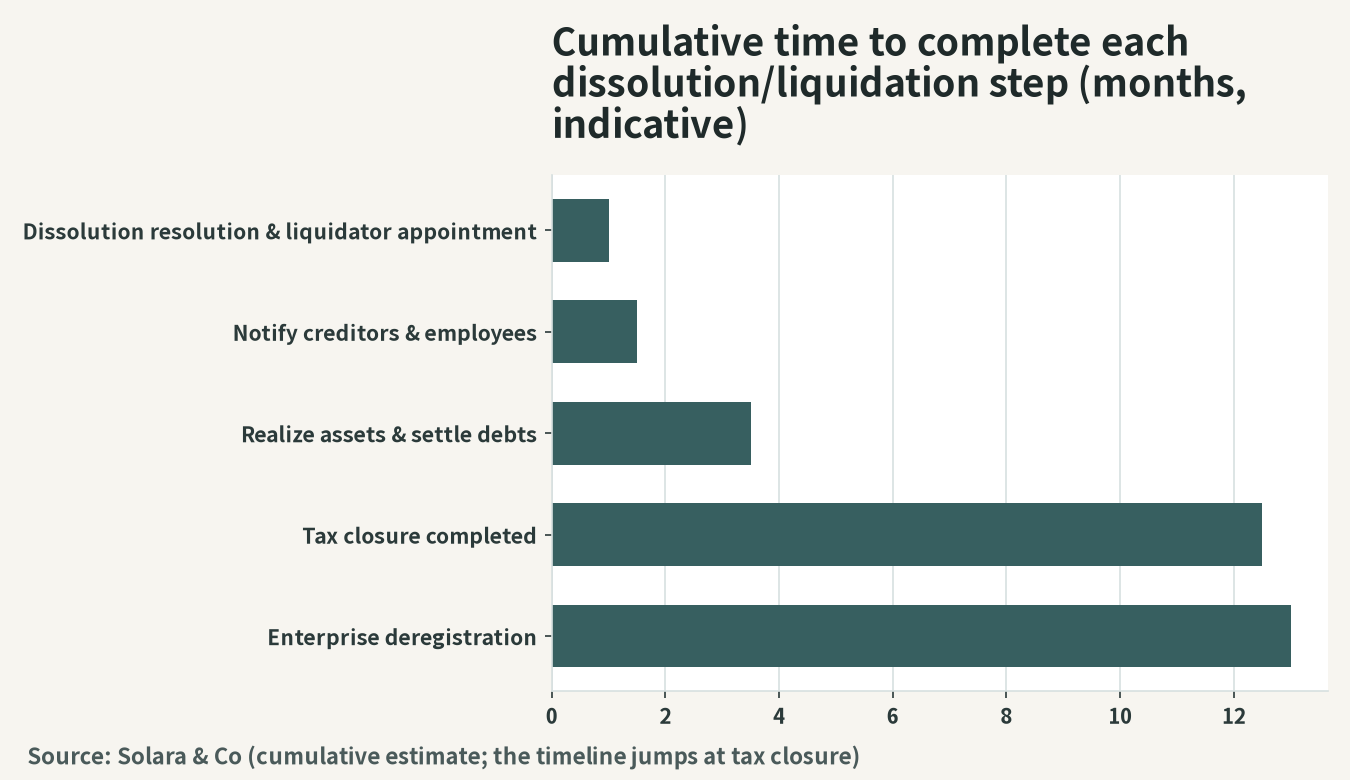
The voluntary dissolution and liquidation of a local subsidiary generally proceeds in sequence through the following stages. Because each stage presupposes completion of the previous one, a single delay pushes the entire process back. In Vietnam, the 2020 Enterprise Law sets out the grounds and procedures for dissolution, under which the entire course — from the dissolution resolution through debt settlement and the conclusion of liquidation — is expected to be filed with the business registration authority within, in principle, 180 days. That said, if the tax closure discussed below drags on, it is in fact more common for the process not to fit within this statutory window, and the very gap between the period the system envisions and the time actually required is what misleads companies in forecasting their exit.
Dissolution resolution and notice to creditors
First, the general meeting of shareholders (or the members' council) resolves to dissolve and determines the liquidation policy and the liquidator. Next, while filing the fact of dissolution with the business registration authority, the company notifies creditors, business partners, and employees, and begins settling its debts. In relations with workers, payment of severance and job-loss allowances under the Labor Code and proper termination procedures are required.
Realizing assets and settling debts
The company sells (realizes) its assets and uses the proceeds to settle its debts. The order of settlement is prescribed by law: unpaid wages and social insurance, taxes, other debts, and finally distribution of remaining assets to shareholders. If debts exceed assets and cannot be fully settled, the company must move to bankruptcy proceedings rather than dissolution. Bankruptcy is a legal resolution involving the courts, a framework separate from dissolution and liquidation, and it further increases the burden of time and procedure. When insolvency is anticipated, it is important to determine early, together with specialists, under which framework the matter will be resolved.
The greatest hurdle: tax closure
In exiting Vietnam, what Japanese companies most often misjudge in terms of time is tax closure (cancellation of the tax code). To complete liquidation, the company must undergo a final tax audit by the authorities, confirm there are no problems with past tax payments, and only then close the tax code.
Why it drags on
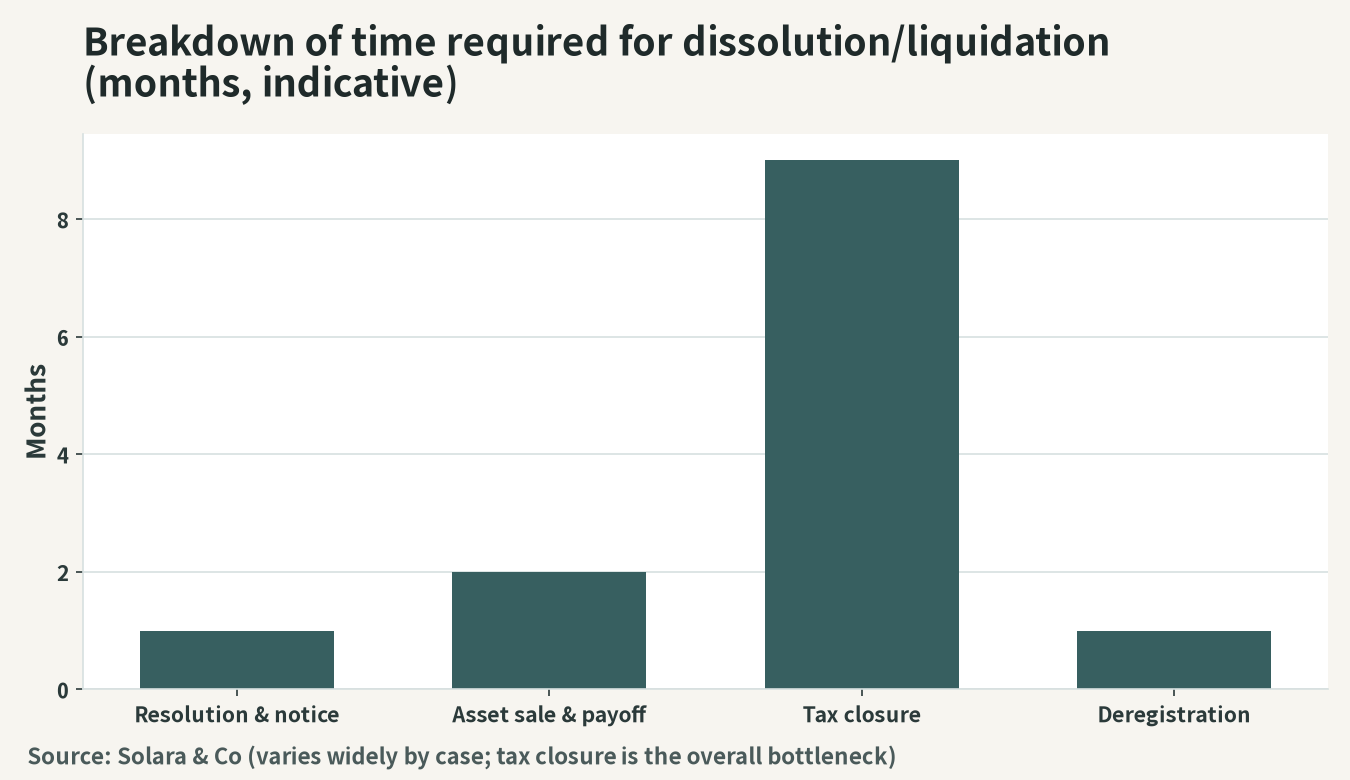
This tax audit retroactively scrutinizes corporate income tax, value-added tax, personal income tax, and transfer pricing going back several years, so if any issues or additional assessments arise, closing cannot proceed until they are resolved. Together with documentation deficiencies and the authorities' workload, it is not uncommon for tax closure alone to require anywhere from six months to over a year. You should anticipate that, from deciding to exit until the legal entity actually ceases to exist, the whole process commonly takes more than a year. The 2019 Law on Tax Administration sets the period within which tax can be reassessed or additionally collected at, in principle, five years from the filing deadline (longer in cases of under-reporting or evasion), and auditors comprehensively review transactions across this span. For transfer pricing, arm's-length verification is conducted under Decree 132 (Decree 132/2020/ND-CP), and local subsidiaries in manufacturing and wholesale that depend on the parent company for importing raw materials or exporting finished goods tend to have a higher ratio of related-party transactions and thus a wider range of issues.
Moreover, if tax closure is not completed, the company cannot proceed to the final cancellation of business registration (extinguishment of legal personality), and the closure of bank accounts and the repatriation of remaining assets are also stalled. In other words, tax closure is both the bottleneck of the entire exit process and the gate for recovering funds. Coordinating with the liquidator and local tax specialists to build a structure that can respond quickly to points raised by the authorities is the realistic measure for keeping the timeline from dragging on.
Past issues surface all at once
In the tax-closure audit, issues that were overlooked in ordinary times — insufficient transfer-pricing documentation, errors in deductible expenses, omitted withholding tax, and the like — surface all at once. So as not to scramble in the exit phase, getting tax compliance in order during ordinary times is, in the end, the most efficient exit preparation. Transfer-pricing issues are discussed in detail in our explanation of Vietnam's transfer pricing (TP) regime.
Taxation in the M&A exit
Even when choosing to sell (the M&A exit), tax considerations are indispensable. Gains on the transfer of shares or capital contributions are subject to taxation.
Treatment of capital gains tax
The profit (capital gain) that a corporate seller obtains from transferring a capital contribution is, in principle, subject to corporate income tax (20%). If the transfer price is markedly low, the authorities may reassess it at an arm's-length price and tax accordingly, so documentation that can explain the reasonableness of the price is important. Remittance requires procedures through a direct investment capital account (DICA) and proof of completed tax payment, and here too, having past tax matters in order is a prerequisite.
Preparing the sale as an "exit"
If problems with off-balance-sheet liabilities, licenses, or land-use rights are exposed during the buyer's due diligence, this leads to a price reduction or a broken deal. To advance the sale favorably, it is effective to put your finances, legal affairs, and taxes in order well before deciding to exit, keeping them in an explainable state. Ironically, the shortcut to "getting out" most smoothly is to maintain a sound, "ready-to-sell-at-any-time" state from ordinary times — and this is two sides of the same coin as structure design at the time of entry.
Workforce reduction and labor procedures
What tends to be overlooked in an exit or liquidation is the cost and procedure of handling labor matters. Vietnam's Labor Code provides strong worker protection, so even termination of employment accompanying the cessation of business incurs prescribed steps and costs.
Severance and job-loss allowances and procedures
For termination of contracts due to cessation of business, payment of severance or job-loss allowances based on years of service (such as one month's pay per year of service, with a minimum of two months) is required. Furthermore, in carrying out a workforce reduction, the company must follow procedures such as preparing a labor-use plan, consulting with the labor union, and notifying the authorities; lacking these, the reduction itself may be deemed invalid. The settlement of social insurance and the wind-down of foreign expatriates' work permits and residency are also carried out in parallel. For details, please refer to our explanation of Vietnam's Labor Code.
Impact on the schedule
Handling labor matters proceeds in parallel with the liquidation procedure, but if a dispute arises it will delay the entire schedule. Explaining the situation to employees honestly at an early stage and proceeding amicably with lawful allowances and procedures is the key to not letting the exit become complicated.
Closing a branch or representative office
If the form of entry is not a local subsidiary but a branch or representative office (RO), the closing procedure is relatively lighter than the liquidation of a company.
Differences from corporate liquidation
Because a representative office is a base that does not conduct business activities, it can be closed through procedures such as returning the license, settling taxes and labor matters, and closing bank accounts. Even so, however, a final tax confirmation and labor processing accompanying the termination of local staff's employment are still required. Which form to choose at the time of entry is worth considering, including from the perspective of ease of exit. If the plan is to start from market research or limited activities and expand in stages, a transition path — initially a representative office, then a local subsidiary upon full-scale rollout — is also an option.
Advance preparation and practical pointers for exit
How well an exit goes is determined less by how you move after deciding to exit than by how thoroughly you have maintained a "ready-to-close-at-any-time" state in ordinary times. Taxes, labor, and capital transactions in particular are certain to be probed in depth during liquidation, so being conscious of the exit from the structure-design stage at entry ultimately leads to the shortest and lowest-cost exit.
A checklist for the exit decision
Before making the exit decision, take stock of at least the following. First, the consistency of filings and payments for corporate income tax, value-added tax, and personal income tax over the past five years, and the state of transfer-pricing documentation (local file and master file). As noted above, because a tax audit can in principle reach back about five years, deficiencies in this period will inevitably surface at tax closure. Second, the transferability and remaining term of land-use rights, factory leases, and key licenses — factors that directly govern both the value on sale and the ease of disposal on liquidation. Third, the consistency between a schedule of liabilities such as bank loans, parent-subsidiary loans, and payables, and the deposit-and-withdrawal history of the DICA (direct investment capital account). If these are in order, both the judgment of whether to sell or liquidate and the handling of the authorities become markedly faster.
Impact on the parent company and the whole group
An exit is not confined to the local subsidiary alone. On the Japanese parent's side, home-country tax and accounting treatment — the timing for recognizing valuation losses on the investment and bad-debt losses, the application of the controlled-foreign-company (anti-tax-haven) rules, and the write-off of goodwill and deferred tax assets on consolidation — moves in tandem with the local procedures. Because where you place the fiscal year in which liquidation concludes changes the timing of deductible expenses and the realization of foreign-exchange gains and losses, it is important to design by aligning the local liquidation schedule with the home-country closing period. One must not lose sight of the view that an exit is at once the work of "winding down locally" and a financial decision to "minimize losses across the entire group."
Estimating exit costs and duration
The most important thing in the decision to exit is to estimate costs and duration realistically. With dissolution and liquidation in particular, tax closure occupies most of the period.
Don't misjudge "when it will end"
Exit costs include liquidation work and specialist fees, severance allowances, the possibility of additional assessments in the tax audit, and the maintenance costs that keep accruing while the procedure drags on (minimum staffing, rent, audits). In particular, if you are optimistic about "when it will end," unforeseen maintenance costs pile up. Setting a conservative schedule and budget at the very moment you decide to exit is the key to completing the exit with certainty.
Comparison of exit methods (summary table)
Organizing the main exit methods by duration, cost, and characteristics gives the following.
Method | Estimated duration | Main costs | Characteristics |
|---|---|---|---|
Share / business transfer | Several months and up | Brokerage, DD, capital gains tax | Recovers consideration; fast procedure |
Dissolution / liquidation | Over a year | Tax audit, liquidation, severance | Tax closure drags on |
Bankruptcy | Long-term | Court procedure | Legal resolution when insolvent |
Branch / RO closure | Several months and up | Tax and labor settlement | Procedure lighter than a company |
Exiting Vietnam begins with determining whether to "sell and leave" or "wind down and leave," and if you choose dissolution and liquidation, the greatest hurdle of tax closure awaits. What matters is to estimate the entire schedule and cost realistically at the moment you decide to exit, and to organize tax and labor issues in advance. Solara & Co provides seamless support — from organizing the exit decision, searching for an M&A buyer, the dissolution and liquidation procedures, and responding to tax closure, through to handling labor matters — with a team versed in the practical realities of both Japan and Vietnam. Designing with the "exit" in view actually begins at the entry gate. At the stage of considering an exit, please start by consulting us on organizing your options. An exit is by no means a "failure"; it is a strategic decision to reallocate management resources to the optimal place. That is precisely why it is important to calmly choose the least-loss exit based on numbers and schedules, not emotions.