
Acquisition finance is a question of "structure," not "cash flow"
The first question Japanese companies considering the acquisition of a Vietnamese company tend to ask is about the figure: "How much do we need?" Yet the essence of acquisition finance is not a cash-flow problem of how to raise the required amount. Whether to inject funds as parent-company equity, as a shareholder loan or offshore borrowing (debt), and how to design the allocation between the two — this single point governs the entire post-acquisition tax burden, the ability to remit dividends and interest abroad, and even the ease of recovering capital at a future exit (sale/withdrawal).
What decisively distinguishes acquisition finance in Vietnam from that in Japan is that a foreign investor's movement of funds is tightly bound by an account-and-registration regime. Equity contributions cannot be paid in without going through a Direct Investment Capital Account (DICA); offshore borrowing in certain cases requires registration of the foreign loan with the State Bank of Vietnam (SBV); and the interest rate on related-party loans may be disallowed under the lens of transfer-pricing rules. If you decide on a funding method in order of "cheapest first," you will later face a situation where remittances get stuck, costs are denied deductibility, and you cannot recover funds at exit.
In this article, we organize acquisition finance for Vietnam M&A into the three categories of equity, debt, and hybrid, and explain from a practical standpoint Vietnam's specific account-and-registration infrastructure, the constraints of thin capitalization and interest deductibility, the choice of acquisition vehicle, and the key design points with an eye on remittance and exit. For where this fits within the overall flow of a deal, please also see The full M&A process in Vietnam.
Three categories of funding: Equity, Debt, Hybrid
The funds that cover the acquisition consideration along with post-acquisition working capital and capital expenditure fall broadly into three categories. Because the regulatory, tax, and remittance characteristics of each differ entirely, grasping the nature of each category at the outset is the starting point of the design.
Equity: Parent-company contribution (charter capital・paid-in capital)
The simplest approach is for the Japanese parent to contribute funds as the charter capital of the local entity. There is no repayment obligation, and it is not subject to the constraints of thin capitalization or interest deductibility. On the other hand, once paid in as capital, the funds can only be recovered through limited procedures such as capital reduction, liquidation, or share transfer, giving rise to the constraint that they are hard to withdraw flexibly. The contribution amount is recorded on the Investment Registration Certificate (IRC) and Enterprise Registration Certificate (ERC), and changes require procedures with the authorities.
Debt: Shareholder loan・offshore borrowing
A shareholder loan from the parent to the local subsidiary, or offshore borrowing from a third-party financial institution, has the advantage of allowing funds to be moved flexibly through repayment and interest remittance. Interest expense is in principle deductible and can be recovered ahead of dividends. However, in Vietnam, offshore borrowing depending on its maturity structure requires foreign loan registration with the SBV, and the interest rate on related-party loans is subject to arm's-length verification under transfer pricing. Furthermore, because the cap on interest deductibility described below applies, the simplistic notion that "loading up on debt saves tax" does not hold.
Hybrid: A combination of Equity and Debt
In practice, a hybrid structure that covers part of the acquisition consideration with equity and part with a shareholder loan or local bank borrowing is common. By creating the vehicle with minimal capital and adjusting variable funds with borrowing, you strike a balance between remittance flexibility and tax efficiency. The chart below is a typical example of the funding mix relative to the total acquisition amount.
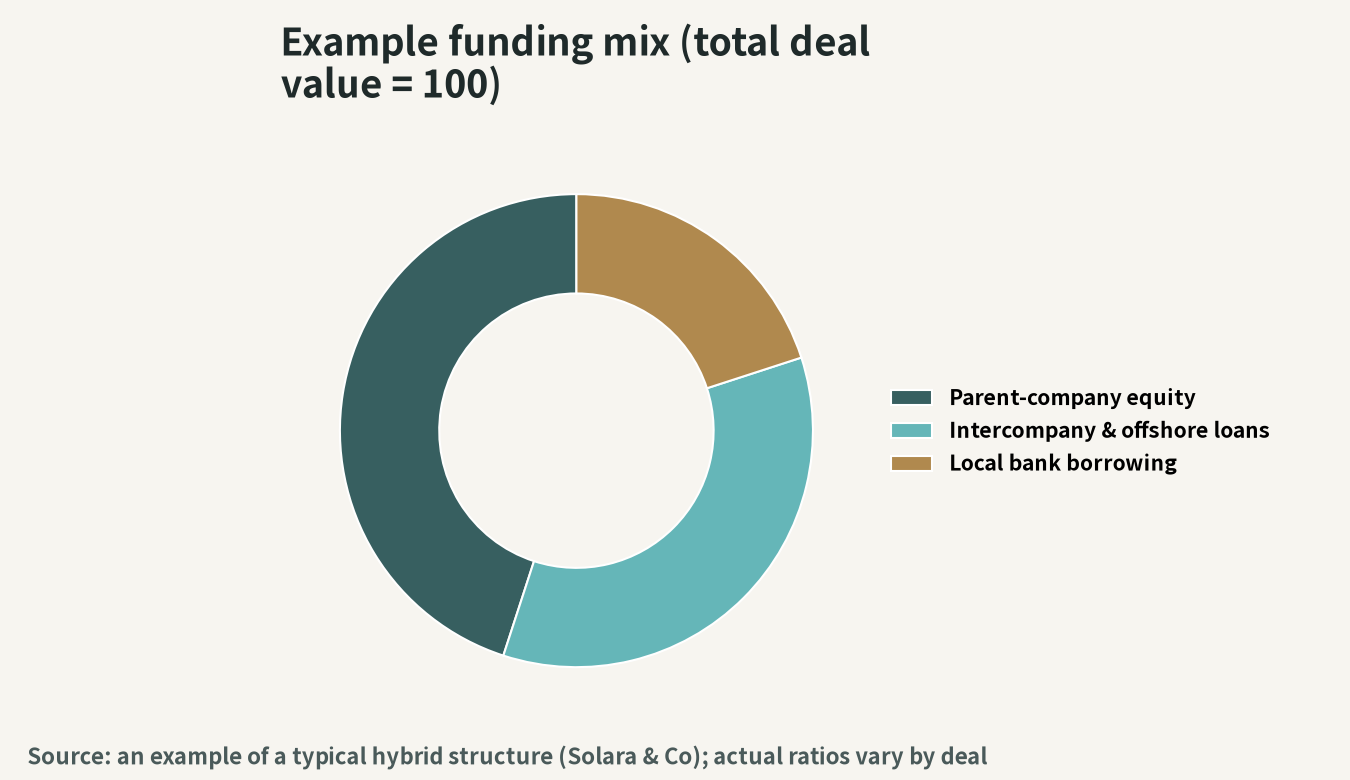
A structure that layers a shareholder loan and local bank borrowing on top of an equity base is common, but the optimal ratio should be worked backward from the target's earning power (EBITDA), required capital expenditure, and the constraints of remittance and deductibility.
Vietnam's specific account-and-registration infrastructure
In Vietnam, which account a foreign investor's funds pass through and where they are registered is inseparably tied to the choice between equity and debt. If you move funds without understanding this, the payment-in and remittance simply cannot be physically executed.
The Direct Investment Capital Account (DICA) and equity injection
The payment-in of charter capital of a foreign direct investment (FDI) enterprise, and the remittance abroad of dividends・capital reduction proceeds・share transfer consideration, are in principle carried out through the Direct Investment Capital Account (DICA). The basic flow is for the parent's contribution to land in this DICA and then be transferred to the operating account. When acquiring the shares of an existing FDI enterprise through M&A, the settlement of consideration also passes through the DICA.
Loan accounts and management of medium-to-long-term borrowing
When receiving offshore borrowing, the receipt and payment of its principal and interest are also managed through capital-system accounts (the DICA for medium-to-long-term borrowing, and a separate loan account for short-term borrowing). Clearly distinguishing equity injection from debt receipt-and-payment at the account level makes subsequent remittance review and audits smoother. In the case of indirect investment (acquisition that is purely a financial investment, such as share investment without involvement in management), a separate Indirect Investment Capital Account (IICA) is used, and care is needed because the account lineage differs from that of direct investment.
SBV registration of offshore borrowing (foreign loan registration)
Among loans from non-residents (the parent or offshore financial institutions), medium-to-long-term foreign loans with a repayment period exceeding one year must be registered with the SBV. Short-term borrowing of one year or less is in principle exempt from registration, but cases such as refinancing that effectively extends beyond one year become subject to registration. In registration, the loan agreement・interest rate・repayment schedule・use of funds are reviewed, and principal and interest can only be remitted within the registered scope. If this registration is neglected, not only interest but even the overseas remittance of principal becomes impossible, making it the most critical procedure when arranging a shareholder loan. The overall framework of foreign-investment regulation is organized in Foreign investment regulation in Vietnam.
Comparison of funding methods
Contrasting the principal funding methods across the perspectives of funding-cost feel・regulation/registration・advantages・points to note brings the crux of the choice into view.
Method | Funding-cost feel | Regulation・registration | Advantages | Points to note |
|---|---|---|---|---|
Parent contribution (Equity) | Requires dividend source・effectively higher | Capital registration on IRC/ERC, paid in via DICA | No repayment obligation・not subject to thin-cap or interest cap | Rigid recovery (limited to capital reduction・liquidation・transfer) |
Shareholder loan (offshore borrowing) | Interest rate subject to transfer-pricing verification | Medium-to-long-term requires SBV foreign loan registration | Interest deductible・recoverable ahead of dividends | Cap on interest deductibility・remittance only within registered scope |
Local bank borrowing | VND interest rates relatively high | No SBV registration required (domestic borrowing) | Curbs FX risk・self-contained locally | Tends to require collateral・guarantees・credit-line constraints |
Hybrid | Optimizable depending on structure | Procedures for both equity+debt | Both remittance flexibility and tax efficiency | Complex design・requires overall consistency checks |
Funding cost should be compared not by the headline rate alone but by the "effective cost" that includes remittance feasibility・whether costs are deductible・FX risk. VND-denominated local bank borrowing avoids FX risk but carries a high rate, while foreign-currency shareholder loans, even at low rates, bear exchange-rate fluctuation and registration constraints.
The wall of thin capitalization and interest deductibility
The notion of "loading up on debt to save tax through interest" is strongly constrained in Vietnam. At its core is the cap on interest deductibility under transfer-pricing rules (Decree 132).
The 30% EBITDA interest cap (Decree 132)
For enterprises with related-party transactions, the portion of net interest expense (interest expense less interest income) that exceeds roughly 30% of EBITDA is non-deductible. This is a rule to prevent profit shifting through excessive debt injection via shareholder loans, and the larger the borrowing from related parties, the more easily the cap is breached. The excess may be carried forward for a certain number of years in some cases, but the tax-saving effect for the current year is lost. The chart below illustrates how interest expense breaks through the deductibility cap as the borrowing ratio is raised.
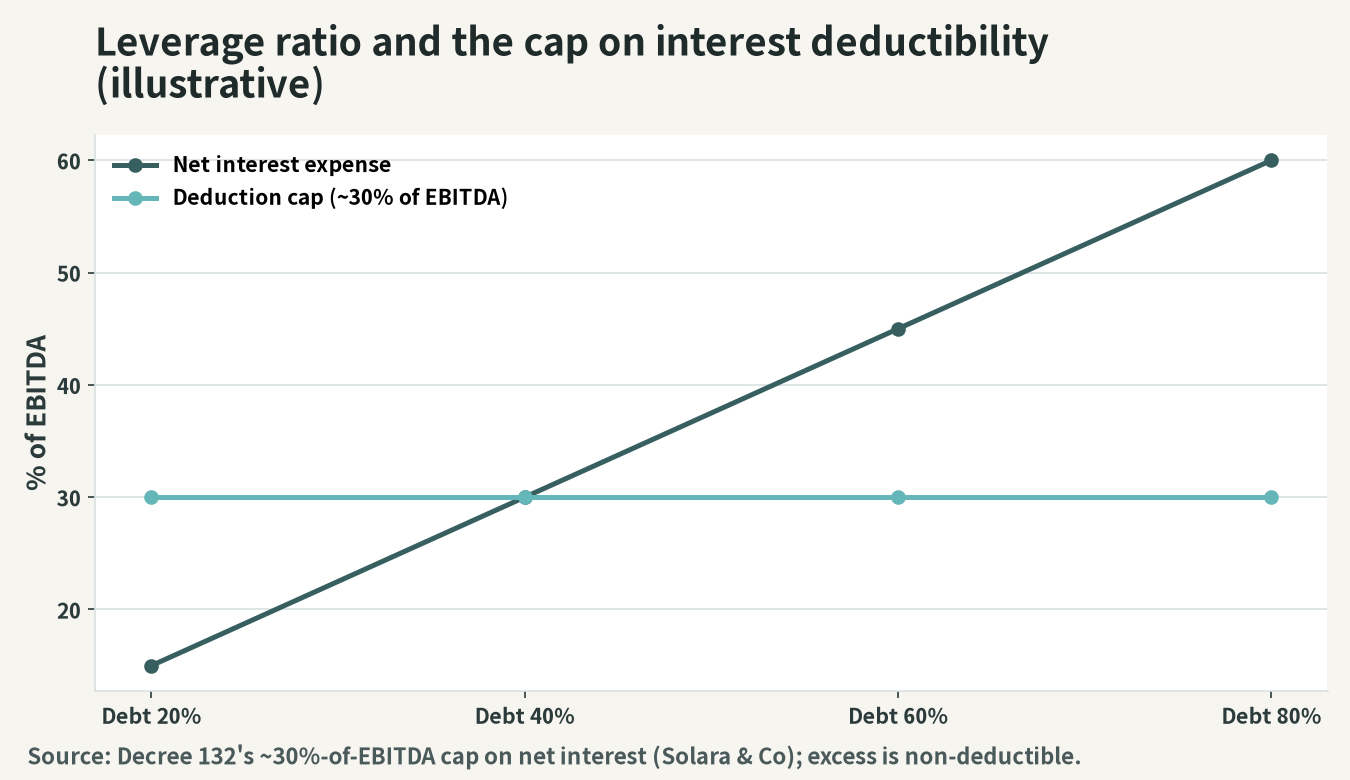
The higher the borrowing ratio, the more interest expense increases, but the portion exceeding about 30% of EBITDA is not deductible, so the tax-saving benefit plateaus. The optimal debt ratio lies just short of this cap — that is the crux of the design.
Transfer pricing and the interest level of related-party loans
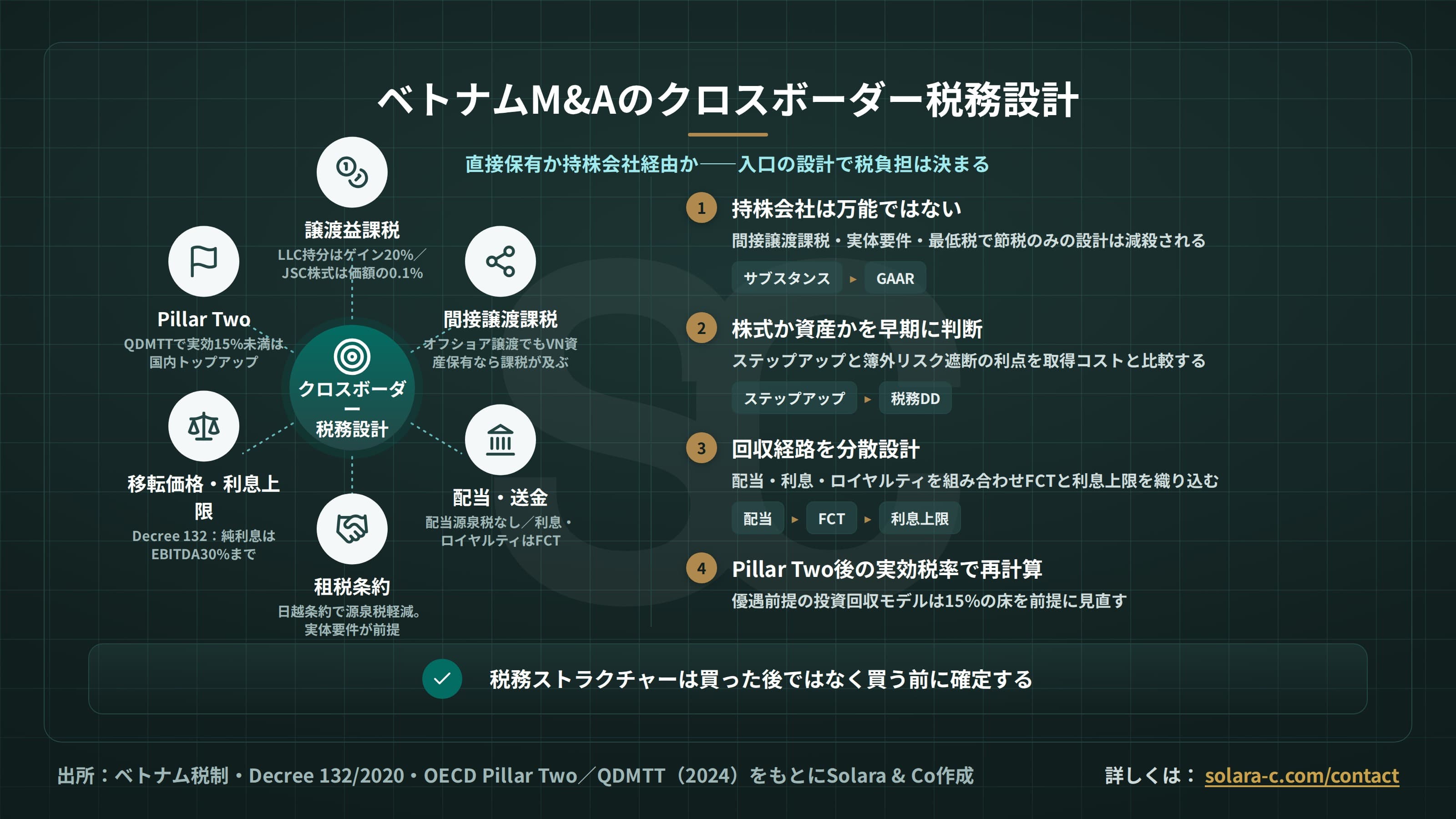
The interest rate on a shareholder loan must be at a level that would be established between independent parties (the arm's-length price). If the rate is too high, the excess interest is disallowed; if too low, a tax issue arises on the lender's side. You need to document the loan agreement・the basis for the interest rate・the use of funds, and be ready to explain them with transfer-pricing documentation (the local file, etc.). The details are explained in Transfer-pricing rules in Vietnam. Optimization that includes the withholding tax on cross-border remittance of interest and dividends is covered in Cross-border tax structure in Vietnam M&A.
Choosing the acquisition vehicle: Offshore holding company or onshore SPV
The choice of acquisition vehicle — "who buys" — is also designed in unison with the financing. Because how you choose the vehicle governs the route of fund injection and the ease of exit.
Offshore holding company (intermediate holding company)
This is a structure that places an intermediate holding company in a third country such as Singapore and holds the Vietnamese subsidiary through it. Because at a future exit you can sell the shares of the intermediate holding company rather than the shares of the Vietnamese entity, it is easier to avoid the domestic share-transfer procedures in Vietnam (ERC amendment・authority review), and the scope for utilizing tax treaties expands. On the other hand, a holding company without substance carries the risk of having treaty benefits denied, and incurs setup and maintenance costs.
Onshore SPV/local LLC
This is a structure that establishes a special-purpose acquisition company (SPV) within Vietnam to acquire・merge, or in which the parent directly holds the local entity. While simple and highly transparent, at exit it becomes a domestic share transfer in Vietnam, and capital-gains taxation and authority procedures apply directly. The choice of the vehicle's legal form (single-member LLC or joint-stock company) also affects the subsequent scope for raising funds, such as capital increases and bond issuance.
Design with an eye on remittance and exit
Whether acquisition finance is good or bad is judged not at the entrance (fund injection) but at the exit (fund recovery). It is important to foresee, from the design stage, the four repatriation routes of dividends・interest・principal・transfer consideration.
Remittance of dividends・interest
Overseas remittance of dividends draws on distributable profit after payment of corporate income tax and loss coverage locally, and is carried out through the DICA. Interest remittance is executed within the scope of the aforementioned SBV registration, and both payments to non-residents require consideration of withholding tax. A debt-centric structure can recover funds in the form of interest ahead of dividends, making it more nimble than an equity-centric one.
Capital recovery at exit
In an exit by share transfer, the taxation of the transfer gain and the recovery of the consideration via the DICA become the issues. Going through an offshore holding company makes it easier to complete via a transfer of the intermediate company's shares, while an onshore structure requires domestic procedures in Vietnam. In addition, an earnout (deferred consideration linked to performance) factored in at the time of acquisition is, for its remittance, subject to capital-system account and registration constraints, so it needs to be aligned with the financing design. The practice of earnouts is detailed in Earnout design in Vietnam M&A.
Registration・execution timeline
Fund injection follows the sequence of obtaining・amending the IRC/ERC, opening the DICA, and (for medium-to-long-term borrowing) SBV foreign loan registration. These take weeks to months, and getting the order wrong stalls payment-in and remittance. The payment schedule for the acquisition consideration should be worked backward incorporating the lead time of these registrations. Also, regarding the corporate valuation that underlies the total amount to be raised, please see Valuation in Vietnam M&A, and for the contractual clauses that ultimately fix the structure, please refer to The SPA (share transfer agreement) in Vietnam M&A.
Solara & Co's support for acquisition finance design
In Vietnam M&A acquisition finance, behind the seemingly simple question of allocation between equity and debt lies a complex interweaving of the remittance infrastructure of the DICA and SBV registration, the interest-deductibility cap of Decree 132, the choice of acquisition vehicle, and the capital-recovery route through exit. Handling these individually as a matter of "cash flow" will inevitably create distortions somewhere in the tax burden・remittance・exit.
Solara & Co has bases in both Japan and Vietnam, and designs as a single continuous line — from calculating the required funding amount based on corporate valuation, to the optimal allocation among equity・debt・hybrid, the execution procedures including DICA・SBV registration, shareholder-loan design that withstands transfer pricing, and vehicle selection with an eye on exit. If you wish to build acquisition finance with a perspective that runs through tax・remittance and the future exit, please consult with us from the conceptual stage.