
The Letter of Intent (LOI/MOU) is the "blueprint of the negotiation"
In negotiations to acquire a Vietnamese company, cases abound where the parties press ahead on the basis of an initial handshake left ambiguous in conversation or email, only to find—once due diligence (DD) is under way—that both sides held different assumptions ("so that was the premise?"). The Letter of Intent (LOI) or Memorandum of Understanding (MOU) is the "blueprint of the negotiation" that prevents such misalignment before it arises. An approximate price range for the acquisition, exclusivity, the schedule, and the conditions precedent for proceeding to DD—it is easiest to think of the LOI/MOU as the document that confirms whether the parties are looking at the same picture before any serious cost is incurred.
What matters is that an LOI/MOU is not "a memo at the pre-contract stage" but a strategic document that gives clear legal binding force to a select set of clauses. Price and structure are left open for negotiation, while the "devices that protect the negotiation"—exclusivity and confidentiality—are made binding. Whether you can intentionally design the presence or absence of this binding force is the first fork in the road that Japanese companies face in the early stage of M&A in Vietnam. This article explains, from a practitioner's perspective, the purpose of the LOI/MOU, how to delineate binding force, how to present an approximate valuation, how to design the exclusivity period, and finally the issues specific to Vietnam—governing law, language, and dispute resolution. For a bird's-eye view of the whole flow, please also see our explanation of the full M&A process in Vietnam.
The purpose and positioning of the Letter of Intent
The difference between LOI, MOU, and Term Sheet
In practice, terms such as LOI, MOU, Term Sheet, and IOL (Indication of Interest / Letter) are used interchangeably. Rather than any strict difference in legal definition, what matters is the substance of what the parties have agreed. Generally, the common usage is: an LOI is a document in which the buyer indicates to the seller its intent to acquire, an MOU is a memorandum confirming mutual understanding between both parties, and a Term Sheet is an attached document organizing the key conditions in bullet-point form. In Vietnamese deals, where three languages—English, Vietnamese, and Japanese—are intertwined, clearly stating in the body of the document "which clauses carry binding force"—rather than focusing on labels—is the only reliable way to avoid later disputes.
Not a "contract" but a "framework for negotiation"
The essence of an LOI/MOU lies not in promising to conclude the final contract—the share purchase agreement (SPA)—but in setting a framework to advance negotiations toward the SPA under certain rules. Because core conditions such as price and representations and warranties are settled in the SPA based on the results of DD, they are not fixed at this stage. On the other hand, the devices that protect the negotiation itself—exclusivity and confidentiality—if not made binding here, invite the worst-case scenario: the seller slips away to another buyer after you have poured tens of millions of yen into DD. The flow from sourcing deals to narrowing down to a preferred negotiating party is covered in detail in deal sourcing in Vietnam M&A.
Delineating binding from non-binding clauses
Typically binding: exclusivity, confidentiality, cost allocation, governing law
The clauses that should be made binding in an LOI/MOU are almost standardized. First, exclusivity (the Exclusivity / No-Shop clause). This is the buyer's single most important defensive clause, committing the seller not to negotiate with other buyers for a certain period. Second, confidentiality. Even where a separate NDA has been signed, it is customary to confirm it again within the LOI. Third, cost allocation. This sets out whether DD and legal fees are each party's own burden, and how matters are handled if the deal breaks down. Fourth, governing law and dispute resolution. This specifies the law applicable to the LOI document itself and the means of resolution should a dispute arise (arbitration or litigation). These are clauses that govern "the arena of the negotiation," and without binding force they are meaningless.
Typically non-binding: acquisition price, structure
Conversely, the acquisition price, the method of paying consideration, the structure (share transfer or business transfer), and the content of representations and warranties are, as a rule, not made binding. Because these fluctuate significantly with the facts uncovered in DD, fixing them at this stage would close off your own room for price-reduction negotiations later. The ironclad rule is to present the approximate price purely as a "reference level" and to state clearly that it "will be adjusted depending on the results of DD." Core conditions such as representations and warranties and indemnification are first stipulated with legally binding force in the final contract, the SPA. The structure of the SPA is detailed in the SPA (share purchase agreement) in Vietnam M&A.
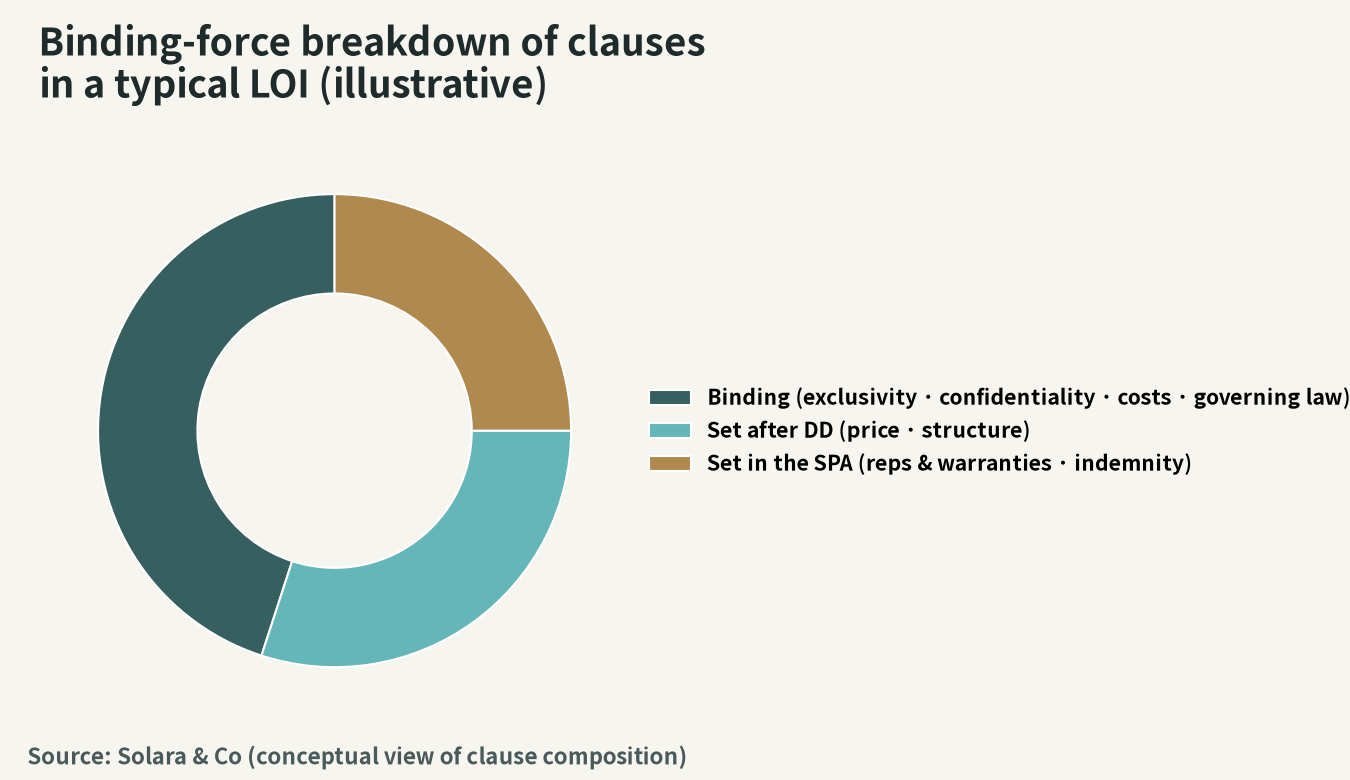
Among the key clauses included in an LOI/MOU, those that should be made binding are limited. The figure below is a conceptual illustration of how a typical LOI's clauses are divided into "binding," "to be settled after DD," and "stipulated in the SPA."
The table below organizes whether the key clauses in an LOI/MOU carry binding force, along with points to note in Vietnamese deals.
Clause | Binding force | Points to note |
|---|---|---|
Exclusivity | Binding | State the period, renewal, and effects of breach. The buyer's most important defense |
Confidentiality | Binding | May overlap with the NDA. Stipulate the purpose of use, return, and survival period of information |
Cost allocation | Binding | Each party bears its own as a rule. Consider treatment on break-down and a break-up clause |
Governing law, dispute resolution | Binding | Applies to the LOI itself. Designate the arbitral institution (SIAC / VIAC) |
Duty of good-faith negotiation | Binding (limited) | Keep it to a "duty to negotiate in good faith," not a "duty to agree" |
Acquisition price, price range | As a rule, none | An estimate by EBITDA multiple, etc. State that it will be adjusted through DD |
Structure | As a rule, none | The choice of share transfer / business transfer is settled after DD |
Representations and warranties, indemnification | None (stipulated in the SPA) | The LOI states direction only. Legal effect arises upon signing the SPA |
Deposit / earnest money | Conditionally binding | If placed in deposit, clarify escrow and refund conditions |
How to present the level of an approximate valuation
Presenting a range by EBITDA multiple
The price at the LOI stage is presented as a "level (indicative range)," not a fixed figure. In practice, it is common to present a band obtained by multiplying the target company's normalized EBITDA by a multiple appropriate to its industry. For example, in the form "based on EBITDA × 5–7, assuming an equity value after deducting net interest-bearing debt." In Vietnam, off-balance-sheet liabilities and pre-normalization profits often coexist, so committing to a pinpoint price at the early stage—when the accuracy of disclosed information is low—is dangerous. Presenting a range secures room for price-reduction negotiation in line with the findings of DD. How to use the various valuation methods is explained in valuation in Vietnam M&A.
The meaning of setting a range
A price range also serves to visualize early the gap between the seller's expectation and the buyer's acceptable level. If the upper and lower bounds of the range diverge significantly from the seller's wishes, you can decide—before proceeding to DD—whether to renegotiate or withdraw, avoiding wasted cost. Conversely, if the ranges align, a rationale emerges to secure exclusivity and proceed to DD. Price is both an "anchor for negotiation" and, at the same time, the cut-off line for whether to continue with the deal.
Designing the exclusivity period
Period and renewal clause
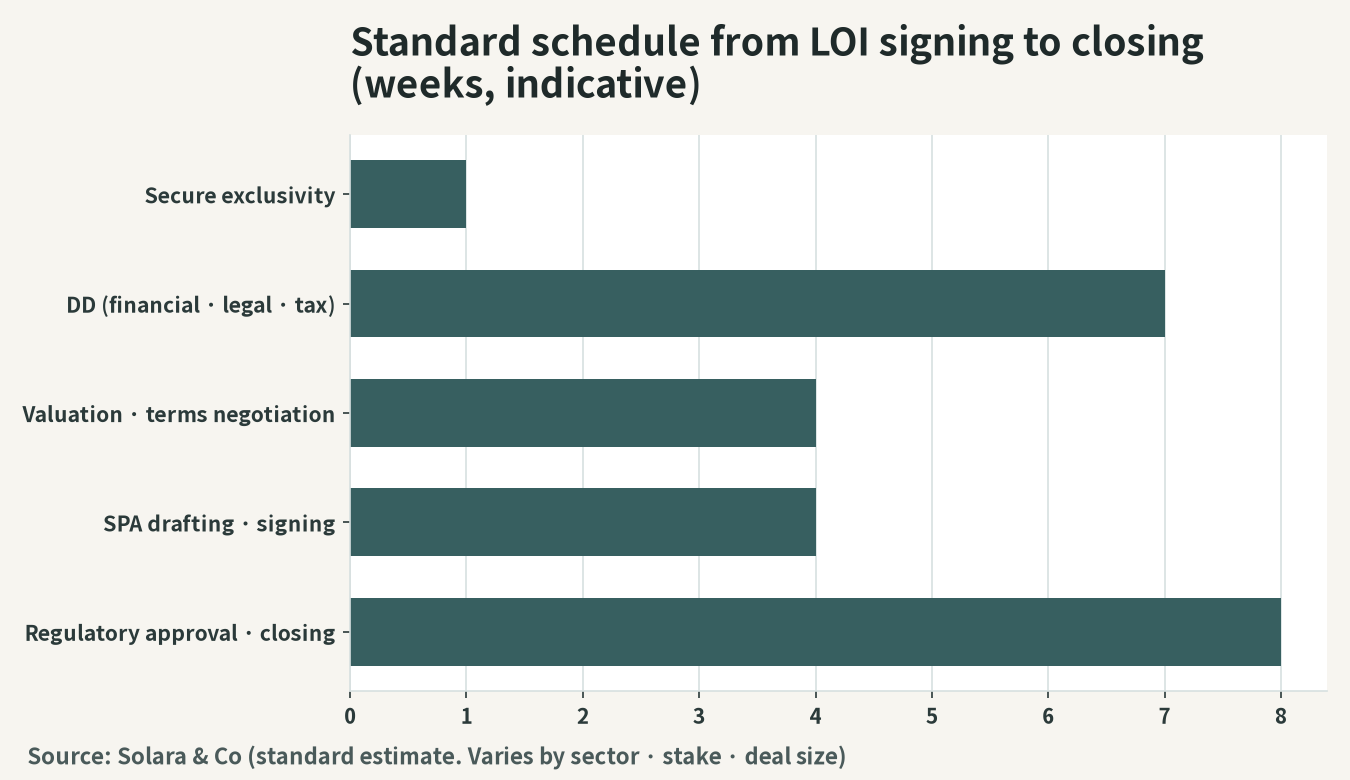
The exclusivity period is set by working backward from the time needed for DD, negotiation, and SPA drafting. In Vietnamese deals, financial, legal, and tax DD take one to two months, and the subsequent negotiation and SPA preparation take several weeks, so the practical approach is to set roughly 60–90 days initially and to include a renewal clause allowing extension for a certain period if there is reasonable cause. Too short, and it expires before DD can be carried out sufficiently; too long, and the seller—reluctant to lose other options—will not agree.
Why exclusivity is decisively important in Vietnam
Vietnamese companies have a strong owner-control character, and it is not uncommon for them to approach several candidate buyers in parallel. If you begin DD without securing exclusivity in writing, the scenario in which the seller leans toward another buyer offering a higher price—while you bear substantial professional costs—really does occur. The binding force of exclusivity is the only shield that protects the DD investment. Stipulating even the effects of a breach (cost indemnification or a break-up fee) raises the deterrent effect a notch further.
Key conditions (Term Sheet) and the connection to DD
Structure of the key conditions
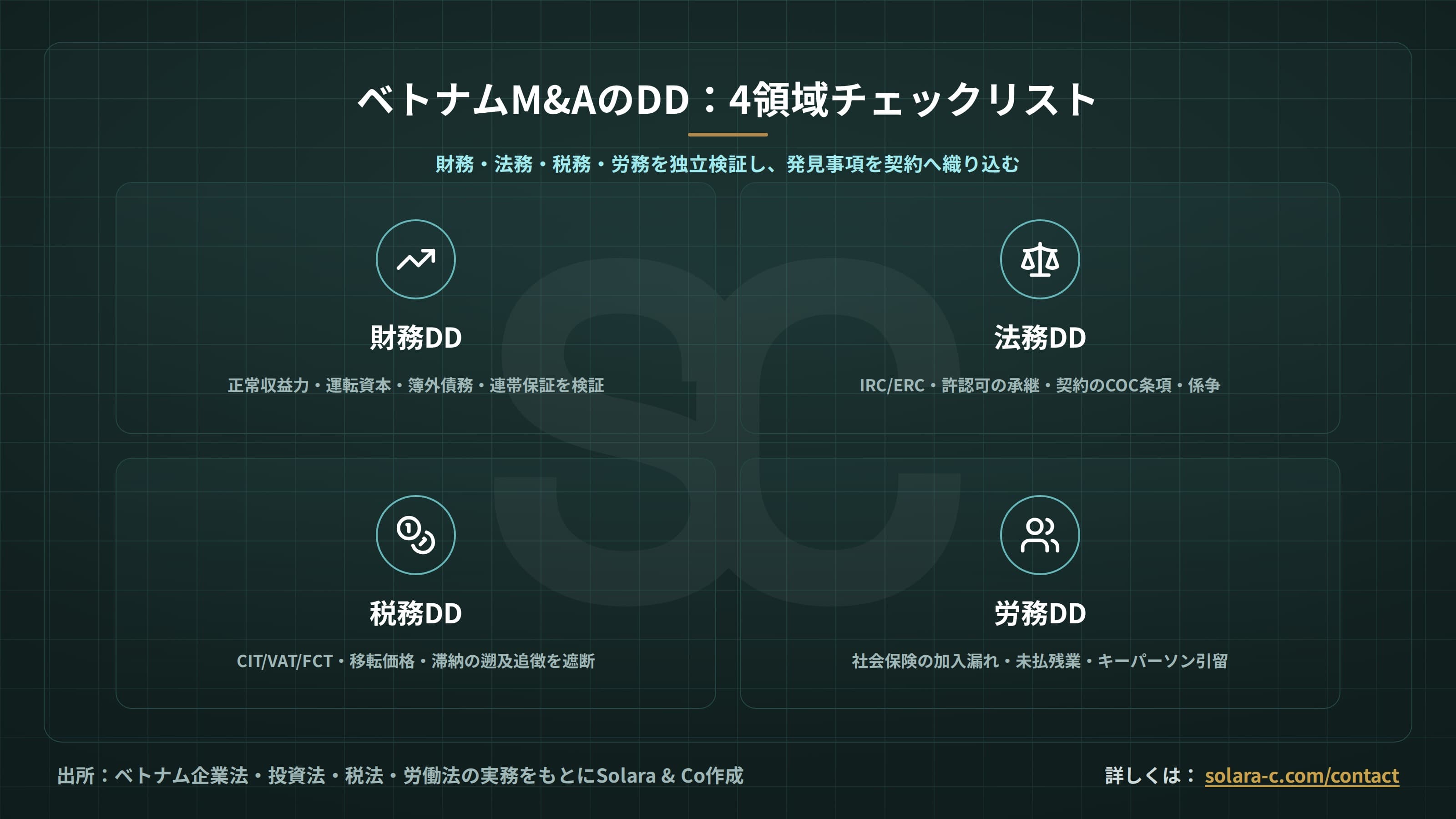
In the Term Sheet, organize in bullet-point form items such as the approximate price range, the percentage of target shares, the assumed structure, the exclusivity period, the scope and schedule of DD, the assumed timing of closing, and the main conditions precedent. Sharing the scope of "what will be examined in DD" here smooths the seller's preparation of the data room and shortens the lead time of the entire DD.
The sense of a standard schedule from LOI signing to closing is built into the exclusivity period by working backward from the number of weeks required for each process, as shown in the figure below.
Conditions precedent for conducting DD
Signing the LOI is the green light to launch full-scale DD. How to coordinate financial, legal, and tax DD must be designed in advance. The key financial points are covered in detail in financial due diligence in Vietnam M&A, and the legal aspects in legal due diligence. The efficient approach is to firm up exclusivity and the scope of DD in the LOI, then mobilize the expert team all at once.
Issues specific to Vietnam: governing law, language, dispute resolution
Bilingual documents and the priority order of language
Binding documents exchanged with Vietnamese parties are customarily prepared in two languages, English and Vietnamese (adding Japanese to make three when necessary). What matters is to state clearly which language version prevails should a discrepancy arise between languages. While the English version is often made the prevailing language in practice, the accuracy of the Vietnamese version cannot be taken lightly either, given enforcement and registration procedures within Vietnam. Because translation discrepancies become the spark for later interpretation disputes, cross-checking by experts is indispensable.
Governing law and arbitration (SIAC / VIAC)
The governing law and means of dispute resolution for the LOI itself, and for the future SPA, are issues whose direction should be decided at the early stage. In cross-border deals, it is common to choose arbitration by the Singapore International Arbitration Centre (SIAC) or the Vietnam International Arbitration Centre (VIAC), selecting the seat and the arbitral institution carefully from the standpoints of neutrality, enforceability, and language. The design of arbitration clauses and their enforceability is explained in detail in contract disputes and arbitration practice in Vietnam.
Owner control and a culture of performance
In Vietnam, there are situations where, even for a written agreement, a sense that "it can be flexibly changed according to the relationship" persists—a difference in temperature from the culture of strict contract performance that Japanese companies assume. It is precisely for this reason that, rather than relying on verbal handshakes, putting binding clauses into writing in clear wording and stipulating even the effects of a breach is the realistic preparation that prevents later trouble. On raising acquisition funds and the options for structure, financing and structure in Vietnam M&A is also a useful reference.
From the Letter of Intent to the SPA—connecting them in a single line
An LOI/MOU is not a document that is complete on its own. Conducting DD under the exclusivity secured in the LOI, translating its findings into price, conditions, and structure, and finally distilling them into a legally binding form in the share purchase agreement (SPA)—whether you can design this whole sequence as a "single line" determines the success or failure of M&A in Vietnam. If you misjudge the delineation of binding force in the LOI, the DD investment goes unprotected, or you close off your own room for price negotiation—and those distortions ripple across the entire downstream process.
Solara & Co has bases in both Japan and Vietnam, providing seamless support from selecting the preferred negotiating party, designing the NDA and LOI/MOU, securing exclusivity, supervising DD, valuation and negotiation, through to concluding the SPA. We design the negotiating arena for your company on the basis of foreseeing how each and every line of the Letter of Intent will bear on the later SPA and closing. We are ready to support you, starting with a single step of organizing together "what to make binding, and what to entrust to DD."