
The Logic Behind "How Much to Pay" — How Do You Measure the Value of a Vietnamese Company?
When advancing the acquisition of a Vietnamese company, the most vexing issue is the question of price: "in the end, how much should we pay?" The seller emphasizes high growth and future potential, and the business plan presented invariably trends upward. The buyer, on the other hand, cannot be confident about the reliability of the financial figures, the actual market value of land and equipment, or the risks to be inherited. The work of bridging this gap and deriving a "well-grounded price" that can be put on the negotiating table is valuation (the appraisal of corporate value).
Valuation is not merely a calculation. It is an "accumulation of judgments" — which assumptions to adopt, which risks to factor in and where — and it is precisely those judgments that underpin the reasonableness of the price. In Vietnam especially, idiosyncratic issues intertwine: financial opacity caused by double bookkeeping, the unique asset regime of land use rights, a thin stock market, and overly aggressive growth assumptions. Appraising with the same instincts you would use in Japan or Singapore will lead you badly astray.
This article first organizes the three major approaches to corporate valuation, then explains the practice of DCF and comparable company analysis in Vietnamese deals, the bridge from EV to equity value, and the issues specific to Vietnam. Finally, it connects all of this, from a practitioner's standpoint, to how the valuation result is translated into "price and contractual terms."
The Three Major Approaches to Corporate Valuation
The starting point of valuation is to understand the three approaches common across the world. The iron rule of practice is not to rely on a single method, but to use several in combination to draw a valuation range and cross-verify them against one another.
The Income Approach (DCF)
This is a method that measures value by discounting the cash flows a business will generate in the future back to their present value, the representative example being the DCF (discounted cash flow) method. Its strength is that it can evaluate the future potential of the business itself, but conversely, the result is heavily swayed by two assumptions: the business plan and the WACC (weighted average cost of capital). For Vietnamese deals with high growth expectations, it becomes the central method, and the verification of those assumptions determines the quality of the appraisal.
The Market Approach (Comparable Company Analysis)
This is a method that estimates value by applying the share-price multiples (EV/EBITDA, PER, etc.) of comparable listed companies, or the deal prices achieved in similar past M&A transactions, to the metrics of the target company. It divides into comparable company analysis (CCA) and comparable transaction analysis. Its strength is the objectivity of reflecting the market's perspective, but in Vietnam, pure listed companies that can serve as comparables are scarce, so application requires ingenuity.
The Cost Approach (Net Assets / Adjusted Book Value)
This is a method that measures value based on the net assets of the balance sheet, adjusting assets and liabilities to fair value (the adjusted book value / fair-value net asset method). It suits the appraisal of liquidation value and asset-holding companies and is useful as a guide to the floor value, but because it cannot capture goodwill or future earning power, it plays a supplementary role in valuing growth companies.
Valuation approach | Key assumptions | Strengths | Caveats in Vietnam |
|---|---|---|---|
Income (DCF) | Business plan and WACC are reasonable | Can reflect future potential and synergies | Verifying high-growth assumptions, reflecting country risk in WACC |
Market (comparable company analysis) | Comparable listed companies/transactions exist | High objectivity from the market's perspective | HOSE/HNX are thin, pure comparables are scarce |
Market (comparable transaction analysis) | Closed deals of the same kind are obtainable | Based on actual deal prices | Many private deals, multiples hard to obtain |
Cost (adjusted book value) | Assets and liabilities can be marked to fair value | Guide to floor value and liquidation value | Book value ≠ fair value, land-use-right appraisal is peculiar |
The Practice of DCF — Building the Assumptions Is Everything
DCF is the core method in Vietnamese deals, but it is also the textbook case of "garbage in, garbage out." If the quality of the input business plan and WACC is poor, then no matter how sophisticated the calculation result appears, it carries no meaning.
Normalized Free Cash Flow
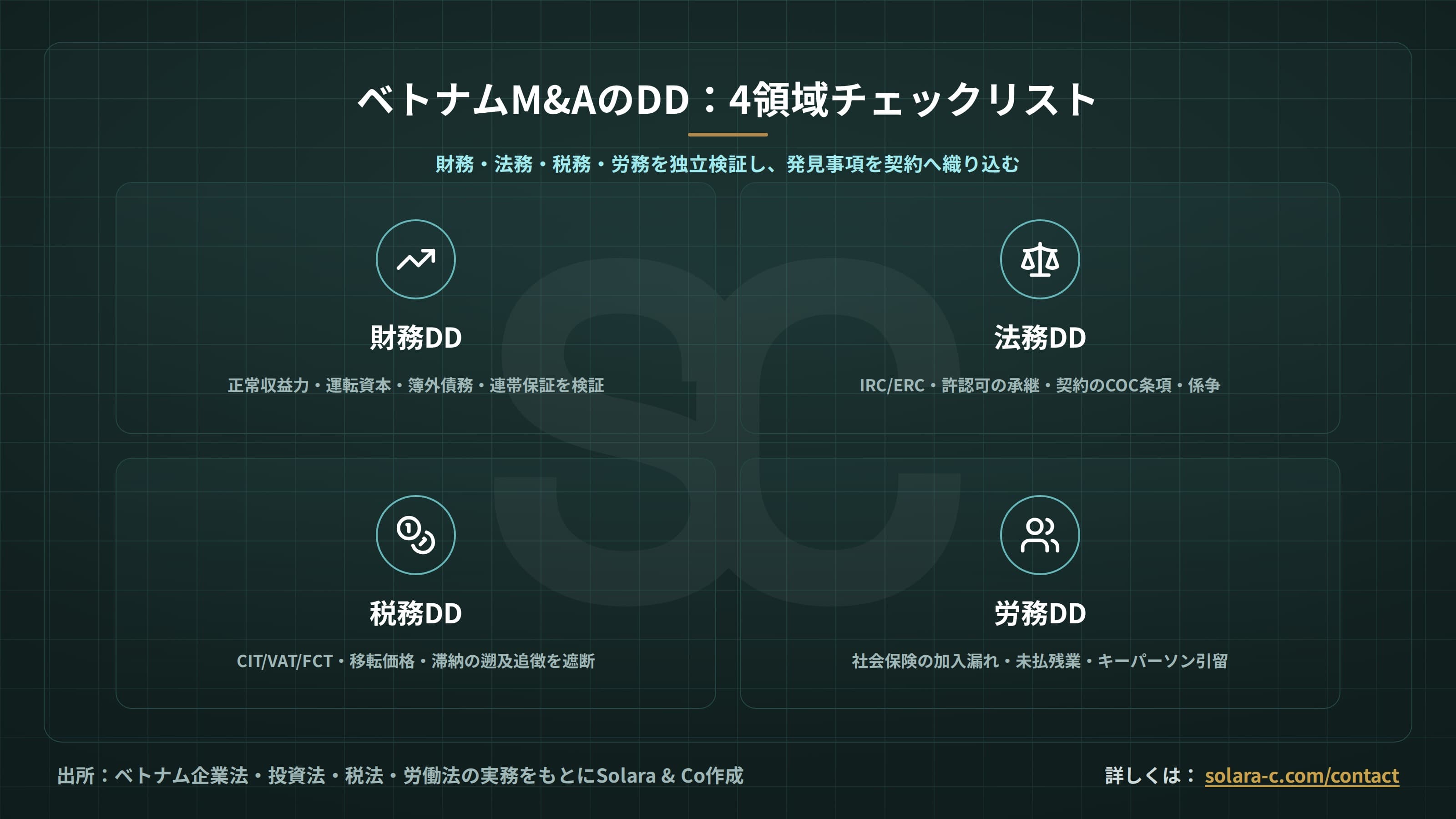
As a rule, the profit and loss presented by the seller cannot be used as is. You must adjust for the owner's personal expenses, distortions in related-party transactions, revenues and expenses omitted due to double bookkeeping, one-off gains and losses, and so on, to restate the business back to its inherent "normalized earning power," and from there build up the free cash flow (FCF). The precision of this normalization fundamentally governs the reliability of the DCF. Only when financial due diligence and valuation operate in tandem can a persuasive FCF be drawn.
A WACC Loaded with Country Risk
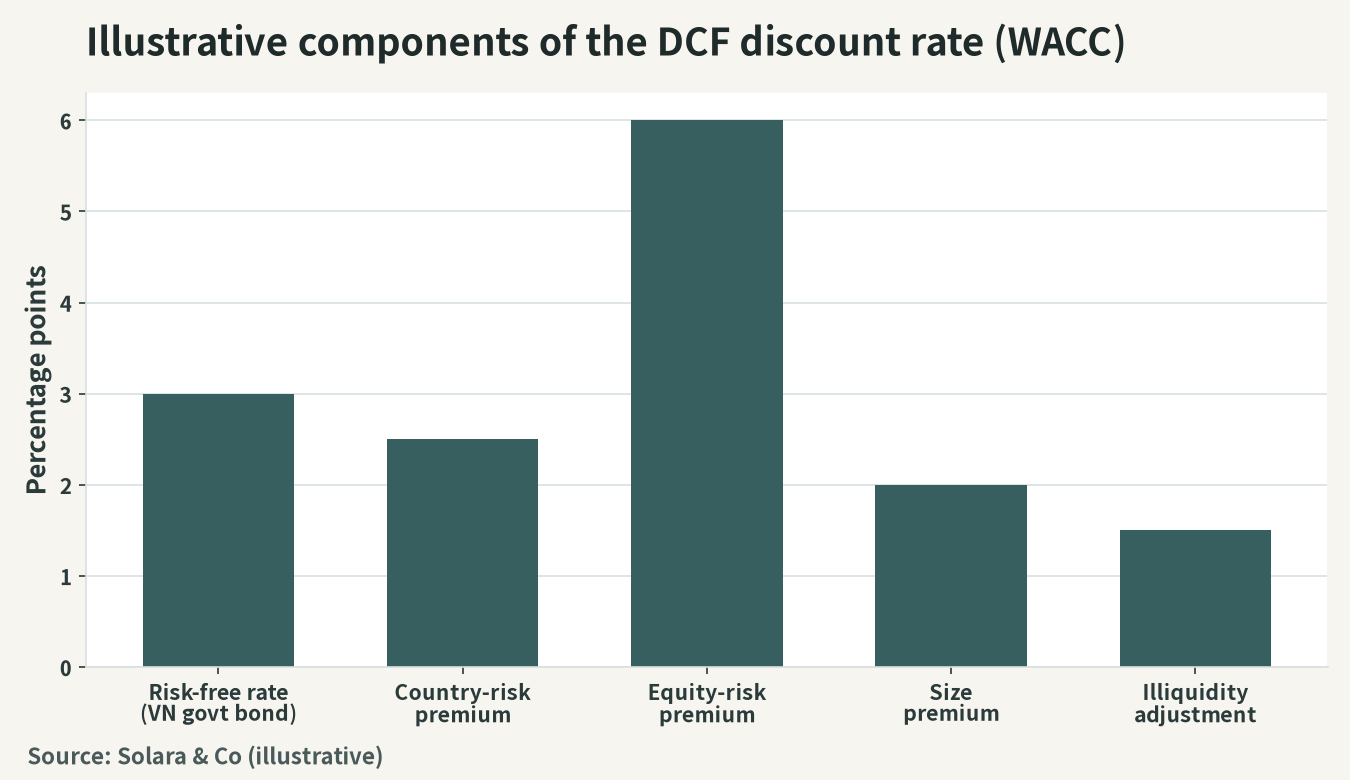
The design of the WACC, which serves as the discount rate, is the crux of Vietnamese deals. In practice, you start from the cost of capital of a mature market such as the United States, then add a country risk premium derived from the spread between Vietnamese government bond yields and developed-country government bonds (the sovereign spread). On top of that, you factor in an equity risk premium, a size premium according to the scale of the target company, and an illiquidity adjustment. Because it is an emerging market, the discount rate ends up higher than in developed-country deals, and as a result the present value typically comes out conservative.
Handling Terminal Value and Foreign Exchange
Beyond the forecast period (usually around five years), value is appraised as the terminal value (continuing value) using a perpetual growth rate or an exit multiple. If, because it is a high-growth country, you set the perpetual growth rate too high, value tends to be overstated, so conservatism is required to converge toward the long-term economic growth rate. As for currency, it is crucial to be consistent: either appraise in dong (VND) and use a dong-denominated discount rate, or unify everything in dollars (USD). The dong's long-term depreciation trend and the inflation rate must be treated consistently in both the cash flows and the discount rate; otherwise, the foreign-exchange assumption ends up double-counted or omitted.
The Practice of Comparable Company Analysis and the Constraints of the Vietnamese Market
The market approach is an important partner for verifying the reasonableness of the DCF, but in Vietnam the market structure itself becomes a constraint.
Choosing Between EV/EBITDA and PER
The multiple most frequently used in practice is EV/EBITDA, which is less affected by capital structure. It readily absorbs differences in the burden of capital expenditure and depreciation policy, making it suited to cross-border comparison. The PER (price-to-earnings ratio), on the other hand, is intuitive because it is based on net profit, but it is easily affected by differences in tax regimes and debt levels, so it is used as a supplement. It is also a precondition that the target company's EBITDA placed in the denominator be a normalized figure.
The Thinness of HOSE・HNX and the Liquidity Discount
Vietnam's stock markets (HOSE in Ho Chi Minh City, HNX in Hanoi, and the over-the-counter UPCoM) are all thin compared with developed-country markets in terms of the number of listings, market capitalization, and trading value, and it is not uncommon for some sectors to have only a handful of companies as pure comparables. The multiples of low-liquidity markets are highly volatile, and applying them as is causes the appraisal to swing. Ingenuity is required, such as broadening the pool of comparables across the region (within ASEAN) or considering a liquidity discount.
The Illiquidity Premium and the Control Premium
Because an unlisted target company cannot be bought or sold immediately, its value is discounted relative to listed shares (the illiquidity discount / DLOM). Conversely, in an acquisition that secures management control, a control premium is added to the value of a minority stake. Making explicit which multiple is applied to the target company, and through which adjustments, is what secures the transparency of the appraisal.
The Bridge from EV to Equity Value
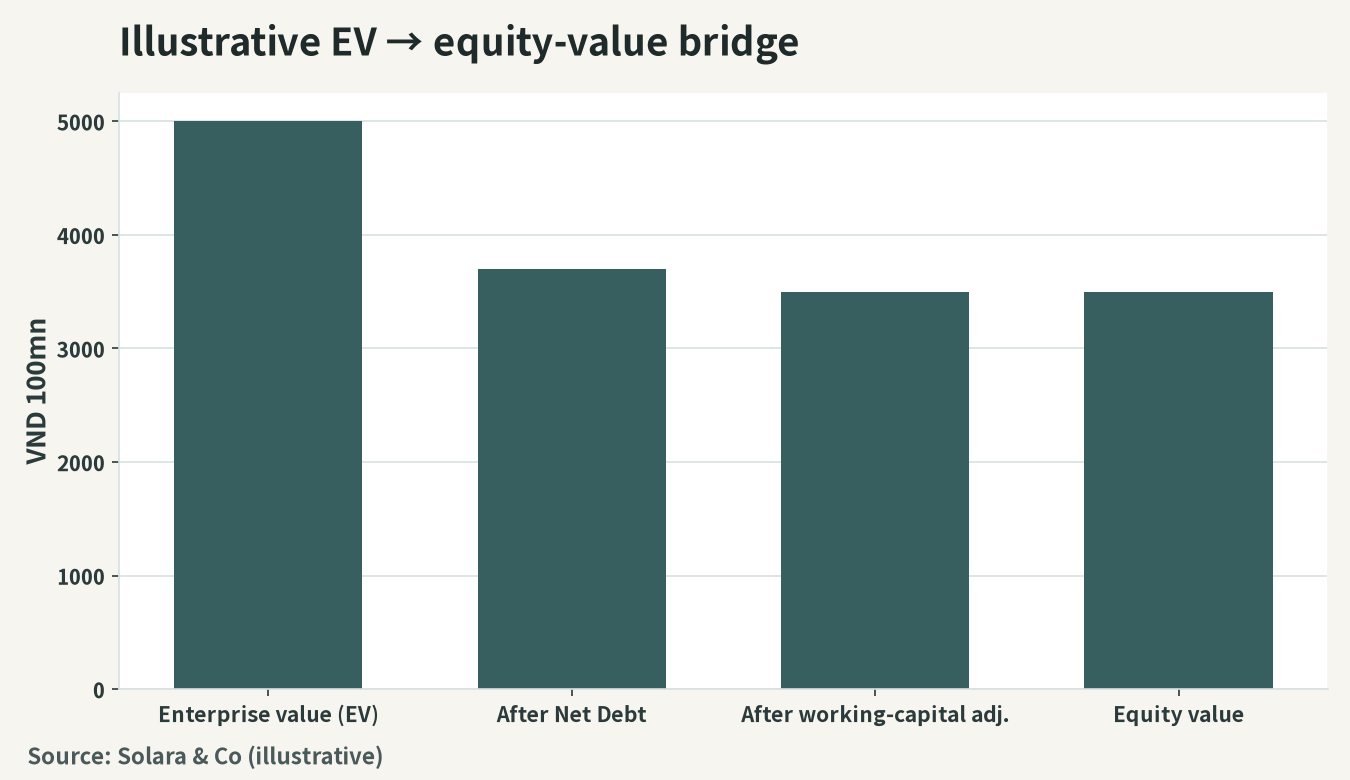
What you obtain from the multiples method or DCF is, in most cases, "enterprise value (EV)." In the bridge process that crosses over to the "equity value" the buyer actually pays, the price moves substantially.
Deduction of Net Debt and Debt-Like Items
The starting point is the net debt adjustment: subtracting interest-bearing debt from EV and adding back cash and deposits. Furthermore, in Vietnamese deals, you must identify and deduct "debt-like items" that are substantially equivalent to liabilities, such as off-balance-sheet guarantee obligations, unpaid taxes and social insurance, under-provisioning related to disputes, and owner loans. Many of these only become visible through financial DD, and overlooking them overstates the equity value.
Working Capital Adjustment
Whether the working capital at the time of handover is above or below the normal level (normalized working capital) is also reflected in the price. Excessive accounts receivable and stagnant inventory have little substantive value, and here too the book value cannot be taken at face value. Below is an illustration of the flow that proceeds from EV, through each adjustment, to the final equity value.
Factoring Vietnam-Specific Issues into Value
If you apply textbook valuation models exactly as they are, you will inevitably stumble in Vietnamese deals. Translating the idiosyncratic issues into value is the condition for a valuation that holds up on the ground.
Financial Reliability and Double Bookkeeping
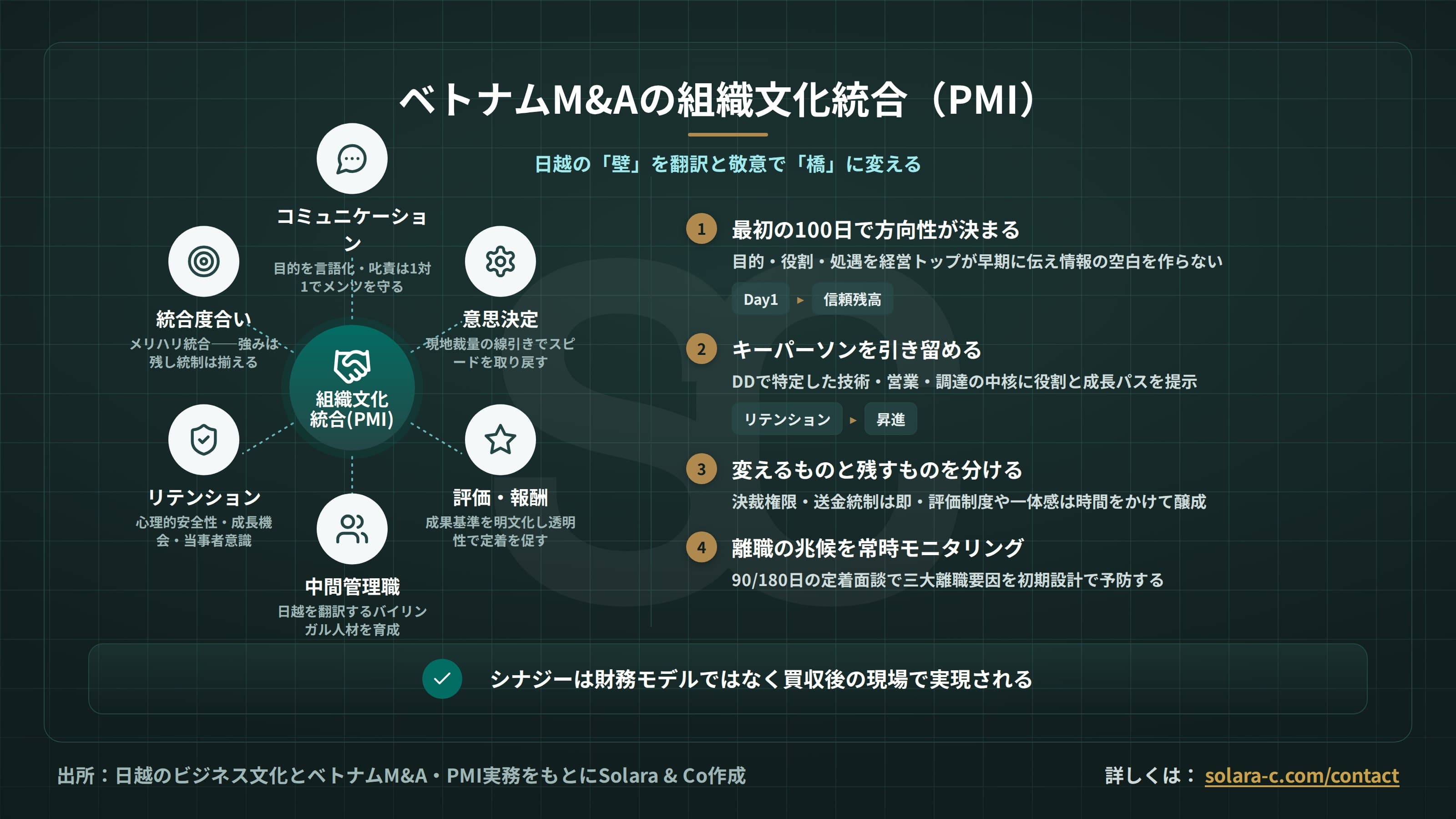
Mainly among small and medium-sized enterprises, there are cases where "double bookkeeping" — one set for tax filing and one for actual management — coexists, making the very reliability of the financial statements presented a point of contention. If the real earning power cannot be restored through normalization, then both the DCF and the multiples method are castles built on sand. When the reality cannot be grasped through financial DD, a judgment is needed either to widen the valuation range or to defer the price via an earn-out.
Book Value ≠ Fair Value and the Appraisal of Land Use Rights
In Vietnam, land belongs to the State, and what a company holds is the "land use right (LUR / LURC = the red book)." The asset value changes greatly depending on whether the land is allocated or leased, paid in a lump sum or annually, the remaining term, and transfer restrictions, and it matches neither book value nor fair value. When appraising land use rights through the cost approach or asset adjustments, you must drill down to the type of right and the remaining term.
Key-Person Risk and the Verification of High-Growth Assumptions
In small owner-run companies, the business depends on the founder's personal network, licenses, and customer relationships, so key-person risk — the founder's departure after the acquisition impairing value — is severe. This is addressed by adding to the discount rate or by designing an earn-out. At the same time, you must always independently verify whether the high-growth assumptions presented by the seller (such as annual growth of several tens of percent) are consistent with the constraints of market size, competition, and equipment capacity.
Translating Valuation into Price and Contract
The goal of the appraisal work is not to produce a single "correct number." Its essence is to draw a valuation range using multiple methods and then fold that range into the negotiation strategy and contractual terms.
The Valuation Range and Price Adjustment Mechanisms
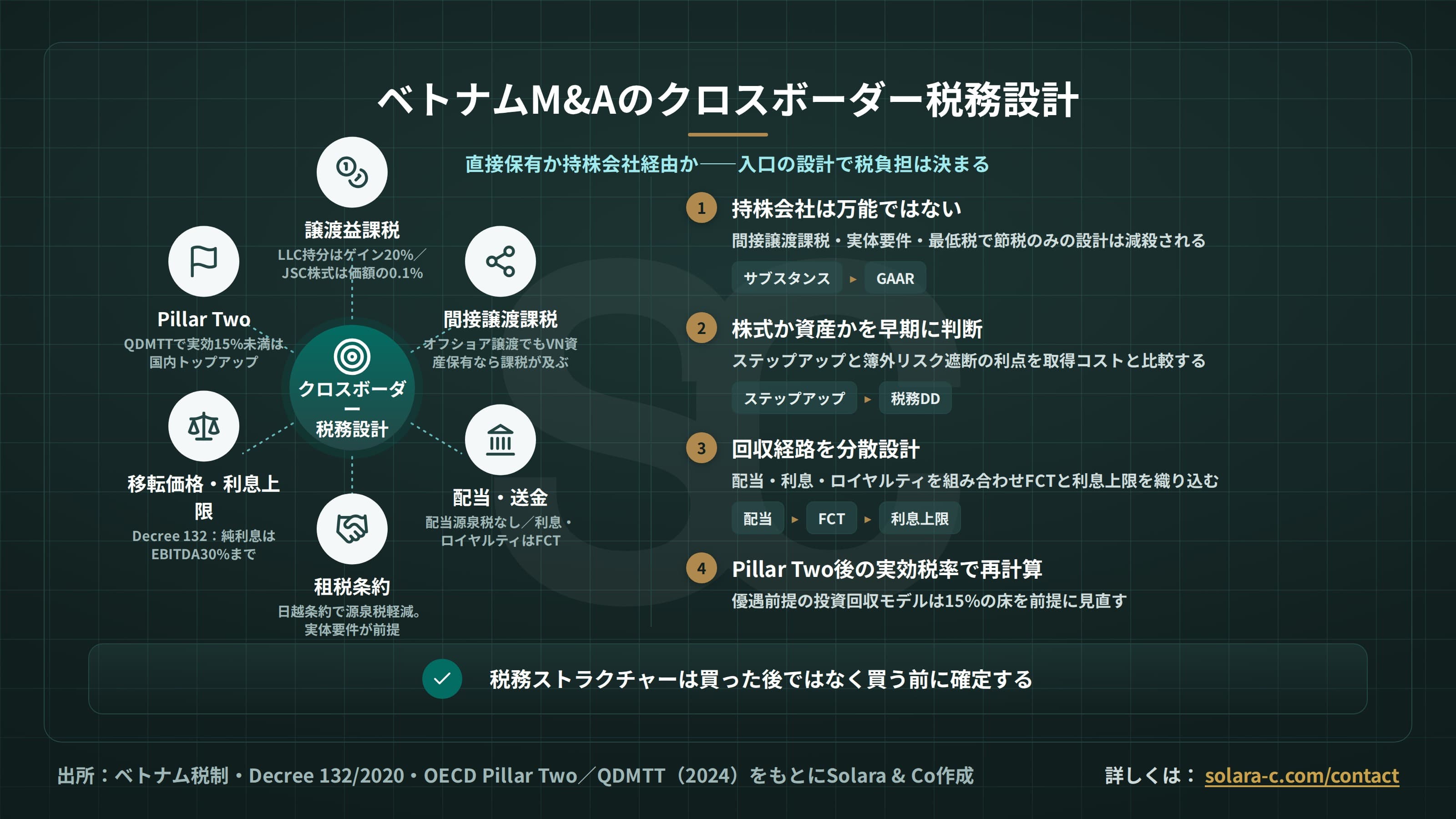
Based on the range obtained from the DCF and the multiples method, you design the ceiling and floor of the negotiation. In the final contract, you incorporate a closing adjustment (locked box or the completion accounts method) that adjusts the price after the fact according to net assets, working capital, and net debt as of closing, filling the gap between the valuation date and the handover date.
Sharing Assumption Risk Through Earn-Outs
For deals where high-growth assumptions or financial uncertainty remain, an earn-out — linking part of the acquisition consideration to the achievement of future performance — is effective. It allows the risk of overpayment when the assumptions miss to be shared with the seller, and it also functions to retain key persons. The mindset of translating the uncertainty revealed in the valuation directly into contractual provisions is what makes price negotiation in Vietnamese deals sound.
Solara & Co's Integrated Support — Reading What Lies Behind the Numbers
The valuation of a Vietnamese company cannot be completed with knowledge of methods such as DCF and the multiples method alone. Normalizing double bookkeeping to restore real earning power, designing a discount rate that factors in country risk, translating land use rights and off-balance-sheet liabilities into value, and finally folding that uncertainty into price adjustments or earn-outs — only when this series of judgments is built up on an understanding of the circumstances on both the Japanese and Vietnamese sides does a "well-grounded price" that can withstand negotiation come into being.
Solara & Co provides integrated support from financial and legal due diligence, to the construction of the valuation model, the design of the valuation range, and on to the price clauses and earn-out design of the SPA (share purchase agreement). Starting from the first step of confirming "is there a basis for that price," we will discern the success or failure of your Vietnam M&A together with you.