
The Growth Phase That Vietnam's Construction and Real Estate Development Is Entering
Construction and real estate development in Vietnam is a mirror of economic growth and urbanization. Against the backdrop of rapid economic growth, a population exceeding 100 million, and the concentration of people in cities, construction demand of every kind—from housing, offices, and commercial facilities to industrial parks and infrastructure—continues to expand. Construction is a major industry accounting for roughly 6% of GDP, and together with real estate development it has driven the economy on both the employment and investment fronts. The cityscape is repainted year by year: high-rises stand in dense clusters in the centers of Hanoi and Ho Chi Minh City, while in the suburbs new urban areas are developed one after another.
This growth is not merely quantitative expansion. The demand for higher housing quality from an expanding middle class, the concentration of foreign capital in industrial parks, the development of tourism and commerce, and large-scale infrastructure investment all overlap, raising the "substance" of development as well. That higher value-added development themes—smart cities, environmentally conscious architecture, mixed-use development—have come to the fore is another feature of recent years. This article organizes the demand structure of Vietnam's construction and real estate development and explains, from a practical standpoint, the trends by segment, the forms of foreign-capital involvement, how to read financing and the market cycle, and the risks to keep in mind.
The Structural Factors Pushing Up Demand
Demand for construction and real estate development is underpinned by several structural factors.
Urbanization and Population Movement
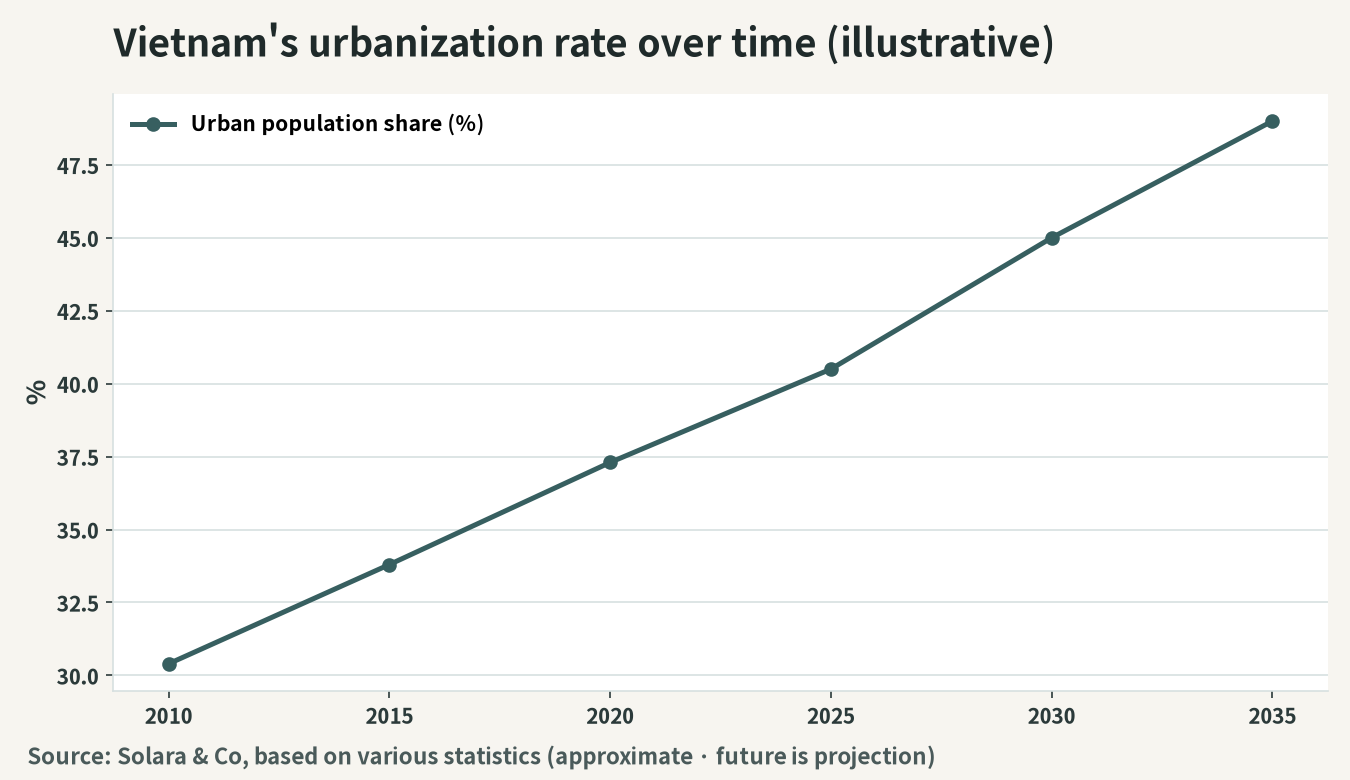
In Vietnam, the movement of people from rural areas to cities continues, and the urban population ratio is expected to rise over the medium to long term. The urban population ratio currently stands at around 40%, and the government has set a target of raising it to about 45% by 2030. Roughly one million people are said to move from the regions into cities each year, and creating the receptacle for this population is itself a source of construction demand that lasts over the long term. Urbanization generates broad construction demand—housing, transport infrastructure, commercial facilities, water and sewerage. In particular, the housing supply needed to absorb an ever-growing urban population is the most fundamental and sustained source of demand. In addition to the two major metropolitan areas of Hanoi and Ho Chi Minh City, urban development is also picking up in Da Nang and other regional core cities.
Middle-Class Expansion and Housing Demand
As incomes rise, the quality of housing people seek is climbing. Demand is expanding from the self-built detached houses of the past toward apartments (condominiums) with proper facilities and management, and toward planned residential districts (townships). Housing also attracts strong interest as an object of asset formation and investment, and both genuine end-user demand and investment demand support the market. The government has set a goal of supplying around one million social-housing (low-price housing) units by 2030, and the development of affordable-priced housing is positioned as a national policy objective. While the low-price band carries thin margins, demand is overwhelmingly thick, and for developers who can combine land, incentives, and standardized design to deliver volume, it can become a stable base of orders.
Industrial Parks and Infrastructure Investment
The concentration of foreign manufacturing (China Plus One) is strongly driving demand for the construction of industrial parks and logistics facilities (warehouses and factories). In major industrial parks such as Bac Ninh, Hai Phong, and Bac Giang in the north and Binh Duong, Dong Nai, and Long An in the south, occupancy rates have stayed at high levels and rents are on an upward trend. Furthermore, large-scale infrastructure investment—expressways, airports, ports, subways and urban railways, and power—is a tailwind for the construction industry as a whole. The expressway network linking north and south, the new Long Thanh Airport, and the opening of Ho Chi Minh City's Urban Railway Line 1—a succession of large projects advancing—are emblematic of this. Infrastructure development is itself construction demand and, at the same time, raises the real estate value of surrounding areas and induces new development.
Development Trends Seen by Segment
In construction and real estate development, the nature of demand and risk differs by segment. Below we organize the trends in the main segments.
Housing (Condominiums and Townships)
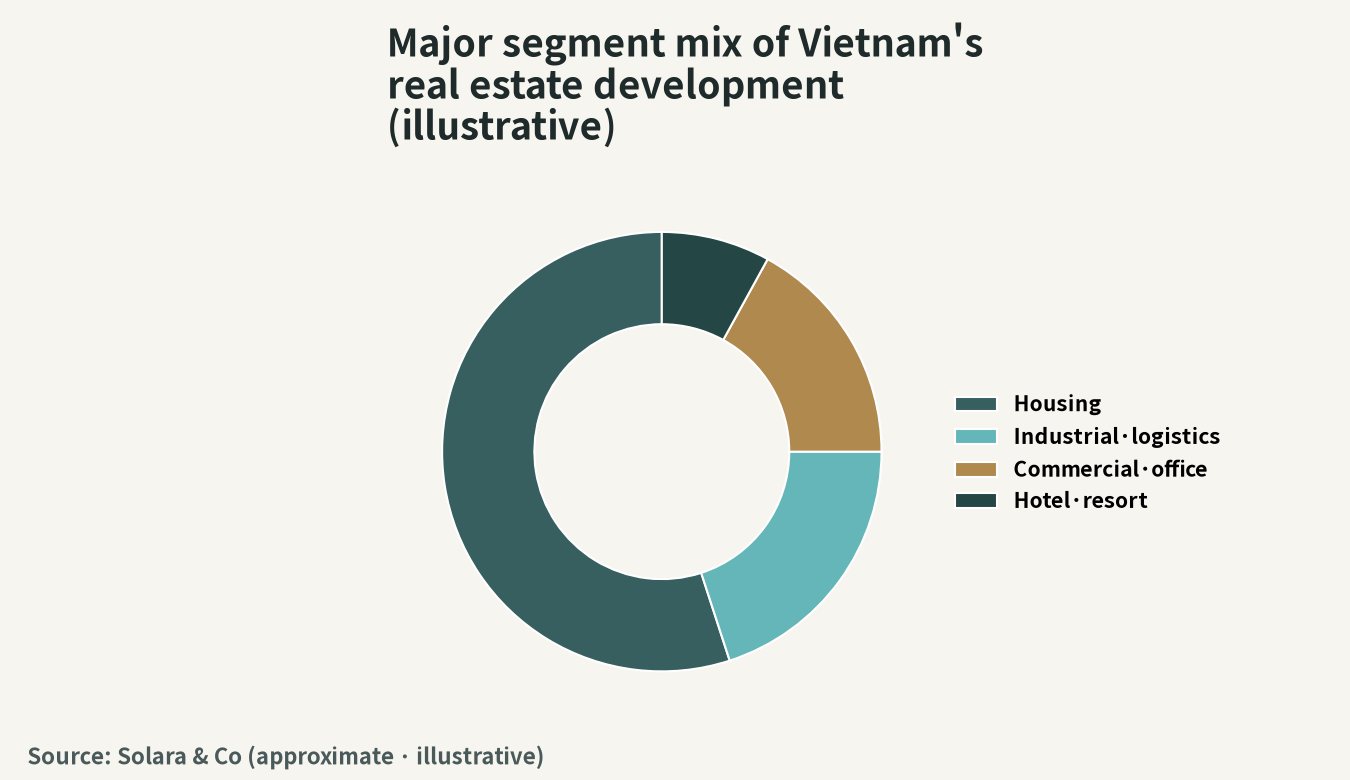
Housing is the core of the market. From mid- to high-grade properties for the urban middle and upper-middle class to affordable housing in the reasonable price band, there is demand in every price segment. In many price bands supply has not caught up with demand, and ample room for development remains. In particular, affordable-priced housing sought by young households working in cities and by people moving in from the regions is chronically undersupplied relative to demand—a social policy challenge and, at the same time, a long-term, resilient business opportunity. On the other hand, in luxury properties excessive speculation or local oversupply can arise, so product design that comes after gauging the price band, location, and buyer segment is what divides a project's success from its failure. In recent years, supply has tended to concentrate in high-priced properties in central districts, while the mid-price band—the heart of genuine end-user demand—is in short supply; this supply-demand mismatch has been pointed out, and pricing that closely tracks the reality of the buyer segment is once again being called into question.
Commercial and Office
With economic growth and the increase in incoming companies, demand for offices, retail commercial facilities, and hotels is expanding. Particularly active are shopping malls riding the penetration of modern retail, and hotel and resort development riding the recovery of tourism. In the centers of Hanoi and Ho Chi Minh City, demand for high-quality office buildings is resilient, while in Da Nang and coastal resort areas, hotel and villa-type development is regaining momentum together with the recovery of tourism demand. In particular, offices with high energy-saving performance that have obtained environmental certification (green building) more easily meet the leasing criteria of incoming multinational firms, and are becoming a differentiating factor that attracts quality tenants. Commercial and hotel assets are susceptible to the business cycle, yet they are a segment where high profitability can be expected depending on location and operating capability.
Industrial and Logistics Real Estate
With the entry of foreign manufacturers and the expansion of e-commerce (EC), demand for industrial parks and logistics facilities (warehouses and distribution centers) is rising. This field is a segment where relatively stable demand can be expected, growing in tandem with the concentration of manufacturing and supply-chain trends. In particular, demand is rising for high-quality industrial real estate—peri-urban logistics warehouses that support instant delivery, temperature-controlled cold-storage warehouses, and modern ready-built leasable factories with high ceilings and high floor-load capacity. As receptacles that support the entry of foreign capital prioritizing a quick launch, these have become attractive investment targets for the development side. Standardized leasable factories and warehouses housing multiple tenants are a strong option for small and mid-sized incoming companies that want to start operations early while holding down initial investment, and for the development side they are a solid business model offering the prospect of stable rental income.
How Foreign Capital Gets Involved
Real estate development is a field with major constraints from the land system and licensing, so foreign-capital involvement takes distinctive forms.
The Premise of Land-Use Rights
In Vietnam, land is held in all-people ownership (managed by the state as representative), and the framework is one in which enterprises and individuals hold "land-use rights." There are constraints on how foreign capital may handle land and real estate, and the permissible scope differs by the form and use of the project. The sale of housing to foreigners also carries certain constraints on the number of units and the duration, and acquiring or converting development land requires administrative approval. The revised Land Law, which took effect in August 2024, reviewed compensation for land acquisition, price determination, and the operation of land-use planning, and is expected to raise market transparency. As for foreigners purchasing housing, there are caps on the number of units that may be acquired per building and on the holding period (in principle 50 years, renewable), and such details of the system shape project design. The related legal framework, beginning with the revised Land Law, is being developed in the direction of raising market transparency and the stability of rights, but its operation varies greatly by locality; understanding this land system is the major premise for getting involved in real estate development.
Joint Ventures, Equity, and Funds as Entry Points
The typical forms in which foreign capital gets involved in development are a joint venture with a local developer, an equity investment in a development project, and investment through a real estate fund. The local partner plays an important role in securing land, obtaining permits, and managing relationships with local authorities. Japanese construction, real estate, and housing-related companies can build a complementary relationship with a local partner by bringing in know-how in technology, quality, and project management. In fact, cases are increasing in which a Japanese company teams up with a major Vietnamese developer to jointly develop large, systematically designed residential districts (smart townships). In such collaborations, the Japanese side provides knowledge of urban planning, the living environment, and quality control, while the local side handles land, permits, and the sales network—multiplying each party's strengths to enable high value-added development.
Spillover into Peripheral Industries
The expansion of construction and real estate development spills demand over into a broad range of peripheral industries—building materials (steel, cement, materials), housing equipment, elevators, air conditioning, interiors, and real estate management services. These are fields that can enjoy the benefits of market expansion even without being directly involved in the development itself. In particular, in high value-added equipment and materials—where quality, energy-saving performance, and the post-construction maintenance system are valued—the products and services of Japanese companies, whose strength is reliability, tend to be highly rated, and demand is expected to grow as development is upgraded. As the stock of housing and facilities accumulates, service demand for management, operation, and renovation also continues to expand.
How to Read Financing and the Market Cycle
Real estate development involves large amounts of capital and a long period until recovery, so it is sensitive to changes in the financial and credit environment. In Vietnam, over 2022 to 2023, turmoil in the corporate bond market overlapped with a tightening of bank lending, and some developers experienced an adjustment phase in which their cash flow hit a wall. A concentration of bond redemptions, a stalling of project approvals, and a worsening of the mortgage environment for buyers proceeded at the same time, so new supply and sales temporarily cooled. Subsequently, through measures such as cuts to the policy interest rate, the smoothing of approval procedures, and support for bond refinancing, the market bottomed out and is shifting toward a recovery phase.
What this experience shows is that Vietnam's real estate market has a clear cycle even within its growth trend. When Japanese companies participate, it is essential not to be swept along by the momentum of a boom but to gauge the developer's capital structure (degree of reliance on bonds, reliance on advance receipts, and the state of bank credit). Cash flow that relies excessively on advance receipts (prepayments from customers before pre-sale) exposes its fragility the moment sales stall. With a medium- to long-term perspective, the discipline of choosing financially sound partners and price bands and locations where demand is resilient is the key to riding out the cycle.
Organizing the Investment Opportunities and Risks
The table below organizes the opportunities and risks of the main segments in construction and real estate development.
Segment | Main investment opportunities | Risks to keep in mind |
|---|---|---|
Housing development | Urbanization, middle-class demand, quality improvement | Oversupply, speculation, financing |
Commercial and hotel | Retail modernization, tourism recovery | Economic fluctuation, site selection |
Industrial and logistics real estate | Manufacturing concentration, EC expansion | Regional gaps in infrastructure |
Building materials and equipment | Demand spillover across all development | Quality competition, price volatility |
Real estate management and services | Demand from growing stock | Talent, brand building |
The risks to keep in mind are, first, the complexity of the land system and licensing: project approval and the acquisition of land-use rights require time and local knowledge. Second is the cyclicality of the real estate market: monetary tightening and changes in the credit environment affect demand and financing. Third is the reliability and financial soundness of the local partner or developer. Because real estate development involves large amounts of capital and a long recovery period, credit investigation of the partner and scrutiny of the business are decisively important.
How Japanese Companies Can Seize the Opportunity — Solara's Perspective
Vietnam's construction and real estate development, riding multiple tailwinds—urbanization, middle-class expansion, industrial concentration, and infrastructure investment—is a field where long-term growth is expected. The entry points for involvement are diverse, ranging across housing, commercial, industrial and logistics, and on to building materials, equipment, and management services. Japanese companies can participate in this growth by leveraging their strengths in technology, quality, project management, and housing equipment, and by building a complementary relationship with a local partner.
The key is to correctly understand the land system and licensing, choose a trustworthy local partner, and design an appropriate form of involvement (joint venture, equity, fund, or material supply). Precisely because this is a field with large amounts of capital, business scrutiny at the entry stage and credit investigation of the partner greatly determine success or failure.
Solara & Co, with bases and human networks on both the Japanese and Vietnamese sides, provides end-to-end support—from market research and the formulation of entry strategy, to selecting local partners, executing joint ventures and M&A, and credit investigation and due diligence before acquisition or equity investment. We help connect the great opportunity of the growth of Vietnam's cities and industry to sure results.