
Vietnam's place in the semiconductor supply chain
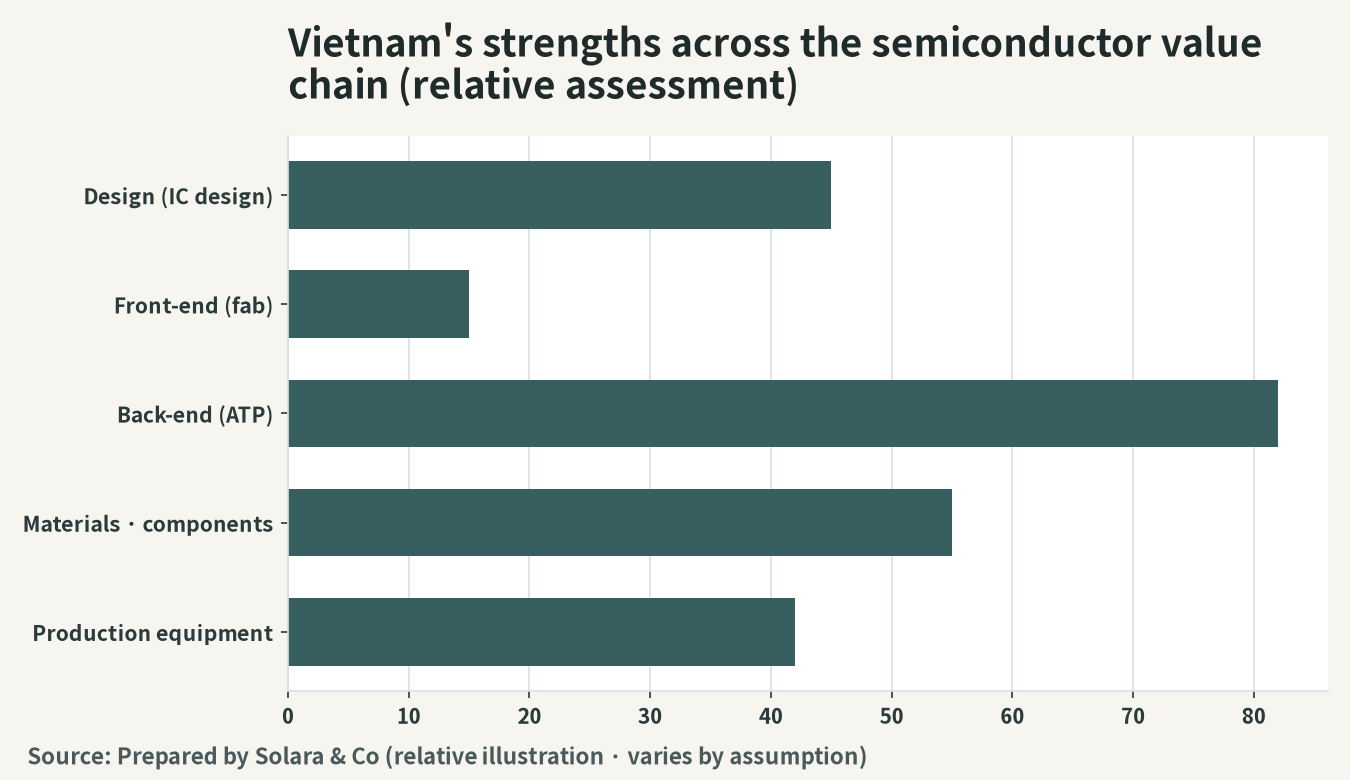
Semiconductors are the products with the most complex supply chains in the world, spanning countless process steps and crossing many national borders from design to finished part. Amid US–China rivalry and the geopoliticization of supply chains, countries are seeking supply networks "in friendly nations" (friend-shoring), and the resulting wave of restructuring is opening up a major opportunity for Vietnam. The area where Vietnam realistically demonstrates strength is the back-end of semiconductors—assembly, test, and packaging (ATP)—where leading global semiconductor companies and specialist back-end manufacturers (OSATs) are establishing large-scale sites one after another, forming a growing concentration of investment.
This article maps where Vietnam sits within the semiconductor value chain, and explains—from a practical supply-chain perspective—the substance of the back-end, the geographic clusters where investment is converging, the surrounding ecosystem that supports it, and the entry opportunities and risks for Japanese companies. For the broader picture as national strategy, see also Vietnam's semiconductor and digital economy strategy; for the industry outlook, see The outlook for Vietnam's semiconductor industry.
The semiconductor value chain and Vietnam's position
The semiconductor value chain divides broadly into three phases. Each demands entirely different capital, technology, and talent, and the room for Vietnam to enter changes from phase to phase.
Design (front-end design)
IC design, which designs the circuitry, is a knowledge-intensive process requiring advanced talent and software (EDA tools). Vietnam has a foundation of science and engineering talent, and design-service firms and design centers have begun setting up bases, but this is still at a nurturing stage.
Front-end (wafer fabrication / fab)
The front-end, which forms circuits on silicon wafers, is the phase with the highest barriers to entry, requiring enormous capital investment in equipment (on the order of billions of dollars for a single plant) and the most advanced manufacturing technology. For Vietnam to take this on in earnest is a medium- to long-term challenge, and at present it is not a realistic main battleground.
Back-end (ATP) — Vietnam's main battleground
The back-end (ATP)—cutting, assembling, inspecting, and encapsulating the finished wafer—is precisely the phase where Vietnam is demonstrating strength. Compared with the front-end, the burden of capital equipment is lighter and it is easier to launch with labor and mid-tier technology, making it highly compatible with the existing electronics-industry cluster. Major global manufacturers are concentrating ATP sites in Vietnam, and a major cluster is taking shape. For the depth of the electronics and EMS industry, see Vietnam's electronics and EMS industry.
Breaking down the substance of the back-end (ATP)
The back-end—Vietnam's main battleground—is a stack of many precision processes. Tracing them in sequence reveals where the value added lies. First the wafer is cut into individual chips (dicing), mounted on a substrate or lead frame (die bond), and connected with ultra-fine wiring (wire bond). Next it is encapsulated with resin or similar material (mold/packaging), and finally, after electrical and functional inspection (test), passing parts ship as finished products.
In recent years, the importance of advanced packaging—integrating multiple chips into a single package at high density—has grown. Because the key to boosting the performance of AI semiconductors lies in packaging technology, the back-end is shifting in character from "simple assembly" to "a high-value technology domain." Whether Vietnam can use its back-end cluster as a springboard to build up toward more advanced packaging will determine its standing in the supply chain.
The geographic clusters where investment converges
Vietnam's semiconductor- and electronics-related investment is not spread evenly across the country but concentrated in a handful of bases. Each cluster holds a different strength.
Cluster | Characteristics | Strength |
|---|---|---|
North (near Hanoi, Bac Ninh, etc.) | Cluster of major electronics and semiconductors | Proximity to South China · materials supply network |
Northern coast (Hai Phong, etc.) | Integrated development of ports and industrial parks | Import/export convenience · large sites |
South (near Ho Chi Minh City) | High-tech parks and talent cluster | Design · advanced back-end · talent |
Central (Da Nang, etc.) | Emerging investment-attraction base | Land · incentives · dispersed siting |
The area near Hanoi in the north, backed by a cluster of major electronics makers, has a thick materials supply network and the advantage of leveraging supply-chain continuity with South China. The northern coastal port cities, where ports and industrial parks are developed as an integrated whole, offer import/export convenience and large sites. The area near Ho Chi Minh City in the south, backed by high-tech parks and abundant talent, holds the potential to take on high-value domains such as design and advanced back-end. For the details of site selection, we compare region by region in Industrial parks in northern Vietnam and Industrial parks in southern Vietnam.
The surrounding ecosystem that supports the supply chain
For semiconductor back-end work to function, it takes not only the assembly and test themselves but also a thick ecosystem of materials, components, equipment, and services that support them. It is precisely here that opportunities for Japanese companies open up.
Materials and components
The back-end requires large quantities of materials and components such as encapsulation resin, substrate materials, lead frames, bonding wire, and various chemicals and specialty gases. For many of these, quality and stable supply are decisively important—domains where Japanese companies hold world-class competitiveness. The more the ATP cluster advances, the more local component demand arises.
Manufacturing and inspection equipment
Each process—dicing, bonding, mold, and test—requires dedicated equipment. Semiconductor manufacturing and inspection equipment is a field in which Japan holds one of the world's leading strengths, and equipment demand will expand alongside the growth of Vietnam's back-end.
Talent and outsourced services
Securing and developing talent—equipment operators, quality managers, design engineers—as well as peripheral services such as maintenance, logistics, and customs clearance, are also indispensable elements that make the supply chain work. In the back-end especially, because equipment utilization and yield drive profitability, the quality of the technical services that handle equipment maintenance and calibration, the upkeep of clean-room environments, and the precision logistics that control static electricity, humidity, and vibration tie directly to a site's competitiveness. The more a cluster assembles these behind-the-scenes functions, the greater its appeal as a back-end base. We address the trend of manufacturing relocation in Manufacturing relocation to Vietnam and high-tech investment.
Entry opportunities for Japanese companies
There are multiple ways for Japanese companies to engage with Vietnam's semiconductor supply chain, depending on their own strengths. First, the most promising is supplying materials, components, and equipment. The more the back-end cluster advances, the higher the local demand for the Japanese-made materials and equipment that support it. A "follow-along investment" strategy—keeping pace with finished-product makers' expansion and establishing supply bases close to customers—is effective.
Second, there is the option of taking in strong local component suppliers or OSAT-related companies through M&A or joint ventures. Rather than building from scratch, taking in an existing cluster and customer base launches faster and more reliably. Third, in the design domain, setting up a design center that leverages Vietnam's science and engineering talent, or partnering with a local design firm, is a realistic option. The broader context of China-plus-one supply-chain restructuring is discussed in Vietnam's supply-chain restructuring (China-plus-one).
Risks to keep in mind
The greater the opportunity, the more coolly the risks must be assessed. First is the talent bottleneck. Whether workforce development can keep up with the expansion of the back-end is uncertain, and this is also a domain of fierce wage pressure and poaching competition. Second are power and infrastructure constraints. Semiconductor processes presuppose stable electricity and water and high-quality infrastructure, and the capacity to supply them becomes a decisive factor in site selection. Third is the high capital intensity and long payback period—the burden of investment grows heavier the further upstream one moves. Fourth is geopolitical risk. Semiconductors are subject to each country's export controls and security measures, and a policy change can transform the supply chain overnight.
These must be managed by sketching out the exit strategy from the entry stage, selecting reliable local information and partners, and conducting thorough due diligence in M&A and joint ventures. Because the scale of investment is large and recovery extends over the long term, an early misjudgment of site, partner, or talent will leave consequences that linger for years.
How Japanese companies can seize the opportunity — Solara's view
Vietnam's semiconductor supply chain is a growth domain that, starting from the concentration of investment in the back-end (ATP), broadens out into materials, components, equipment, and design. For Japanese companies, opportunities to leverage their strengths spread across every part of the supply chain: supplying world-class-competitive materials, equipment, and inspection; taking in local suppliers through M&A and joint ventures; and tapping design talent. The key lies in designing the entry point not by viewing semiconductors as a single "point," but by surveying the entire ecosystem that supports them.
Solara & Co, drawing on bases and human networks in both Japan and Vietnam, provides seamless support from market research and investment-strategy formulation, to the search for local partners and suppliers and M&A and joint ventures, to pre-acquisition credit investigation and due diligence, to building out the operating structure after market entry. Amid the great current of supply-chain restructuring, we help you pinpoint the position where your strengths come most fully into play while steadily managing the risks at hand—achieving both at once.