
Vietnam cross-border e-commerce — a growth market
Vietnam's e-commerce is expanding at one of the fastest paces in Southeast Asia. A population of around 100 million, a median age in the low 30s, and the rapid spread of smartphones and mobile payments have swiftly elevated online shopping into an everyday habit. It is no longer only urban consumers: users in provincial cities and rural areas have also begun shopping online, entering through social media and video, and the breadth of the market grows thicker year by year.
For Japanese companies, this growth signals a prime opportunity to open sales channels where "you can sell without setting up a local subsidiary." In categories such as cosmetics, health foods, baby products, daily necessities, and food, trust in "Made in Japan" remains strong, and through cross-border e-commerce a path has opened to deliver directly to Vietnamese consumers while keeping inventory in Japan—or while leveraging bonded warehouses. This article organizes, from the perspective of Japanese companies, the structure of Vietnam's cross-border e-commerce market, how to choose sales channels, and the practical realities of logistics and payments that determine success or failure.
Vietnam's e-commerce market in numbers
First, let us grasp the contours of the market through the trajectory of its scale. Vietnam's retail e-commerce market accelerated another notch with the COVID-19 pandemic as a turning point, and has continued to post double-digit growth since. The online share of total retail sales is also steadily rising, and the room for further growth is seen as still large.
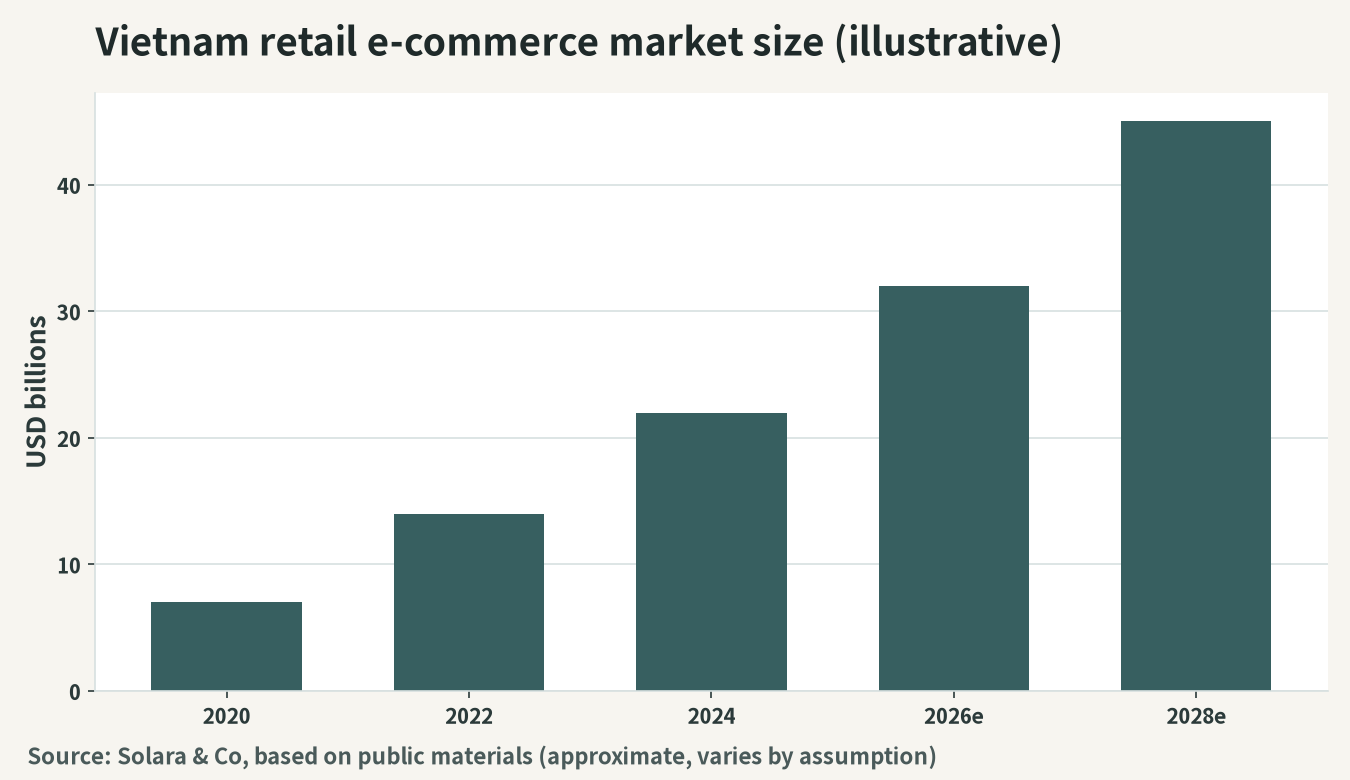
The figures swing depending on assumptions, but the direction is clear. Competition among platforms, the rise of live commerce, and the build-out of logistics networks have advanced as a unified whole, transforming online shopping from a "special experience" into an "obvious option." In particular, the growth of purchasing that originates from video and live streaming (social commerce) is striking, to the point where the very way products are showcased now governs the design of sales channels. For overall trends in the digital economy, please also refer to Vietnam's digital economy and AI; for the latest picture of the domestic e-commerce market, see Vietnam's e-commerce market 2026.
How to choose your sales channels
When entering the Vietnamese market via cross-border e-commerce, the choice of channel is the starting point of business design. Combine multiple entry points of differing character, weighed against your own products, organization, and goals.
Opening a store on a marketplace
The easiest to launch is opening a store on a major marketplace. Using the cross-border seller programs of platforms with strong customer-pulling power, you can open a store even without a local subsidiary, and place part of payments, delivery, and customer support onto the platform's infrastructure. On the other hand, commission fees, advertising costs, and pricing-discount pressure tend to squeeze profits, and there is the risk of the brand getting buried among the "everyone else." On the premise that this is an arena where buyers compare by reviews and price, the decisive battlegrounds become the crafting of the product page and the capture of initial reviews.
Social commerce / live commerce
What is growing explosively in Vietnam is selling that originates from video platforms and social media. "Live commerce"—selling while demonstrating products via live streaming—pairs well with impulse purchasing and has high reach to younger demographics. Collaboration with influencers (KOLs/KOCs) heavily determines success or failure, and it demands operational capability attuned to local language, trends, and sense of humor. It is difficult for a Japanese company to run this single-handedly, so engaging a local partner or agency is the realistic approach.
Owned D2C / brand site
If you aim to nurture a brand over the medium to long term, one option is to anchor on your own D2C site. You can accumulate customer data in-house and design the brand experience consistently; in return, you must shoulder all customer acquisition yourself, so the launch burden is higher. Many companies adopt a "hybrid": building awareness and initial demand on marketplaces and social media, then guiding repeat customers to their own site.
Logistics — the lifeline of cross-border e-commerce
In the end, the success or failure of cross-border e-commerce hinges on whether you can "deliver fast, cheap, and reliably." The Vietnamese market has any number of difficult passes unique to this logistics.
The issues of customs clearance and low-value tax exemptions
When sending goods into Vietnam, the handling of import duties and value-added tax (VAT) is the key point. The operation of the duty-free threshold for low-value shipments (de minimis) is under review, so you must recognize that a design premised on "continuing to send small parcels duty-free" is vulnerable to future rule changes. If you sell at a stable scale, a setup that consolidates inventory into a bonded warehouse or fulfillment hub and ships from on-site becomes advantageous. The practicalities of customs clearance are covered in detail in Vietnam's import-export and customs practices.
Last mile and the delivery network
Vietnam stretches long and narrow along its north-south axis, encompassing the two major metropolitan areas of Hanoi and Ho Chi Minh City and the mid-sized cities and rural areas spread between them. While same-day and next-day delivery is becoming a matter of course in urban areas, in the provinces the delivery lead time and cost spike. The selection of local delivery operators (3PLs), the design of returns (reverse logistics), and the capacity to handle cash on delivery (COD)—discussed below—simultaneously govern both customer satisfaction and cost. For the overall picture of warehouse and logistics infrastructure, please refer to Vietnam's logistics and warehouse market.
Designing fulfillment
Once sales volume exceeds a certain level, you need to put in place a fulfillment mechanism that handles order processing, inventory management, packing, and shipping. Do you use the platform's fulfillment service, outsource to a local 3PL, or hold your own facility? The choice changes with sales volume, SKU count, and product characteristics (whether refrigeration is required, whether there are expiration dates, etc.). The standard playbook is to outsource during the launch phase to turn costs variable, then move to in-house operations and your own warehouse once the scale comes into view.
Payments — the coexistence of cash culture and the digital
Alongside logistics, another difficult pass is payments. Vietnam's payment environment has a dual nature: rapidly digitizing while a cash culture remains deeply rooted.
Handling cash on delivery (COD)
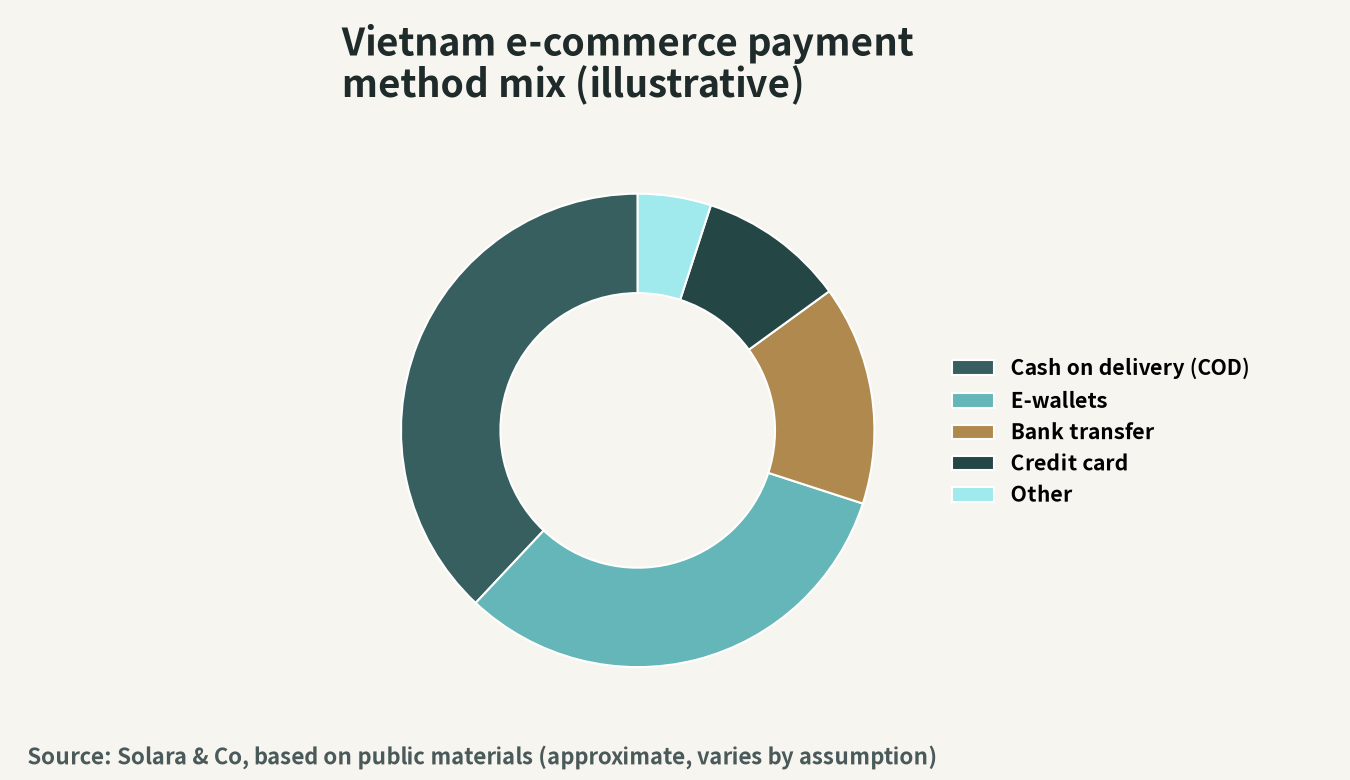
In Vietnam's online shopping, cash on delivery (COD)—paying in cash after receiving the goods—has continued to occupy a large share. In a market premised on COD, operational burdens hard to imagine in Japan arise: returns from refused receipts, cash collection by delivery staff, and a lengthening of the collection cycle. Whether or not you can handle COD ties directly to whether you can capture provincial demand, so the selection of 3PLs and payment agents that can accommodate it is important.
E-wallets and QR payments
At the same time, the spread of e-wallets and QR-code payments is also advancing at a rapid pace, raising the cashless ratio centered on younger demographics and urban areas. Connecting to major wallets and bank-transfer networks is indispensable for preventing missed payments. Since credit card ownership remains limited, the notion that "a card is enough" does not hold. A design that broadly covers COD, wallets, QR, and cards via a payment service provider (PSP) that bundles multiple payment methods is becoming the standard. Fintech and payment trends are explored in depth in Vietnam's fintech market.
Market-entry models and how to assemble your structure
Even within cross-border e-commerce, there is a wide range in how you engage. You choose the model that suits you by balancing risk and control.
Model | Launch burden | Control | Suited situation |
|---|---|---|---|
Cross-border marketplace store | Low | Low–Medium | Test selling / initial entry |
Local agent / sales partner | Low–Medium | Low | When you want to borrow operational capability |
Bonded warehouse + fulfillment | Medium | Medium | Scaling up / shortening delivery |
Full-scale e-commerce via a local subsidiary | High | High | Brand establishment / long term |
For most Japanese companies, the realistic path is staged expansion: first test the market at small scale via a cross-border marketplace or a local partner, get a feel for best-sellers, price sensitivity, and the key points of logistics, then expand investment into bonded warehousing and fulfillment, and finally, if necessary, incorporate a local subsidiary. Rather than building a heavy structure from the outset, you can hold down initial risk by thickening investment while verifying demand with data. For how to assemble a market-entry strategy, please also see How to build a Vietnam market-entry strategy.
Risks to keep in mind
The greater the opportunity, the more there are issues that must not be overlooked. First is the problem of authorized distribution versus parallel imports and counterfeits. The more popular a product, the more readily unauthorized resale and counterfeits circulate, making brand protection and management of authorized channels essential. How to protect intellectual property is covered in Intellectual property protection in Vietnam. Second is regulation of labeling, advertising, and ingredients. For cosmetics, health foods, food, and the like, the registration and labeling rules at import differ from Japan, and a violation ties directly to a sales suspension. Third is price and exchange rates. Once you factor in logistics, fees, duties, and payment costs, the profit margin tends to be thinner than expected, and exchange-rate fluctuations also shake earnings. Fourth is data and privacy regulation, where the handling of personal information must comply with local rules.
These can be realistically managed by, before entry, working through the practicalities of customs, regulation, logistics, and payments one by one, and by teaming up with a reliable local partner. The more a market has momentum, the more it is worth taking pains over the design of on-the-ground operations.
How Japanese companies build their sales channels — Solara's perspective
Vietnam cross-border e-commerce is a wide-doored sales channel that lets you deliver the value of "Made in Japan" even before setting up a local subsidiary. The key lies less in flashy marketing than in whether you can accurately assemble the unglamorous operations of customs, logistics, and payments. Without being greedy about channels, first discern the products and prices that will sell, then thicken your logistics and payment structures while watching the data—that steady accumulation is what leads to sustainable sales.
Solara & Co, building on bases and human networks in both Japan and Vietnam, provides end-to-end support: from market research and channel-strategy planning, to the search for local partners, 3PLs, and payment agents, the design of bonded and fulfillment structures, and even incorporation of a local subsidiary, M&A, or joint ventures in step with scaling up. In Vietnam's rapidly growing e-commerce market, we design together with you the way of selling that best leverages your strengths, and help you build a solid sales channel while steadily managing the risks at your feet.