
The Mekong Delta — the Economic Region That Feeds Vietnam
Spread across southwestern Vietnam, the Mekong Delta is the nation's "food treasury," blessed with the fertile soil and abundant water resources that the Mekong River bestows. Made up of 13 provinces and cities, this region produces more than half of Vietnam's rice and the bulk of its fruit and seafood, single-handedly underpinning the country's food security and agri-aquaculture exports. With the central city of Can Tho as its core, agriculture, aquaculture, and food processing converge in layered clusters, and in recent years — alongside accelerating infrastructure development — the region has been raising its profile as an investment destination.
At the same time, the Mekong Delta also faces structural challenges such as saltwater intrusion (salinization) caused by climate change, land subsidence, lagging infrastructure, and a large number of smallholder farmers. It is precisely for this reason that fields such as productivity improvement, value addition, and cold-chain development offer wide-open room for the technology and capital of Japanese companies to make a difference. This article organizes — from a practical standpoint — the overall picture of the Mekong Delta economic region, its flagship industries of agriculture and aquaculture, the investment opportunities, and the risks to keep in mind. For the broader picture of agri-aquaculture exports, please also see Vietnam's Agri-Aquaculture Exports.
The Overall Picture of the Mekong Delta Economic Region
The Mekong Delta builds on agriculture and aquaculture as its foundation, and by linking food processing and logistics, it forms a single economic region. Let us take an overview of that structure.
Rice and High-Value Crops
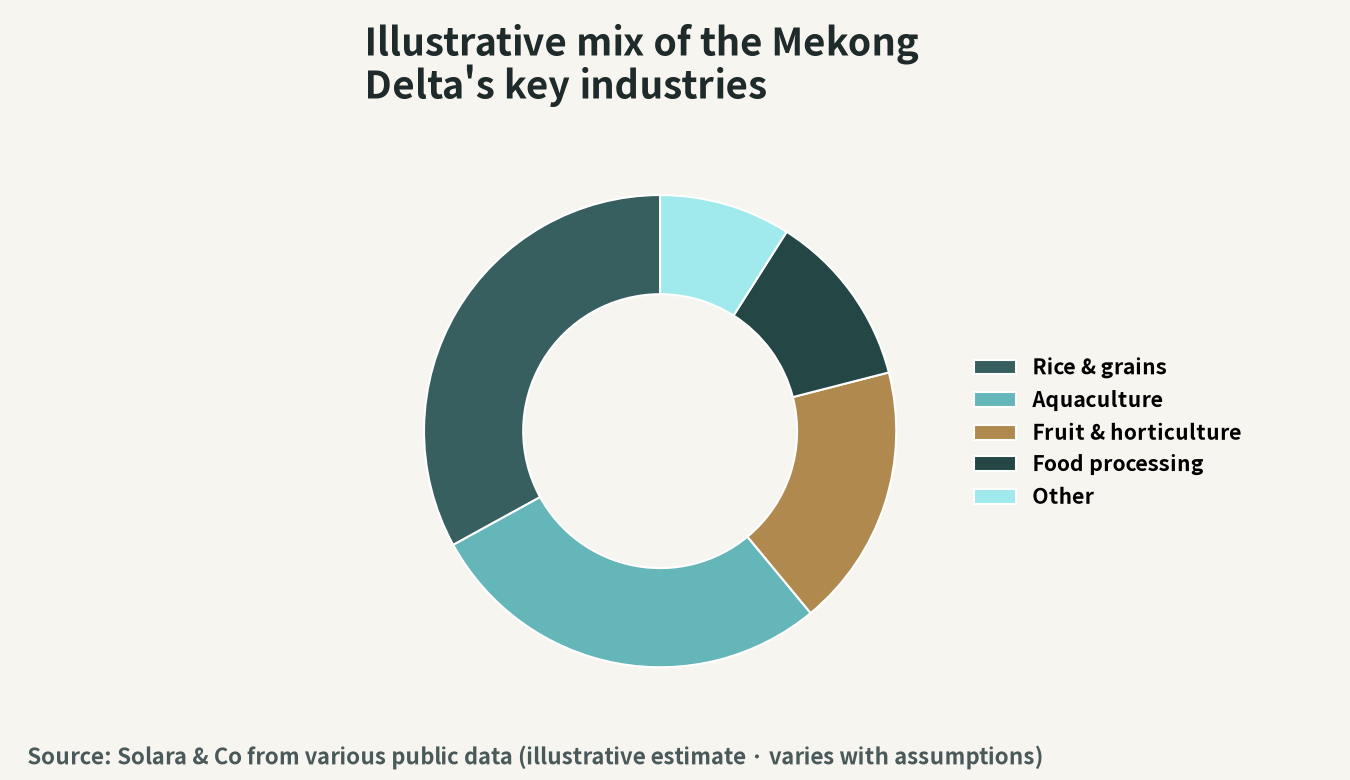
The Mekong Delta is the "rice bowl" that plays the central role in Vietnam's rice production and rice exports. In recent years, the rudder has turned from mere volume expansion toward raising quality and added value, with the production of high-quality and branded rice spreading. Alongside this, the cultivation of tropical fruits such as mango, dragon fruit, and durian is also thriving, drawing attention as high-value crops geared toward export.
Aquaculture and Exports
The Mekong Delta is also the beating heart of Vietnam's fisheries sector. The farming of shrimp (black tiger and whiteleg) and pangasius (a catfish species, commonly known as basa or tra) is carried out on a world-class scale, with much of it exported to Europe, the Americas, Asia, and Japan. Seafood is one of Vietnam's leading export items, and the lion's share of it comes from this region.
The Node Linking Food Processing and Logistics
Food processing that raises the added value of agri-aquaculture products, and the logistics that carry them, form another axis of the economic region. Rather than exporting primary products as they are, the trend toward processing them to add value is strengthening, heightening demand to build out processing, refrigeration, and transport as an integrated whole.
A Closer Look at the Flagship Industries
The Mekong Delta's strength lies in the depth of its two flagship industries: agriculture and aquaculture. Let us examine the current state and direction of each.
Agriculture — The Shift from Quantity to Quality
For a long time the Mekong Delta pursued the goal of "how to harvest as much as possible," but in recent years its center of gravity has shifted to "how to make products that can sell at a higher price." Behind this lies the need to break free from low-price competition and the call for sustainable agriculture under climate change. Branding high-quality rice, reduced-pesticide and organic cultivation, opening up export markets for fruit, and introducing smart agriculture (precision farming) are the concrete measures. Organizing producers and advancing quality management are the keys to lifting added value.
Aquaculture — The Source of Export Competitiveness
The farming of shrimp and pangasius is a pillar that underpins the Mekong Delta's export competitiveness. Export markets are intensifying their demands for food safety, traceability, and environmental consideration (such as sustainable-aquaculture certification), and the ability to meet these will determine competitiveness. There is room for advancement at every stage — fry, feed, farming technology, processing, and quality management — and this is a domain where investing technology and capital translates directly into results.
Food Processing and the Cold Chain
Food processing that transforms agri-aquaculture products into high-value goods, and the cold chain (low-temperature logistics) that transports them while preserving quality, are the domains with the greatest growth potential in the Mekong Delta. The more the technologies of freshness preservation, freezing, and processing are in place, the more dramatically the value of primary products rises. This is also a field where Japanese companies' know-how in quality, hygiene, and technology is highly valued. Entry into the food and beverage market is covered in Entering Vietnam's Food and Beverage Market.
Infrastructure Development as a Turning Point
What long constrained the Mekong Delta's investment environment was its lagging infrastructure. As a vast watery delta, building roads and bridges is difficult, and the logistics costs and lead times from production areas to ports and consumption centers have been a drag on competitiveness.
In recent years, however, this situation has been changing dramatically. The extension of the expressway network, the development of trunk routes connecting major cities and ports, and the construction of bridges are progressing, shrinking the distance between production areas and markets. As a result, investments that had been shelved due to logistics constraints are becoming realistic, and opportunities to invest in food processing, logistics, and warehousing are expanding. For the overall picture of infrastructure investment, please refer to Infrastructure Investment in Vietnam, and for trends in logistics and warehousing, see Vietnam's Logistics and Warehouse Market. In addition, connectivity with the southern industrial zone is also strengthening, and the Mekong Delta serves as a hinterland and labor-supply source for Vietnam's Southern Industrial Parks.
An Economic Corridor Centered on Can Tho
The Mekong Delta's economic activity is organized around the axis of the central city of Can Tho. Can Tho is the region's hub for commerce, logistics, and education, and functions as a hub for the aggregation, processing, and shipment of agri-aquaculture products. With this as its core, a logistics corridor connecting each province's production areas with ports and consumption centers is taking shape, and as infrastructure development advances, its importance as a connecting node keeps growing.
For companies considering investment, the key point is to design as an integrated whole: proximity to the production areas of the raw primary products, the location of processing and refrigeration facilities, and access to the ports and roads that ship the products out. Too close to the production area and you end up far from consumption centers and export ports; lean toward the consumption center and the lead time for raw-material procurement lengthens — this locational trade-off must be optimized in light of one's own business characteristics.
Building Relationships with Producers
In businesses involving primary industry, whether one can secure stable quality and quantity divides success from failure. Under a structure borne by numerous small-scale producers, building mechanisms for contract farming and contract aquaculture, partnering with producer organizations (such as cooperatives), and lifting quality through technical guidance are indispensable. Rather than ending with short-term transactions, persistently building long-term relationships of trust leads to a sustainable procurement base.
Investment Opportunities for Japanese Companies
The Mekong Delta opens multiple points of entry for Japanese companies. First is food processing. The business of transforming abundant primary products into high-value processed foods with Japanese technology has opportunities on both the domestic-demand and export fronts. Second is the cold chain and logistics. Freshness-preservation and low-temperature transport technologies and facilities are indispensable infrastructure for raising the value of agri-aquaculture products, and demand is expected to expand.
Third is agriculture and aquaculture technology (agritech). Demand is rising for technologies that raise productivity and quality — smart agriculture, farming technology, fry and feed, and quality-management and traceability systems. Fourth is the procurement and import of agri-aquaculture products. As a supply source for stably procuring safe, high-quality rice, fruit, and seafood for the Japanese market, the Mekong Delta is attractive. Fifth are the opportunities surrounding sustainability, where there is also business in environmentally conscious agriculture and aquaculture and in climate-change adaptation technologies. The current of green transition is discussed in Vietnam's Green Transition and ESG.
Risks to Keep in Mind
The greater the opportunity, the more the inherent risks must be examined. First is climate-change risk. Saltwater intrusion (salinization), land subsidence, and extreme weather threaten the production base of agriculture and aquaculture, bringing long-term uncertainty to siting and business design. Second is the unevenness of infrastructure; while development advances, constraints still remain depending on the area and the use. Third is the smallness and dispersion of production. The structure borne by numerous small-scale farmers and aquaculturists makes standardizing quality and securing stable procurement difficult, posing challenges in organizing producers and designing contract farming. Fourth is food safety and regulatory compliance, where building out the traceability and certification that meet the demand level of export markets is indispensable. Trends in environmental regulation are covered in Vietnam's Environmental Regulation and EIA.
These can be managed realistically by building long-term relationships with trustworthy partners and producer organizations on the basis of locally grounded information, and by designing mechanisms that guarantee quality and sustainability. The more an investment involves primary industry, the more that steady design grounded in on-the-ground realities divides success from failure.
How Japanese Companies Can Seize the Opportunity — Solara's Perspective
The Mekong Delta economic region is a growth domain that, on the firm foundation of agriculture and aquaculture, is meeting the turning point of infrastructure development and expanding investment opportunities into food processing, the cold chain, and agritech. For Japanese companies, multiple ways of engaging are open: leveraging strengths in technology and quality to raise the added value of primary products, securing safe supply sources, and supporting sustainable production. The key lies less in flashy topics and more in how well one can build trustworthy relationships in the down-to-earth domains of on-the-ground production, quality, and logistics.
Solara & Co, building on its bases and human networks in both Japan and Vietnam, provides end-to-end support — from market research and business-strategy formulation, to the search for local partners, producers, and processors, to M&A and joint ventures in the food and agri-aquaculture fields, to pre-acquisition credit investigation and due diligence, and through to building the organizational setup after market entry. In the food treasury that is the Mekong Delta, we help you identify the mode of engagement where your strengths come most alive, while steadily managing the risks of climate, infrastructure, and procurement — supporting you in achieving both at once.