
Smart Cities and Infrastructure Development Driven by Vietnam
Amid rapid urbanization and economic growth, Vietnam has placed the "smart city" at the heart of its vision for building cities. The concentration of population in cities, traffic congestion, air pollution, waste management, and surging energy demand—these urban challenges that erupt alongside growth are to be solved through digital technology and infrastructure development, creating cities that are livable, efficient, and sustainable. That is the aim of the smart city vision.
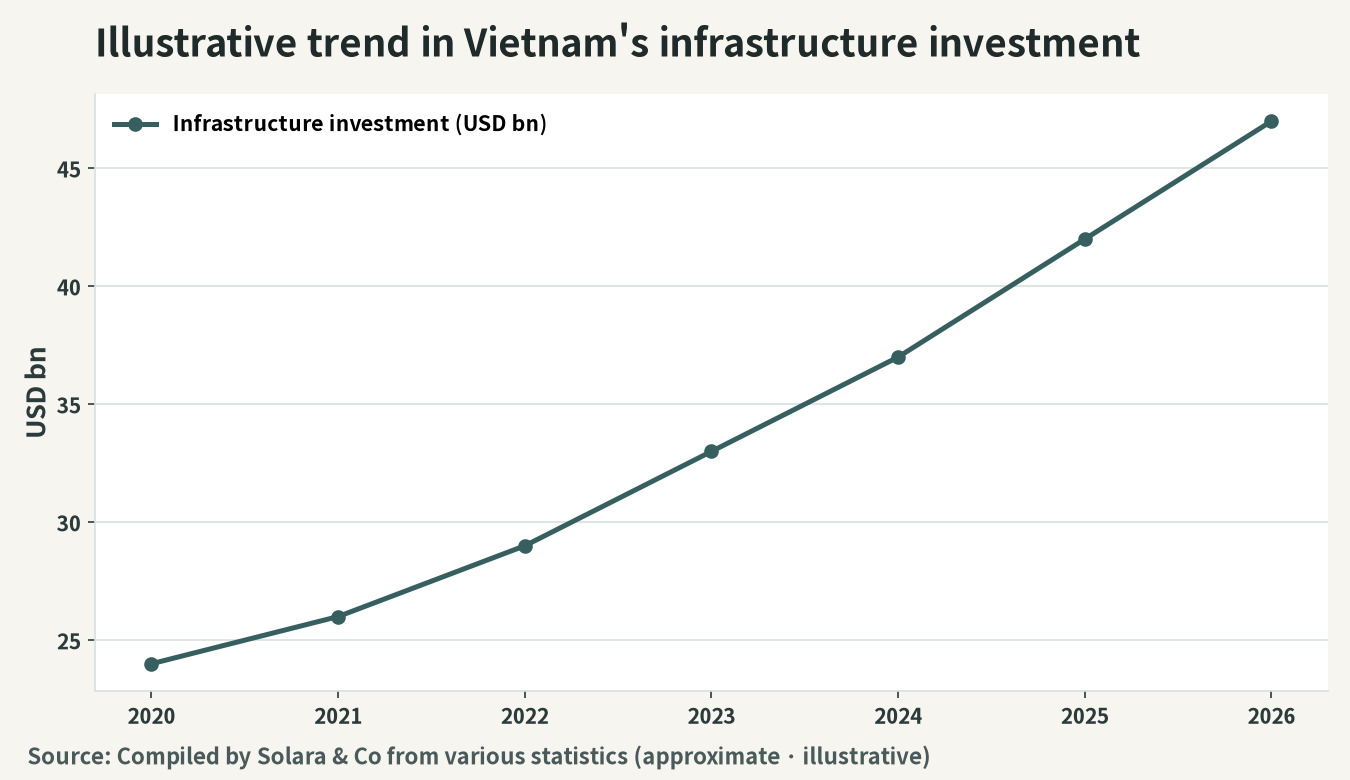
This effort goes well beyond mere urban planning. Large-scale investment is beginning to move, embedding IoT, data, and AI across every domain of urban infrastructure—transport, energy, water, waste, disaster prevention, and administrative services. Investment in infrastructure development is expected to continue at high levels, and as digitalization and environmental considerations are layered on top, the breadth of the market will expand still further. This article organizes the overall picture of Vietnam's smart cities and infrastructure development, and explains—from a practitioner's standpoint—the investment opportunities by domain, the forms of involvement available to Japanese companies, and the risks to bear in mind.
The Background to Promoting Smart Cities
Behind Vietnam's focus on smart cities lie structural pressures that cannot be avoided.
The Challenges Brought by Rapid Urbanization
Vietnam's urban population ratio continues to rise, with population and economic activity concentrated in the two major metropolitan areas of Hanoi and Ho Chi Minh City. Rapid urbanization sharply intensifies challenges all at once—traffic congestion, housing shortages, environmental burdens, and insufficient infrastructure capacity. In particular, chronic congestion in traffic dominated by motorbikes, flooding during the rainy season, and air pollution are serious problems that erode urban quality of life and economic efficiency. For urban challenges that conventional infrastructure development alone cannot keep pace with, the smart city approach—using digital technology to raise efficiency within limited budgets and time—has become indispensable.
Positioning as a National Strategy
The government is promoting smart city development in major cities as a national policy. In newly created urban developments (new cities), efforts to embed smart functions from the planning stage are advancing, while in existing cities, digitalization is being pursued across the fields of transport, administration, and the environment. The smart city is a symbolic domain where two national goals—digital transformation (DX) and the green transition—intersect.
Sustainability and Greening
Against the backdrop of responding to climate change and international commitments to carbon neutrality, urban development is strongly required to incorporate environmental considerations (greening). Elements such as renewable energy, energy-efficient buildings, electric mobility, and water resource management have become indispensable components of the smart city. The globally shared goal of decarbonization introduces environmental performance as a new axis of evaluation for Vietnam's urban infrastructure, and is driving investment in green buildings and in low-carbon transport and energy.
Smart City and Infrastructure Opportunities by Domain
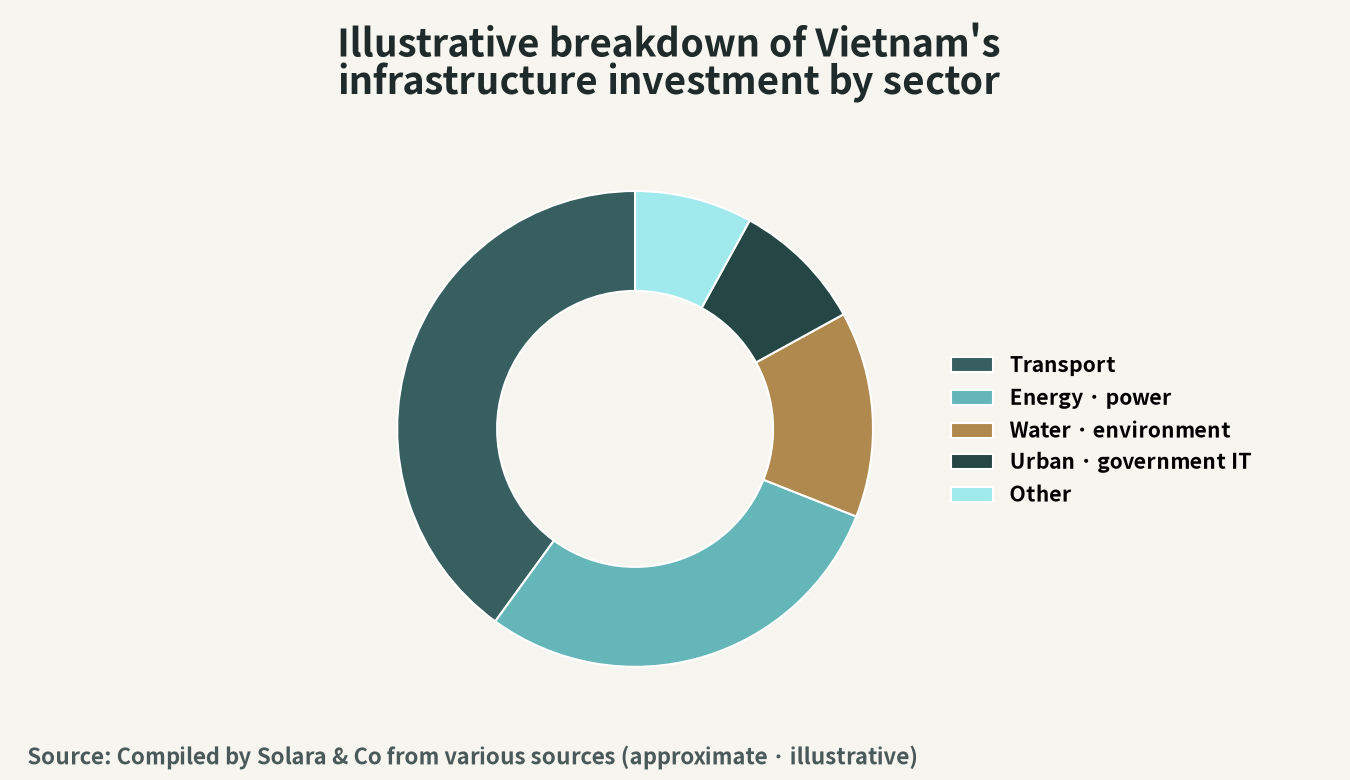
Smart cities and infrastructure development span multiple domains. Below, we organize the investment opportunities by major domain.
Smart Transport and Mobility
Easing traffic congestion is the foremost urban challenge. Investment in smart transport is advancing: urban rail (metro), bus rapid transit (BRT), intelligent transport systems (ITS), signal control, parking management, electric buses, and electric two-wheelers. In Hanoi and Ho Chi Minh City, the development of urban rail lines is progressing, and a shift in urban structure is being explored—from traffic centered on two-wheelers toward one centered on public transport. In Vietnam's cities, where vast numbers of motorbikes come and go, digital management of traffic flows and electrification deliver major effects on both congestion and air pollution, and demand is also expanding to software-side technologies such as fare collection, operations management, and demand forecasting. The rise of domestic electric-vehicle and electric two-wheeler makers is accelerating the electrification of vehicles, and together with the build-out of charging infrastructure, an electric-mobility market is beginning to take shape. The deployment of intelligent transport systems (ITS)—such as electronic toll collection (ETC) on expressways and the visualization of bus location data—is also advancing step by step, calling for integrated proposals that combine hardware infrastructure with software-side control technology. Developing public transport and digitally managing traffic flows are the foundation of the smart city.
Smart Energy and Grid
To meet rising electricity demand, demand is growing in fields such as upgrading transmission and distribution networks (smart grids), integrating renewable energy, energy management systems, and smart meters. A stable power supply is a precondition for the growth of cities and industry, and improving its efficiency is an urgent task. Vietnam has rapidly advanced the deployment of renewable energy such as solar and wind, but stably integrating variable renewables into the grid requires upgrading transmission and distribution networks along with mechanisms for storage and supply-demand balancing. Under the national Power Development Plan (PDP8), the policy direction for expanding renewable energy and the transmission grid has been set, and the framework for direct power purchase agreements (DPPA)—allowing companies to procure electricity directly from generators—is being put in place. For the supply chains of global corporations pursuing decarbonization, access to renewable electricity is becoming a factor in site-selection decisions. Energy management systems (EMS) that optimize the energy use of buildings and factories, as well as responding to the growing electricity demand of data centers, are also important themes going forward.
Smart Water, Environment, and Waste
Environmental infrastructure—such as building and efficiently operating water supply and sewerage, water quality monitoring, the collection, treatment, and recycling of waste, and air quality monitoring—is the foundation of a livable city. These are domains that call for both efficiency gains through digital technology and environmental technology. Because rapid urbanization and industrialization have outpaced the development of water supply, sewerage, and waste treatment—making water pollution and the growth of waste serious challenges—investment demand for environmental infrastructure such as water purification, wastewater treatment, waste incineration with power generation, and recycling is large, making this a promising domain for Japanese companies with strengths in environmental technology. Indeed, on the outskirts of Hanoi, large-scale waste-to-energy (WtE) plants have begun operating, showing that the energy use of waste is moving from the conceptual stage to the implementation stage. Sewerage coverage remains low, leaving room for investment across the entire value chain—from the construction and operation of treatment plants to sludge treatment and the reuse of reclaimed water.
Smart Administration and Digital Governance
Fields such as e-government, digital administrative services, data platforms for operating cities (city OS), and monitoring and analysis systems for disaster prevention and crime prevention are also important components of the smart city. They simultaneously improve the convenience of citizen services and the efficiency of urban operations. A platform that integrates and analyzes data gathered from various sensors and cameras to operate the city across transport, disaster prevention, the environment, and administration is positioned as the central nervous system that "intelligently" connects individual pieces of infrastructure. In Vietnam, which is highly susceptible to the effects of climate change, the importance of disaster-prevention infrastructure and data utilization—as preparation against floods, storm surges, and typhoons—is also rising.
Organizing Investment Opportunities and Risks
The table below organizes the opportunities and risks across the major domains of smart cities and infrastructure.
Domain | Main investment opportunities | Risks to bear in mind |
|---|---|---|
Smart transport | Rail, ITS, electric mobility, traffic control | Massive investment, payback period, permits |
Smart energy | Transmission/distribution, renewable integration, EMS | Regulation and power market, grid constraints |
Water, environment, waste | Water/sewerage, treatment, monitoring | Profitability, project scheme |
Digital governance | City OS, administrative DX, disaster prevention | Data protection, procurement mechanisms |
Construction, materials, equipment | Energy-efficient buildings, smart buildings | Quality competition, price |
As for the risks to bear in mind: first is the massive investment and long payback period inherent to infrastructure projects, which makes an understanding of public-private partnership (PPP) institutional design and project schemes indispensable. Second is the mechanism of permits and procurement—projects with high public-interest character have complex bidding and approval processes. Third is the response to data protection and cybersecurity—a city's digital foundation presupposes the assurance of safety. These must be managed through locally grounded information and the selection of trustworthy partners.
Movements in Major Cities and the Practicalities of PPP and Financing
Smart cities and infrastructure are not an abstraction; they are moving as concrete projects in each city. In assessing locations and deals, it is important to grasp the direction of the major cities and the frameworks for raising capital.
Concrete Movements in Hanoi, Ho Chi Minh City, and Da Nang
In Ho Chi Minh City, urban rail Line 1 (Ben Thanh–Suoi Tien, about 20 km), funded by Japanese ODA loans, began commercial operation at the end of 2024—a symbolic event for the shift from motorbike-centered traffic toward public transport. In Hanoi, too, the development of the Cat Linh–Ha Dong line and the Nhon–Hanoi Station line is progressing, and both cities are planning rail networks on the scale of more than a dozen lines over the long term. In the Dong Anh area on the outskirts of Hanoi, a large-scale smart city development—formed by a Japanese trading company together with a major local developer—is underway, a representative example of the new-city model that embeds smart functions and environmental performance from the planning stage. Binh Duong Province, a hub of manufacturing, is advancing its smart-city transformation around an urban development between a local development entity and Japanese capital, and has been repeatedly selected as a leading city by international urban organizations. Da Nang, in the central region, is orienting itself toward becoming a hub city on the twin pillars of IT/data centers and tourism. Maturity, industrial structure, and administrative priorities differ from city to city, and deal selection cannot do without a locally grounded assessment based on these differences.
PPP, ODA, and Financing Schemes
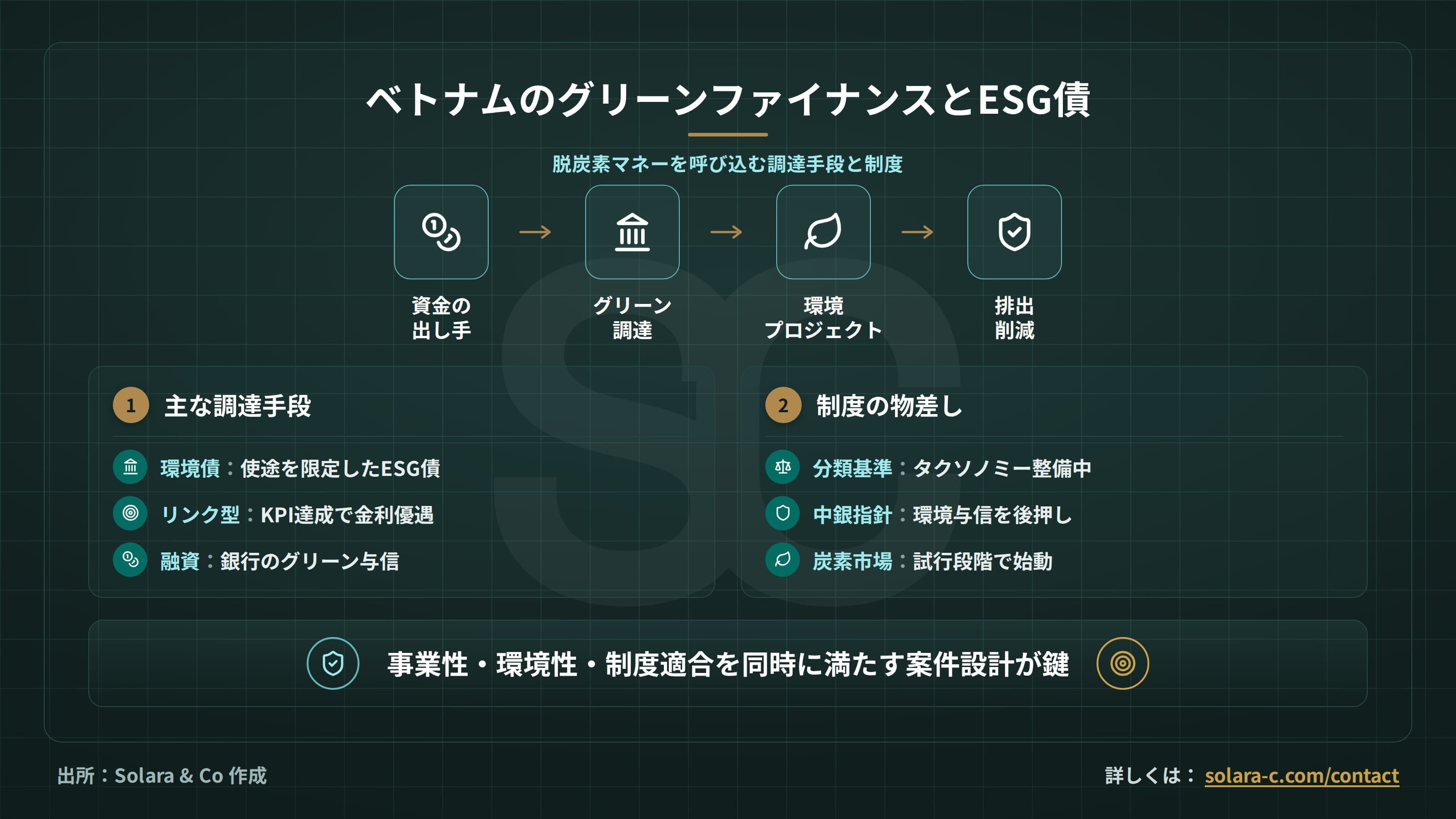
The capital demand for infrastructure development cannot be covered by the state budget alone, so the participation of private and foreign capital is a precondition. With the Law on Public-Private Partnership (PPP), which took effect in 2021, Vietnam institutionalized project forms such as BOT and BTO, as well as a mechanism for sharing the increase or decrease in revenue accompanying demand fluctuations between the public and private sides (a revenue-risk-sharing mechanism). That said, there are constraints on the target sectors, the minimum project scale, and the treatment of foreign-currency remittances and revenue guarantees, so structuring a deal cannot do without grasping the details of the system and how it operates in practice. For Japanese companies, ODA loans, the framework of the Japan International Cooperation Agency (JICA), and projects tied to bilateral cooperation remain weighty points of entry. In addition, financing instruments for the green field—such as green bonds and sustainability-linked loans—are also expanding, and the scope for financing urban infrastructure projects with environmental performance is expected to widen further. Because a project's profitability is governed by tariff levels, demand forecasts, exchange rates, and interest rates, scrutinizing the financial model at the entry stage determines success or failure.
The Strengths of Japanese Companies and Forms of Involvement
Smart cities and infrastructure development are among the domains where the strengths of Japanese companies come most fully into play. Japan possesses one of the world's foremost accumulations of technology and operational know-how in urban infrastructure—urban rail, water supply and sewerage, energy management, waste treatment, disaster prevention, and energy-efficient buildings. The experience of efficient, highly reliable, and environmentally conscious urban infrastructure cultivated within Japan can be applied directly to building Vietnam's cities, which face the same challenges.
The forms of involvement are diverse. From participation in infrastructure projects (construction, equipment, and system supply), to investing in and operating public-private partnership (PPP) projects, joint ventures with local companies, the supply of technology and products, and even consulting on urban development as a whole—the points of entry are broadly open. In particular, the cooperative relationship between the Japanese and Vietnamese governments forms the foundation that supports Japanese companies' involvement in the infrastructure field. Many infrastructure projects are tied to official development assistance (ODA) and bilateral cooperation, and the ability to leverage such frameworks is also an advantage for Japanese companies.
In any form, the selection of local partners and due diligence at the time of a project, investment, or acquisition determine success or failure. Because infrastructure projects are large in scale and long in duration, scrutinizing the project scheme and conducting credit investigations on partners are the prerequisites for capturing opportunities while keeping risk in check.
Supporting the Growth of Cities and Industry — Solara's Perspective
Vietnam's smart cities and infrastructure development, riding the tailwinds of rapid urbanization, national strategy, and greening, are seeing large-scale investment move across every domain—transport, energy, water, environment, and administration. For Japanese companies with strengths in the technology and operation of urban infrastructure, this is a major, long-term business opportunity.
The key is to correctly understand the project schemes and institutions of each domain, select trustworthy local partners, and design the appropriate form of involvement (participation, PPP, joint venture, or supply). Precisely because these are large-scale, long-duration domains, scrutinizing the project and conducting credit investigations on partners at the entry stage greatly influence success or failure.
Solara & Co maintains bases and human networks in both Japan and Vietnam, providing integrated support—from market research and entry-strategy formulation, to the selection of local partners, support for joint-venture, M&A, and PPP deals, and credit investigation and due diligence prior to investment or acquisition. We help connect the infrastructure investment opportunities that will build the future of Vietnam's cities and industry to solid, tangible results.