
The Rising Tide of Green Finance in Vietnam
Vietnam has declared internationally its commitment to net zero (effectively zero greenhouse-gas emissions) by 2050, placing the energy transition and the decarbonization of industry at the top of the national agenda. Realizing this ambitious goal will require pouring vast sums of capital, continuously and over the coming decades, into fields such as renewable energy, power transmission and distribution grids, energy efficiency, waste treatment, and green logistics. Public funds alone come nowhere near covering it; how to draw private capital into the environmental sphere is the question—and the answer drawing attention is green finance.
Through instruments such as green bonds, sustainability-linked loans, and green credit, the machinery for channeling funds into projects that contribute to environmental improvement is rapidly taking shape in Vietnam as well. This article organizes the overall picture of Vietnam's green finance and ESG bonds, the principal funding instruments, the institutional framework, and the opportunities and risks for Japanese companies—from the practical perspective of capital raising.
Why This Is Now a New Tide in Capital Raising
Behind green finance's rapidly growing presence in Vietnam lie three structural inevitabilities.
The Vast Capital Decarbonization Requires
Expanding renewable energy in line with the power development plan, reinforcing transmission and distribution grids, and industry's energy-efficiency investments all demand enormous upfront capital. These have long payback periods and cannot be covered by the public budget alone. Precisely for this reason, a framework for raising market funds suited to long-term environmental investment becomes indispensable. The overall picture of power planning is covered in detail in Vietnam's Renewable Energy and PDP8.
Demands From Global Investors and Supply Chains
International institutional investors have come to insist strongly that their investees address ESG (environmental, social, and governance) issues. At the same time, global corporations have begun demanding that their suppliers decarbonize across the entire supply chain. For companies with production bases in Vietnam, procuring green power and cutting emissions is no longer an "aspirational target" but is becoming a condition for continuing to do business. On the flow of the energy transition, please refer to Vietnam's Energy Transition and GX.
The Backing of International Financial Institutions
International development-finance institutions (DFIs) such as the Asian Development Bank (ADB) and the International Finance Corporation (IFC), along with Japanese institutions such as JBIC and JICA, are strengthening their provision of funding and technical cooperation for Vietnam's decarbonization projects. These public funds act as a catalyst, and blended finance—drawing in private capital alongside them—is steadily spreading.
The Market Picture for ESG Bonds and Green Finance
We grasp the contours of the market through the growth trend in funding scale. Vietnam's issuance and outstanding balance of green bonds and green credit, though still small, are taking shape rapidly.
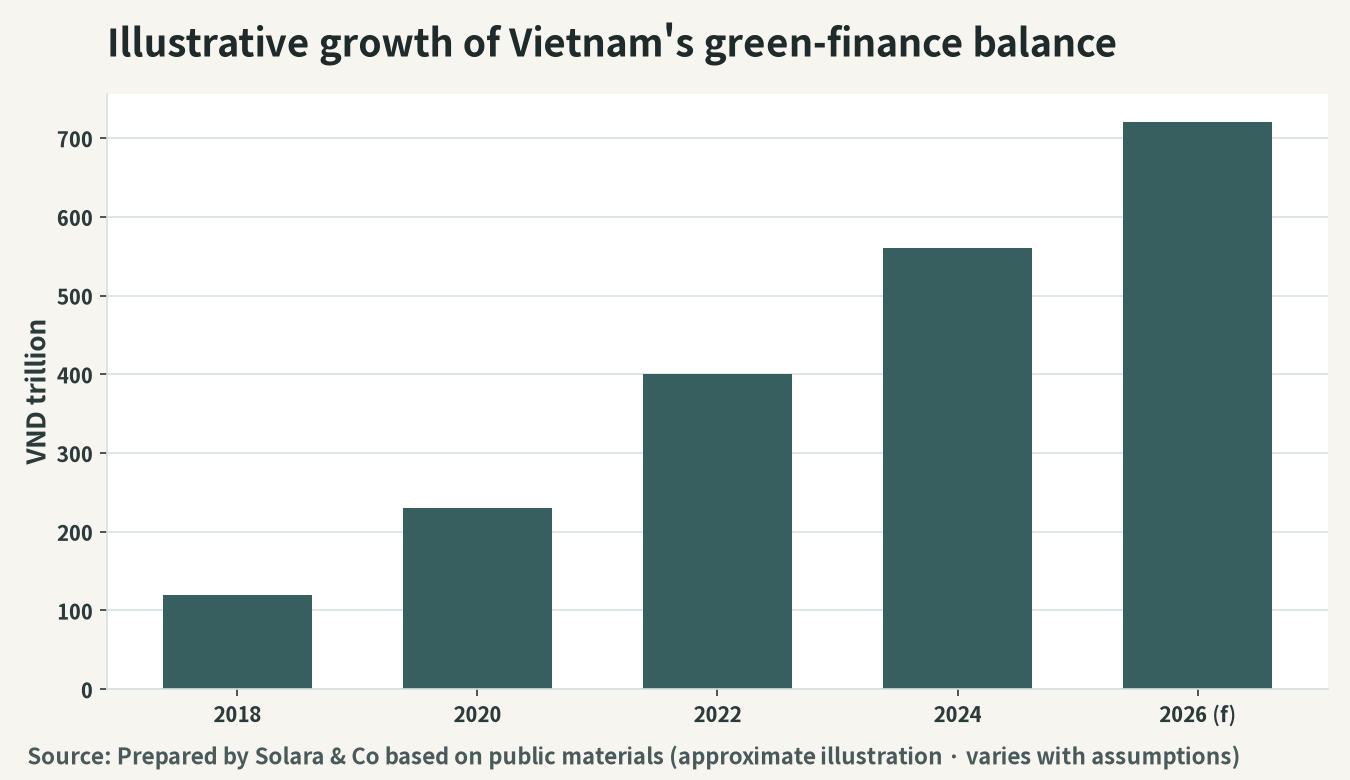
The figures swing depending on the assumptions, but the direction is consistent. Within Vietnam's financial structure, which has long leaned heavily on bank lending, the environmental sphere is expanding with green credit in the lead, and as the corporate-bond market is built out, the room for green-bond issuance is widening too. That said, green credit's share of total credit is still low, and the headroom for growth is large—that is the reality today. On the overall structure of the financial sector, please also see Vietnam's Banking and Finance Sector.
The Principal Funding Instruments and How to Use Them
Green finance is not a single, uniform thing. Its character divides according to how the use of proceeds is constrained, and according to who is raising funds and for what.
Instrument | Character | Main fundraising entities | Suitable situations |
|---|---|---|---|
Green bond | Use of proceeds limited to environmental projects | Government, banks, large companies | Large-scale, long-term environmental investment |
Sustainability-linked | Interest incentive on meeting KPIs | Operating companies | Company-wide decarbonization transition |
Green credit (lending) | Banks lend to environmental projects | Mid-sized and small companies | Equipment renewal, energy-efficiency investment |
Blended finance | A combination of public and private | Project companies | Higher-risk new ventures |
Green Bonds and ESG Bonds
A green bond is a bond issued with its use of proceeds limited to renewable energy, energy efficiency, environmental conservation, and the like. Its defining features are clarifying the use of proceeds and assuring its "greenness" through third-party assessment (an external review). The collective term when sustainability bonds and social bonds are added to these is "ESG bonds." Government-affiliated agencies, commercial banks, and large companies in infrastructure, real estate, and manufacturing have begun to appear on the roster of issuers.
The Sustainability-Linked Type
The mechanism that, rather than constraining the use of proceeds, varies the interest rate according to the degree to which a company-wide decarbonization target (such as an emissions-reduction rate) is met is the sustainability-linked loan/bond. Because it is not tied to a specific project, its advantage is that it is easy to use as a means for an operating company in transition to advance decarbonization across the whole company.
Green Credit and Blended Finance
Lending that banks undertake for environmental projects (green credit) is the core of Vietnam's green finance. The central bank has put in place guidelines for environmental credit, and commercial banks are expanding lending to energy efficiency, renewable energy, clean agriculture, and the like. In addition, for new projects with high uncertainty of recovery, blended finance—in which a DFI or public funds take on a subordinated tranche or a guarantee to draw in private capital—is effective. The design of a project's capital structure can also apply the thinking in Financing Structures for M&A in Vietnam.
The Institutional Framework—How Far It Has Come
For green finance to function, you need a yardstick that defines "what is green" and a disclosure and assessment mechanism to back it up. Vietnam is advancing its institutional development as well, but it remains at a developing stage.
Building the Green Taxonomy
Work is under way to formulate the classification criteria (the taxonomy) that define which projects qualify as "green," contributing to the environment. Once this is settled, issuers, investors, and banks can judge by a common yardstick, raising the transparency of the use of proceeds. That the criteria are still developing is, at present, also a hurdle to issuance.
The Central Bank's Green-Credit Guidelines
The central bank (SBV) has put in place guidelines that urge commercial banks to manage environmental and social risk and to expand environmental credit, backing the growth of green credit. The connection with environmental regulations such as the environmental impact assessment (EIA) is also important; regulatory developments are covered in Vietnam's Environmental Regulation and the EIA.
The Carbon-Credit Market Starts Up
Building out the market for emissions trading and carbon credits is also proceeding in stages. It is at a pilot stage, but if a mechanism for converting emissions reductions into monetary value is put in place in the future, the base of green finance will broaden further still.
The Opportunities for Japanese Companies
Vietnam's green finance opens several points of entry for Japanese companies. First, for operating companies that supply decarbonization technology, energy-efficient equipment, and renewable-energy machinery, Vietnamese companies and projects that raise funds through green credit or green bonds become promising customers. Second, when investing in or participating in renewable power generation or energy-efficiency ventures, green finance becomes the key to making the project's financing come together. On M&A trends in the energy sector, please refer to Energy M&A in Vietnam 2026.
Third, Japanese financial institutions such as JBIC, JICA, and the megabanks are providing funding and know-how to Vietnam's decarbonization projects, and Japanese companies can make use of this public-private partnership framework. Fourth, advancing green-power procurement and emissions reductions at one's own bases in Vietnam itself answers the demands of global customers and connects to protecting one's competitiveness within the supply chain. The overall picture of the green transition and ESG response is summarized in Vietnam's Green Transition and ESG.
The Risks to Bear in Mind
The greater the expectations, the more there are points to view with a cool head. First is the risk of greenwashing (a sham show of environmental concern). At a stage where the classification criteria and disclosure are immature, funding that styles itself "green" without the substance to match can slip in, putting the quality of third-party assessment and information disclosure in question. Second is the developing nature of the institutions. Because the taxonomy and market rules are not yet fully settled, a change in the rules could shift the business environment. Third is the project's commercial viability (bankability). However high its environmental merit, funds will not gather unless profitability and recoverability accompany it. Fourth is the burden of disclosure and data preparation, which requires putting in place systems for collecting and reporting ESG information.
These can be managed by teaming up with trustworthy external assessment bodies and advisors, continuously tracking institutional developments, and designing projects that reconcile commercial viability with environmental merit. The newer the financial field, the more it is worth securing firm footing on both the institutional and the practical sides.
How Japanese Companies Should Engage—Solara's Perspective
Vietnam's green finance and ESG bonds, against the backdrop of the irreversible tide of decarbonization, are maturing into a new mainstream of capital raising. For Japanese companies, several modes of engagement are open: as a supplier of technology and equipment, as an investor in renewable-energy and energy-efficiency ventures, and as a party advancing decarbonization at one's own bases. The key lies not in a glamorous signboard but in how well one can design projects that simultaneously satisfy all three—commercial viability, environmental merit, and institutional fit.
Solara & Co, building on bases and human networks on both the Japanese and Vietnamese sides, provides seamless support—from market research and the formulation of business strategy, to the search for local partners and financial institutions, M&A and joint ventures in the renewable-energy and decarbonization fields, and the design of financing structures and due diligence. In green finance, a growth area, we help you identify the mode of engagement that best leverages your strengths, while steadily managing risk on both the institutional and the business fronts.