
The Port and Logistics Infrastructure Underpinning a Trade-Built Vietnam
Vietnam is a "trade nation" that has achieved export-led economic growth. The bulk of its exports—electronics, textiles, automotive parts, and agricultural and fishery products—are carried to the world by sea, and the gateway to that flow is the port. The port and logistics infrastructure that underpins both the logistics of a domestic market of more than 100 million people and the trade that connects to the world is the very lifeblood of Vietnam's economy, and it is no exaggeration to say that its capacity sets the ceiling on economic growth.
In recent years, Vietnam's trade volume has surged along with the concentration of manufacturing, raising the pressure on the capacity of the existing port and logistics infrastructure. The combined value of imports and exports has already reached a scale exceeding GDP, and this high degree of trade dependence speaks directly to the importance of logistics infrastructure. To meet this, large-scale port expansion, the development of deep-water ports, and the modernization of logistics networks are being advanced as national priorities. This article organizes the current state and expansion plans of Vietnam's port and logistics infrastructure, and explains from a practical standpoint where the business opportunities for Japanese companies lie and the risks to keep in mind.
The Geography and Current State of Vietnam's Ports and Logistics
Vietnam has a territory that stretches north to south, and along its long coastline several port clusters have formed. The arteries of logistics are strongly governed by this geographic configuration.
The Two Great Gateways of the South and the North
In the south, the Cái Mép–Thị Vải port cluster near Ho Chi Minh City is a deep-water port where large container ships can call, serving as one of Vietnam's largest gateways for international trade. A deep-water port that can connect directly to the trunk routes serving Europe and the Americas is a source of competitiveness, in that goods can be exported without going through transshipment. In the north, Hải Phòng port and the deep-water port developed off its coast underpin the imports and exports of the electronics and manufacturing clusters spread around Hanoi and in places such as Bắc Ninh and Hải Dương. Furthermore, the central region also has ports such as Đà Nẵng, which handle the logistics of the regional economy. This gateway configuration centered on the two poles of north and south carries the backbone of Vietnam's international logistics.
Growing Cargo Volume and Capacity Pressure
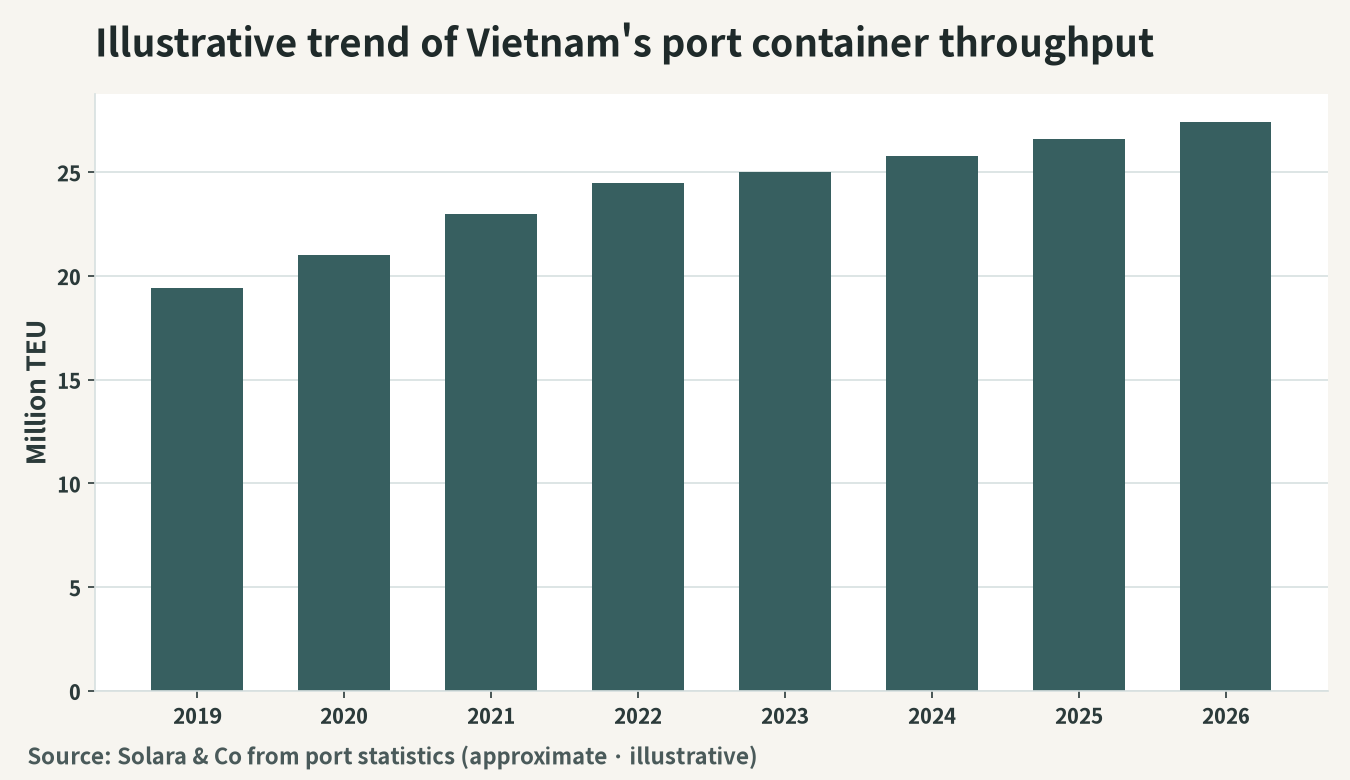
With the concentration of manufacturing and the expansion of domestic demand, the volume of container cargo handled is increasing year by year, and nationwide container throughput is said to have already reached a scale of around 25 million TEU per year. The relocation of production against the backdrop of China Plus One is a structural factor that pushes import and export cargo volumes still higher. The handling capacity of existing ports has begun to show its limits, and at peak seasons there are moments when congestion, lengthening lead times, and yard congestion become challenges. Whether the expansion of port and logistics infrastructure can keep pace with the growth in cargo volume will determine the efficiency of the entire supply chain and, by extension, the locational competitiveness of manufacturing. It is precisely for this reason that the expansion of ports and logistics is positioned not as mere infrastructure development but as one with the nation's industrial policy.
The Challenge of High Logistics Costs
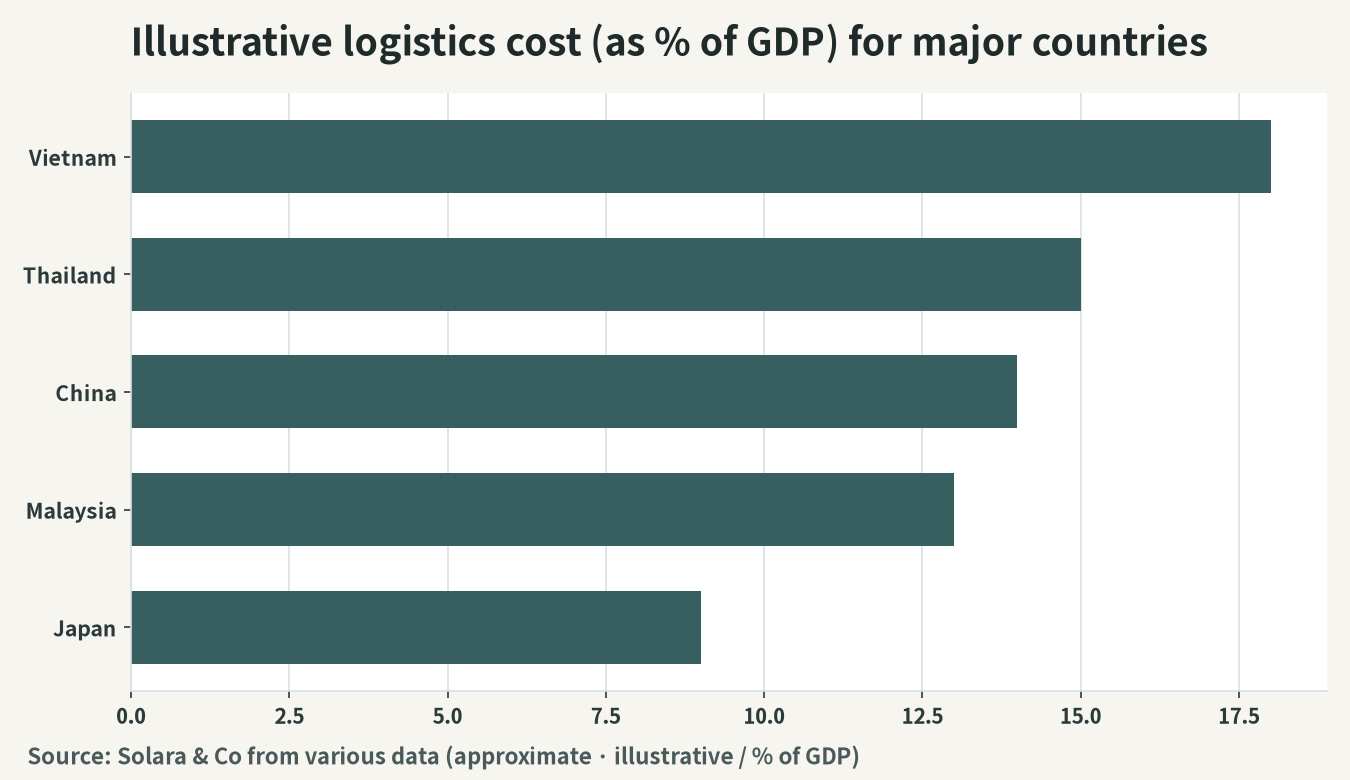
Vietnam's logistics costs, measured as a ratio to GDP, are said to run at roughly 16–20%—about twice the 8–9% of developed countries—and remain high even compared with major neighboring countries. This stems from underdeveloped infrastructure, the fragmentation of logistics networks, the prevalence of empty backhauls (vehicles returning without cargo), and inefficient customs and documentation procedures. Lowering logistics costs is an important challenge for both Vietnam's export competitiveness and the efficiency of domestic demand, and solving it is itself an investment opportunity. Removing one by one the factors that have pushed costs up—modern warehouses, efficient distribution networks, digitized procedures—becomes, in itself, the field of business for logistics operators.
The Direction of Expansion and Modernization
The Vietnamese government is advancing the expansion and modernization of its port and logistics infrastructure as a clear national plan.
Responding to Deep-Water Ports and Larger Vessels
The world's maritime transport is moving toward ever-larger container ships, so the development of deep-water ports capable of accommodating them is indispensable. If large vessels can call directly, transshipment via hub ports in neighboring countries can be avoided, reducing cost and time and raising export competitiveness. In addition to expanding the major ports in the south and the north, plans are under way for new large-scale deep-water ports that could also bear an international transshipment function, with the aim of elevating Vietnam from a mere point of origin and destination to a regional logistics hub. These large-scale projects generate a wide range of business opportunities, such as port operation, cargo-handling equipment, and surrounding development.
Connecting Infrastructure (Roads, Railways, Inland Logistics)
A port's capacity functions as one with the connecting infrastructure behind it that underpins it (roads, railways, inland container depots, and river transport). No matter how much a port is expanded, if the roads linking the port to industrial parks and places of consumption become congested, the efficiency of the entire logistics chain cannot rise. The development of expressway networks that carry cargo efficiently to the port, the establishment of inland logistics bases (dry ports), and the use of inland water transport leveraging rivers such as the Mekong—that is, the modernization of the logistics network connecting ports and the interior (multimodal transport)—are being advanced on both the hardware and software sides. It is precisely logistics design that grasps the hinterland and the port as one that holds the key to cost reduction and shorter lead times.
Improving Efficiency and Digitalizing Logistics
Alongside hardware infrastructure development, improving efficiency on the "software side"—the modernization of warehouses and distribution centers, the development of cold chains (low-temperature logistics), the digitalization of customs procedures, and the introduction of logistics information systems—is also an important theme of modernization. The expansion of e-commerce has caused demand for instant-delivery networks in urban areas (the last mile) to surge, spurring investment in automated large-scale warehouses (fulfillment centers) and distribution bases on the urban fringe. In addition, the expanding distribution of agricultural and fishery products, food, and pharmaceuticals calls for the development of cold chains that consistently maintain temperature control—a growth field tied directly to the export competitiveness of perishables and to food safety. Such modernization on the software side raises the efficiency of the entire logistics chain only when advanced in tandem, as two wheels, with the development of hardware (ports and roads).
Reading the State of Expansion Through the Numbers — Key Projects and Institutions
Vietnam's port development is framed by the national master plan for the seaport system (2021–2030, with a vision to 2050) approved in 2021. The plan groups the country's ports by function, prioritizes the allocation of investment to deep-water ports and international gateways, and sets handling-capacity targets toward 2030. How far the plan is achieved directly governs the room for trade expansion and the locational competitiveness of manufacturing. Grasping both the progress of individual mega-projects and the institutions that govern entry is the starting point for turning opportunity into concrete plans.
Key Projects in the North and the South
In the north, Lạch Huyện port off Hải Phòng—the region's first full-fledged deep-water port—is being expanded in phases, raising its capacity for large vessels to call directly through the construction of additional berths. The Hanoi–Hải Phòng Expressway runs behind it, and its strength lies in directly connecting the port to industrial parks. In the south, Cái Mép–Thị Vải port has the capacity to receive ultra-large container ships of the 18,000-TEU class on North American and European routes, while Cát Lái port within Ho Chi Minh City, though it handles the bulk of southern cargo, carries chronic congestion, so the move to disperse some of its functions toward Cái Mép continues. In addition, the large-scale international transshipment port envisioned on the outskirts of Ho Chi Minh City (the Cần Giờ concept) anticipates investment on the order of billions of dollars, aiming to capture a portion of the transshipment cargo currently held by the hub ports of Singapore and Malaysia. In air cargo as well, Long Thành International Airport, whose opening is drawing near, lifts the flow of the south's high-value-added goods, helping to strengthen a composite gateway function that binds together sea, land, and air.
The Practicalities of Foreign-Investment Restrictions and the Customs Regime
The logistics and transport field has been opened up in stages in line with the commitments made when Vietnam joined the WTO, but caps on the foreign-ownership ratio remain in some maritime auxiliary services and parts of domestic transport, and there are operations that require forming a joint venture or obtaining a local license. Because the conditions differ by business type—warehousing, customs brokerage, forwarding—you need to separate out, at the early stage of business design, what can be done on your own and what requires a local partner. On the customs side, the electronic customs system (VNACCS/VCIS) introduced with Japanese support has become widespread, enabling efficient cargo management when combined with bonded warehouses and CFS (container freight stations). Understanding how these institutions actually operate is the key to raising the predictability of lead times and costs and to improving the precision of the entry scheme.
Where the Business Opportunities Lie
The expansion and modernization of port and logistics infrastructure bring Japanese companies a diverse range of business opportunities. The opportunities and risks of the major fields are organized in the table below.
Field | Main Investment Opportunities | Risks to Keep in Mind |
|---|---|---|
Port operation · terminals | Port development · operation · cargo-handling equipment | Massive investment, licensing, the PPP regime |
Logistics real estate | Warehouses · distribution centers · cold storage | Location, supply and demand, land prices |
3PL · logistics services | Integrated international and domestic logistics, customs | Competition, talent, networks |
Cold chain | Low-temperature logistics for food and pharmaceuticals | Capital investment, operational quality |
Logistics DX · equipment | Warehouse automation · logistics IT · handling equipment | Implementation cost, support |
In particular, the fields in which Japanese companies have strengths are logistics real estate (modern warehouses and cold storage), integrated logistics services through 3PL (third-party logistics), the cold chain, and warehouse automation and logistics IT. Japanese logistics operators enjoy a high reputation for quality, punctuality, and the precision of their inventory management, and their ability to meet the sophisticated logistics needs of local manufacturing and retail is a point of differentiation. The "high cost, low efficiency" challenge that Vietnamese logistics carries means, conversely, a large demand for technologies and services that can realize efficiency gains. The two tailwinds of manufacturing concentration and the expansion of e-commerce are structurally lifting these demands, and a strategy of acquiring networks and a customer base in a single stroke through a joint venture with a local partner or the acquisition of an existing logistics company is also effective.
Risks and Points to Note When Investing or Entering
Entering the port and logistics field involves several points to note. First, port and infrastructure projects entail massive investment and long payback periods, so an understanding of the institutional design of public-private partnerships (PPP) and of the project scheme is essential. Second, regarding licensing and foreign-investment restrictions, conditions for foreign-capital entry exist in the logistics and transport fields, so designing the form of the business and leveraging a local partner becomes important. In particular, for operations such as domestic transport, warehousing, and customs clearance, the foreign-ownership ratio and licensing conditions are stipulated by industry, so you need to determine in advance what can be done on your own and what requires a local partner. Third, regarding regional differences in infrastructure development, the maturity of the logistics environment—roads, ports, warehouses—varies greatly by region, so the choice of the region of entry greatly influences the efficiency of the business. Fourth, regarding the reliability and financial soundness of the local partner or the acquisition target, the larger the project, the more decisive the scrutiny of the business at the entrance stage and the credit investigation of the partner become. These risks need to be managed through locally rooted information and the selection of trustworthy partners, and careful investigation at the entrance stage underpins the long-term stability of the business.
Seizing the Opportunities in Vietnamese Logistics — Solara's Perspective
Vietnam's port and logistics infrastructure is a growth field undergoing large-scale expansion and modernization against the backdrop of the challenges of surging trade volume and high logistics costs. In fields such as logistics real estate, 3PL, the cold chain, and logistics DX, a large business opportunity supported by structural demand is opening up for Japanese companies with strengths in efficiency-raising technologies and services.
The key is to correctly understand the geography, the project scheme, and the foreign-investment restrictions; to select a trustworthy local partner; and to design an appropriate form of entry (operation, investment, joint venture, or service provision). Precisely because it is a large-scale field that spans many years, scrutiny of the business at the entrance stage and credit investigation of the partner greatly determine success or failure.
Solara & Co has bases and a human network on both the Japanese and Vietnamese sides, providing seamless support from market research and the formulation of entry strategy, to the selection of local partners, the execution of joint ventures and M&A, and credit investigation and due diligence prior to investment or acquisition. We help connect the growth of logistics infrastructure—the lifeblood of Vietnam's economy—to solid results.