
Toward ¥10 billion a day — Vietnam's fast-growing e-commerce market
Vietnam's e-commerce market continues to expand at one of the fastest paces in Southeast Asia. Annual gross merchandise value (GMV) has reached the tens of billions of dollars, and converted to a daily figure, this works out to roughly ¥10 billion in transactions being generated every single day. A population of more than 100 million, one of the world's highest smartphone penetration rates, and a young, digitally fluent demographic make up the foundation that supports this growth. Vietnam's 2026 e-commerce market is not merely "the expansion of online shopping"; it is in the midst of a structural shift in which consumption behavior itself is moving from the store to the smartphone screen, with live streaming and social media becoming the starting point of purchases.
In this article, we confirm the size of Vietnam's e-commerce market and its growth drivers with hard numbers, decode the defining characteristics of its platform structure and live commerce, and then explain — from a practical standpoint — category-by-category entry opportunities, developments in the payment and logistics foundations, and the risks foreign companies face. Read alongside Vietnam Retail Market 2026 for the broader movements of the overall consumer market, and the full picture becomes far easier to grasp.
Three drivers lifting the market
Vietnam's e-commerce boom is not a fleeting fad but is underpinned by structural engines.
Mobile-first consumers
Vietnamese consumers operate on a "mobile-first" premise, connecting to the internet directly from their smartphones rather than via a PC. Social media, video, messaging, payments, and shopping are all consolidated into a single device, making the distance to a purchase extremely short. Among younger consumers in particular, discovering a product on social media and completing the purchase right there has become the norm.
An expanding middle class and the sophistication of consumption
As disposable income rises, consumption is shifting from a focus on necessities toward an emphasis on quality, brand, and experience. Online channels play an "equalizing" role, allowing even consumers in the provinces to access the same brands and products as those in urban areas, thereby driving the geographic spread of the market. As a result, even foreign brands without a store network can now reach consumers nationwide directly through e-commerce.
A maturing digital infrastructure
The maturation of surrounding infrastructure — the spread of e-wallets, the build-out of last-mile delivery networks, and improved reliability of digital payments — is reducing friction in e-commerce transactions. Even the "reliance on cash on delivery (COD)," once a barrier to e-commerce adoption, is gradually being resolved as cashless payments take hold. The accumulation of payment data also becomes a foundation for new financial services such as credit scoring and buy-now-pay-later (BNPL), further broadening the base of consumption.
The size and growth of the e-commerce market in numbers
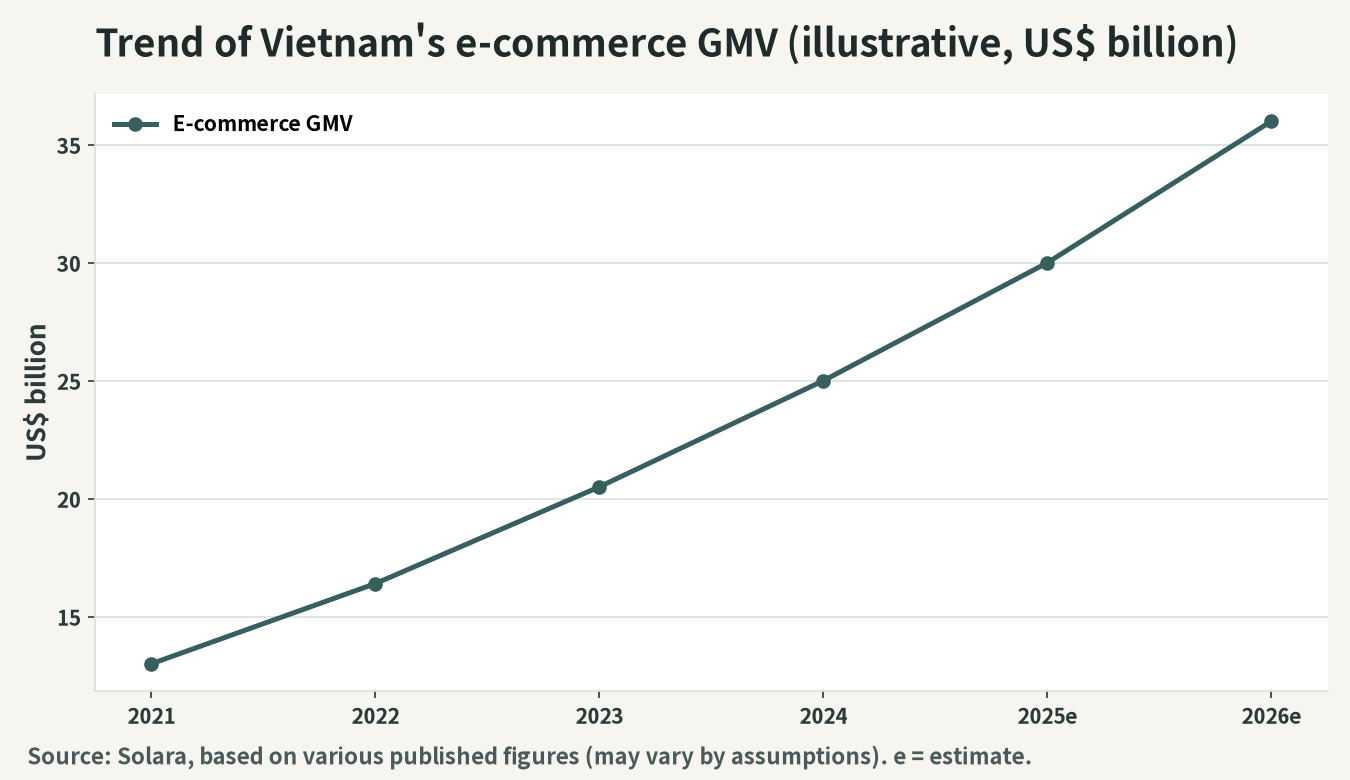
Let us confirm the contours of the market through two indicators. First, the trajectory of e-commerce GMV. The pace at which the overall market pie is expanding is the starting point for gauging the appeal of entry.
Second, the composition of purchasing channels. Beyond general e-commerce malls, the fact that live commerce and social commerce are rapidly gaining share is the single greatest distinguishing feature of the Vietnamese market.
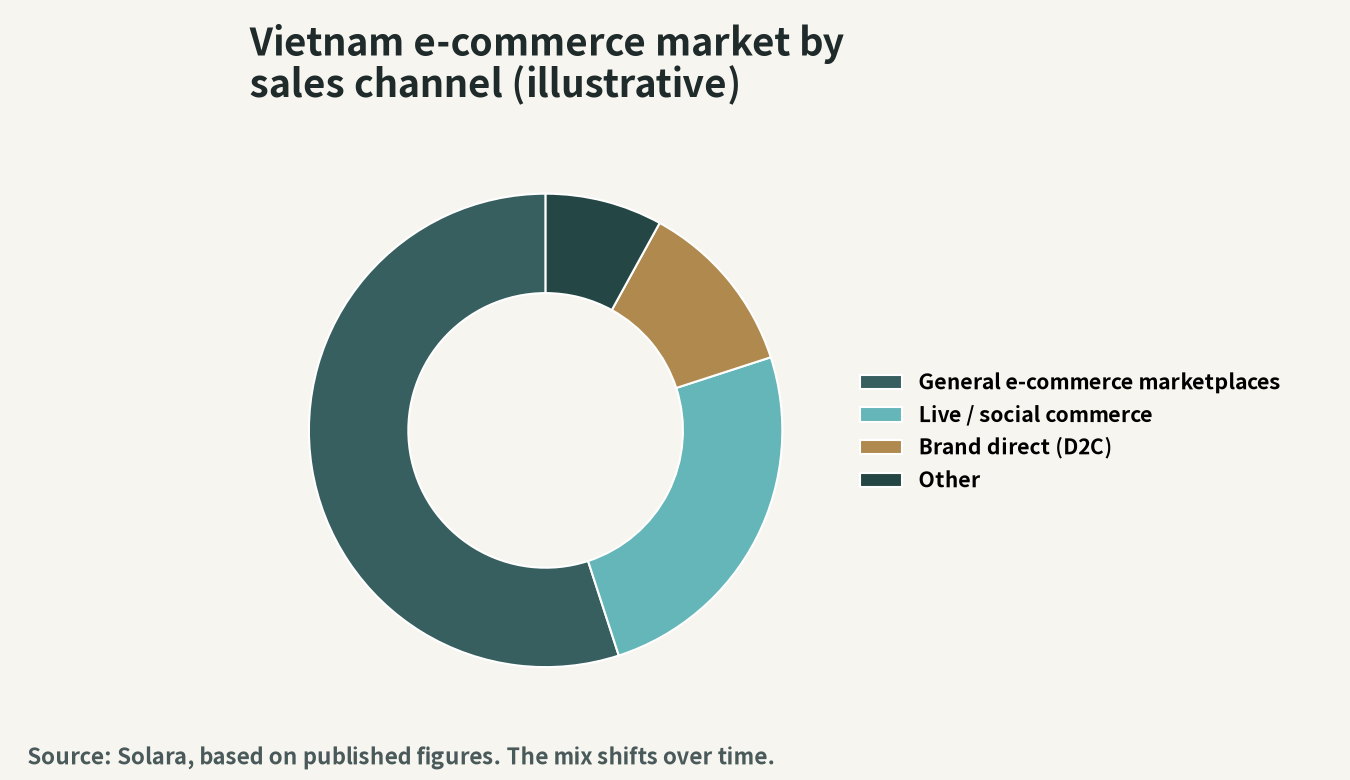
These figures fluctuate depending on the assumptions, but the direction is consistent. The overall market continues its double-digit growth while its internal composition shifts toward live commerce and social commerce — these two movements advancing simultaneously is precisely what defines Vietnam's e-commerce market in 2026.
Platform structure and live commerce
The main battleground of Vietnamese e-commerce has a two-tier structure: general malls where several major platforms compete fiercely, and social commerce originating from social media and video.
Competition among the general malls
General e-commerce malls wage fierce competition along the axes of product range, price, and delivery speed. Each player locks in customers through promotions, shipping subsidies, and payment integration. For sellers, the customer-drawing power is substantial, but it is also a harsh environment marked by price competition and the visibility of ratings through reviews.
The rise of live commerce and social commerce
What characterizes Vietnamese e-commerce is the flourishing of "live commerce" — demonstration selling of products through live streaming. Influencers and store staff introduce products in real time, and viewers purchase on the spot. Entertainment value and immediacy combine, shifting the entry point of purchasing from "search" to "video viewing." Together with social commerce that is completed entirely on social media, the power to convey a brand's worldview and trustworthiness now directly governs sales.
Live commerce is, for foreign brands, both an opportunity and a domain of high operational difficulty. Capturing viewers' hearts requires close cooperation with streamers (KOLs/KOCs) who are intimately familiar with the local language, culture, and trends, and it demands an operational structure that reconciles product knowledge with entertainment value. It is not easy for a Japanese company to bring this fully in-house on its own, so collaborating with local marketing firms or streaming partners — or a capital alliance with a strong local operator — becomes a realistic option.
Entry opportunities seen by category
The benefits of e-commerce expansion manifest differently across categories. We organize them here against the strengths of Japanese companies.
Category | Growth driver | Promising channel | Strength of Japanese companies |
|---|---|---|---|
Cosmetics & beauty | Beauty consciousness, young consumers | Live commerce, social media | Brand trust, quality |
Food & health foods | Safety orientation, health consciousness | General malls, e-commerce exclusives | Safety & evidence |
Fashion & sundries | Experiential consumption, trends | Social commerce | Design & quality |
Home appliances & gadgets | Replacement demand, urbanization | General malls | Quality & after-sales |
Baby & kids | Child-rearing generation, safety orientation | General malls, e-commerce exclusives | Safety & trust |
What is common across all of these categories is that the Japanese brand strengths of "quality, safety, and trust" appeal readily to consumers who are increasingly quality-conscious. However, since price and reviews are made visible online and reputations spread instantly, what divides success from failure — beyond product strength — is the quality of customer support and a marketing design originating from social media. Rather than transplanting home-market specifications as is, localization tailored to local tastes, climate, and purchasing behavior is essential. The trust in "Made in Japan" and "Japanese quality" in particular runs deep among Vietnamese consumers, and whether that brand value can be communicated correctly is the key to breaking out of price competition.
Balancing cross-border e-commerce and localization
There are broadly two ways for foreign brands to enter Vietnam. One is cross-border e-commerce, selling directly from overseas. Because it allows a brand to test the market's reaction without holding a local entity or inventory, it suits test marketing in the early stage of entry. The other is the localization (local) model, establishing inventory, logistics, and customer support on the ground. This offers an advantage in delivery speed and the quality of customer service, but it requires commensurate investment and organization.
In practical terms, a phased approach is effective: first ascertain demand and price acceptance through cross-border e-commerce, then step into localization starting with the categories that show promise. In the localization phase, options such as partnering with a sales distributor, a joint venture, or the M&A of a strong local e-commerce operator come into view. By taking in an existing sales network, customer base, and logistics functions with a "buying time" mindset, the speed of launch can be greatly increased.
Payments and logistics as the foundation
What supports the growth of the e-commerce market from below is the evolution of payments and logistics. Cashless payment, led by e-wallets, enhances convenience and reliability and lowers the barrier to purchasing. On the logistics side, meanwhile, the build-out of last-mile delivery networks that deliver swiftly and reliably from cities to the provinces governs customer satisfaction and repeat purchases. In categories where maintaining quality is critical, such as food and cosmetics, logistics quality — including temperature control — directly translates into competitiveness. The reliability of payments and logistics is a factor that governs a brand's very reputation, and an important consideration in selecting platforms and partners.
Risks and points of caution for foreign companies
Precisely because the market is attractive, the risks must be viewed coolly. First is the intensity of price competition. On platforms, prices are made visible and it is easy to get drawn into promotion wars, making it a challenge to secure profit margins. Second is the presence of counterfeit and parallel-imported goods. Establishing legitimate distribution and protecting intellectual property to prevent brand damage is important. Third is the risk of platform dependence. Relying too heavily on a particular mall leaves the business shaken by changes in fees or rules. Fourth is the reliability of local partners (distribution agents, logistics, marketing).
These must be managed through locally rooted information, the selection of trustworthy partners, and — where necessary — taking in local capabilities through M&A or joint ventures. When choosing a distribution agent or joint-venture partner in particular, credit investigation that confirms finances, the actual state of transactions, and compliance in advance is the most reliable means of preventing later trouble.
How Japanese companies can seize the opportunity — Solara's perspective
Vietnam's 2026 e-commerce market is at an extremely attractive juncture for timing entry: the overall market continues its double-digit growth while the center of gravity of purchasing shifts toward live commerce and social commerce. The middle class's quality orientation pairs well with the strengths of Japanese brands, and opportunities are spreading across a wide range of categories — cosmetics, food, fashion, home appliances, baby products, and more. The keys are choosing the right channels, designing marketing and customer service tailored to the local market, and solidifying the payment and logistics foundation.
Solara & Co holds bases and human networks in both Japan and Vietnam, providing seamless support from market research and entry-strategy planning to the search for distribution agents and joint-venture partners, pre-acquisition credit investigation and due diligence, and the build-out of local operations. Capturing the tailwind of expanding digital consumption while carefully discerning the risks at hand — we believe that reconciling the two is the shortest path to achieving results in Vietnam's e-commerce market.