
The "Double-Digit Growth" Ambition Vietnam Has Set
For the medium- to long-term beyond 2026, the Vietnamese government has set an extraordinarily ambitious figure: annual economic growth in the double digits (around 10%). This target is bound up with a national vision in which a country that has sustained high growth of 6–7% a year for more than three decades shifts up yet another gear to join the ranks of "high-income nations" by 2045. Since the Đổi Mới (Renovation) policy of 1986, Vietnam has transformed itself from an agrarian country into an export base for manufacturing, growing into one of the leading emerging markets with a population of over 100 million. The next stage is a shift from the "quantity" of assembly processing to the high-value-added "quality" of semiconductors and the digital economy.
Double-digit growth is no easy target. The slowdown of the global economy, the rise of protectionism, the erosion of the low-cost advantage by rising wages, and the structural wall of the "middle-income trap" all stand in the way. Even so, the reason this target is more than a mere slogan is that Vietnam is clearly seeking to switch the engine of growth from traditional labor-intensive manufacturing to semiconductors, electronics, and the digital economy. This article verifies with numbers just how realistic the challenge of double-digit growth is, and organizes from a practical standpoint the drivers and constraints that underpin it, along with the business opportunities Japanese companies should seize.
The Growth Trajectory Seen in Numbers
First, let us take a bird's-eye view of where Vietnam's growth stands. Excluding the years of external shocks such as the Asian financial crisis and the COVID-19 pandemic, Vietnam's GDP growth rate has consistently held within a 6–8% range. This is an outstandingly high level even within the region, the result of a demographic dividend and robust inflows of foreign capital pushing it up.
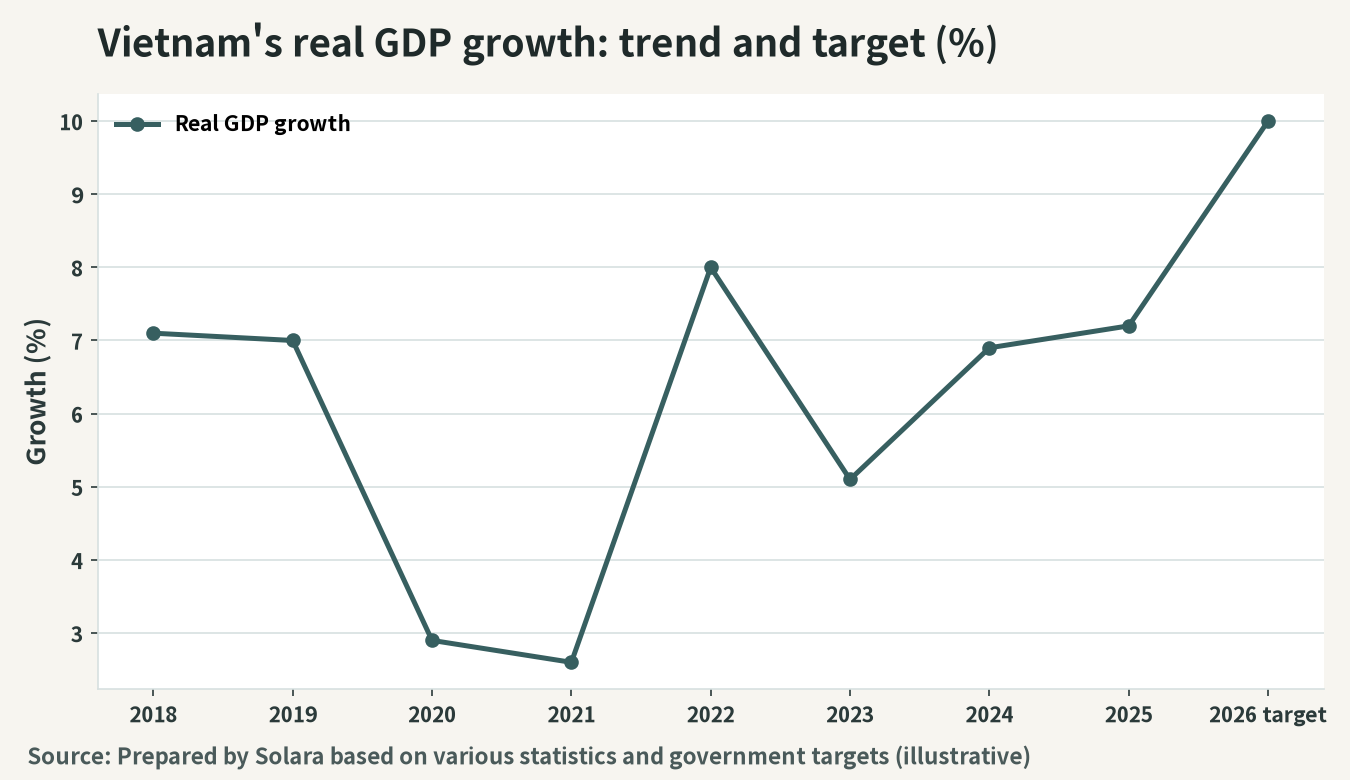
To realize double-digit growth, a further 2–4 points must be added on top of this existing trend. The sources the government is counting on for that are the upgrading of manufacturing, the expansion of the digital economy, the acceleration of infrastructure investment, and the revitalization of the private sector. In particular, whether the industrial structure can be lifted from low-value-added "assembly processing" to the "upstream and midstream"—encompassing design, components, and materials—will determine the ceiling on the growth rate.
The Sources of the Uplift Seen Through Growth Accounting
Economic growth can be decomposed into three elements: labor input, capital input, and productivity (total factor productivity). Until now, Vietnam has been underpinned by an expansion of "quantity"—an abundant labor force and vigorous investment. However, the growth of the working-age population will eventually slow, and investment efficiency diminishes over time. The key to double-digit growth therefore lies in lifting "productivity" through technology, education, and institutional reform. The shift toward semiconductors and the digital economy can be positioned precisely as a national strategy aimed at this productivity transformation.
The Semiconductor Industry Holds the Growth Ceiling
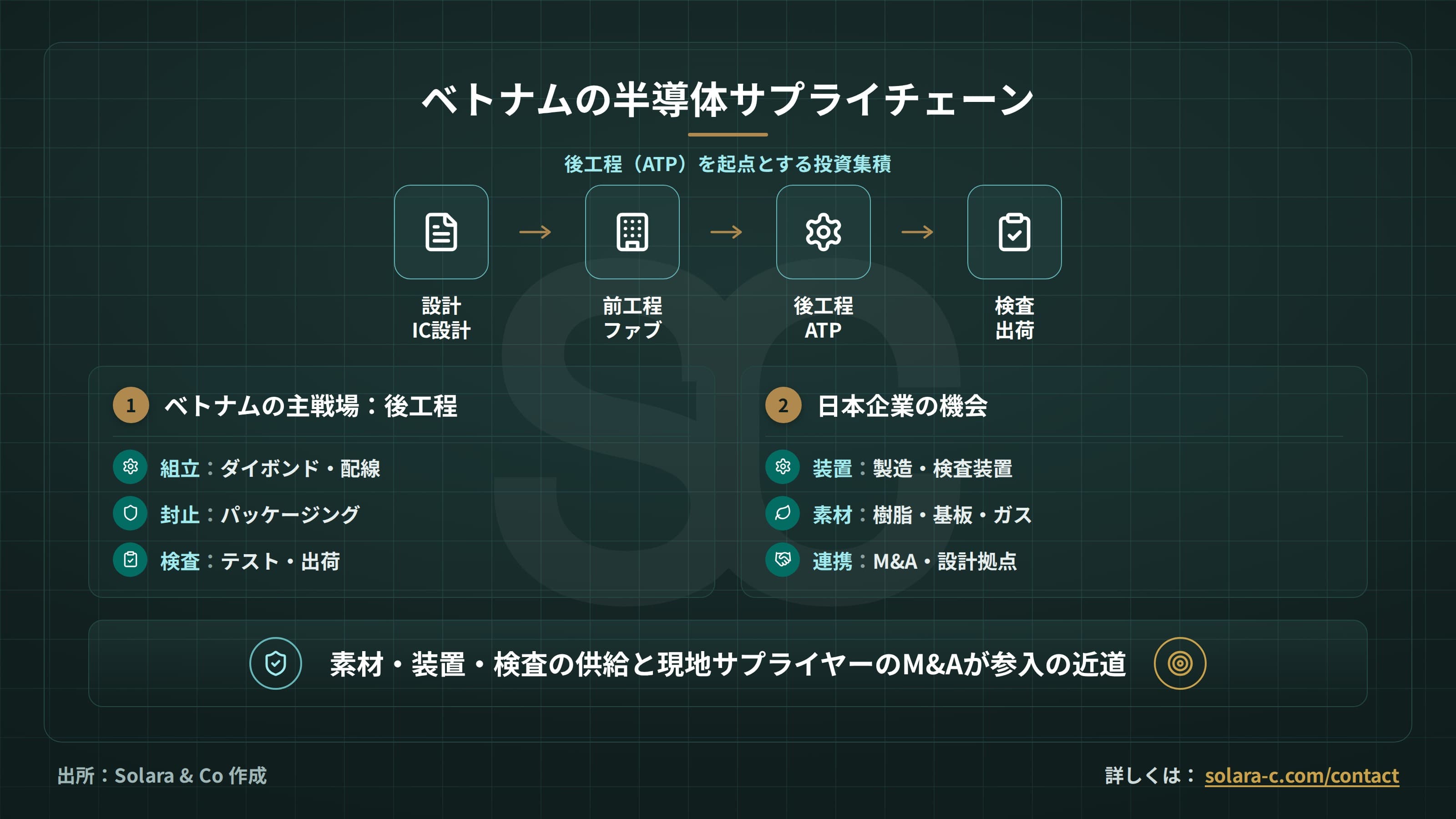
What Vietnam places at the core of double-digit growth is the semiconductor industry. Amid the supply-chain realignment (China+1) against the backdrop of the U.S.–China confrontation, Vietnam is rapidly raising its profile as a leading base for back-end processes (assembly, testing, and packaging). The world's major semiconductor and electronics companies have announced investments one after another, and the clustering of related facilities is advancing in industrial parks in the north and south.
The Vietnamese government has rolled out a national program to train semiconductor talent on a large scale, accelerating the cultivation of engineers at universities and vocational training schools. Entry into design (front-end) is still at an early stage, but Vietnam is charting a "catch-up" development path of starting from back-end processes and working its way upstream. Because semiconductors have high added value and a broad supporting base of related materials, equipment, and logistics, they hold the potential to lift a nation's productivity in one stroke. Whether Vietnam can establish a presence here will heavily influence the feasibility of double-digit growth.
Working Upstream from Back-End Processes to Design and Materials
The semiconductor value chain is broadly divided into design → front-end processes (wafer fabrication) → back-end processes (assembly, testing). Vietnam's immediate strength is in back-end processes, but if talent, equipment, and peripheral materials cluster here, the business domain will eventually expand into design services and materials supply. For Japanese companies, the opportunities to supply the "behind-the-scenes" elements—equipment, materials, testing, and clean-room facilities—are substantial, and the room to enter through joint ventures and technical tie-ups with local partners is widening.
The Digital Economy as a Second Engine
Another engine alongside semiconductors is the digital economy. Vietnam has a population structure that is young, with a high smartphone penetration rate and an extremely strong affinity for digital services. E-commerce, fintech (electronic payments), live commerce, and online services are growing explosively, and the digital economy is steadily raising its share of GDP. The government has set a target that "the digital economy will account for a substantial share of GDP," and is promoting the digitalization of administration (e-government) and the development of data infrastructure as a national strategy.
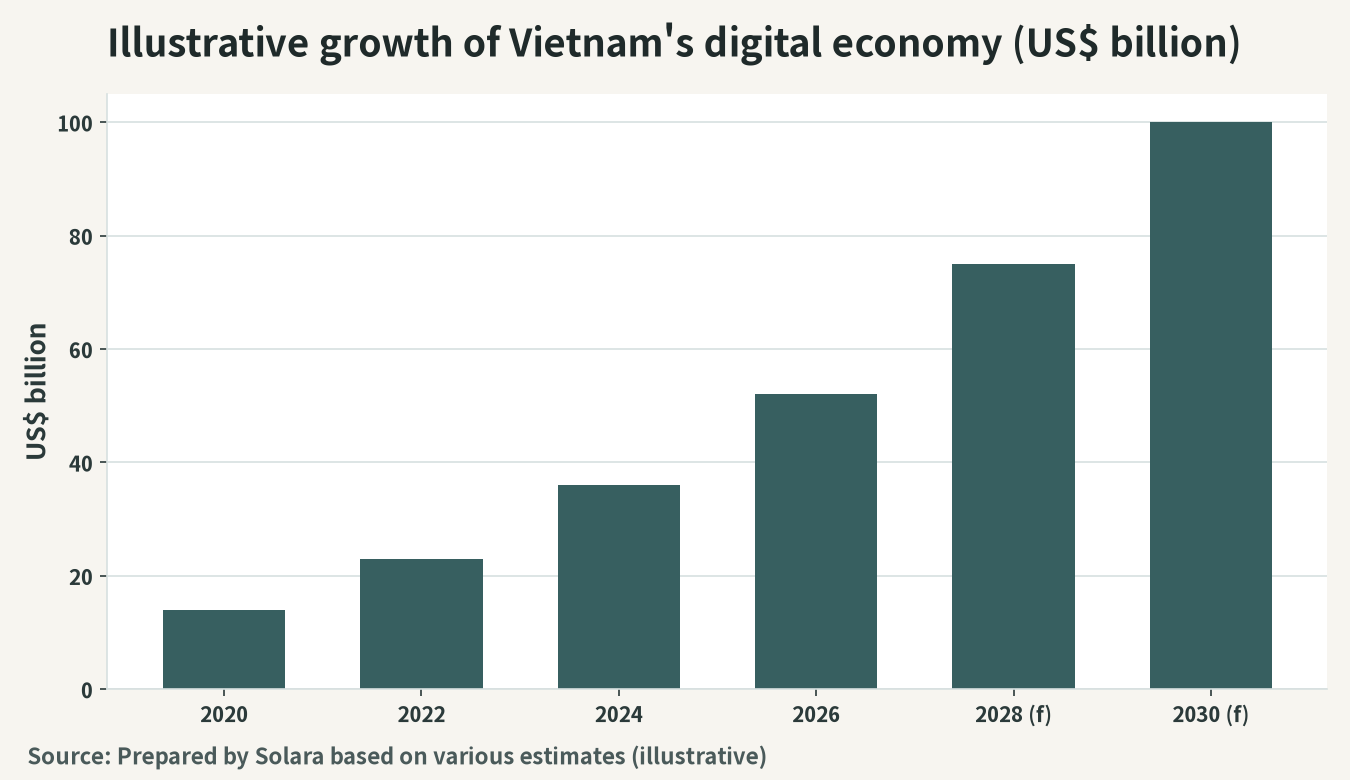
The appeal of the digital economy lies in its ability to push up productivity and market size at the same time, without depending on a network of physical stores or infrastructure. Whereas manufacturing requires the clustering of hardware, the digital economy creates value through software and services, linking young talent and entrepreneurial spirit directly to growth. The maturing of the startup ecosystem, the inflow of venture investment, and the depth of digital talent all underpin this second engine.
The Spread of Cashless Payments and Fintech
Symbolic of the digital economy's permeation is the rapid spread of electronic wallets and QR-code payments. In Vietnam, where many people did not hold bank accounts, smartphone-based fintech has advanced financial inclusion in one leap, bringing services such as payments, remittances, microloans, and insurance into everyday life. The accumulation of payment data sharpens the accuracy of credit assessment and marketing, and, in concert with e-commerce, logistics, and retail, lowers transaction costs across the whole economy. The development of such digital infrastructure itself raises productivity and becomes an element that underpins double-digit growth from below.
The Structural Drivers and Constraints Underpinning Double-Digit Growth
The feasibility of double-digit growth is determined by the balance of tailwinds and headwinds. Let us organize the main factors.
Factor | Content | Effect on growth |
|---|---|---|
Demographic dividend | Over 100 million people; young working-age population | Tailwind (labor force and domestic demand) |
China+1 and semiconductors | Supply-chain realignment, back-end clustering | Tailwind (investment and upgrading) |
Digital economy | E-commerce, fintech, e-government | Tailwind (productivity) |
Infrastructure investment | Expressways, ports, power, high-speed rail | Tailwind (clearing bottlenecks) |
Power and talent supply | Risk of power shortages, shortage of high-level talent | Headwind (growth constraint) |
Middle-income trap | Delayed value-added transition, institutional reform | Headwind (structural wall) |
While the tailwinds are structural, the headwinds are structural too. In particular, whether power supply can keep pace with rapid industrialization, whether enough high-level talent to carry semiconductors and the digital economy can be cultivated, and whether the transparency of administrative procedures and the legal system can be raised will separate growth that overshoots from growth that undershoots. There is no need to take the double-digit figure at face value, but the government's direction of concentrating investment in institutions, infrastructure, and talent toward this goal also benefits foreign capital in the form of an improved investment environment.
Infrastructure Investment as the Foundation
To raise the growth ceiling, clearing infrastructure bottlenecks in logistics, power, and telecommunications is indispensable. The expressway network running north–south, the expansion of major ports, and the long-term vision of the north–south high-speed railway—these large-scale infrastructure investments form the foundation for growth. As infrastructure is put in place, the dispersal of industry to the provinces advances, and upward pressure on land and labor costs eases. For Japanese companies, infrastructure-related projects through ODA and public-private partnerships (PPP) are a promising field.
The Business Opportunities and Points Japanese Companies Should Note
Vietnam's challenge of double-digit growth generates multiple business opportunities for Japanese companies. First, the opportunities to supply the equipment, materials, testing, and logistics linked to the semiconductor and electronics value chain. Second, the field of fintech, e-commerce, and IT services against the backdrop of the digital economy's expansion. Third, the industrial machinery, automation, energy-saving, and environmental technologies that support productivity improvement—the more Vietnam transitions from "quantity to quality," the more demand for these high-value-added solutions rises.
In addition, in a phase that anticipates double-digit growth, the appeal of domestic-demand businesses targeting the Vietnamese market itself also increases. Rising incomes will gradually awaken demand in fields such as home appliances, automobiles, insurance, education, healthcare, and leisure, raising Vietnam's value not only as a production base but also as a "market to sell into." The appeal as an export base and the appeal as a vast domestic-demand market—being able to capture both sides of this duality at once is a major characteristic of investing in Vietnam.
On the other hand, the higher the growth expectations, the more composure entry decisions demand. The constraints of power, talent, and infrastructure, the reliability of local partners, and the uncertainty of permits and the legal system remain significant risk factors in individual investment decisions. In a fast-growing market, M&A and joint ventures that "buy time" are effective, but the precondition for that is credit investigation and due diligence to see through the target company's finances, permits, and off-balance-sheet liabilities. A perspective that watches both the great macro tide and the immediate micro risks at the same time is indispensable.
Conclusion — The Opportunity Lies in the Shift from "Quantity" to "Quality"
The double-digit growth Vietnam has set is an ambitious target with a high bar to achieve. But what matters is not the figure itself, so much as the direction in which the nation is shifting the fulcrum of growth toward high-value-added industries such as semiconductors and the digital economy, and concentrating investment in infrastructure and talent to realize it. From the expansion of "quantity" to the upgrading of "quality"—it is this very process of transition that is the source of business opportunity for Japanese companies.
Solara & Co, with bases and human networks on both the Japanese and Vietnamese sides, provides seamless support—from market research and entry-strategy formulation tied to the upgrading of semiconductors, the digital economy, and manufacturing, to securing partners through M&A and joint ventures, and credit investigation and due diligence before acquisition. Capturing the great tide of growth while carefully seeing through the immediate risks—we believe that balancing the two is the shortest path to achieving results in Vietnam's "golden phase."