
Why 2026–2035 Is Vietnam's "Golden Decade"
Over the ten years from 2026 to 2035, Vietnam's economy is expected to reach a turning point remarkable even within the postwar growth story of Asia. The government has set a long-term goal of joining the ranks of high-income countries by 2045, and it positions this decade—the halfway point of that journey—as the "take-off period" in which growth shifts from quantity to quality. For Japanese companies, too, the moves made during this period will determine the success or failure of their Vietnam operations on a decade-long scale.
The grounds for calling it a "golden decade" lie not in a high growth rate in any single year, but in the fact that several conditions—demographics, income levels, industrial structure, and external relations—happen to converge as tailwinds in the same period. A young and abundant labor force approaches the peak of its working age, per-capita income crosses the threshold that drives consumption, manufacturing becomes the recipient of supply-chain realignment, and free trade agreements (FTAs) widen market access—and it is precisely this decade in which all of these advance at once.
This article organizes the structural drivers that underpin the golden decade, confirms the growth trajectory with figures, then divides the ten years into three phases to lay out the outlook, while explaining—from a practical standpoint—the business opportunities Japanese companies should seize and the risks they must keep in mind.
The Structural Drivers Underpinning the Golden Decade
What underpins growth on a ten-year horizon is not the short-term business cycle but structural factors that do not easily change. In Vietnam's case, the core lies in "people" and "productivity."
The Demographic Dividend and the Explosive Expansion of the Middle Class
Vietnam's population has surpassed 100 million, its median age is young at around the early thirties, and the working-age population still has depth. Because this "demographic dividend" will gradually taper off toward the latter half of the 2030s, the coming decade—while it can still be enjoyed—is the decisive moment. At the same time, as incomes rise, the middle and upper-middle classes with disposable income will expand rapidly, centered on urban areas. Once per-capita income crosses a certain level, spending shifts from daily necessities toward higher-value-added fields such as automobiles, housing, education, healthcare, leisure, and finance. This structural change in consumption is the single greatest tailwind for domestic-demand-oriented businesses.
The Productivity Shift to Escape the Middle-Income Trap
The key to sustaining growth lies in shifting from low-wage assembly processing to higher-value-added industries—that is, in how the country escapes the "middle-income trap." The government has designated the digital economy, semiconductors, high-tech manufacturing, and green industries as its next growth engines, and is strengthening education, vocational training, and research and development. Whether the country can shift its center of gravity from growth that relies on labor inputs to productivity-led growth is the single biggest theme of this decade. The know-how that Japanese companies hold in technology, quality, and human-resource development can be precisely the complement to that very transition.
The Macro Tailwinds Lifting the Investment Environment
In addition to the structural factors, the external environment surrounding Vietnam and its macroeconomic policy are also making investment easier.
The FTA Network and China+1
Vietnam has built one of the world's leading FTA networks, including the CPTPP, EVFTA, and RCEP, establishing itself as an "export platform" with preferential tariff access to major markets. Furthermore, against a backdrop of rising geopolitical risk, manufacturing industries such as electronics, textiles, and furniture continue to flow in, with Vietnam serving as a recipient of "China+1"—the dispersal of production bases away from concentration in China alone. The twin engines of exports and foreign capital support growth from below.
Infrastructure Investment and Urbanization
Large-scale investment in the North–South high-speed railway, the expressway network, ports, airports, and the power and transmission grid will be intensively rolled out during this decade. Lower logistics costs and the development of regional cities will widen the location choices for manufacturing and expand the domestic market into the provinces. A rising urbanization rate is a factor that structurally lifts demand for housing, retail, and services. Because the state of infrastructure development differs by region, the selection of where to enter remains an important point of discussion. In addition to the two major metropolitan areas of Hanoi and Ho Chi Minh City, conditions for labor costs, talent, logistics, and power supply differ greatly by region—across Da Nang, the industrial zones of central and southern Vietnam, and the Mekong Delta. In the golden decade, another point not to be overlooked is that investment opportunities will broaden from concentration in the capital region toward dispersal into the provinces.
The Growth Trajectory in Figures
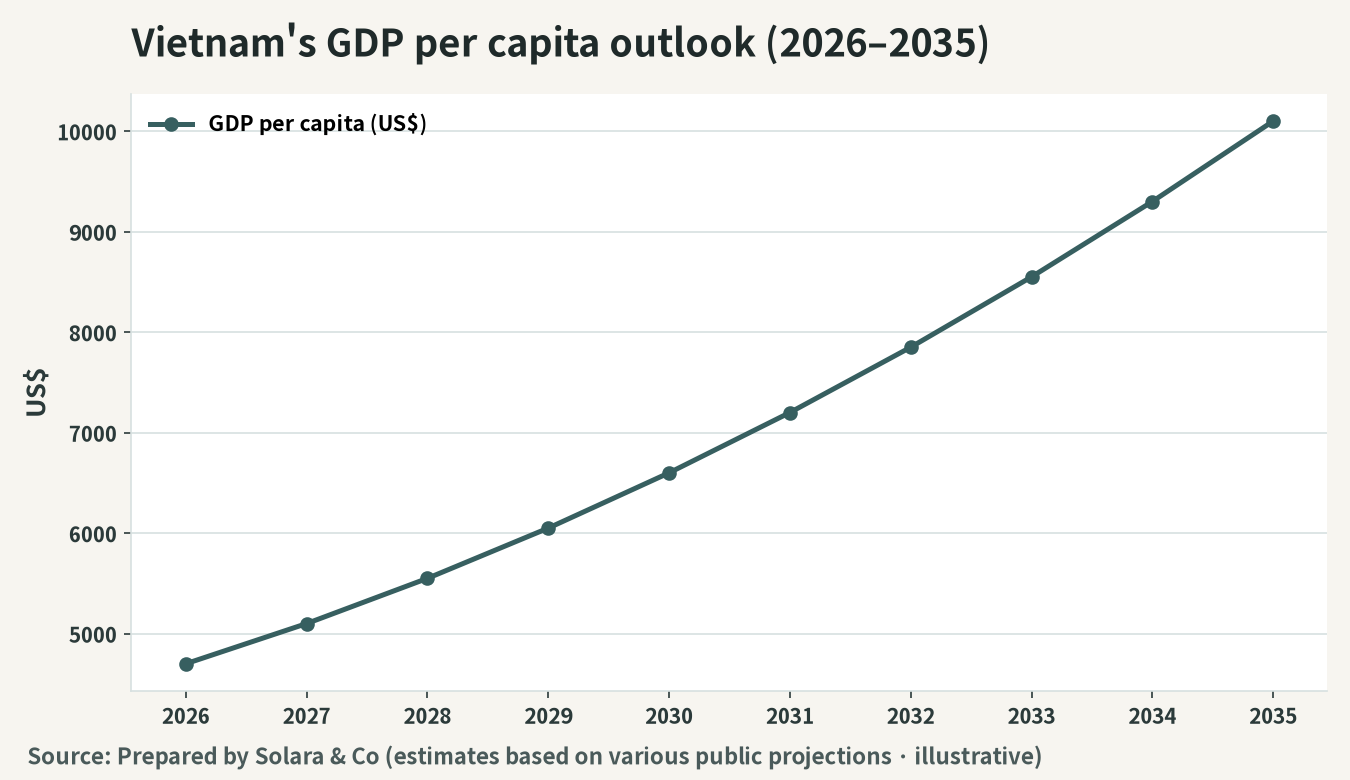
We confirm the contours of the golden decade with two indicators. First is the rise in per-capita GDP. Income growth is the most important signal for reading the timing of a qualitative shift in the consumer market.
Second is the expansion of the middle and upper-middle classes that drive consumption. The upward shift of income brackets directly determines the market size of domestic-demand-oriented businesses.
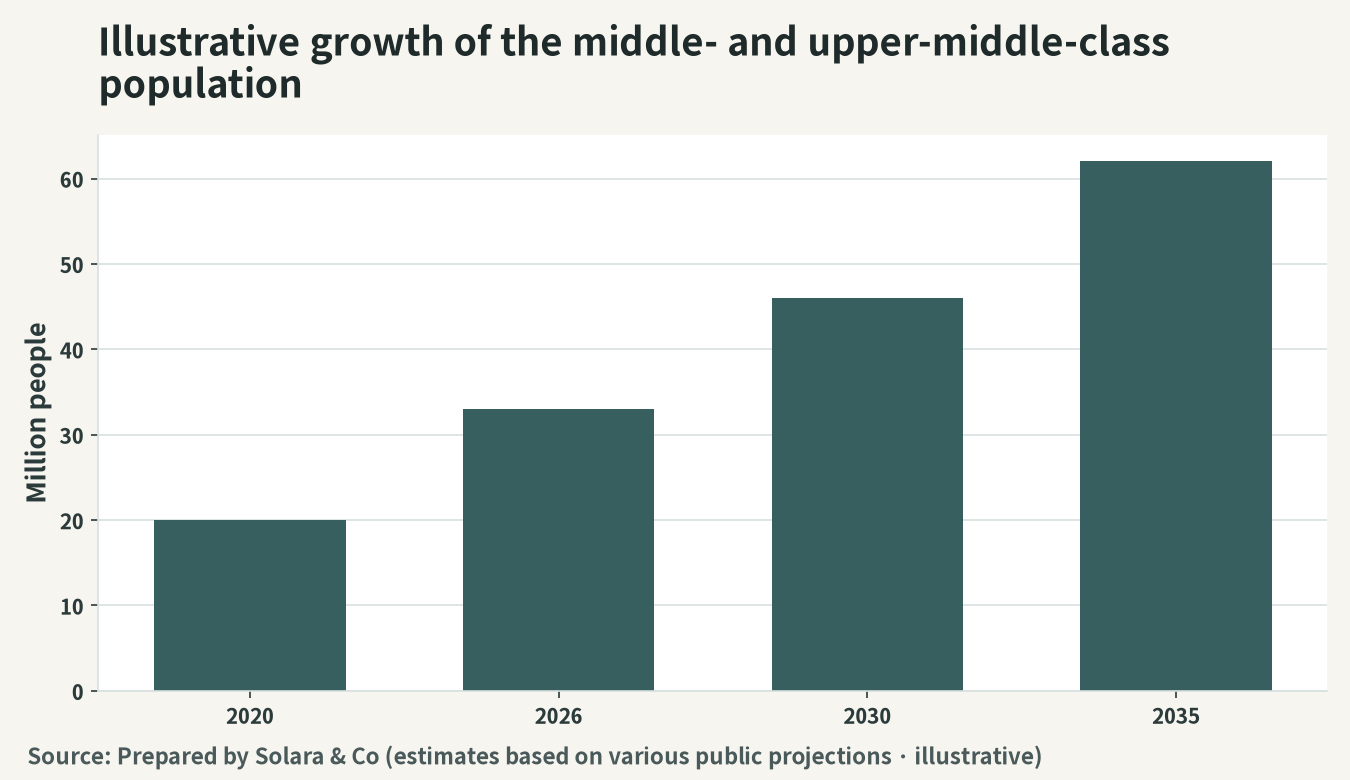
These figures will swing depending on the assumptions, but the direction is clear. Incomes rise, the substance of consumption grows more sophisticated, and the market spreads into the provinces—this decade is the period in which that change advances at its steepest.
Reading 2026–2035 in Three Phases
Rather than treating the ten years as a single block, dividing them into three phases of differing character makes the moves to be played visible.
Phase | Macro environment | Leading fields | Japanese companies' moves |
|---|---|---|---|
2026–2028 Recovery & foundation | Global economy recovers, infrastructure breaks ground | Manufacturing (China+1), exports, real estate & construction | Market entry, establishing bases, M&A to build a foothold |
2029–2032 Sophistication & domestic demand | Middle class expands, urbanization accelerates | Consumer goods, retail, finance, healthcare | Brand investment, capturing domestic demand, expanding joint ventures |
2033–2035 Maturity & high value-added | Shift to productivity-led growth | Semiconductors, green, digital, advanced services | Technology partnerships, R&D, expansion into high-value-added domains |
2026–2028: Recovery and Building the Foundation
Against a backdrop of global economic recovery and infrastructure investment moving into full swing, the inflow of manufacturing and exports will drive growth. For Japanese companies, this is the period to solidify a foothold in the market through market entry, establishing bases, and M&A. The earlier a company enters, the greater the benefit it can reap from the subsequent expansion of domestic demand.
2029–2032: Sophistication and Expanding Domestic Demand
With the expansion of the middle class and the acceleration of urbanization, the engine of growth shifts from exports to domestic demand. Domestic-demand-oriented fields such as consumer goods, retail, finance, and healthcare take the lead, and brand investment and the expansion of joint ventures become effective.
2033–2035: Maturity and Moving Up the Value Chain
The shift to productivity-led growth advances, and semiconductors, green industries, digital, and advanced services drive growth. Japanese companies enter a stage of engaging with the market more deeply through technology partnerships, research and development, and expansion into high-value-added domains.
Where the Opportunities Lie — Promising Sectors
The opportunities Japanese companies should seize in the golden decade can be organized into three broad directions. The first is manufacturing, components, and logistics, grounded in China+1 and supply-chain realignment. The second is domestic-demand-oriented services—consumer goods, retail, food service, finance, healthcare, and education—lifted by the expansion of the middle class. The third is semiconductors, electronic components, green energy, and the digital domain, which the government positions as its next growth engines. All are fields where Japanese companies can bring to bear their strengths in technology, quality, brand, and human-resource development, and beyond going it alone, the option of "buying time" through M&A or joint ventures with local companies is effective.
Domestic-demand-oriented services in particular: the timing of entry divides success from failure. In a market where incomes have entered an upward phase, the company that establishes its brand and sales network early captures a disproportionately large share of the fruits of the subsequent market expansion. The quality, safety, and meticulous service that Japanese companies excel at appeal strongly to the upper-middle class as it grows more quality-conscious. On the other hand, in the manufacturing and high-tech domains, long-term engagement—including the nurturing of local suppliers and human-resource development—is the key to achieving both a cost advantage and a technological advantage at once. The scale of an opportunity is determined not only by which field it is, but by when and in what form one enters.
The Risks and Points to Keep in Mind Hidden in the Golden Decade
Precisely because the growth outlook is bright, the risks must be viewed with a cool head. First is wage growth and the intensifying competition for talent. As growth continues, labor costs will rise, and securing and retaining excellent talent becomes harder. Second are the practical frictions of market entry, such as regional disparities in infrastructure and power supply, and the opacity of administrative procedures and licensing. Third are frequent revisions to the legal system, unevenness in its application, and currency and macroeconomic volatility. Fourth is change in the competitive environment. Because many foreign players flow in during the golden decade chasing the same opportunity, a company that cannot secure a first-mover advantage will be drawn into price competition even in a growing market. Fifth is the difficulty of withdrawal and exit. Entry may be easy, but dissolving a joint venture or selling a business takes time and negotiating power. Drawing up the exit strategy as early as the design stage of entry is the essential point for containing risk.
These do not negate the larger current called the "golden decade," but in each individual investment decision, a precise risk assessment grounded in local realities is indispensable. Not being swept along by optimism, but shoring up your footing through credit investigation and due diligence, is the premise for reliably reaping the long-term fruits. The macro tailwind blows for everyone, but whether you can turn it into your own company's results depends on each company's preparation and execution.
How Japanese Companies Should Move — Solara's Perspective
Vietnam in 2026–2035 is a rare "golden decade" in which multiple tailwinds—demographics, income, industry, and external relations—converge. What matters is not to view this decade uniformly, but to understand the differences in character among the recovery-and-foundation phase, the sophistication-and-domestic-demand phase, and the maturity-and-high-value-added phase, and to execute, in sequence, the moves suited to each phase. Build a foothold early, ride the expansion of domestic demand, and then deepen into high-value-added domains—this design of the time axis determines the scale of the results.
Solara & Co has bases and human networks on both the Japanese and Vietnamese sides, providing consistent support throughout the golden decade—from formulating a market-entry strategy, to market entry and establishing bases, to M&A and joint ventures, and on to the sophistication of the business. Capturing the larger current while carefully discerning the risks underfoot—we believe that achieving both is precisely the key to leading investment in Vietnam to success.