
2026: Vietnam's Real Estate Market Shifts from Correction to Recovery
After a corrective phase driven by tighter credit and funding strains since 2022, Vietnam's real estate market is expected to enter a phase of genuine recovery in 2026. Against a backdrop of a maturing legal framework, steadier interest rates, and a resilient real economy, transactions and development that had stalled are beginning to move again. A population of more than 100 million, rapid urbanization, and the inflow of manufacturing under the China+1 strategy — this structural demand positions Vietnamese real estate as one of the leading growth markets in Southeast Asia.
That said, "real estate" cannot be treated as a single category. Offices, industrial land, housing, commercial facilities, and logistics facilities have entirely different supply-demand structures and recovery speeds. This article reads Vietnam's 2026 real estate market through three major segments — offices, industrial land, and housing — explaining the trends, investment opportunities, and the land-tenure system and risks that foreign investors must heed for each, from a practitioner's perspective. Correctly reading the temperature gap between segments is the starting point of real estate investment.
The Structural Drivers Moving the Real Estate Market
Before turning to segment-level trends, let us organize the structural drivers lifting the market as a whole.
Urbanization and the Expanding Middle Class
In Vietnam, migration from rural areas to cities continues, and the urbanization rate is rising steadily. A growing urban population underpins demand for housing, offices, and commercial facilities. At the same time, the expansion of the middle class and upper-middle class is generating demand for higher-quality housing and more modern commercial spaces. Rising incomes strengthen the orientation toward homeownership, forming a long-term demand base for the housing market.
Manufacturing Inflows and Industrial Real Estate
The inflow of manufacturing under the China+1 strategy is directly boosting demand for industrial land, factories, and logistics facilities. As global manufacturing diversifies its supply chains, Vietnam has become a strong destination, and industrial parks in both the north and the south continue to see robust demand for land. The concentration of manufacturing also generates surrounding demand for housing, commercial, and logistics space in a chain reaction.
A Maturing Legal Framework and Greater Transparency
In recent years, Vietnam has advanced amendments to the principal laws governing land, housing, and real estate business, developing the system in a direction that enhances market transparency and predictability. This has clarified the rules around developers' fundraising and the acquisition of real estate by foreigners and foreign capital, becoming an important tailwind from the standpoint of sound market functioning and the promotion of foreign entry. In particular, the successive amendment of the three foundational laws — the Land Law, the Housing Law, and the Real Estate Business Law — and their phased entry into force from 2024 carry significant weight: they bring transparency to land valuation and expropriation compensation, clarify the home-ownership quota and registration procedures for foreigners, and tighten the discipline of developers' presale practices and fundraising rules. Recalling that one cause of past market turmoil lay in developers' excessive reliance on corporate bonds to manage cash flow and in opaque land valuation, this institutional overhaul is not a mere procedural amendment but a structural reform that shifts the market's constitution toward one centered on genuine demand.
Office Market — Polarization Toward Quality
The office market is recovering, centered on the two major cities of Hanoi and Ho Chi Minh City. What stands out is a polarization in which demand turns toward "quality." Multinationals and growth companies favor Grade A offices that excel in location, facilities, and environmental performance (green certification), and demand for such prime properties remains firm. Conversely, properties with older facilities face competitive pressure on both rents and occupancy.
Rising awareness of sustainability is also transforming the office market. Green buildings that hold environmental certification carry added value as a response to tenants' ESG requirements and become a source of rent premiums. Office demand from foreign capital, including Japanese companies, is expected to expand over the medium to long term in step with the growth of Vietnam's economy and the increasing number of companies entering the market.
On the supply side, while new supply in the central business district (CBD) is limited, large-scale mixed-use developments are advancing on the urban fringe, showing a geographic broadening of office supply. Because rents and occupancy differ by location, tenant companies are forced to choose whether to prioritize "the convenience of the city center" or "the cost and space of the fringe." The spread of flexible offices and coworking is also becoming a strong option for foreign investors seeking to enter with low initial costs, diversifying the choices available in the office market.
Industrial Land and Logistics Facilities — The Strongest Segment
The segment showing the most powerful recovery and growth in Vietnam's real estate market is industrial land and logistics facilities. The inflow of manufacturing generates direct demand, and land in industrial parks is attracting steady interest at major hubs in both the north and the south.
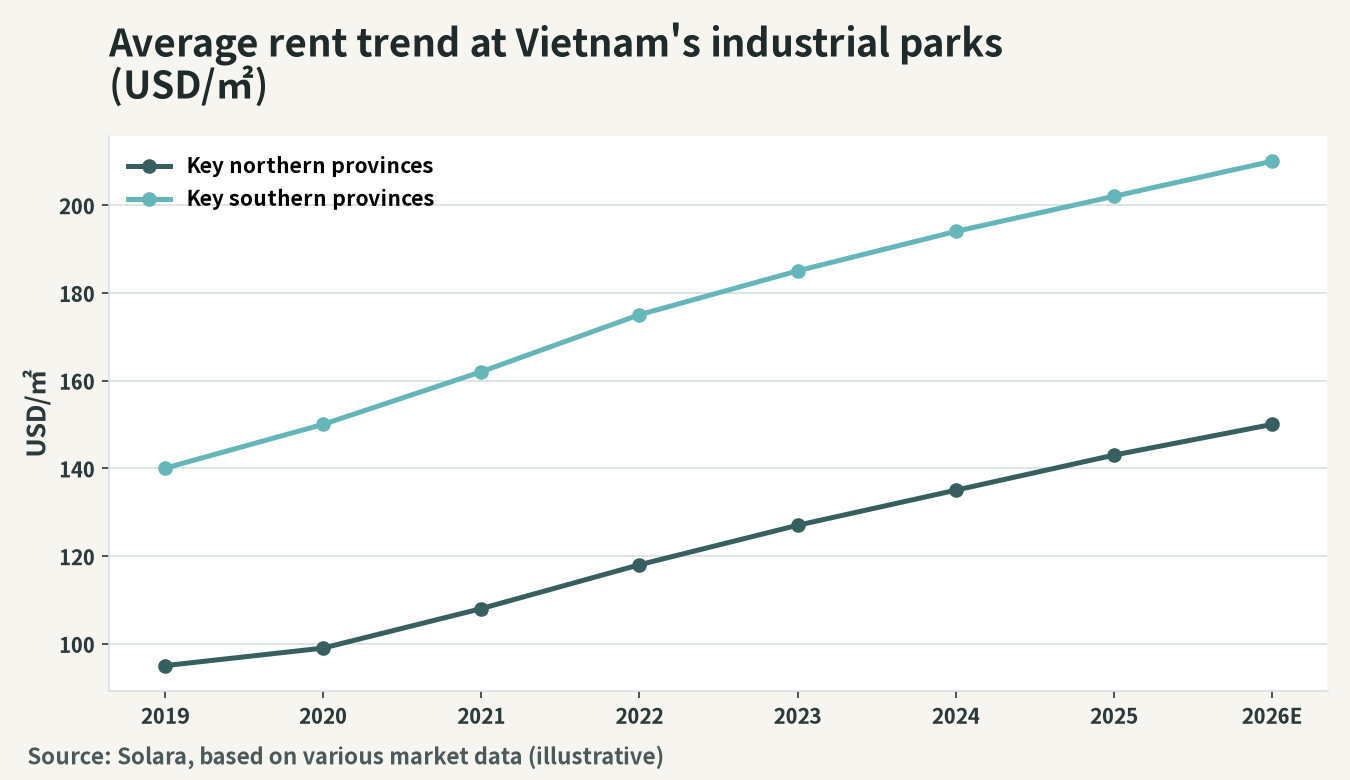
Industrial land rents are on an upward trajectory, reflecting the strength of demand. In particular, in the major northern provinces near Hanoi and the major southern provinces around Ho Chi Minh City, land in prime industrial parks has grown tight, with rising rents and a shrinking number of vacant lots occurring simultaneously. In addition, against the backdrop of expanding e-commerce, demand for modern logistics warehouses and cold-chain-capable warehouses is also rising rapidly. Industrial and logistics real estate can be called the most compelling segment, receiving the two tailwinds of manufacturing concentration and e-commerce logistics at the same time.
Looking concretely at the geographic concentration: in the north, provinces around Hanoi such as Bac Ninh and Hung Yen, and the port city of Hai Phong, are raising their profile as bases for electronics and machinery, while in the south, the provinces adjoining Ho Chi Minh City — Binh Duong, Dong Nai, and Long An — serve as the traditional core of manufacturing. In recent years, infrastructure investment such as ring roads, the north–south and east–west expressway networks, the Long Thanh International Airport under construction, and the expansion of major ports has lifted the value of land, making clear a trend in which industry spreads from established clusters, where land and rents have already risen, toward newer provinces farther inland. In site selection, not only the level of rent but also a stable power supply, the depth of skilled labor and supporting industries, and access from the land to ports, airports, and border gateways become the practical deciding factors. Whether these can be evaluated comprehensively greatly affects logistics costs and operational stability after entry.
Ready-Built Factories and Warehouses as an Option
For companies entering the market, building their own factory takes time and money. The option gaining presence in recent years is therefore leasing pre-constructed "ready-built" factories and warehouses. This allows operations to begin in a short period while keeping initial investment in check. Industrial real estate developers supply these lease-type factories and warehouses in a variety of sizes, meeting the diverse needs of incoming companies.
Housing Market — Recovery Gains Substance
The housing market is heading toward recovery after a corrective phase. Demand for mid-priced housing (affordable housing) supported by genuine end-user demand remains resilient, underpinned by urbanization and the expanding middle class. Meanwhile, the luxury segment, which had stalled amid excessive speculation and funding strains, is in the process of restoring balance between supply and demand.
A sound recovery of the housing market is inseparable from improvement in developers' fundraising environment and the supply of price points within reach of genuine end-user buyers. The government, too, is policy-driving the supply of social housing and affordable housing, broadening the base of the market. Although there are certain restrictions on home acquisition by foreigners, clarification of the rules is advancing, widening the room for foreign developers and investors to participate.
Real estate is supported by this genuine demand while also retaining enduring popularity as a destination for foreign investment. The real estate and development field is one of the leading sectors attracting foreign direct investment (FDI) into Vietnam, second only to manufacturing, with overseas developers and funds participating in the market through joint ventures and equity stakes.
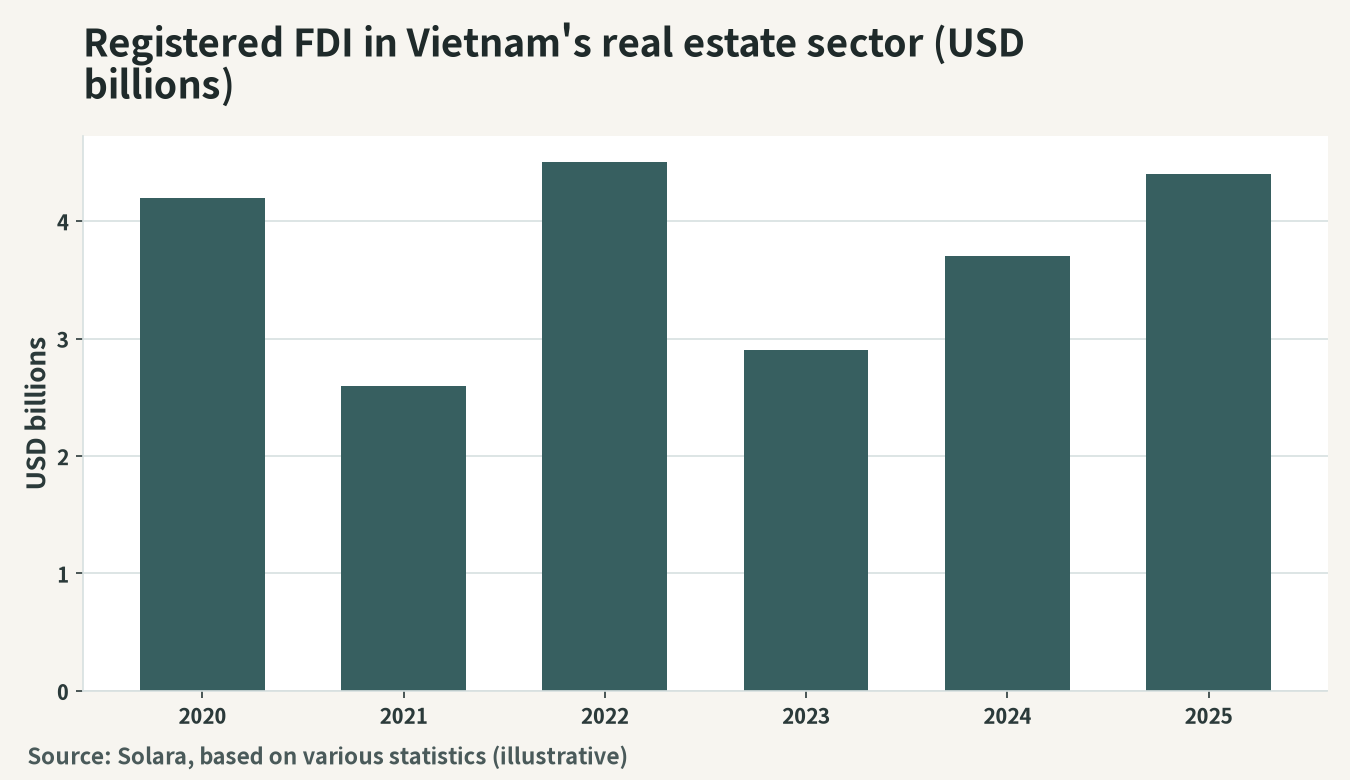
The fact that foreign interest is holding at a high level corroborates expectations for the market's long-term growth. However, given the history in which inflows of speculative capital and subsequent tightening have amplified market swings, what matters is a perspective that discerns not only the volume of capital but also its "quality" — whether it is development rooted in genuine demand or speculative movement.
Commercial and Retail Real Estate — Consumption Recovery and Room to Modernize
Commercial and retail real estate is recovering gradually but steadily, on the back of recovering domestic demand and the modernization of retail. Vietnam's retail market has sustained high nominal growth of around double digits per year, yet the penetration of modern trade — supermarkets and shopping malls — still stands at only around twenty percent of total retail, with traditional markets and individual shops remaining dominant. Put the other way around, modern retail still has substantial room to grow, and this is precisely where the medium- to long-term opportunity lies for foreign capital and developers.
At present, vacancy rates for prime retail space in central Hanoi and Ho Chi Minh City are declining, and rents are holding firm. Meanwhile, the focus of new supply is shifting toward large shopping malls expanding into the suburbs in line with population concentration, and toward mixed-use developments that integrate retail, offices, and housing. The store expansion of Japanese retailers such as AEON is also a factor lifting demand for modern commercial floor space. The rapid expansion of e-commerce is often seen as a threat to physical stores, but in reality the move toward omnichannel — combining in-store pickup and experiential stores — is spreading, generating demand for both modern commercial facilities and logistics facilities on the urban fringe at the same time. Commercial real estate can be called a segment whose success or failure hinges heavily on location, tenant mix, and operating capability, making the discernment of development and operating partners especially important.
Organizing Segment Trends and Investment Opportunities
Here we organize the characteristics of the three major segments examined so far.
Segment | 2026 tone | Main drivers | Opportunity for foreign capital |
|---|---|---|---|
Office | Recovery, polarization toward quality | More entering companies, ESG demand | Grade A and green properties |
Industrial land, logistics | Strongest growth | China+1, e-commerce logistics | Industrial parks, ready-built, warehouses |
Housing | Recovery gains substance | Urbanization, middle class, genuine demand | Affordable housing, joint-venture development |
Commercial, retail | Gradual recovery | Consumption recovery, modern retail | Shopping malls, mixed-use development |
As this shows, even within the same "real estate," investment appeal and risk differ greatly by segment. The picture is one in which demand is strongest in industrial and logistics, selection by quality advances in offices, and housing recovers supported by genuine demand. In investing, clarifying which segment and which phase of it to bet on is the starting point.
The Land-Tenure System and Risks Foreign Investors Must Heed
The most important point to heed in Vietnamese real estate investment is the land-tenure system. In Vietnam, land is deemed to be owned by the state (the entire people), and what companies and individuals hold is a "land-use right" for a fixed period. Accordingly, acquiring real estate is strictly the "acquisition of a land-use right," and it is essential to verify precisely its term, permitted use, and transferability. When acquiring factory land or development land, one must scrutinize the remaining term of the land-use right, the use classification, consistency with the master plan, and the presence of any mortgage or dispute.
If verification of the land-use right is neglected, problems such as being unable to change the use after acquisition, failing to obtain development permits, or finding the right shorter than assumed will surface, and the investment-recovery plan can collapse at its foundation. It is not unusual for information on drawings and the land registry to diverge from on-the-ground reality, so on-site inspection is indispensable.
In addition, the acquisition of real estate by foreigners and foreign capital is subject to restrictions that vary by use and segment, and the licensing procedures are also complex. In development projects, joint ventures with local partners are common, but large information asymmetries remain regarding the partner's trustworthiness, the legal status of the target property, and off-book liabilities. It is precisely for this reason that pre-acquisition real estate and factory due diligence, together with credit investigation of the target company and partner, determine success or failure in Vietnamese real estate investment.
Conclusion — Read the Segment, Shore Up the Fundamentals
In 2026, Vietnam's real estate market emerges from its corrective phase and enters a phase of recovery and growth. Strongest is the industrial and logistics segment supported by manufacturing inflows and e-commerce logistics; offices undergo selection by quality; and housing recovers supported by genuine demand — the character of each segment differs greatly. The structural tailwinds of urbanization, an expanding middle class, manufacturing inflows, and a maturing legal framework are unshakable, but turning them into results presupposes the practical work of reading the segment correctly and shoring up the fundamentals of the land-tenure system, legal relationships, and partners.
Solara & Co maintains bases and human networks in both Japan and Vietnam, providing end-to-end support from the consideration of acquiring real estate and industrial land in Vietnam, through market research, real estate and factory due diligence, verification of land-use rights, and credit investigation of local partners and the structuring of joint ventures. Capturing the tailwind of a recovering market while carefully discerning the risks underfoot — we believe that achieving both at once is the shortest path to success in Vietnamese real estate investment.