
In 2026, Vietnam's retail market shifts from "recovery" to "expansion"
Vietnam's retail market in 2026 is expected to be a pivotal year, one in which consumption emerges from the post-pandemic adjustment phase and the picture switches from "recovery" to genuine "expansion." Against a backdrop of easing inflation, improving employment, and continued income growth, household purse strings are beginning to loosen, and consumption is returning to its role as the leading engine of growth. With a population of more than 100 million and a young, high-spending consumer base, this market offers one of Southeast Asia's foremost opportunities for businesses oriented toward domestic demand.
What matters is that this recovery is not merely a "return to previous levels" but is accompanied by a qualitative shift in which the "substance" of consumption changes. Spending moves from a focus on daily necessities toward outlays that prize quality, brand, and experience. Channels move from traditional markets (mom-and-pop shops) toward modern retail and e-commerce. Because these structural changes are unfolding simultaneously, 2026 carries particular significance for foreign consumer-goods and retail companies as a timing for market entry and for establishing share.
This article organizes the drivers powering the consumption recovery in Vietnam's retail market, decodes the structural shift in distribution channels, and then examines—from a practitioner's perspective—category-by-category investment opportunities, entry models, and the risks that warrant attention.
Three engines driving the consumption recovery
What underpins the consumption expansion of 2026 is not a temporary rebound but structural engines.
A growing middle class and disposable income
In Vietnam, the middle class and upper-middle class are expanding rapidly, particularly in urban areas. Once per-capita income crosses a certain threshold, the center of gravity of consumption shifts from necessities such as food and daily goods toward higher value-added areas such as dining out, beauty, home appliances, education, leisure, and financial services. Rising disposable income does not merely increase the volume of consumption; it raises the "quality" of consumption and strengthens an orientation toward quality and brand. This is a tailwind for Japanese companies whose strengths lie in high quality and high trust.
Urbanization and the rise of regional consumption
In addition to the maturation of the two major metropolitan areas of Hanoi and Ho Chi Minh City, consumption is rising in secondary cities such as Da Nang and Can Tho and in provincial capitals. Through the progress of urbanization, infrastructure development, and the spillover of income to the regions, modern retail and brand consumption—previously concentrated in urban areas—are spreading to regional cities. The geographic expansion of the market is a factor that widens both the room for new store openings and the room for growth. Even in categories where competition has already intensified in urban areas, secondary cities and regional areas still hold significant room to be developed, and companies that build distribution networks and brand recognition early will find it easier to capture the fruits of the rise in regional consumption.
In addition, the generational shift among consumers cannot be overlooked. A younger demographic that grew up alongside digital technology and is highly conscious of foreign brands and of health and the environment is emerging as the leading force in consumption. They value reputation on social media and experiential value, and they increasingly choose not by price alone but by "what the brand embodies." Whether a company can win the support of this generation will determine its share over the long term.
Structural shift in channels — modern retail and e-commerce
The most distinctive feature of Vietnam's retail market lies in the rapid modernization of its channels. While traditional retail still accounts for a large share, its composition is changing steadily.
The penetration of modern trade (MT)
Modern retail (modern trade) formats such as convenience stores, mini-supermarkets, supermarkets, and shopping malls are expanding, particularly in urban areas. Store networks with thorough refrigeration, hygiene, and quality control are winning the support of a middle class that prizes quality and safety. For consumer-goods manufacturers, accurate distribution to and brand exposure on these modern retail channels become the key to capturing share.
The acceleration of e-commerce and live commerce
Because Vietnam has a high smartphone penetration rate and a young, digitally savvy population structure, e-commerce is growing at an extremely rapid pace. In particular, "live commerce" and social commerce—which combine social media with video—are working their way to the center of consumer behavior, and the entry point of purchasing is shifting from the store to the smartphone screen. A channel strategy that fuses online and offline (omnichannel) is becoming a precondition for retail going forward.
The advance of e-commerce also has the effect of lowering entry barriers for foreign companies. Even without building a large-scale store network of one's own, a company can reach consumers directly—not only in urban areas but also in the regions—through major e-commerce platforms and live commerce. On the other hand, because competition in the digital arena makes prices and reviews visible and brand reputation spreads instantly, product strength and the quality of customer support sway sales more than ever. The maturation of supporting infrastructure such as payments (e-wallets) and logistics (last-mile delivery) is also propelling the expansion of e-commerce.
The size and growth of the retail market in figures
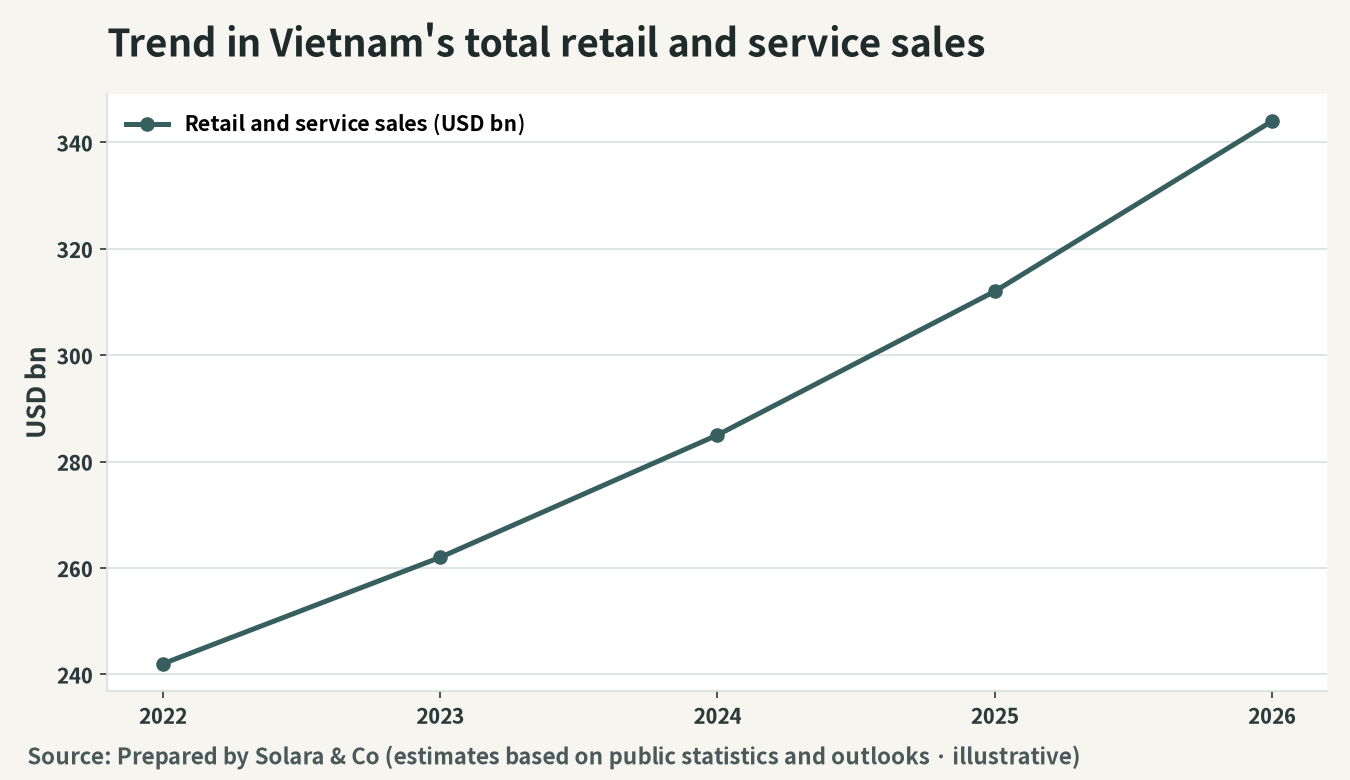
Let us confirm the contours of the consumption recovery through two indicators. First is the trend in total retail and service sales. The speed at which the overall market pie is expanding is the starting point for measuring the attractiveness of entry.
Second is the composition by channel. It shows how far the transition from traditional retail to modern retail and e-commerce has progressed.
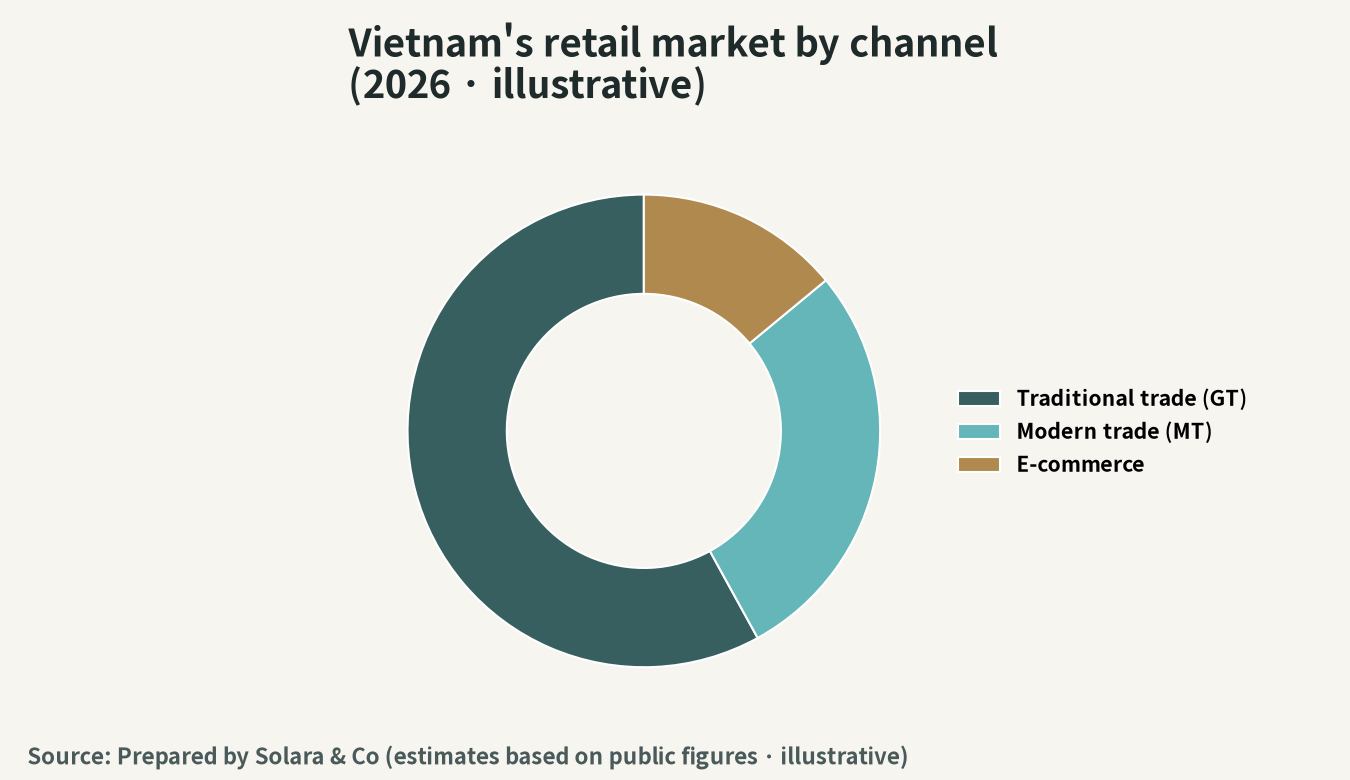
For reference, Vietnam's total retail and service sales have in recent years sustained growth typically ranging from the high single digits to double digits annually, and the scale is said to have reached the level of hundreds of billions of US dollars. Even on a real basis (excluding inflation), growth remains firm, and a structure in which consumption underpins the growth of the economy as a whole is taking hold. Among the channels, the growth of e-commerce stands out, with the market expanding at a pace of around twenty percent a year and steadily raising its share of total retail. On the other hand, although the number of modern retail outlets (convenience stores and mini-supermarkets) is rising rapidly in urban areas, traditional retail still accounts for more than half of total retail sales by share, leaving substantial room for modernization. In other words, the market's "room to grow" lies in both the expansion of overall volume and the shift in composition, and for foreign companies this is a phase in which the economic rationale for early entry is high.
These figures fluctuate depending on assumptions, but the direction is consistent. The overall market expands while its breakdown shifts toward modern retail and e-commerce—the simultaneous progress of these two movements is Vietnam's retail market in 2026.
Investment opportunities by category
The benefits of consumption expansion appear in different ways by category. Overlaying the strengths of Japanese companies, the following organizes the investment opportunities of the major categories.
Category | Main growth drivers | Strengths of Japanese companies | Promising channels |
|---|---|---|---|
Food & beverage | Middle class's quality orientation, expansion of dining out | Product strength in safety, quality, and health orientation | MT, convenience stores, e-commerce |
Cosmetics & personal care | Rising beauty awareness, younger demographic | Brand trust, skincare technology | E-commerce, live commerce |
Home & consumer appliances | Urbanization, replacement demand | Quality, energy efficiency, after-sales service | Specialty electronics retailers, e-commerce |
Healthcare & pharmaceuticals | Health awareness, early signs of aging | Reliability, evidence | Drugstores, e-commerce |
Dining & services | Disposable income, experiential consumption | Operational and service quality | Urban store openings, franchising |
What is common across every category is that the Japanese brand strength of "quality, safety, and trust" appeals readily to a middle class that is intensifying its quality orientation. However, because price competitiveness and adaptation to local needs are demanded at the same time, a design that localizes while leveraging strengths is indispensable. In food and beverage, for example, product development tailored to local tastes and preferences will determine success or failure; in cosmetics, formulations suited to Vietnam's climate and skin types together with social-media-driven marketing will do so. What is tested is not bringing home-country specifications in unchanged, but the "design capability for localization" that preserves the core of one's strengths while optimizing for local conditions.
Entry models for foreign retail and consumer-goods companies
The faster a market grows, the more the speed and form of entry determine success or failure. Building distribution networks and a brand from zero takes time, and during that period there is a risk that competitors will consolidate a first-mover advantage.
Saving time through M&A and joint ventures
By acquiring or forming joint ventures with existing retail chains, distributors, or consumer-goods brands, a company can secure distribution networks, store networks, customer bases, licenses, and talent all at once. This is a "buying time" strategy, and it is especially effective in fast-growing markets. However, because there is large information asymmetry regarding the target company's finances, licenses, and off-balance-sheet liabilities, credit investigation and due diligence before acquisition are indispensable.
Distribution networks and the cold chain
In categories such as food, beverage, and pharmaceuticals, the logistics network for delivering quality all the way to the regions—and in particular the cold chain that maintains refrigeration and freezing—sways competitiveness. Whether a company can reconcile broad distribution coverage with the maintenance of freshness and quality will decide success or failure on modern retail channels.
Practical points to grasp on the regulatory and institutional front
While keeping an eye on the market's attractiveness, what decides the success or failure of entry at the practical level is an understanding of the regulations surrounding distribution, retail, and products. Whether a company can design its business on the premise of the institutional framework greatly changes the speed and safety of its launch. Proceeding with the instincts of a Japanese head office risks misreading the time required to obtain licenses or the labeling requirements, which can push back the entire schedule for store openings or product launches.
Foreign distribution and retail licenses and store-opening regulations
In Vietnam, for a foreign investor to conduct wholesale or retail, in addition to an Investment Registration Certificate and an Enterprise Registration Certificate, the company needs the "right to conduct the purchase and sale of goods and related activities (a trading license)," and opening a retail outlet requires a separate retail establishment license. In particular, opening a second outlet or beyond may be subject to a review known as the "Economic Needs Test (ENT)," in which the location, store size, and the balance of supply and demand within the area are taken into account. In recent years, the application has tended to be eased for smaller stores below a certain floor area, but because the authorities' interpretation and review practices differ by province and city, store-opening plans need to be built while confirming how the local authorities apply the rules. When expanding through franchising, it should also be noted that registration of franchise activities is a precondition.
Regulations on food safety, labeling, and e-commerce
For consumer goods, regulatory compliance by product category is a premise of the business. For food, there are systems of self-declaration or registration, labeling regulations on nutrition, ingredients, and origin, and inspection upon import; for cosmetics, notification of ingredient information is required. Labels must in principle be in Vietnamese, and products that do not satisfy the mandatory items can run into problems at customs or on the shelf. For e-commerce and live commerce as well, rules on the registration of operators, advertising and sales promotion, and consumer protection are being put in place, so selling online does not mean being outside the scope of regulation. Because these regulations are revised and their application changes at a rapid tempo, it is essential to confirm the latest application locally while building product design, labeling, and promotion as an integrated whole. Whether a company can incorporate regulatory compliance into its initial design greatly affects rework and costs in later stages.
Risks and points to note upon entry
Precisely because the market is attractive, it is necessary to view the risks calmly. First is intensifying competition. Because strong companies both domestic and foreign target the same growth categories, share cannot be secured without clear differentiation and front-loaded investment. Second is adaptation to local needs. Price sensitivity, tastes and preferences, packaging, and promotional methods differ greatly from Japan, and home-country specifications as they stand will not work. Third are practical frictions such as the business customs of distribution and retail, the trustworthiness of partners, and licensing and labeling regulations. These must be overcome through locally rooted information and the selection of trustworthy partners. Fourth is securing talent and standardizing store operations. In a rapidly growing market, the competition to secure excellent store and sales talent is fierce, and whether a company can expand its store network while maintaining service quality will determine whether brand value is preserved. The market's tailwind is substantial, but turning it into one's own results is premised on steadily firming up the day-to-day practicalities at hand.
How can Japanese companies seize the opportunity — Solara's perspective
Vietnam's retail market in 2026 is in an extremely attractive phase for entry, one in which the recovery of consumption is turning into genuine expansion and the structural shift toward modern retail and e-commerce is unfolding simultaneously. The middle class's quality orientation pairs well with the strengths of Japanese brands, and opportunities are spreading across a wide range of categories—food and beverage, cosmetics, home appliances, healthcare, and dining. The keys are to localize while leveraging strengths, to ride the right channels, and to secure speed of entry.
Solara & Co maintains bases and human networks in both Japan and Vietnam, providing seamless support from market research and the formulation of entry strategy, to partner acquisition through M&A and joint ventures, credit investigation and due diligence before acquisition, and the building of distribution networks. Capturing the tailwind of an expanding market while carefully discerning the risks at hand—that very balance, we believe, is the shortest path to delivering results in Vietnam's consumer market.