
Vietnam's Rising Startup Ecosystem
Vietnam is building one of the fastest-growing startup ecosystems in Southeast Asia. A population of more than 100 million, one of the highest smartphone penetration rates in the world, a digitally native young generation, and a rapidly expanding digital consumer market are enriching the soil for entrepreneurship and innovation. From fields such as fintech, e-commerce, gaming, edtech, and healthtech, companies that draw global attention have emerged, and Vietnam is steadily strengthening its presence as a leading candidate for "Asia's next technology hub."
This rise represents the appeal of a new investment destination and partner for venture capital (VC) firms and operating companies alike. Riding the tailwind of expanding digital consumption, Vietnamese startups are growing rapidly by capturing domestic demand, and some are spreading their wings into the global market. This article organizes the structural factors underpinning Vietnam's startup ecosystem, decodes the fields attracting attention and the actors that drive the ecosystem, and then, from a practical standpoint, explains the investment and partnership opportunities for Japanese companies along with the risks to keep in mind. For the broader picture of the digital economy, please also see Vietnam's semiconductor and digital economy strategy.
The Structural Factors Underpinning the Ecosystem
The rise of Vietnam's startups is supported by several structural foundations.
Demographics and Digital Consumption
Vietnam has a young, digitally native population. The habit of using payment, shopping, entertainment, learning, and healthcare services via smartphones is spreading rapidly, creating enormous domestic demand for digital services. This robust demand simultaneously provides startups with both a "testing ground" and a "growth market." The expansion of the e-commerce market is covered in detail in Vietnam's e-commerce market 2026.
Depth of Talent and Engineers
Vietnam places strong emphasis on science and engineering education and has an abundant pool of software-engineering talent. The technical capabilities cultivated through its role as an offshore development hub have built a deep bench of startup founders and engineers. Combined with cost competitiveness in labor, the speed and cost efficiency of product development have become a strength of Vietnamese startups. The history of major global IT companies establishing development bases in Vietnam has rooted an advanced engineering culture locally, generating a flow of talent who, after gaining experience there, strike out on their own to found startups. The presence of "returnee" entrepreneurs—those who study and work abroad before returning home to launch ventures—is also an important element that brings a global perspective and networks into the ecosystem.
Government Support and the Building of the Ecosystem
The government has positioned innovation and the digital economy as a national strategy and is building startup-support frameworks, exemplified by the National Innovation Center. Incubators, accelerators, coworking spaces, and VCs are increasingly clustering, and an environment that supports the journey from founding to growth is taking shape. Under the national goal of raising the digital economy's share of GDP, support measures such as regulatory sandboxes and talent development are also being expanded, making clear a stance in which the public and private sectors work together to lift the ecosystem. This institutional backing is also a source of reassurance for overseas investors and operating companies in terms of ease of participation.
The Ecosystem's Growth in Numbers
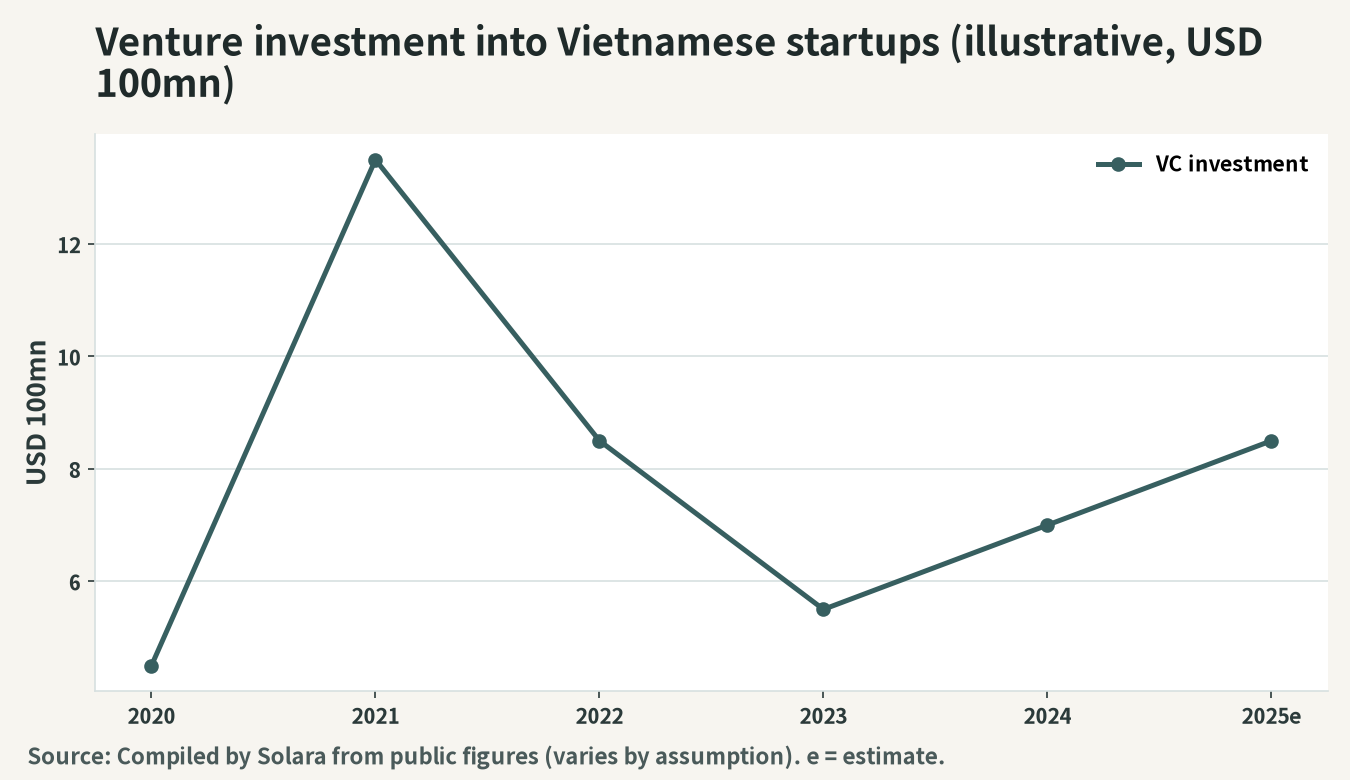
We trace the contours of the ecosystem using two indicators. First is the trajectory of venture investment into startups. Despite the market's ups and downs, over the medium to long term it shows a path of expanding investment.
Second is the composition of the major sectors attracting investment. It shows a structure in which funds flow into a wide range of fields, centered on fintech, e-commerce, and gaming.
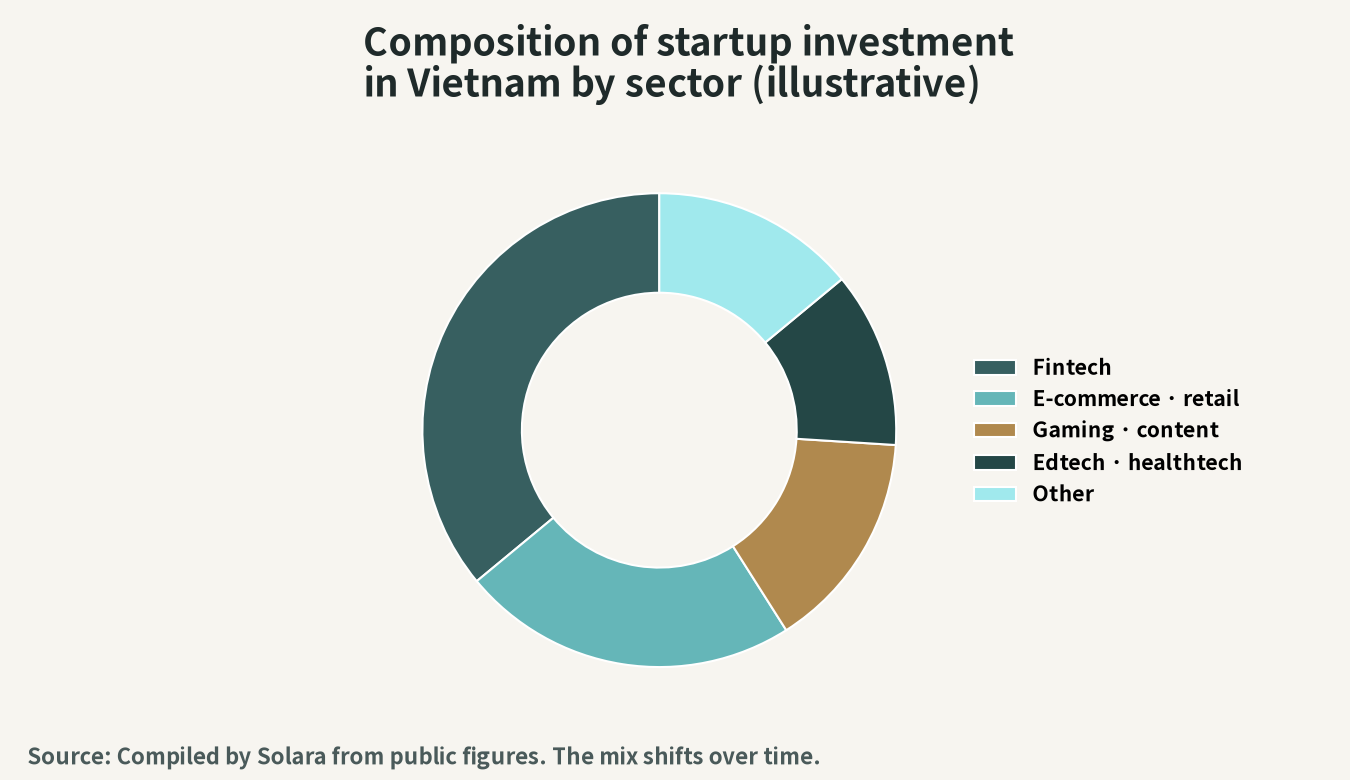
These figures fluctuate depending on assumptions, but the direction is consistent. Even amid swings in the global investment environment, Vietnam's startup ecosystem has steadily gained depth over the medium to long term and continues to attract both capital and talent.
Fields Attracting Attention and the Actors That Drive the Ecosystem
Vietnamese startups are showing particularly strong growth in several fields.
Field | Growth driver | Investment appeal | Touchpoint for Japanese companies |
|---|---|---|---|
Fintech | Unbanked population · mobile payments | Vast financial-inclusion market | Finance · payments · credit |
E-commerce | Digital consumption · live commerce | Expanding consumer market | Logistics · payments · retail |
Gaming · content | Development capability · youth | Global expansion | Content · IP |
Edtech | Educational zeal · digitalization | Large education demand | Education · talent |
Healthtech | Health awareness · medical demand | Expanding medical market | Medical · healthcare |
Fintech in particular—in a Vietnam where many remain without bank accounts—has driven "financial inclusion" through mobile payments and e-wallets, serving as the core of the ecosystem. E-wallets have penetrated deeply into everyday shopping, money transfers, and utility payments, and the payment data accumulated there is becoming the foundation for the next generation of financial services such as credit, insurance, and asset management. E-commerce, gaming, edtech, and healthtech are also growing, each backed by enormous domestic demand and development capability. In gaming and digital content in particular, cases have emerged of Vietnam-born studios earning recognition in the global market, demonstrating global expansion that goes beyond the domestic market.
The actors that drive the ecosystem are not only founders and engineers but are also supported by a virtuous cycle of domestic and foreign VCs, the corporate venture capital (CVC) arms of operating companies, government agencies, universities, and successful entrepreneurs investing in the next generation. Entrepreneurs who have once achieved success go on to nurture the next generation as angel investors and mentors—the fact that this cycle has begun to turn is proof that Vietnam's ecosystem is gaining sustainable depth rather than being a passing boom.
Investment and Partnership Opportunities for Japanese Companies
Vietnam's startup ecosystem creates diverse opportunities for Japanese companies. First is equity investment in growth startups (VC and CVC investment). By investing early in promising companies, firms can aim for both access to new markets and technologies and financial returns. Second is business alliances and collaboration. There are open-innovation opportunities to create new value by combining one's own business with a startup's technology and services. Third is incorporation through M&A. Acquiring a startup that has grown allows a company to obtain technology, talent, and a customer base all at once. Fourth is product development and offshore collaboration that leverages Vietnam's development capability.
Japanese companies practice management that values quality, trust, and the building of long-term relationships, and they hold deep technology and customer bases in specific fields. Combining these with the speed and development capability of Vietnamese startups generates collaboration that is valuable for both sides. In particular, operating companies that can provide not only capital but also business know-how, sales channels, and credibility can become attractive partners for startups. For Vietnamese startups, access to the Japanese market and to Japanese companies' global networks is a major draw, while for Japanese companies it is an opportunity to absorb cutting-edge technology and speed from the front lines of a growth market. This mutual complementarity is precisely the essence of Japan–Vietnam startup collaboration.
On the other hand, involvement with startups differs greatly in character from the expansion of traditional manufacturing. Because business uncertainty is high and valuations swing widely, an approach commensurate with the risk is required: investing in small amounts, in a diversified manner, and in stages, and deepening involvement only once promise has been confirmed. Rather than plunging into a large M&A deal from the outset, building a relationship starting from equity investment or business alliances and raising the degree of integration while deepening mutual understanding lowers the probability of failure.
Risks to Keep in Mind
Precisely because the opportunities are large, the risks must be viewed calmly. First is volatility in valuation and the investment environment. Changes in the global financial environment cause startups' fundraising conditions and valuations to swing widely. Second is immaturity in governance and disclosure. Early-stage companies often have financial management, internal controls, and compliance that are still developing, so it is necessary to ascertain the actual situation before investing or acquiring. Third is talent mobility. Competition to secure outstanding engineers and management talent is fierce, and the departure of a key person carries the risk of impairing business value. Fourth is regulatory uncertainty. For fintech and data-handling businesses, regulatory changes directly affect the business model.
These must be managed through locally rooted information, the selection of trustworthy partners, an exit strategy set at the entry stage, and thorough due diligence prior to investment or acquisition. In startup investment in particular, advance investigation that ascertains the actual state of finances, legal matters, intellectual property, and key persons is the key to preventing large losses down the road.
How Japanese Companies Can Seize the Opportunity — Solara's Perspective
Vietnam's startup ecosystem, supported by a young population, abundant engineers, robust digital consumption, and government backing, is steadily gaining depth over the medium to long term. Opportunities for Japanese companies to participate through equity investment, partnerships, M&A, and development collaboration are spreading broadly across fields such as fintech, e-commerce, gaming, edtech, and healthtech. The key is to combine the agility to catch the growth wave with the firm-footed soundness to ascertain the actual state of investment and partnership targets.
Solara & Co has bases and human networks in both Japan and Vietnam, providing integrated support from market research and the formulation of investment strategy, through the search for startups and partners, the execution of equity investment, M&A, and joint ventures, pre-investment credit checks and due diligence, to the building of post-partnership structures. Capturing the vitality of a rising ecosystem while carefully ascertaining the risks at hand—we believe that achieving both is precisely the shortest path to results in Vietnam's innovation market.