
The VN-Index Reflects the Growth of Vietnam's Economy
The VN-Index (Vietnam's stock price index) is the country's benchmark index, composed of stocks listed on the Ho Chi Minh City Stock Exchange. Beginning its calculation at a base value of 100 in the year 2000, this index has raised its level substantially over the past two decades and more, advancing in step with the high growth of Vietnam's economy. Underpinned by a population of over 100 million, economic growth in the 6–8% range, and robust inflows of foreign capital, Vietnam's stock market draws attention from domestic and foreign investors alike as one of the leading growth markets in Southeast Asia.
That Vietnamese stock market is now facing a major turning point. The move by the world's leading stock-index providers to upgrade Vietnam from a "frontier market" to the higher classification of "emerging market" has taken on a sense of reality. If the upgrade is realized, capital from global institutional investors is expected to flow in anew, raising the market's liquidity and valuation another notch. This article explains, from a practical standpoint, the structure and characteristics of the VN-Index, the substance of upgrade expectations, and the investment opportunities and considerations that Japanese companies and investors should grasp.
Upgrade Expectations — From Frontier to Emerging
The single largest theme surrounding Vietnam's stock market is the "upgrade of market classification" in international stock indices. The world's stock markets are classified into categories such as "developed," "emerging," and "frontier" according to their maturity and ease of investment. Vietnam has long been positioned as a frontier market, but with progress in market scale, liquidity, and institutional development, an upgrade to emerging-market status has come into view.
What an Upgrade Means
An upgrade is important because many of the world's institutional investors use indices linked to such market classifications as the benchmark for their portfolios. If Vietnam is upgraded to emerging-market status, the likelihood rises that enormous index funds—and active funds that treat emerging markets as their investment universe—will newly allocate to Vietnamese equities. This leads to capital inflows across the whole market and a lift in valuation levels, and it also improves the fundraising environment for listed companies. When other emerging markets experienced upgrades in the past, there were many cases in which foreign capital inflows accelerated around the announcement and the market's valuation level was raised. An upgrade is not a mere change of "title," but a structural event that raises the quality and depth of the market by a notch.
The Conditions and Challenges of an Upgrade
Realizing an upgrade requires meeting several conditions. A representative one is improving the convenience of trading and settlement for foreign investors. Specifically, these include a mechanism allowing orders to be placed without preparing funds in advance of the trade (easing of pre-funding requirements), the treatment of caps on foreign ownership ratios (foreign ownership limits), English-language disclosure, and the development of settlement systems. Vietnam's government and regulators are advancing these reforms in stages, and the modernization of market infrastructure holds the key to realizing an upgrade.
International index providers such as FTSE Russell and MSCI periodically review the fulfillment of these requirements and reassess market classifications. Vietnam has steadily climbed the steps of evaluation, having been placed, for instance, on a "watch list" for an upgrade. In recent years, reforms on the authorities' side—such as the launch of a new trading system and regulatory amendments to ease the pre-funding burden—have also taken concrete shape. While it is difficult to predict the precise timing of realization, the direction and momentum of the reforms back up the market's expectations.
The Characteristic of a Market Where Retail Investors Are the Protagonists
Another characteristic of Vietnam's stock market is the extremely high share of retail investors in trading value. The number of securities accounts has risen rapidly, and stock investing has spread widely, especially among the younger generation. While this brings vitality and liquidity to the market, it also gives the market a character prone to large swings driven by themes and sentiment. If the share of institutional investors rises through an upgrade, such price movements are expected to stabilize, and valuation based on corporate value should function more readily. The gradual broadening of the market's "protagonist" from individuals to institutions is also an important lens for gauging the market's maturity.
The Journey of the VN-Index in Numbers
The VN-Index has raised its level over the long term, reflecting economic growth and foreign capital inflows. On the other hand, as a stock market, it fluctuates substantially in the short term due to the global financial environment and domestic factors.
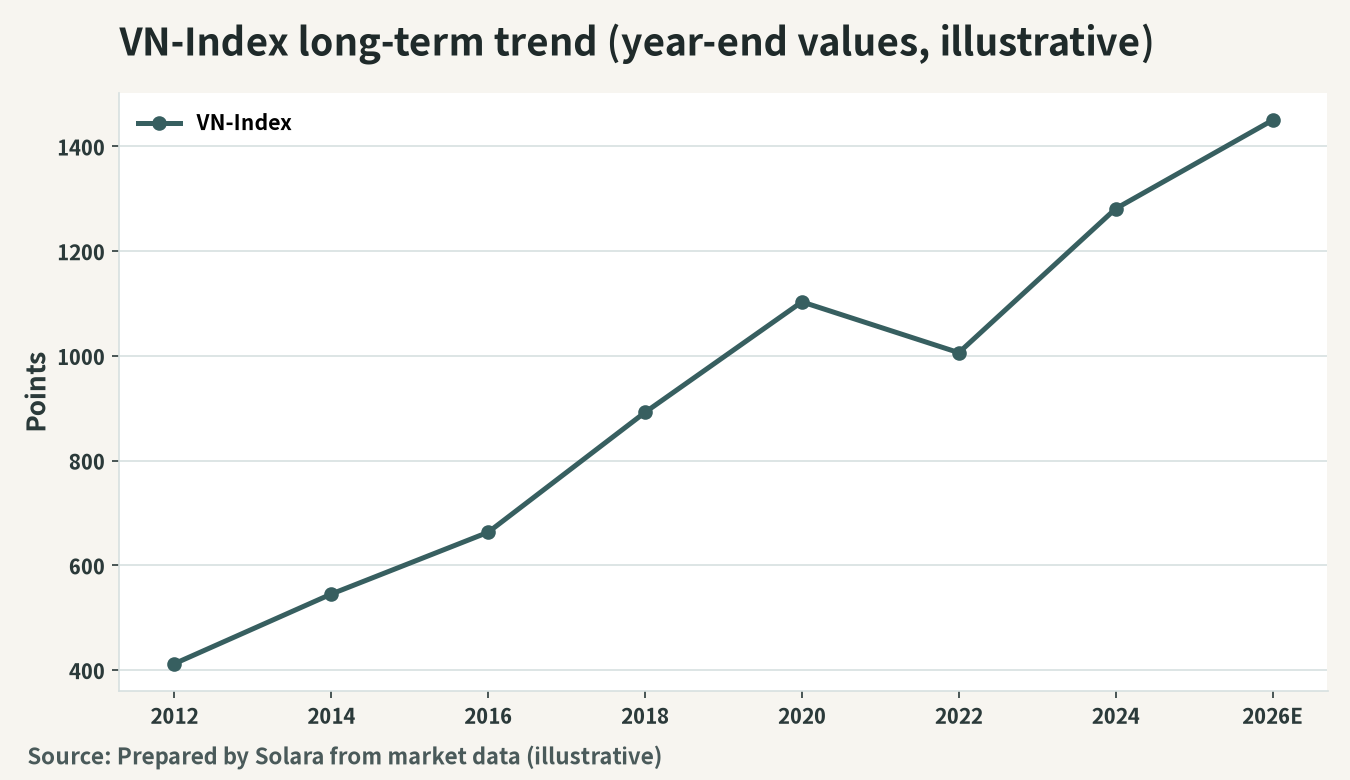
What matters is not short-term swings but the long-term trend. As long as these three continue—the economy growing, the earnings of listed companies expanding, and the market's institutions being developed—the stock market will, over the long run, reflect economic growth. Upgrade expectations are drawing attention as an element that adds a further degree of upside to this long-term trend.
The Sector Composition and Characteristics of the VN-Index
Understanding the contents of the VN-Index is indispensable for grasping the character of Vietnam's stock market. The composition of the index is characterized by the weights of sectors such as banking, real estate, materials, consumer goods, and industrials.
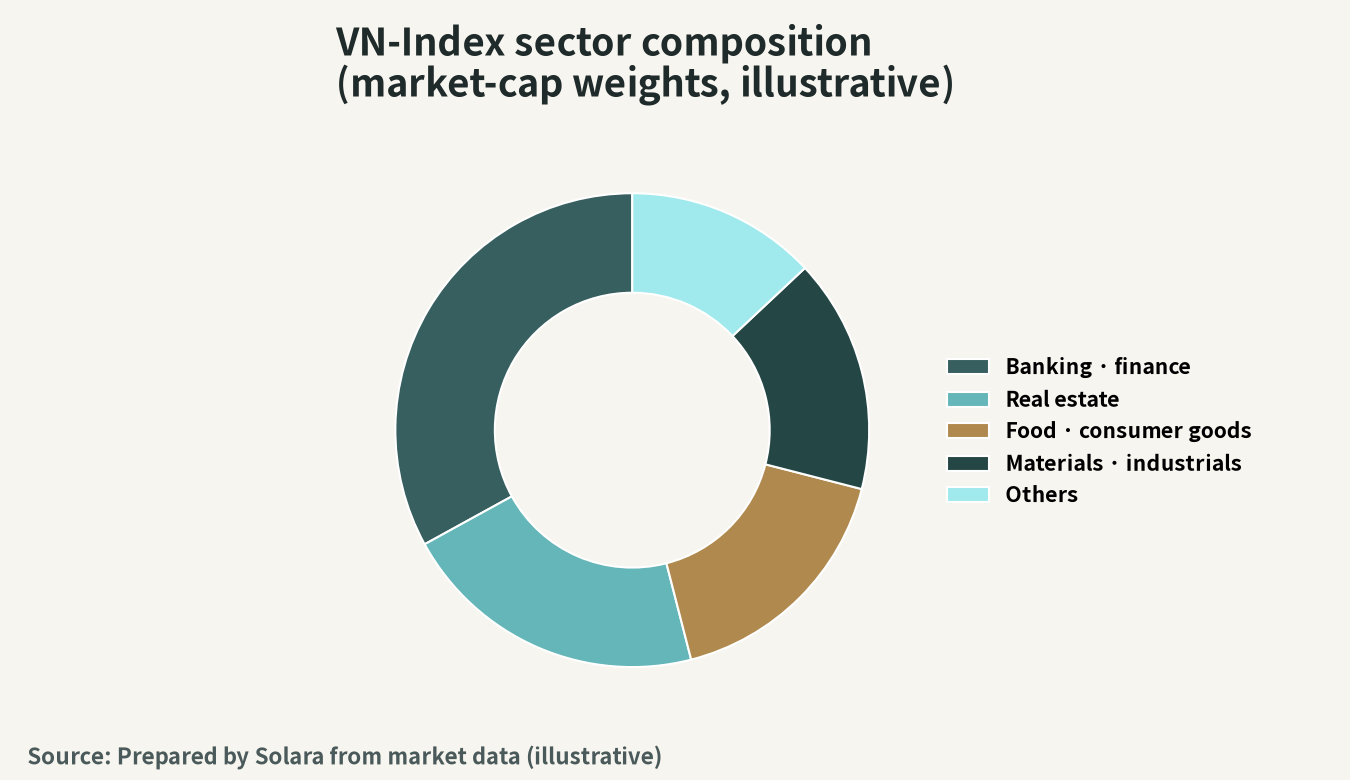
In particular, the fact that the banking-and-finance sector and the real estate sector account for large weights is a characteristic of Vietnam's stock market. This reflects credit expansion (loan growth) accompanying economic growth, and the fact that urbanization and real estate development are drivers of growth. On the other hand, the share of sectors such as manufacturing, consumer goods, and technology is also expected to rise gradually with the upgrading of the industrial structure. For investors, such a sector composition becomes the starting point for the investment decision of which phase of Vietnam's economy to bet on.
Investment Opportunities and Means of Access
Investment opportunities in Vietnam's stock market can be organized into three broad routes. Each has its merits and considerations.
Means of access | Overview | Main considerations |
|---|---|---|
Local individual stocks | Direct trading of stocks listed on the Ho Chi Minh and Hanoi markets | Foreign ownership limits, opening a securities account, language of information |
ETFs / investment trusts | ETFs tracking Vietnamese stock indices, country-specific funds | Exchange rates / management fees, bias in constituent stocks |
Private investment | PE/VC in unlisted companies, M&A | Low liquidity, the importance of due diligence |
Investment in listed stocks is superior in liquidity and transparency, but for stocks subject to foreign ownership limits, one may not be able to buy as desired. ETFs and country-specific funds allow easy diversified investment, but their constituents tend to be biased toward banking and real estate. And for companies aiming for higher returns and business synergies, private investment or M&A in unlisted companies becomes a strong option. On any of these routes, the investigation that gauges the actual condition of the target market and target company determines the results.
Implications for Operating Companies
For Japanese operating companies, the buoyancy of Vietnam's stock market carries two meanings. First is the improvement of the local fundraising environment. As the market gains depth, options for exit and fundraising through the listing (IPO) of a local subsidiary or joint venture broaden. Second is the development of the M&A environment. The more the stock market develops and the clearer the benchmarks for corporate valuation (multiples) become, the easier it is to judge the appropriateness of an acquisition price. The maturation of the stock market is important not only for portfolio investment but also as a foundation for business investment and M&A.
Risks and Considerations
While it is an attractive growth market, Vietnam's stock market also has its own inherent risks. First is the magnitude of volatility (price fluctuation). In phases of global risk aversion, capital tends to flow out of emerging markets, and prices can fall sharply in the short term. Second is exchange-rate risk. Fluctuations of the local currency, the dong, against the yen and the dollar directly affect yen-denominated returns. Third is information asymmetry and liquidity. The quality of corporate disclosure, the availability of English, and the trading volume of individual stocks still vary, and for institutional investors this can be a constraint in trade execution.
Fourth is concentration risk in specific sectors. As noted above, the index is heavily weighted toward banking and real estate, and these sectors are strongly affected by interest-rate trends, real estate conditions, and the credit cycle. Investment that tracks the index may unknowingly become a concentrated investment in these sectors, so caution is needed from the standpoint of diversification. Fifth is the quality of governance and disclosure. In emerging markets, corporate-governance issues remain, such as cases where the interests of controlling and minority shareholders do not align, and the transparency of related-party transactions. The more one invests in individual stocks and individual companies, the more important it becomes to gauge these actual conditions.
Upgrade expectations are a powerful tailwind, but uncertainty remains over the timing and conditions of realization. If expectations run ahead and the stock price has priced them in, a correction can occur should realization be delayed. In investing, it is indispensable to take the long-term growth story as the foundation while calmly estimating short-term volatility and institutional uncertainty. In particular, when an operating company engages with a listed company in the context of M&A or a capital alliance, an attitude of capturing the target in three dimensions—from both the "market's evaluation" expressed by the stock price and the "company's actual condition" grasped through due diligence—is required.
Conclusion — Capturing the "Next Stage" of a Growth Market
Vietnam's stock market, symbolized by the VN-Index, is reaching the "next stage"—an upgrade from frontier to emerging—while reflecting the high growth of the economy. If the upgrade is realized, capital from global institutional investors is expected to flow in anew, improving the market's liquidity, valuation, and fundraising environment another notch. This is at once an investment opportunity for portfolio investors and an improvement of the fundraising and M&A environment for companies operating locally.
Solara & Co has bases and human networks on both the Japanese and Vietnamese sides, and supports the entire process—from the consideration of business investment, M&A, and joint ventures in Vietnam, to the investigation of target companies and markets, pre-acquisition credit investigation and due diligence, and the formulation of capital policy for local subsidiaries. Capturing the great current of the stock market's maturation while carefully assessing the risks at hand—this very combination, we believe, is the shortcut to results in investing in Vietnam.