
Vietnam Tourism: From Recovery to Growth Beyond the Pandemic
Vietnam's tourism industry has overcome the devastating slump caused by the pandemic, and by 2026 foreign visitor arrivals are setting a new record high, returning to a path of genuine growth. The World Heritage site of Ha Long Bay, the ancient capital of Hue, the cave systems of Phong Nha-Ke Bang, and beach resorts such as Da Nang, Nha Trang, and Phu Quoc — possessing diverse and attractive tourism resources, Vietnam is raising its international presence as one of Southeast Asia's leading tourism powers.
Tourism is not merely one industry among many for the Vietnamese economy. It contributes greatly to GDP and employment, is a pillar of foreign-currency earnings, and is a broad-based industry that enriches the regional economy. The government, too, positions tourism as one of its priority industries, and through visa relaxation, infrastructure development, and promotion, is supporting the establishment of Vietnam's standing as a tourism power. Furthermore, peripheral fields such as hotel and resort development, aviation, marine tourism, and MICE (meetings, incentives, conferences, and exhibitions) are generating attractive investment opportunities for foreign capital. This article reviews the structure of Vietnam's tourism recovery in numbers, focuses on the growth areas of marine tourism and MICE, and examines the investment opportunities and points to note that foreign and Japanese companies should capture, from a practical standpoint.
Seeing the Tourism Recovery in Numbers
After plummeting due to the pandemic, foreign visitor arrivals to Vietnam have achieved a robust recovery, riding the tailwind of relaxed visa policy and the recovery of international flights.
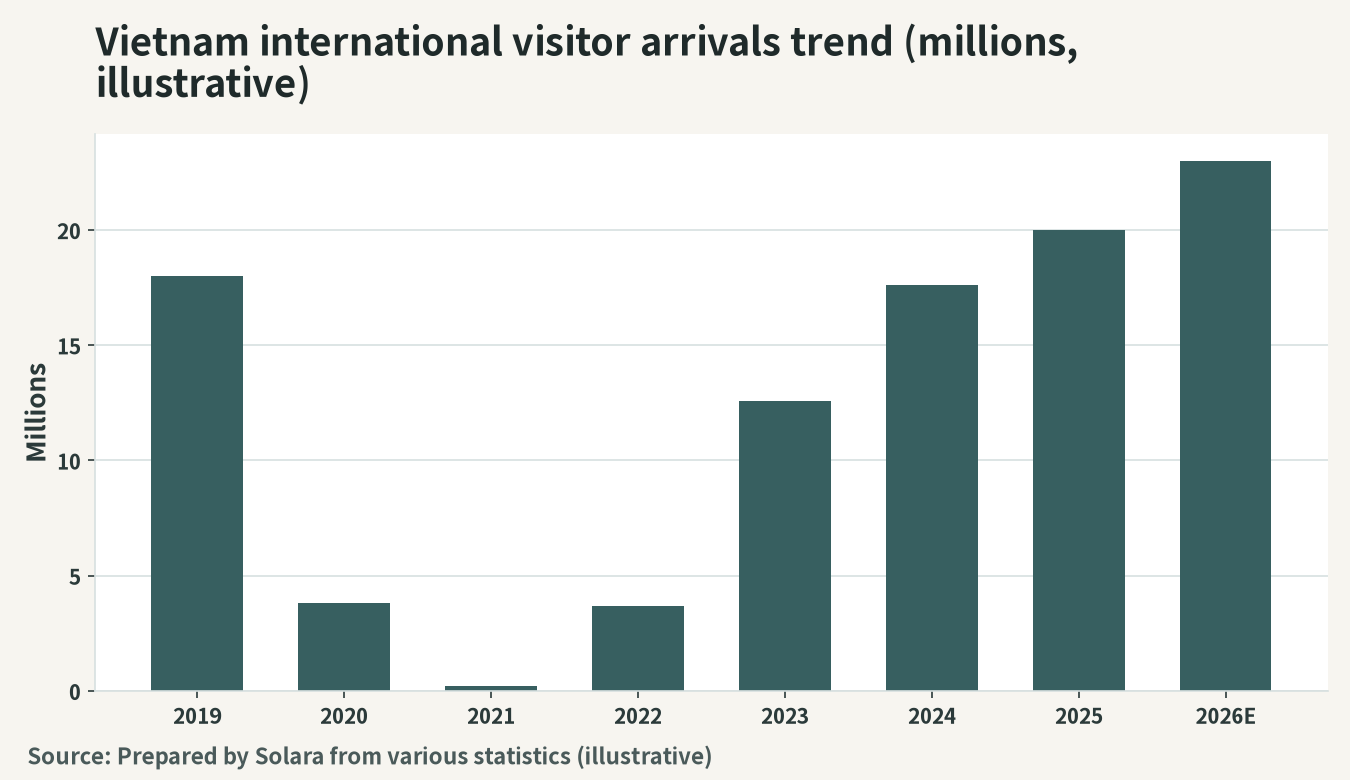
What drove the recovery was the relaxation of tourist visas. The amended Immigration Law that took effect in August 2023 opened e-visa issuance to nationals of all countries and territories worldwide and extended its validity from the previous 30 days, single entry, to a maximum of 90 days, multiple entry. It also raised the permitted stay under visa exemption from 15 to 45 days, and Phu Quoc Island grants foreign visitors a 30-day visa exemption — progressively dismantling institutional barriers. Such relaxation ties directly to capturing demand for long-stay, multi-destination travel as well as "bleisure" demand that combines business travel with leisure. In actual figures, the peak of roughly 18 million arrivals in 2019, after all but vanishing during the pandemic, recovered to about 17.5 million in 2024, with surpassing 20 million coming into view for 2025. In the source mix, South Korea is the largest, accounting for about a quarter of the total, while the recovery of arrivals from mainland China and the surge from India are becoming new drivers. In addition, the increase in direct international flights to resort areas such as Da Nang and Phu Quoc has supported the inflow of visitors. The recovery in visitor numbers has spread to broad-based industries such as lodging, food and beverage, retail, and transport, contributing to the revitalization of regional economies.
Diversification of the Visitor Mix
The composition of visitors is also changing. In addition to the traditional major source countries, visitors from emerging markets such as India and the Middle East have increased, diversifying the visitor mix. A broader visitor base lowers the risk of dependence on any single country and contributes to stabilizing tourism demand. At the same time, demand for high-value-added tourism products aimed at the wealthy and luxury segments is also rising, advancing a trend that lifts not only the "quantity" of tourism but also its "quality" and "unit price."
The Contribution of Tourism Revenue to the Economy
The recovery in visitor numbers spreads to the economy as a whole through the expansion of tourism revenue. The direct and indirect economic contribution of the travel and tourism industry is said to reach about one-tenth of GDP, and its recovery lifts income and employment across a wide range of areas, including the regions. The government has set out a policy of growing tourism into a key industry accounting for 12-14% of GDP by 2030, while also setting an ambitious target of some 35 million international arrivals by 2030. Such policy goals draw in public investment in airport and port expansion, tourism workforce development, and destination marketing, functioning as a framework that raises the predictability of private investment.
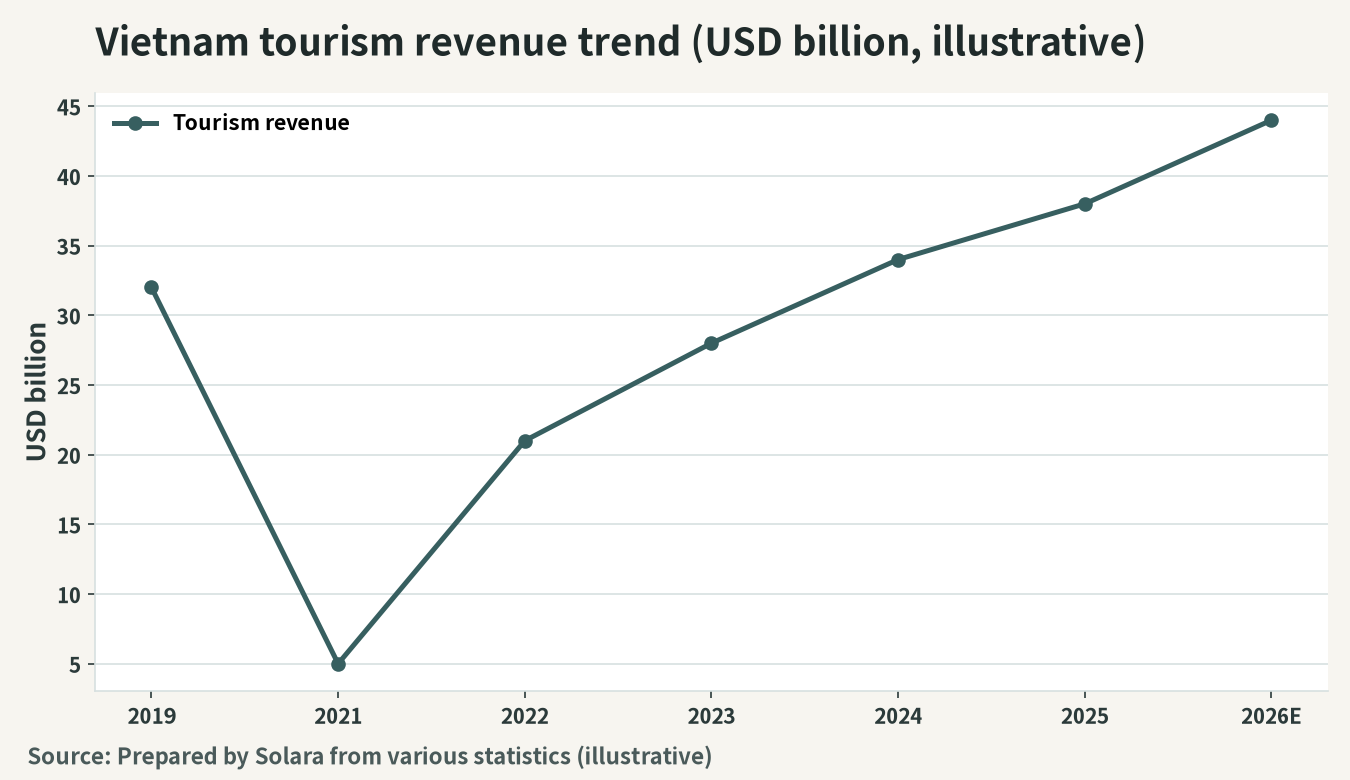
The growth in tourism revenue is driven not only by the recovery in visitor numbers but also by the rise in per-capita spending. Longer stays and increased spending on high-value-added experiences and lodging are raising both the "quantity" and "quality" of revenue. Tourism is a "broad-based industry" that spreads demand across many sectors — lodging, food and beverage, transport, retail, and entertainment — so its recovery has a multiplier effect on the economy as a whole.
Marine Tourism as a Growth Frontier
Vietnam is a maritime nation with a coastline exceeding 3,000 km and countless islands. "Marine tourism," which leverages this rich marine resource, is drawing attention as a growth frontier for Vietnamese tourism. Cruises on Ha Long Bay, beach resorts on Phu Quoc Island, marine activities in Nha Trang — tourism that takes the sea as its stage brings longer stays and higher per-capita spending.
The strength of marine tourism lies in Vietnam's geographic diversity. Ha Long Bay in the north is known for the scenic beauty of its World Heritage landscape, and its tourism circuit is expanding to neighboring Cat Ba Island and Lan Ha Bay. Da Nang and Hoi An in the center combine beaches with history and culture; Nha Trang and Cam Ranh are a cluster of large-scale resorts; and Phu Quoc Island in the south is a hub of duty-free and resort development — each offering a different appeal. In addition, as-yet-undeveloped ecotourism-suited destinations such as the Con Dao archipelago, accessible by high-speed ferry from Ho Chi Minh City, are also drawing attention as the next growth frontier. Visitors can enjoy diverse marine experiences in a single trip, and this leads to longer stays and repeat visits. In resort development in island areas, building infrastructure such as airports, ports, and roads to enhance visitor convenience becomes an important precondition for tourism investment. As with the expansion of Phu Quoc International Airport or the development of a dedicated cruise terminal at Ha Long Bay, the fact that the receiving capacity of hard infrastructure directly governs the unit price and turnover of tourism products is something that cannot be overlooked in investment decisions.
Cruises and Luxury Resorts
The fields with especially high growth expectations are cruise tourism and luxury resorts. Development as a port of call for international cruise ships is advancing, and in places such as Ha Long Bay and Phu Quoc, overnight cruises offering refined cruise experiences are gaining popularity. In addition, global hotel brands are entering, and the development of high-end beach resorts is becoming more active. Marine tourism generates diverse revenue sources — lodging, food and beverage, experiential activities, marinas, and retail — and is an area with high unit prices and broad reach within tourism investment. On the other hand, balancing marine environmental conservation with tourism development — that is, attention to sustainability — will determine long-term competitiveness.
MICE — Pioneering High-Value Business Tourism
Another growth area of tourism is MICE (Meetings, Incentives, Conferences, Exhibitions). Compared with ordinary leisure tourism, MICE has a higher per-capita spending, generates weekday demand, and has a large spillover effect on the regional economy, making it a high-value-added field that countries compete to attract.
Vietnam is advancing the development of large convention centers and hotels and facilities capable of hosting international conferences in major cities such as Hanoi, Ho Chi Minh City, and Da Nang. The National Convention Center (NCC) in Hanoi, the Saigon Exhibition and Convention Center (SECC) in Ho Chi Minh City, and the cluster of large resorts in Da Nang — which successfully hosted the 2017 APEC Summit — are symbolic hubs that demonstrate a track record of receiving international-standard MICE. Alongside economic growth and the expansion of foreign investment, Vietnam's appeal as a venue for corporate meetings, exhibitions, and incentive trips is rising. Because MICE attendees arrive on weekdays and use higher-priced premium rooms and ancillary services, attracting MICE compensates for periods when leisure demand falls and contributes to leveling out tourism demand. For Japanese companies, too, holding distributor award ceremonies, incentive trips, or regional headquarters meetings in Vietnam — where they have production and sales bases — is an option that reconciles strengthening their local network with cost efficiency, and the scope to use it is expanding.
The growth of the MICE market is not realized simply by building facilities. International-standard conference operation, comprehensive hospitality that bundles interpretation, catering, lodging, and transport, and the combination with attractive tourism resources (tour programs before and after the conference) determine a venue's competitiveness. With abundant tourism resources, relatively competitive costs, and improved access to major cities as its weapons, Vietnam is raising its presence in the regional competition to attract MICE. In the exhibitions and trade-fairs field, against the backdrop of manufacturing clusters, the hosting of industrial trade fairs is also becoming more active, creating a structure in which business-purpose visitor demand and tourism complement each other.
Organizing the Investment Opportunities in Tourism
The following organizes the main investment areas surrounding Vietnamese tourism.
Investment area | Content | Growth driver |
|---|---|---|
Hotels and resorts | Beach and urban hotels, luxury resorts | Rising visitor numbers, demand from the wealthy |
Marine tourism | Cruises, marinas, marine activities | Marine resources, longer stays |
MICE facilities | Convention centers, hotels for international conferences | High unit prices, demand leveling |
Aviation and transport | International routes, regional airports, tourism transport | Improved access, broader visitor base |
Tourism services | OTAs, experiential tourism, food and beverage and retail | Digitalization, rising per-capita spending |
Thus, tourism spans broad areas — lodging, transport, experiences, retail, and services — and the investment opportunities are likewise diverse. What they share is that the source of value is shifting from the recovery in the "quantity" of visitors to an improvement in "quality" — longer stays and higher per-capita spending. The more a provider can offer high-value-added tourism products and facilities, the more of the recovery's fruit it can capture.
Entry Approaches for Japanese Companies — Licenses and Business Formats
When considering entry into the tourism sector, the starting point is to discern the foreign-ownership rules and appropriate business format, which differ by business line. Taking the travel business as an example, international travel operations (inbound) that handle foreign visitors allow foreign capital to participate, whereas domestic travel operations that send domestic travelers are in principle limited to local capital. For this reason, a joint venture or business tie-up with a local travel company becomes a realistic option, and securing a partner that holds the license is a precondition of the business.
Hotel and resort operating businesses can be 100% foreign-owned, and entry formats fall broadly into three types. First is the management contract (MC), in which the brand handles operations as well; second is the franchise, which provides the trademark and operating know-how; and third is the lease format, in which one leases the property and operates it oneself. Investors choose the format that suits their strategy based on the allocation of capital burden, brand strength, and operating risk.
As for land, in Vietnam foreigners and foreign companies cannot own land itself; what can be acquired is the land-use right (LURC). For the condotels and villas supplied in resort development, the institutional framework for the documents that prove ownership (the so-called "pink book") is still developing in some segments, affecting exit strategy and the establishment of collateral. Because acquiring such land and permits requires a considerable lead time, the approach of acquiring an existing, already-operating business that comes with licenses and land through M&A is a realistic and powerful option that shortens the startup period and curbs permitting risk. In an acquisition, due diligence that closely examines the target business's ownership relationships and contract terms is indispensable.
Points to Note When Investing
Although the tourism sector carries high growth expectations, investment has its own particular points to note. First is the volatility of tourism demand. Tourism is easily swayed by external factors such as the economy, exchange rates, international affairs, natural disasters, and infectious disease, making it an industry with large swings in demand. The experience of the pandemic strongly impressed upon us this vulnerability. When investing, a business plan that builds in resilience to demand fluctuations is essential.
Second are issues related to real estate and land. Hotel and resort development is closely tied to acquiring land-use rights, intended use, and environmental and construction permits. In development near the coastline or natural environments, attention to environmental regulation and sustainability becomes even more important. Third are local partners and operations. Because the quality of human-delivered service determines competitiveness in tourism and hospitality, securing and training local talent and selecting reliable operating partners determine success or failure. Fourth is the competitive environment. The competition to attract visitors against regional tourism powers such as Thailand, Indonesia, and Malaysia is fierce, and the question is whether one can differentiate not only on price but on experience quality, brand, and marketing. These risks must be assessed through investigation and due diligence of the target business and partner. Especially in M&A of tourism and hotel businesses, closely examining the actual state of the business — occupancy rates and booking status — as well as land and building ownership relationships and the terms of operating-entrustment contracts becomes a precondition for the investment decision.
Conclusion — The Investment Opportunity Lies in the Shift to "Quality"
Vietnamese tourism has moved its phase from recovery to growth beyond the pandemic, and foreign visitor arrivals are setting a new record high. What is important is that the recovery is not merely a return of "quantity" but is accompanied by a shift to "quality" toward high-value-added fields such as marine tourism, luxury, and MICE. It is precisely in this process of transition that diverse investment opportunities are arising — hotels and resorts, marine tourism, MICE facilities, and tourism services.
Solara & Co holds bases and human networks in both Japan and Vietnam, providing integrated support from considering investment in Vietnam's tourism and hospitality sector, to market research, acquiring partners through M&A and joint ventures, pre-acquisition credit investigation and due diligence, and verification of land and permits. Capturing the tailwind of the recovering market while carefully assessing demand fluctuations and immediate risks — we believe that balancing the two is the shortcut to achieving results in Vietnamese tourism investment.