
The Success or Failure of Entering Vietnam Is Decided by "Connections"
In advancing business in Vietnam, the presence of a local partner is decisive. A sales distributor, a procurement supplier, a joint-venture counterpart, an outsourcing contractor, and a trustworthy advisor—whether you can find the right partner greatly shapes the speed and the success or failure of your market entry. Vietnam is a society that values person-to-person ties (relationships), and "whom you know" is the gateway to business opportunity.
This is where business matching comes into play. Trade fairs, business meetings, support programs run by JETRO, chambers of commerce and local governments, industry associations, introductions from local advisors, online platforms—the means of meeting partner candidates have diversified. Yet it is not so simple as "show up at a matching venue and you will find a good partner." A meeting is no more than a starting point; the process design that follows—appraising candidates, building a relationship of trust, and reaching a contract—is the key to turning business matching into results.
This article organizes the practice of developing local partners through business matching in Vietnam—from how to use the various matching channels selectively, to appraising candidates, building relationships, and the process leading to a contract.
The Main Channels of Business Matching
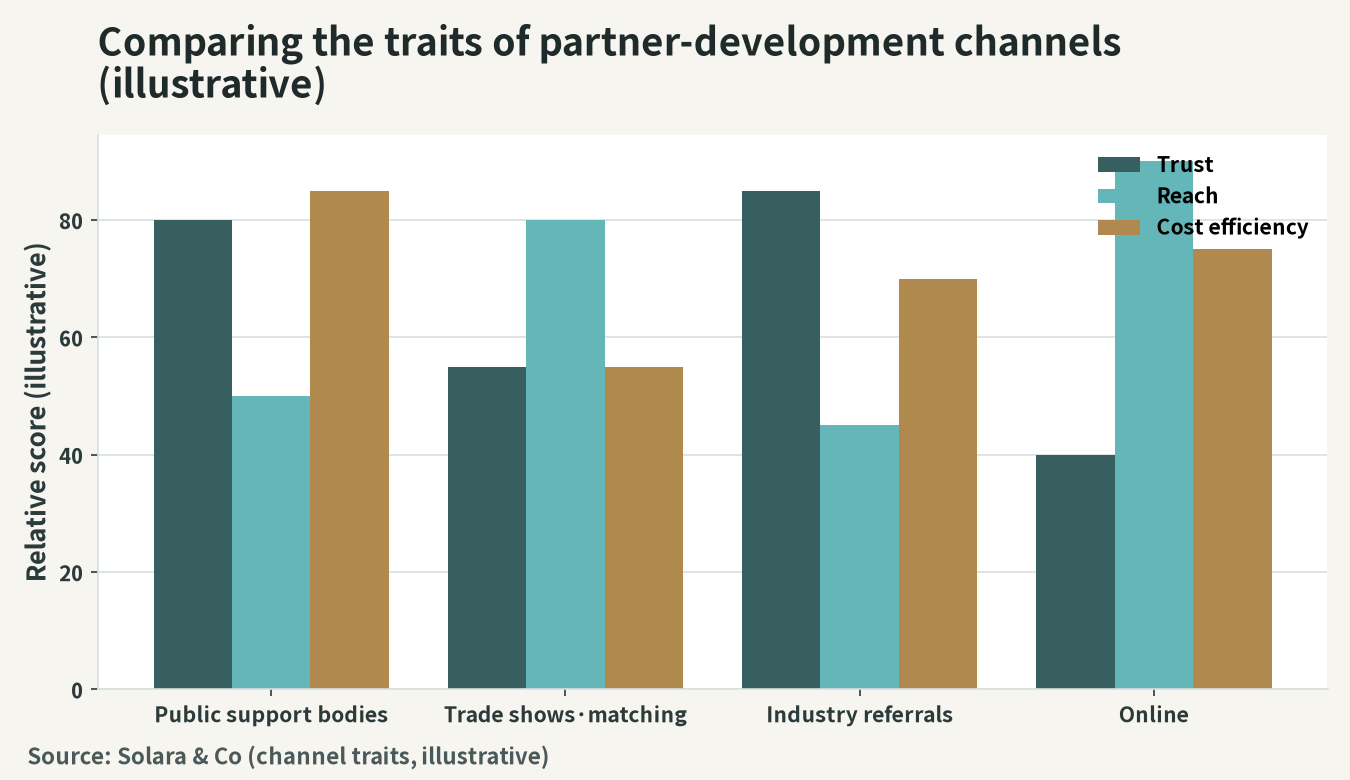
There are multiple channels for developing partners, and which ones are effective differs by purpose, industry, and stage.
Leveraging Public Support Institutions
JETRO (the Japan External Trade Organization), the chambers of commerce and industry in each region, local governments' overseas-expansion support, and Vietnam's own investment-promotion agencies are highly credible gateways to matching. An introduction through a public institution carries a certain backing of credibility and is effective for gathering candidates in the early stage. For small and medium-sized enterprises in particular, it is useful in that you can reach credible candidates while keeping costs down. On the other hand, public support is, after all, merely an "introduction"; the subsequent appraisal and negotiation must be advanced by your own company. Whether an introduced candidate truly matches your purpose cannot be confirmed without separate verification.
Trade Fairs and Business Meetings
Industry trade fairs and business meetings (business-matching events) hosted by the public and private sectors are venues where you can make contact with many candidates in a short period. By researching the exhibiting and participating companies in advance and setting your sights on the counterparts you want to meet, your efficiency changes dramatically.
Industry Networks and Introductions
Introductions from existing business partners, local industry associations, peers in the same industry, and specialist advisors are a powerful route to meeting high-quality partners. In Vietnam, an introduction from a trustworthy person carries great weight as a starting point for relationship-building. Because an introduction triggers the counterpart's psychology of "saving the face of a trustworthy person," it has the advantage that initial trust forms quickly. Going through an advisor with a thick network on both the Japan and Vietnam sides lets you efficiently reach candidates that fit your industry and purpose. In supplier development, gathering candidates through such a network advances the localization of local procurement.
Online Platforms
In recent years, the means of searching for candidates through corporate databases and matching platforms has also spread. The advantage is that you can access many candidates beyond geographic constraints, but because online information alone does not reveal the real situation, the appraisal described later is indispensable. The more attractive a company's profile appears, the more it demands the caution of verifying its actual business scale, finances, and transaction reality. A two-stage approach—gathering a broad pool of primary candidates online, then narrowing to the promising ones for deeper examination through face-to-face meetings and due diligence—is efficient.
From Meeting to Appraisal — The Due Diligence Perspective
The most important yet most overlooked aspect of business matching is "how to appraise the counterpart you have met." Matching is, after all, only a point of contact with a candidate; whether that counterpart is worthy of trust must be verified separately.
Why a Credit Investigation Is Indispensable
In Vietnam, the transparency of corporate information is limited, and a good-looking company brochure or a fluent presentation may not be backed by reality. Before proceeding to a transaction or alliance, a credit investigation—confirming the counterpart's actual existence, business reality, financial condition, credit information, and the presence or absence of disputes—is indispensable. "It is an introduced counterpart, so it is safe" is not necessarily true; the credibility of the introducer and the credibility of the counterpart are two different things.
What to Confirm
You confirm the corporate registration (actual existence, business scope), the substance of the actual business, financial soundness, the reputation among business partners and in the industry, and the character of the management. The deeper the relationship you proceed to (a joint venture, a large transaction), the higher the level of confirmation. In the case of a full-fledged alliance, an investigation comparable to financial due diligence is needed, and its key points are covered in Financial Due Diligence in Vietnam. In Vietnam, beyond querying registration and financial information against primary sources, combining on-the-ground interviews with the counterpart's business partners and field verification lets you grasp realities that documents alone cannot reveal. In particular, it is important to confirm—through third-party testimony and concrete transaction records—whether what the counterpart explains it "can do" is backed by an actual track record.
The Depth of Appraisal According to Your Purpose
The depth you should appraise changes depending on whether it is a one-time transaction, a continuing supply relationship, or a joint venture—a long-term marriage. The selection of a joint-venture partner in particular requires a three-dimensional evaluation of capability, soundness, and compatibility, and its practice is detailed in The Practice of Selecting a JV Partner in Vietnam.
The Practice of Relationship-Building
In Vietnam, building a relationship of trust is the premise of business. Rather than immediately entering terms negotiation with a counterpart you have met through matching, the time spent nurturing the relationship shapes the results.
Trust Is Built over Time
Meeting face to face several times, understanding the counterpart's business and character, and showing how serious your company is—this kind of accumulation supports the relationship in Vietnam even more than a contract. It is rare for a deep alliance to be decided by a single, formal meeting; continuous dialogue cultivates trust. If the Japanese side, impatient for short-term results, skips the relationship-building stage and enters terms negotiation, it gives the counterpart the impression of being "not trusted" or "merely used," and the relationship grows distant instead. The posture of "the longest way round is the shortest way home" turns out, in the long run, to be the faster route.
Bridging Language and Culture
Differences in language and business customs are a source of misunderstanding and lost opportunity. The presence of personnel or partners who can bridge—not by mere word-for-word interpreting, but by grasping context and intent—raises the quality of relationship-building. An intermediary versed in local circumstances is also useful for reading the counterpart's true intentions and the reality of their business.
Turning a Meeting into a Contract or Transaction
Stage | Main Activities | Points to Note |
|---|---|---|
Candidate search | Matching, introductions, trade fairs | Enter with a clear purpose |
Initial contact | Interviews, understanding the company | Do not overtrust first impressions |
Appraisal | Credit investigation, reality check | An introduction ≠ credibility |
Relationship-building | Continuous dialogue, mutual understanding | Take time to build trust |
Contract | Terms negotiation, contract signing | Document roles and responsibilities |
What to Nail Down in the Contract
When the relationship deepens and you proceed to a transaction or alliance, make the division of roles, the scope of responsibility, prices and terms, the handling of intellectual property, dispute resolution, and the rules for dissolution clear in writing. If you proceed on a verbal promise, leaning on a good relationship, you lose your footing when interests come into conflict. In Vietnam, a culture that values relationships of trust and the practice of defining rights and obligations through a clear contract are not contradictory. Rather, sharing the premises through a contract while the relationship is still good protects long-term trust. The governing law and the means of dispute resolution (arbitration or litigation, and where the seat of arbitration is) are also important matters that should be set at the outset in preparation for later disputes. The key points of contracts with distributors and agents, and of joint-venture contracts, are covered respectively in Vietnam's Distribution Channels and Cracking the Retail Market and in the explanation of JV selection.
Building a Relationship That Does Not End in a Single Deal
A good partner becomes a presence that, beyond a single transaction, brings you new business partners, information, and opportunities. By faithfully performing the first transaction, keeping your promises, and being mindful of the counterpart's success as well, the partner gradually becomes the very foundation of your business in Vietnam. The perspective of building long-term relational assets—not merely optimizing short-term transaction terms—leads to sustained growth in the Vietnamese market.
Where Business Matching Stumbles
Making the Meeting the Goal
Collecting many business cards at a matching event and feeling satisfied is a typical failure. A meeting is the start; only by designing the subsequent process of appraisal, relationship-building, and contracting does it lead to results.
Skipping the Appraisal
If you prioritize speed and skip the credit investigation, you risk teaming up with a partner that has no real substance or a counterpart carrying problems. The higher the heat of the encounter, the more important a cool-headed appraisal becomes.
Over-Reliance on the Introducer
The sense of security of "it is an introduction from a trustworthy person" sometimes makes the appraisal lax. The credibility of the introducer and the credibility of the introduced counterpart are two different things. An introduction is, after all, only the creation of a point of contact; the reality of the counterpart itself must be verified independently.
The Main Causes of Stumbling in Partner Development
The causes of partner development failing to translate into results are concentrated in specific stages.
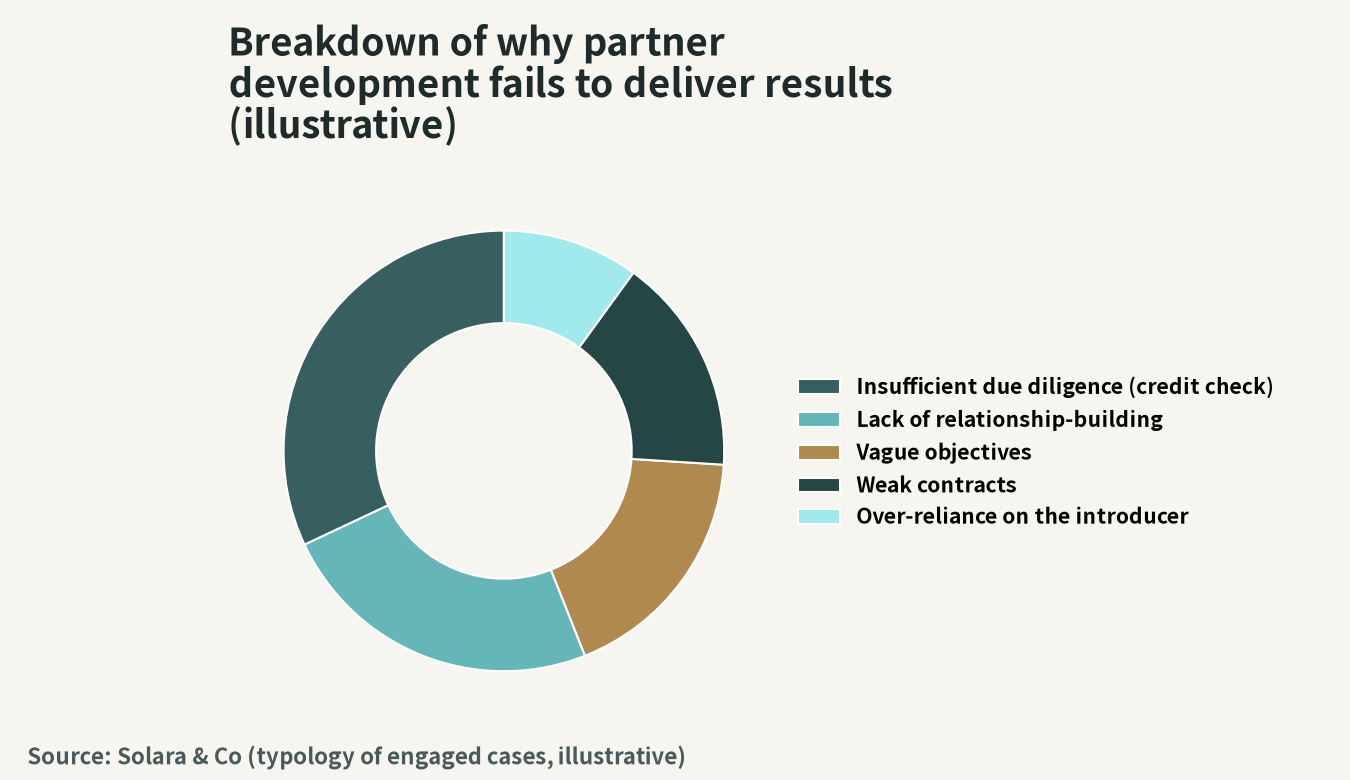
The largest factor is a lack of appraisal (credit investigation), followed by a lack of relationship-building from making the meeting the goal, ambiguity of purpose, and then deficiencies in the contract. All of these can be greatly reduced if you design the whole span from meeting to contract as a single, continuous process.
Solara & Co's Partner-Development Support
Business matching in Vietnam is not something where "you meet and results follow." Meeting candidates through means suited to your purpose, appraising the counterpart through a credit investigation, taking time to build a relationship of trust, and clarifying roles and responsibilities through a contract—only by designing this entire process as a single line does local partner development translate into results.
Solara & Co has bases and human networks on both the Japan and Vietnam sides, and provides seamless support from searching for and introducing partner candidates, to appraisal through credit investigation, to support for relationship-building that includes bridging culture and language, and on to contract design. So that it does not end in a mere "introduction" but instead builds a sustained relationship with a trustworthy partner, we support you from the first step of organizing together "what kind of partner you are looking for, and for what purpose."