
"Being Able to Hire" and "Being Able to Retain" Are Two Different Problems
One of the worries most frequently voiced by executives of companies entering Vietnam concerns people. "We can hire, but they quit right away," "just as we've trained them, a competitor poaches them," "even when we raise pay, they don't stay"—these voices tell the story of the Vietnamese labor market's character. For a Japanese company to succeed in Vietnam, it must treat recruitment and retention as separate challenges, yet design them within a single, unified talent strategy.
Vietnam's labor market, on the one hand, has a young and abundant workforce; on the other, it is marked by wages rising in step with economic growth, a low resistance to changing jobs, and intensifying competition for talent in urban areas. In particular, mid-level and specialist talent who combine language ability and management skills are in chronic short supply, so neither acquiring nor retaining them is easy. Entering the market on the image of "cheap labor" alone means running into hiring difficulty and a high turnover rate. The reality of labor costs is detailed in The Reality of Labor Costs in Vietnam.
This article explains, from a practitioner's standpoint and in a systematic way, the entire path from hiring to retaining people in Vietnam. We organize how to use the various recruitment channels, the key points in selection, and the retention measures that prevent turnover—together with the factors specific to Vietnam.
Understanding the Vietnamese Labor Market
A Young Workforce and the Trend of Rising Wages
Vietnam has a young median population age, and each year a large number of new graduates enter the labor market. At the same time, against a backdrop of economic growth and inflation, wages are rising year by year, and the premise of "cheap labor" is fading. The minimum wage, too, is revised periodically by region.
A Culture Where Changing Jobs Is Common
In Vietnam, changing jobs in search of better conditions is common, so the Japanese premise of long-term or lifetime employment does not hold. Young people in particular move flexibly between workplaces, comparing pay, growth opportunities, and the work environment. This is not "betrayal" but common sense in the market, and companies need to build a talent strategy founded on this premise.
The Shortage of Mid-Level and Specialist Talent
The hardest to acquire is the mid-level tier—people who can use Japanese or English and who have management experience and specialist skills. This tier is in great demand, and the going rate for compensation is rising as well. How well you can hire and hold on to excellent mid-level talent determines the success or failure of local operations. Japanese-speaking talent in particular tends to be fought over among Japanese-affiliated companies, and without added measures such as language allowances and a clear career path, securing them has become difficult.
Regional Differences in the Labor Market
The south, centered on Ho Chi Minh City, and the north, centered on Hanoi, have labor markets of differing character. The south has a deep pool of talent in commerce, services, and consumer goods, and job-changing is active; the north has a cluster of manufacturing and engineering. In areas where industrial parks are concentrated, competition for talent with nearby companies is fierce, so it is important to grasp the regional going rates for wages and benefits before designing your compensation.
The Practice of Recruitment
Using the Recruitment Channels Strategically
Vietnam's recruitment channels include job sites, recruitment agencies (headhunting), partnerships with universities, employee referrals, and social media. The effective channel differs by role and tier: job sites and referrals work for frontline workers, while headhunting and referrals work for specialists and managers.
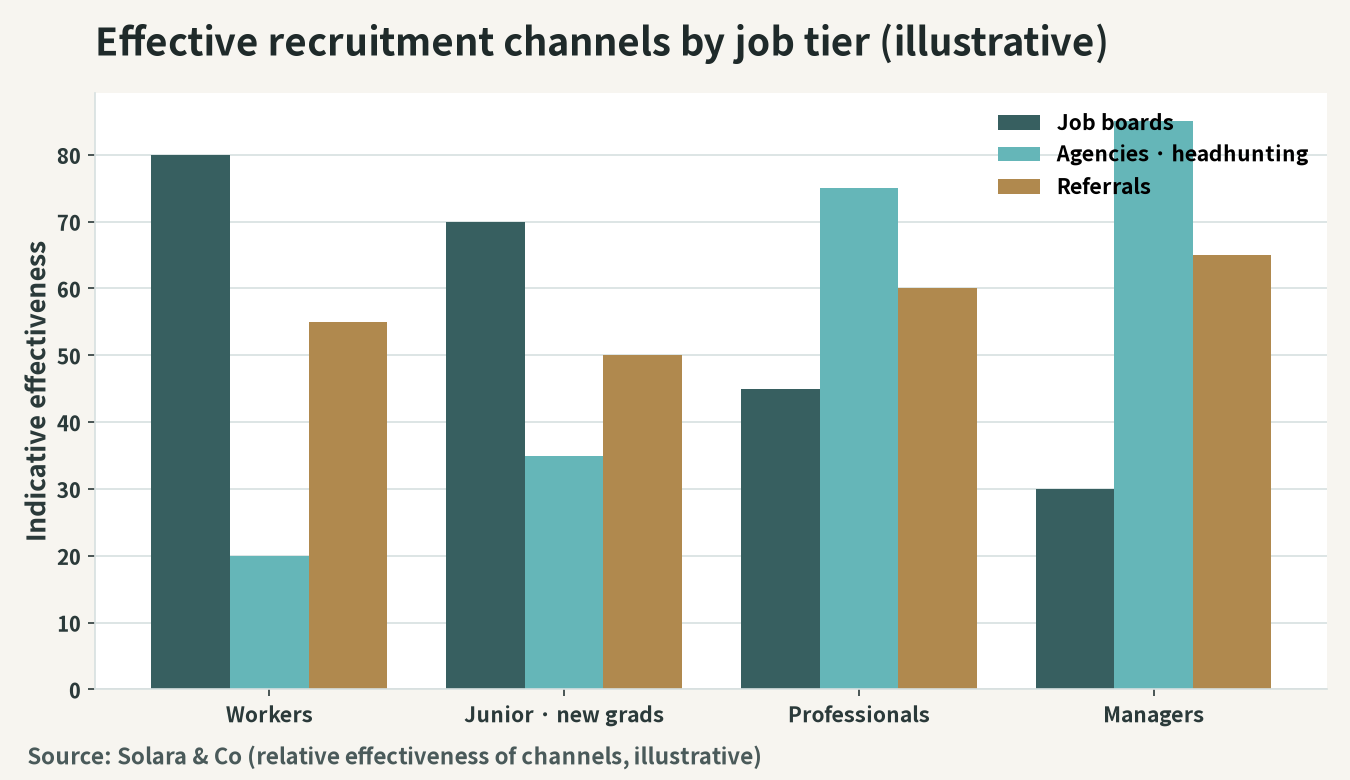
Organizing the characteristics of the main recruitment channels, they can be used as follows.
Channel | Suited tier | Strength | Points to note |
|---|---|---|---|
Job sites | Workers・young hires | Large candidate pool | Variable quality of applications |
Agency・HH | Managers・specialists | Reaches the job-ready | High fees |
Referral | All tiers | High retention rate | Beware of homogenization |
University ties | New graduates・young | Secured on a develop-them basis | Cost and time to develop |
Social media・own channels | Young people broadly | Brand appeal | Requires sustained operation |
The Power of Referral Hiring
In Vietnam, hiring through the connections of trusted people (referral) is an effective way to acquire talent with a high retention rate. Because referred candidates join having understood the realities of the workplace, mismatches are less likely to occur, and community ties help reinforce their staying on.
What to Discern in Selection
Beyond skills and track record, discern the intent to stay, fit with the team, and whether self-reporting is free of exaggeration. In Vietnam, self-reported experience and qualifications can diverge from reality, so reference checks (inquiries to the previous employer) and practical skills verification are effective. Hiring is not "hire and done"; discernment that looks ahead to retention is important.
The Practice of Retention
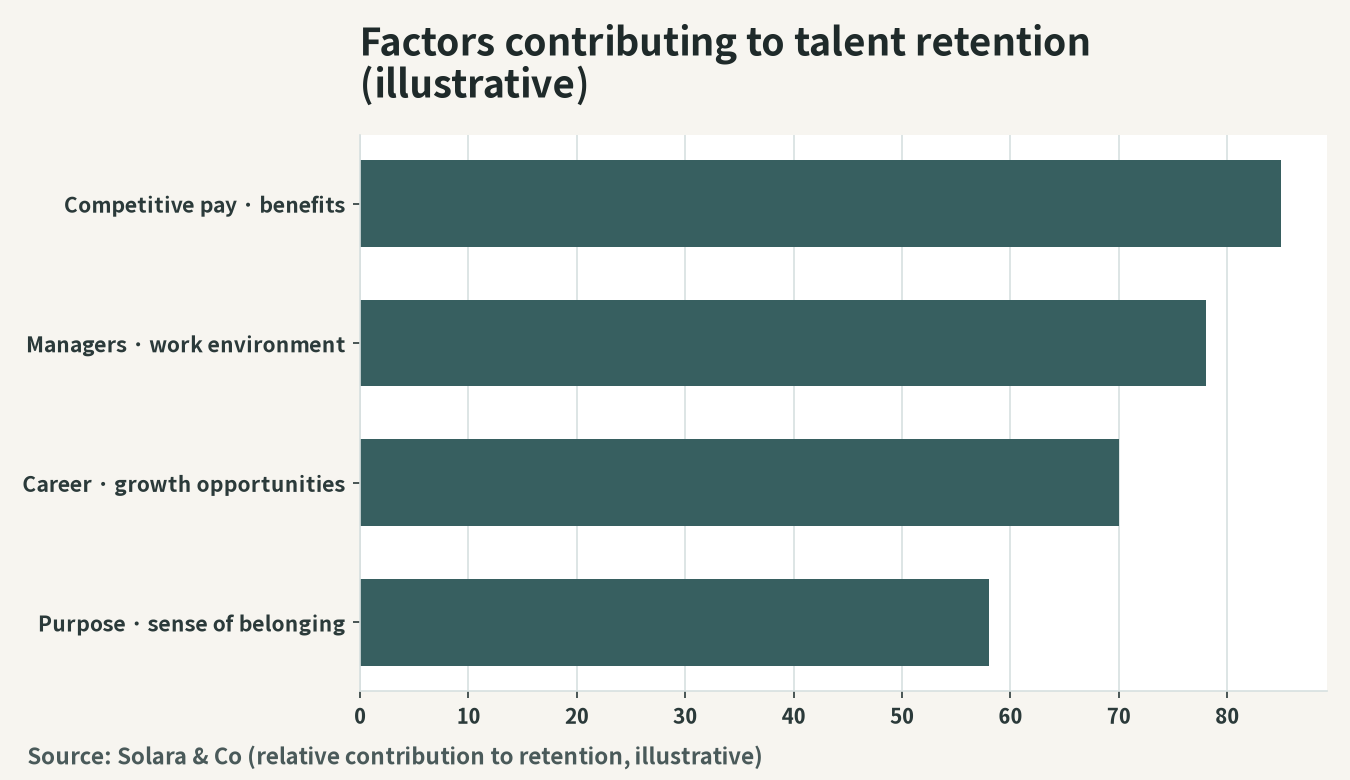
Harder than hiring is retention. If talent you went to the trouble of hiring and training quits, both the hiring cost and the training investment come to nothing. Retention works only when multiple elements are stacked on top of the foundation that is compensation.
The Foundation: Competitive Compensation and Benefits
The premise of retention is compensation and benefits commensurate with the market rate. With treatment below the going rate, no matter how much you speak of ideals, people flow out. Compensation should be designed as a total package—not just base pay, but social insurance, various allowances, bonuses, health insurance, and so on. That said, compensation is an element that "prevents dissatisfaction"; it does not, on its own, generate retention.
The Boss and the Work Environment
In Vietnam too, the rule that "people don't leave the company, they leave the boss" applies. The relationship with one's direct superior, fair evaluation, and a workplace environment that is easy to work in are important elements of retention. There are no few cases where the management style of Japanese expatriates does not fit local staff and invites turnover.
Career and Growth Opportunities
Young Vietnamese talent has a strong interest in growth and career advancement. Presenting growth opportunities—training, paths to promotion, and the assignment of responsible work—is effective in holding people. The sense that "if I stay at this company I can grow" curbs the temptation to change jobs. Showing concrete career paths, such as training opportunities at the Japanese head office or promotion to management posts at the local entity, becomes a point of differentiation from other companies in the eyes of excellent talent. Conversely, if the work stays the same no matter how many years pass, it is precisely the talent with high growth aspirations who leaves early.
Making the Cost of Turnover Visible
Turnover entails not only the loss of hiring costs and training investment but also hard-to-see costs such as confusion in handovers, an increased burden on remaining staff, the leakage of know-how, and a decline in the quality of customer service. Rather than leaving the turnover rate alone as "something unavoidable," making its real cost visible justifies investment in retention measures and raises its priority as a management issue. Grasping quantitatively that the departure of a single excellent person is a far greater loss than imagined is the starting point of any countermeasure.
Ideals and a Sense of Belonging
The highest-order retention factor is empathy with the company's ideals and a sense of belonging. The feeling that one's work has meaning and that one is respected as a member of the organization holds people beyond compensation or conditions. This cannot be built overnight; it is cultivated through the daily accumulation of the company's management posture.
Where Japanese Companies Stumble in Hiring and Retention
Importing the Japanese Way As Is
Bringing in seniority-based evaluation, vague role definitions, and the premise of long working hours just as they are does not resonate with Vietnamese talent and invites turnover. Management must be adapted to the values of the local market.
The Disconnect Between Expatriates and Local Staff
If decision-making leans toward Japanese expatriates and local staff feel they are "merely being used," engagement falls. Delegation of authority and the promotion of local talent lead to organizational stability. Giving excellent local talent responsible positions and discretion, and having them participate in management decision-making, works for both retention and the improvement of organizational capability. Because expatriates will eventually rotate out, building an organization in which local talent can take on the core leads to long-term stability of the business.
Communication and Mutual Understanding
Misunderstandings arising from differences in language and business custom are a breeding ground for frontline dissatisfaction and turnover. So that instructions do not become one-way, setting up mechanisms to gather the voices of local staff and venues for two-way communication helps build relationships of trust. The Japanese expectation of "please read between the lines" rarely works, so it is important to convey expectations and evaluation criteria clearly, in words.
Opacity in Evaluation and Pay Raises
If it is unclear what one must do to be evaluated and to receive raises and promotions, it is precisely the excellent talent who gives up. Putting in place a clear and fair evaluation system is the foundation of retention. By documenting the evaluation criteria and sharing expectations and the current state through regular feedback meetings, employees can understand where they stand and the direction of their growth, and a sense of conviction is born.
Neglecting Labor Compliance
Compliance with labor-related laws—employment contracts, social insurance, working hours, dismissal procedures—is a precondition that comes before retention. Vietnam's labor law has a strong worker-protection coloring, and deficiencies in contracts or procedures can lead to disputes or to being flagged by the authorities. Proper labor management is both the foundation for earning employees' trust and the company's own risk management.
Talent Risk in M&A and PMI
When acquiring a Vietnamese company through M&A, the retention of talent is directly tied to the success or failure of PMI (post-acquisition integration). The defection of key people breaks the synergy that was priced into the acquisition. The practical side of HR and organizational risk after M&A is covered in detail in Vietnam M&A: HR and Organizational Risk to Prevent PMI Failure. For the perspective of subsidiary governance and fraud prevention, please also refer to Governance of Vietnamese Subsidiaries.
Solara & Co's Support for Talent Strategy
When it comes to talent in Vietnam, "being able to hire" and "being able to retain" are entirely different challenges. Only when you understand the character of a young and fluid labor market, use the recruitment channels strategically according to role and tier, and stack the boss and work environment, growth opportunities, and ideals and a sense of belonging on top of the foundation that is compensation—only then does talent stay. Designing hiring and retention not as separate things but as a single talent strategy is the condition for stable local operations.
Solara & Co draws on its networks on both the Japanese and Vietnamese sides and its knowledge of local operations to provide end-to-end support—from designing the talent strategy, to selecting and helping execute recruitment channels, to designing evaluation and compensation systems, to retention measures, and to assessing talent risk in M&A. To break the vicious cycle of "they're hired but they quit" and "we train them and they're poached," we begin our support with the first step of sorting out your own company's talent challenges together.