
Vietnam's Automotive and Parts Industry at a Turning Point
Vietnam's automotive industry stands at two major turning points at once: "from assembly to parts" and "from the internal combustion engine to the EV." Against a backdrop of a population exceeding 100 million, a rapidly expanding middle class, and demand to switch from two wheels to four, the four-wheel market holds substantial room to grow over the medium and long term. At the same time, for a long while this country's automotive industry centered on completed-vehicle (CKD) assembly and knock-down imports, and the low local content of parts (the local procurement ratio) has been regarded as a structural weakness.
Now, that picture is changing. The full-scale mass production of electric vehicles (EVs) by domestic makers, the supply-chain realignment of global automakers, and the entry of parts makers driven by "China Plus One" are overlapping, and the base of the parts industry is starting to thicken. This article organizes the current state of Vietnam's automotive market and the trend toward EVs, and reads—from a practical standpoint—where in the parts supply chain the opportunities lie for Japanese companies.
The Current State and Growth Potential of Vietnam's Automotive Market
Vietnam's four-wheel ownership rate is still low even within Southeast Asia, and automobile penetration per capita lags far behind Thailand and Malaysia. Turned around, this means Vietnam is on the "eve of motorization," when four-wheel demand will rise all at once as incomes climb.
From a Two-Wheel Power to Four Wheels
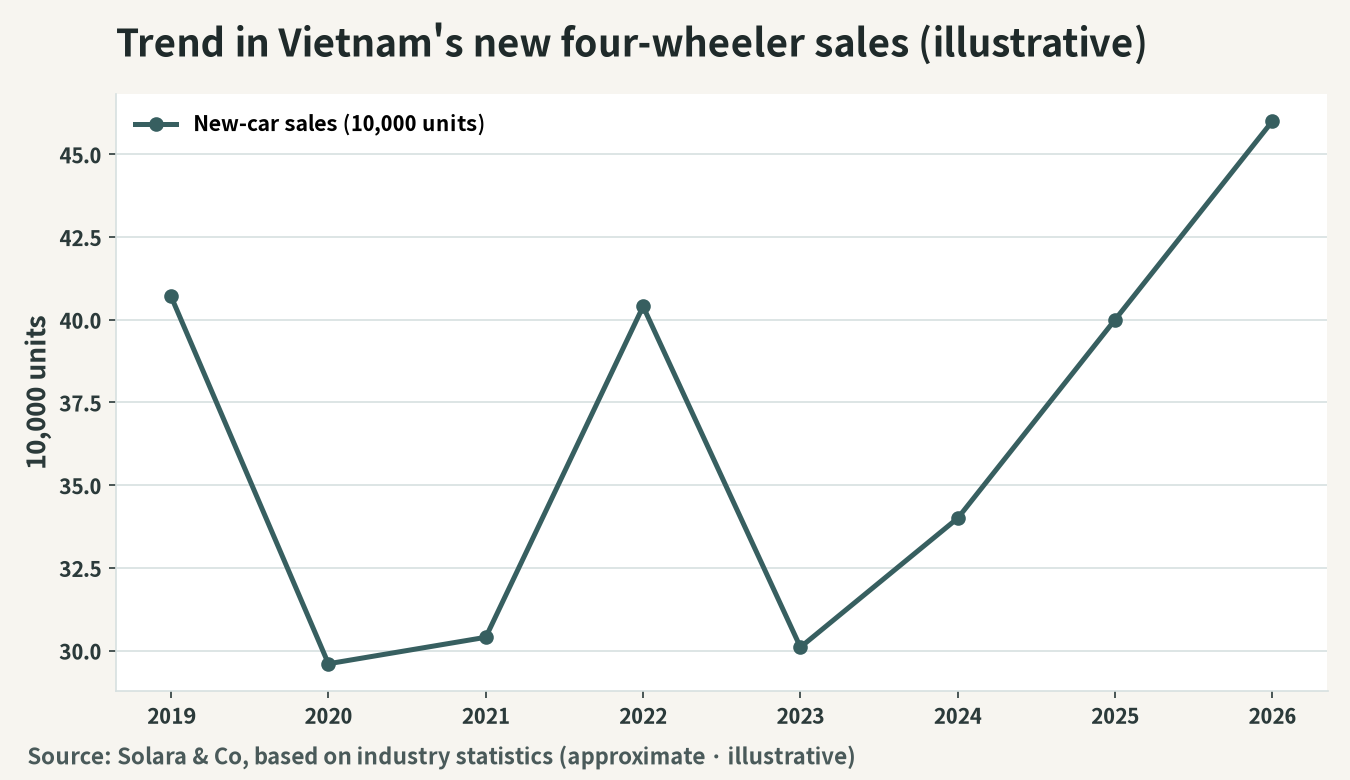
Vietnam is one of the world's leading two-wheel nations, and the means of urban mobility is still dominated by motorbikes. However, with the expansion of the middle class and the advance of urbanization, the segment of households buying their first four-wheel vehicle is steadily increasing. The tendency for four-wheel demand to surge once GDP per capita exceeds a certain level is common across countries, and Vietnam is approaching exactly that threshold. New-vehicle sales, while subject to year-to-year economic swings, are on a structurally upward trajectory.
Competition Between Domestic Makers and Foreign Brands
In the market, while Japanese and Korean global brands have built a firm position in assembly and sales, domestic brands are rising. In particular, the emergence of an EV-dedicated maker backed by domestic capital is rewriting the market's structure. The clustering of completed-vehicle makers within the country generates demand for parts, materials, and logistics suppliers in their vicinity, becoming a starting point that broadens the base of the entire industry.
How EVs Rewrite the Industrial Structure
The global shift to EVs is, for Vietnam, an opportunity not just to "catch up" but to "leapfrog." A "leapfrog" strategy—in which Vietnam, having lagged the advanced economies by decades of accumulation in the internal combustion engine (ICE), aims to gain a degree of lead on the new playing field of the EV—is taking on a sense of reality.
National Policy Backing EV Adoption
Against the backdrop of environmental targets and international pledges on carbon neutrality, the government has set out preferential treatment for EVs (reductions and exemptions of registration taxes and the like) and policies for developing charging infrastructure. Domestic makers have steered toward EV specialization, and electrification—including two-wheel EVs—is spreading from urban areas. Policy and the mass-production investment of domestic makers act as two wheels of the same cart, lifting the initial demand for EV adoption.
Ripple Effects on the Parts Supply Chain
Electrification fundamentally changes the contents of the parts supply chain. While demand for ICE-specific parts such as engines, transmissions, and exhaust systems shrinks, demand surges in new domains such as batteries, motors, inverters, power semiconductors, battery materials, thermal management, and in-vehicle software. This "recomposition of demand" creates room for new entrants unbound by existing keiretsu, and becomes a major opportunity for Japanese parts and materials makers with technological strength. The number of parts that make up a single automobile reaches tens of thousands, and with EVs the composition ratio shifts greatly from mechanical parts toward the electrical, electronic, and battery systems. The domains in which Japanese companies have strengths—power electronics, motor windings, the cathode and anode materials, separators, and electrolytes of batteries, and in-vehicle connectors—lie right at the center of this recomposition.
Charging Infrastructure and the Localization of Batteries
Alongside vehicle price, the bottleneck for EV adoption lies in the development of charging infrastructure. Expanding the charging network at urban commercial facilities, residences, and along trunk roads is a decisive factor that nudges buyers toward replacement. At the same time, because batteries account for a large portion of an EV's cost, where to place the local assembly of battery cells and packs and the procurement network for battery materials becomes important on both fronts: cost competitiveness and rules of origin (enjoying the tariff merits of FTAs). The further the localization of batteries advances, the more local demand for the materials, components, and manufacturing equipment that support it arises in a chain.
The Tiers of the Parts Supply Chain and the Local Procurement Ratio
The auto parts industry has a pyramid structure with the completed-vehicle maker (OEM) at the apex, linking down through Tier 1 (primary), Tier 2 (secondary), and Tier 3 (materials and processing). Vietnam's challenge lies in the fact that the middle and lower layers of this pyramid are thin, and much of the high-value-added parts has depended on imports.
To raise the local procurement ratio, it is necessary to thicken not only Tier 1 but also the network of local suppliers underpinning it at Tier 2 and Tier 3 (precision processing, molds, resin molding, electronic components, surface treatment, and the like). Here lies room for Japan's mid-sized and small suppliers with technological capability to break in. The more completed-vehicle makers are pressed to raise the local procurement ratio, the more the demand to localize base parts structurally rises.
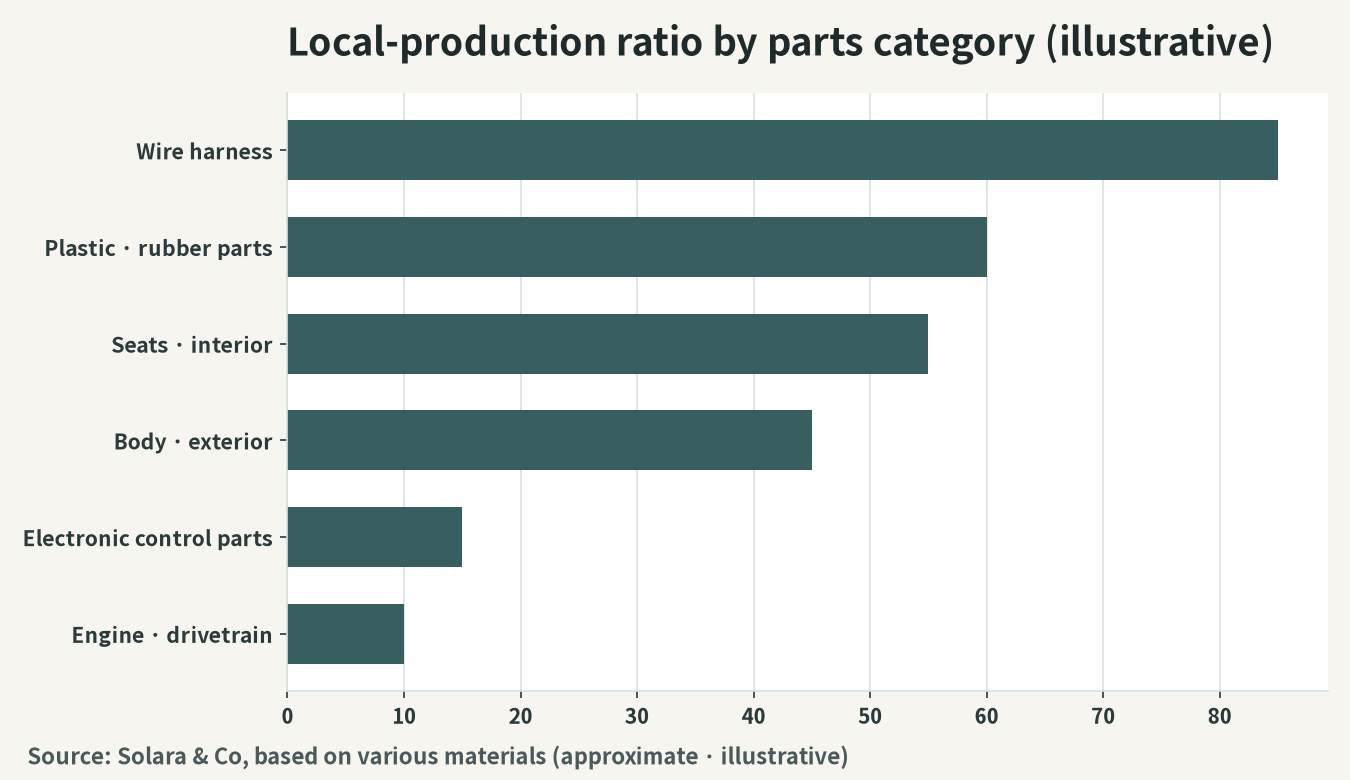
At present, the auto parts produced in Vietnam are skewed toward relatively low-difficulty plastic and rubber parts, seats, wiring harnesses, and body exteriors, while high-value-added parts such as engines, transmissions, and electronic controls have continued to depend on imports. That is precisely why investment to fill these "blank zones" can expect first-mover gains. For completed-vehicle makers, the presence of a nearby, reliable supplier ties directly to inventory compression, shortened lead times, and stable quality, so partners who advance localization together are welcomed.
Behind the thinness of the supporting industries lies a structural problem: the wall of demand volume. When annual completed-vehicle output per model stays at a scale of only tens of thousands of units, mold investment and the depreciation of dedicated lines are hard to justify, and Tier 2 and Tier 3 cannot bring themselves to localize—this "chicken-and-egg" relationship has long capped the local procurement ratio. Turned around, now that expanding domestic demand and concentrated production by EV-dedicated makers are lowering the volume hurdle, it is also a turning point at which the localization of parts that previously did not pay off can move all at once.
Policy, Taxation, and the Cultivation of Supporting Industries That Sway Business Viability
In gauging the viability of a parts business in Vietnam, what cannot be avoided is an understanding of tax policy and industrial-development policy. Completed vehicles are subject to a special consumption tax (SCT) according to engine displacement, and the larger the displacement the higher the rate, which has pushed up vehicle prices. In response, the government has set a time-limited preferential rate for battery EVs and, combined with an exemption of the registration fee, has lowered the initial burden at the point of purchase. Because such tax design greatly sways which segment demand flows toward, it is also a precondition for parts makers in deciding their product portfolio.
On the tariff front, under the ASEAN Trade in Goods Agreement (ATIGA), import duties on completed vehicles recognized as originating within the region have been abolished. To gain originating status, the local and in-region procurement ratio of parts must exceed a certain level (roughly forty percent), and this is a powerful incentive pressing completed-vehicle makers to raise their local procurement ratio. As the flip side of the pressure from cheap imported vehicles flowing in from Thailand and Indonesia, the more a maker continues domestic assembly, the more it must seriously commit to cultivating nearby base suppliers. For Japanese parts makers, it is precisely this structural demand—"localization to satisfy rules of origin"—that becomes the foothold for entry.
Furthermore, the government positions the cultivation of supporting industries as a national priority, and has put in place, through decrees, incentives such as reductions and exemptions of corporate income tax for the production of eligible parts and exemptions of import duties on equipment and raw materials. Time-limited corporate-income-tax incentives for companies in industrial parks or certified as high-tech are also not to be overlooked in drawing up an investment-recovery scenario. However, the requirements for applying these incentives involve complicated procedures, and whether certification is granted can sometimes shake the premises of a business plan, so scrutinizing applicability before entry together with tax and legal experts is the practical key to preventing later swings in profitability.
The Clustering of Japanese Parts Makers and "China Plus One"
Vietnam is one of the largest recipients of the global supply-chain realignment, the so-called "China Plus One." Against a backdrop of dispersing geopolitical risk, labor costs, a young workforce, and increasingly well-developed industrial parks, the relocation and new establishment of manufacturing bases—from electronic components to auto parts—continues.
Industrial Clustering in the North and South
The North (around Hanoi, Haiphong, Bac Ninh, Hai Duong, and the like) has developed as a cluster for electronics and electrical machinery, and that foundation has rippled into auto parts as well. The South (Ho Chi Minh City, Dong Nai, Binh Duong, and the like) has long held an industrial cluster, with assembly and parts bases forming layers. The expansion of port and logistics infrastructure also supports the import and export of parts and the in-region supply chain.
The Dual Nature as an Export Base
Vietnam's auto parts industry has two faces: one aimed at the domestic market and one at exports. For labor-intensive parts typified by wiring harnesses, Vietnam has already become one of the world's leading export bases. Both domestic demand from the country's motorization and export demand from being incorporated into the global supply network underpin the industry's growth. Its role as an export base supplying parts to completed-vehicle plants in Japan and across the ASEAN region, combined with the tariff merits of free trade agreements (FTAs) concluded within the region, is expected to keep expanding.
Investment Opportunities and Risks
Precisely because it is a market with high growth, the opportunities and risks must be assessed calmly. The table below organizes the investment opportunities and risks by major segment.
Segment | Main Investment Opportunities | Risks to Note |
|---|---|---|
EV-related parts | Batteries, motors, power semiconductors, thermal management | Shifts in technical standards, the large size of initial investment |
Base parts (Tier 2/3) | Localizing precision processing, molds, resin, electronic components | Quality and delivery management, securing talent |
Wiring harnesses, etc. | Expansion as a labor-intensive export base | Wage increases, exchange-rate fluctuations |
Aftermarket | Repair and maintenance demand as the vehicle fleet grows | Building distribution networks and brands |
Logistics and parts procurement | Industrial-park location, building an in-region procurement network | Regional disparities in infrastructure development |
There are three common points to note. First is assessing the quality, delivery, and finances of local suppliers. When transacting or partnering with local companies outside the keiretsu, the information asymmetry is large, and credit investigation is indispensable. Second is securing and developing talent. The competition to acquire engineers and skilled workers is fierce, and a compensation design that raises retention is required. Third is the risk of shifts in policy and standards, requiring continuous tracking of trends in EV incentives, emissions regulations, and rules of origin (FTA utilization).
How Should Japanese Companies Participate — Solara's Perspective
Vietnam's automotive and parts industry is in a growth phase, riding two tailwinds—the rise of domestic demand and electrification—as the base of the parts supply chain thickens. For Japanese parts and materials makers whose strengths are technology and quality, multiple entry points are open: localizing base parts, entering the new domains of EVs, and leveraging the country as an export base.
The key is designing the form of entry. In addition to going solo, the option of "buying time"—acquiring factories, talent, transaction networks, and licenses all at once through a joint venture or M&A with an existing local parts maker or a leading supplier—is also effective. In that case, because the information asymmetry over the target company's finances, quality systems, and off-book liabilities is large, credit investigation and due diligence before acquisition are indispensable.
Solara & Co has bases and human networks in both Japan and Vietnam, and provides integrated support from market research and the formulation of entry strategy, to the selection of local partners, the execution of M&A and joint ventures, and credit investigation and due diligence before acquisition. We help turn the great opportunity of the automotive industry's structural transformation into solid results.