
Market Overview: Why Vietnam's Education Market Is So Promising
Vietnam's education market is drawing attention as a field with exceptionally high energy, even by Asian standards. Behind this lies the strong willingness of households to invest in education. Vietnamese parents tend to treat their children's education as the top spending priority, and a culture in which any rise in income is channeled first into education is deeply rooted. As the demographic dividend continues with a population of roughly 100 million and a young age structure, the simultaneous advance of a thick school-age population and rising purchasing power is a strength not found in other Asian markets.
On top of this, the growing orientation toward English and study abroad is lifting the market in qualitative terms. Looking ahead to global employment opportunities, the urban middle class that prizes English proficiency and admission to overseas universities is thickening, expanding demand for premium education such as international schools, language schools, and study-abroad preparation. The middle class's expanding consumption alongside rising incomes also moves in tandem with the growth of Vietnam's retail and consumer market, and education enjoys a demand-side tailwind as a priority item in household spending. For Japanese companies, this is a market with multiple points of entry where they can leverage their own strengths—from school operation and EdTech to language education and vocational training.
The Segment Structure of the Education Market
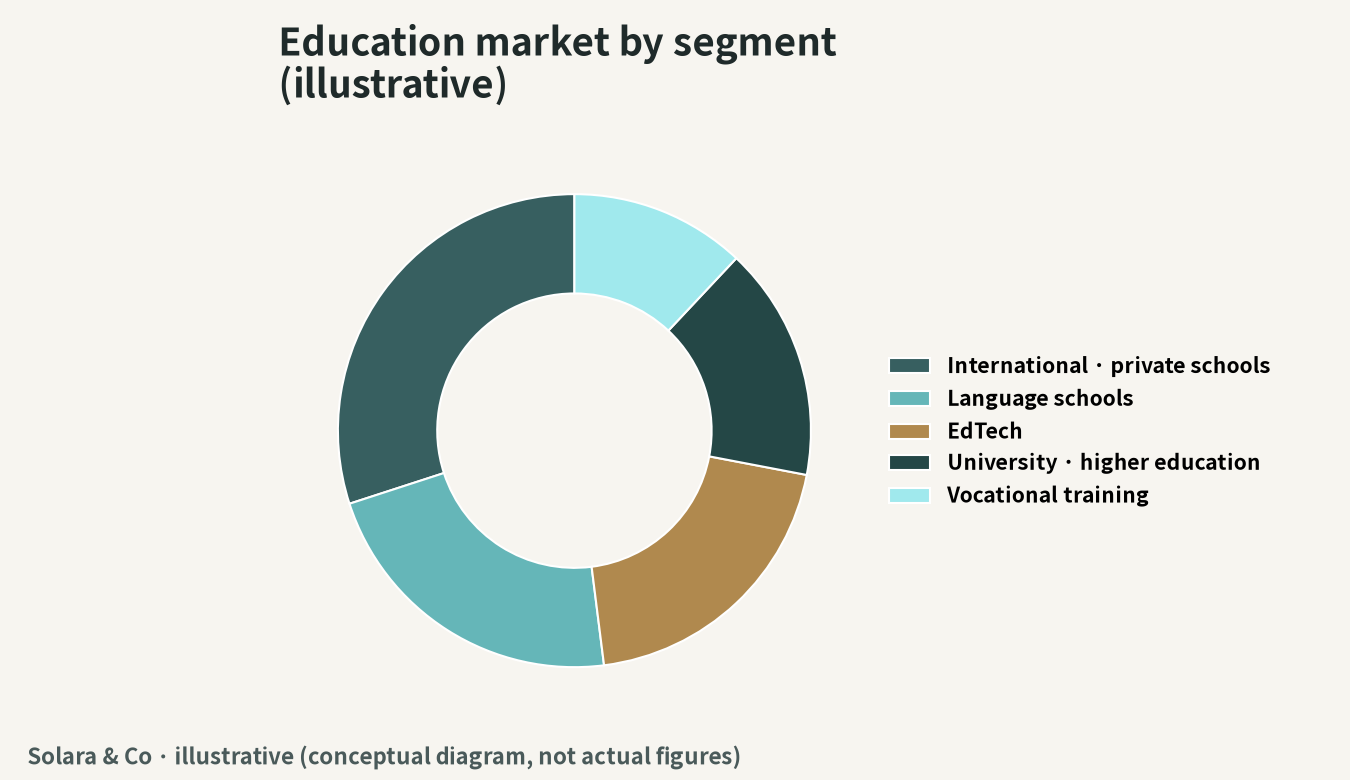
In practical terms, it is best to view Vietnam's education market as a collection of multiple segments with differing characteristics. First are international and private schools, which provide foreign curricula (British/American systems, IB, and so on) or bilingual education and capture the urban wealthy and the upper middle class with high tuition levels. Second are language schools, centered on English with a deep range from test preparation to business English—an area with relatively low entry barriers but fierce competition. Third are universities and higher education, where there is demand for high-quality higher education delivered through foreign capital or partnership programs.
Fourth is the rapidly growing EdTech field, spanning a broad range from online learning, English-learning apps, and skills/reskilling to learning management (LMS), expanding on the back of smartphone penetration and the high receptiveness of young people. Fifth is vocational training and skills education, practical education that responds to the human-resource needs of manufacturing, IT, and services. The composition of each segment is illustrated in the conceptual diagram below.
The required capital, payback period, the weight of regulation and licensing, and the character of the local partner needed differ greatly from segment to segment. The starting point for considering entry is not to think vaguely about "getting into education," but to define concretely: in which segment, to which customer (parents, students, businesses), and what value you will deliver.
The International School Market: Demand, Regulation, Foreign-Investment Conditions, and Tuition
International schools are one of the most symbolic and most profitable segments of Vietnam's education market. Centered on Ho Chi Minh City and Hanoi, demand for schools offering British/American or IB curricula is firm, and the target customer base is widening as the urban middle class's income rises. Tuition sits in the high band by domestic standards, and the quality of facilities, teachers, and curriculum is the deciding factor in choice. In urban areas where demand outstrips supply, enrollment capacity and location heavily determine the viability of the business.
At the same time, education falls under a conditional sector for foreign investment, and regulatory compliance occupies the core of the business plan. Establishing a school requires not only establishment and operating permits but also a stack of multiple requirements—minimum capital, school land and buildings, equipment, teacher qualifications, and curriculum approval—and operational constraints such as a cap on the proportion of Vietnamese students may be imposed. Understanding the full picture of these permits and approvals together with the basics of foreign-investment regulation, which lays out the system foreign entrants face, will improve the precision of your plan. It is essential not to be optimistic about the lead time for permits and approvals, but to factor it correctly into the school's opening timing and cash flow.
EdTech: Online Learning, English, and Skills
EdTech is the fastest-growing area in Vietnam's education market. High smartphone penetration, young people's digital receptiveness, and the social need to close the education gap between urban and rural areas overlap, and online learning services are spreading rapidly. English learning in particular is the largest demand category, with app-based learning, online English conversation, and test preparation all thriving. In addition, reskilling in IT and digital skills, programming education for children, and business-skills education for working adults are also growing.
EdTech makes it easier to keep initial investment down compared with running a school and offers high agility at launch, while user-acquisition cost and retention determine viability. The keys to differentiation are content quality, localization, the convenience of payment and billing, and the combination with face-to-face (offline) delivery, that is, a hybrid model. From the standpoint of the supply capacity of digital talent, this also relates to the engineer base shown in the IT offshore development guide, and it is compatible with a design that places the development and operations structure locally. For the option of partnering with or investing in startups, Vietnam's startup ecosystem is also a useful reference.
The Regulatory Environment: Foreign-Investment Rules, Licenses, and Conditions
The education field is fairly heavily regulated in Vietnam as well, and understanding the regulation directly affects both the feasibility of entry and the choice of form. School operation and higher education are open to foreign investment but are conditional, with constraints imposed on establishment and operating permits, minimum capital, facility/teacher/curriculum requirements, and the enrollment ratio and scope of provision. Language schools and short-term education also carry requirements for registration and licensing as educational institutions and for teacher qualifications, and unlicensed operation is a high-risk area.
Even for businesses centered on software and content, such as EdTech, depending on the scope provided as an educational service, education-related permits may be involved, and consideration for personal-information/data protection and content regulation also becomes necessary. In practice, it is best to confirm the conditions for each target segment regarding the room for foreign entry and the constraints. What matters is not to view regulation solely as an "obstacle," but to build it into the design of the entry form (direct operation, FC, joint venture, investment) and to turn it into an ally as an entry barrier against competitors.
How to Choose the Form of Entry
The form of entry into the education market is designed according to the segment, the regulatory hurdle, and the size of the initial investment. The main options are direct operation (establishing and running a school yourself), franchise (FC) (leveraging an existing brand and operating know-how, or licensing your own brand), joint venture (JV) (teaming up with a local partner that holds the permits, land, and connections), and investment/M&A (acquiring existing permits, brand, and a student base to buy time). The image of the regulatory hurdle and the weight of the initial investment by form is shown in the conceptual diagram below.
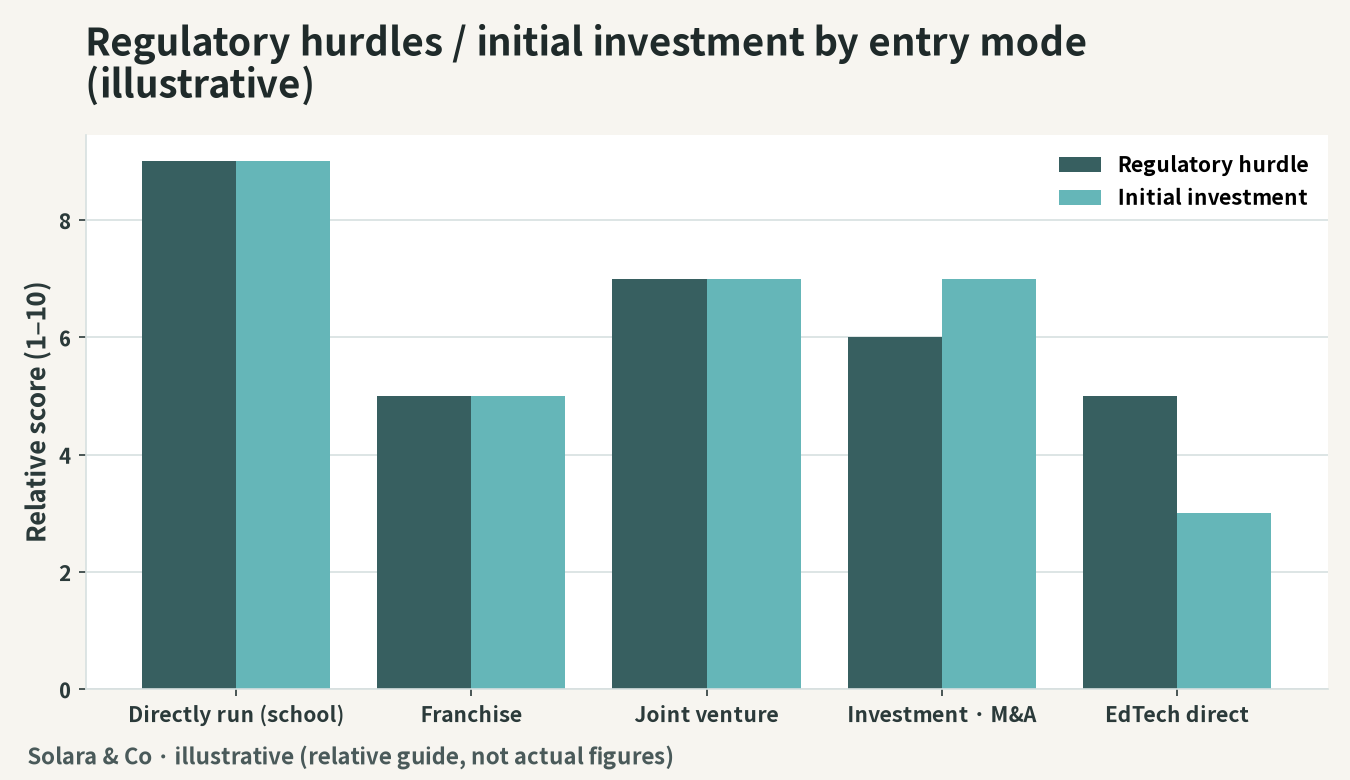
Organizing the characteristics of each form gives the following. It is important to choose a design that fits your own risk tolerance and goals from the balance of control strength, the weight of regulatory compliance, launch speed, and required capital.
Form of entry | Regulatory hurdle | Initial investment | Main fit |
|---|---|---|---|
Direct operation (school establishment) | High | Large | International schools / private schools |
Franchise | Medium | Medium | Language / skills / children's education |
Joint venture (JV) | Medium–high | Medium–large | School operation / higher education |
Investment / M&A | Medium | Medium–large | Existing schools / EdTech / language chains |
EdTech direct operation | Medium | Small–medium | Online learning / English / skills |
Opportunities, Challenges, and Talent
Viewed from the opportunity side, the promising areas are clear. International and private schools capture the quality orientation of the urban middle class; language and EdTech are supported by the depth of English and skills demand; and vocational training connects directly to industry's human-resource needs. The fact that demand is expanding structurally is this market's greatest attraction. In particular, not only in major cities like Hanoi and Ho Chi Minh City, but also in Da Nang and regional hub cities, rising incomes and urbanization are advancing, and the base for premium and online education is broadening. The substantial room to roll out a success model from a single city to others is also a factor underpinning medium- to long-term viability. On the other hand, the challenges are real: the complexity of regulation and licensing, the lead time for permits and approvals, securing location and school land, and above all talent—securing and retaining qualified teachers, excellent principals and operating heads, and digital personnel is what separates success from failure.
Securing and retaining talent is the very quality of the education business, and skill in recruitment, evaluation, compensation, and career design directly affects turnover rates and customer satisfaction. This point is closely tied to the practices organized in recruitment and retention of talent in Vietnam. Precisely because education is a labor-intensive business in which "people raise people," it is indispensable to design a sustainable operating structure on the basis of understanding the local labor market and business customs.
Solara & Co's Support for Entering the Education Market
Solara & Co, as an M&A and market-entry advisory connecting Japan and Vietnam, supports entry into the education field end to end. Specifically, we walk alongside you in line with the realities on the ground: from segment selection and market/competitor research; organizing the foreign-investment regulations, licenses, and conditions for each of international schools, language, EdTech, and vocational training; comparative design of the entry forms of direct operation, FC, joint venture, and investment; searching for and evaluating local partners and acquisition candidates; financial, tax, legal, and regulatory due diligence in M&A; through to support for building the organization, talent, and governance after opening and launch. Our role is to factor the complexity of regulation, the lead time for permits and approvals, and the distinctive difficulty of securing talent into the plan from the planning stage, thereby minimizing the "unexpected." When you are considering entering Vietnam's education market, please feel free to consult with us.