
Vietnam's Electronics and EMS Industry — the Biggest Lead Player Driving Exports
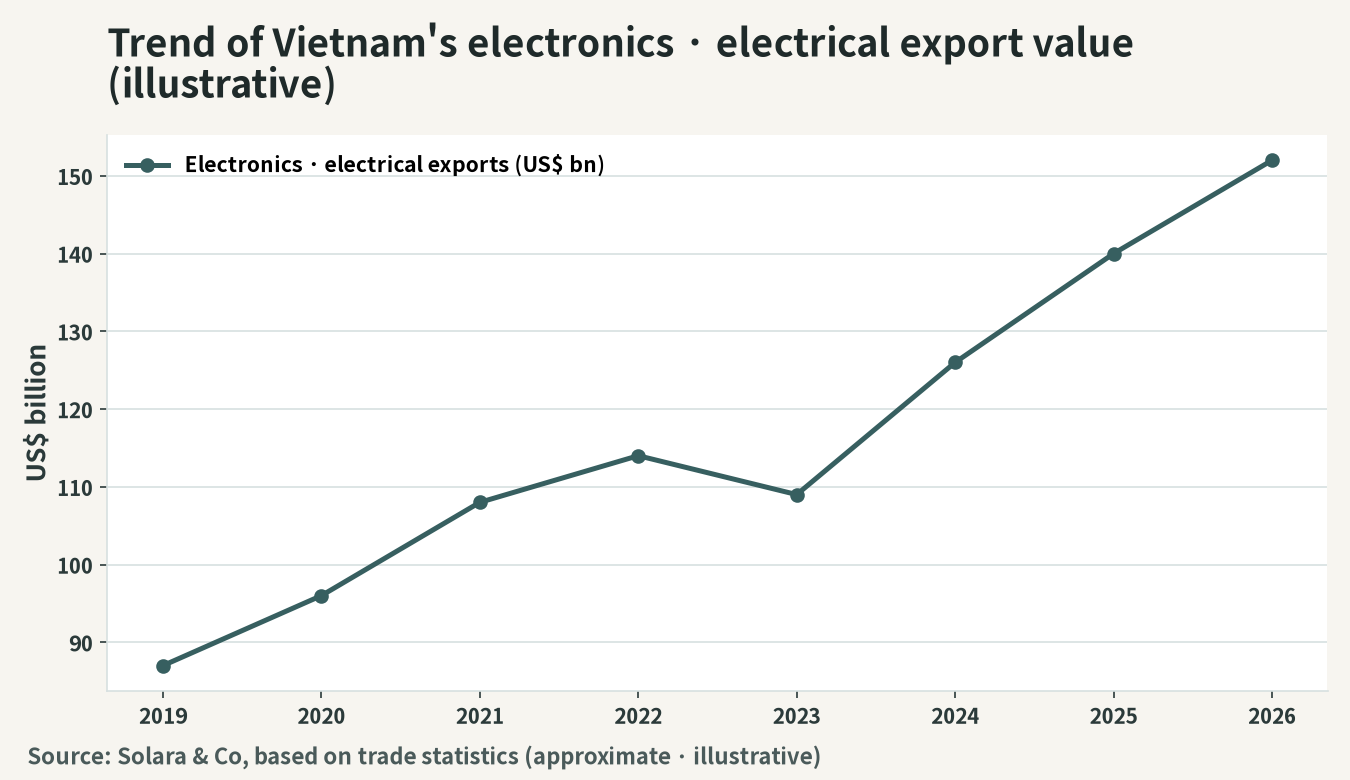
In any discussion of Vietnam's exports, the presence of the electronics industry is decisive. Smartphones, PCs, displays, and various electronic components now account for the largest share of Vietnam's total exports, pushing this country up to a corner of the "factory of electronic devices for the world." Bearing the core of this is the cluster of EMS (electronics manufacturing services) and ODM (original design manufacturing), which take on manufacturing contracted out by the world's electronics brands.
This cluster is no product of chance. The large investments of global brands act as priming water, suppliers of components, materials, and logistics gather around them, and further talent and technology accumulate—this "virtuous cycle of industrial clustering" has begun to turn in both the northern and southern regions. The electronics industry is also a major bearer of foreign direct investment (FDI), and a large portion of registered and realized FDI is directed at manufacturing, especially the electronics and electrical field. This article reads the structure of the investment cluster of Vietnam's electronics and EMS industry, and organizes from a practical standpoint where on the value chain Japanese companies' opportunities lie, and what risks should be prepared for.
Why the Electronics Industry Gathers in Vietnam
Behind Vietnam's becoming a major base for electronics and EMS, multiple structural strengths overlap.
The Biggest Recipient of China Plus One
Against the backdrop of US-China confrontation and the geopoliticization of supply chains, global companies are advancing "China Plus One"—dispersing production bases from a China-only concentration. Vietnam, armed with the geographic advantage of bordering China, political stability, improving relations with the US, and a network of numerous free trade agreements (FTAs), has become the biggest recipient of this realignment. Because electronic devices are susceptible to the influence of tariffs and logistics, the tariff benefit from FTAs becomes the decisive blow in location selection.
A Young, Abundant Labor Force and Labor Costs
Vietnam has a young average age and possesses an abundant labor force that is diligent and highly literate. For labor-intensive EMS centered on assembly processes, a stable labor supply and relatively low labor costs are a major attraction. In addition, there is a foundation of science and engineering talent, and room remains to raise the role of human resources from simple assembly to higher-value-added processes such as inspection, design, and automation. The relative cost advantage compared with the rising labor costs in coastal China further heightens Vietnam's attraction as a destination for relocating labor-intensive processes.
The Development of Industrial Parks and Infrastructure
In regions such as Bac Ninh, Bac Giang, Thai Nguyen, and Hai Phong in the north, and the outskirts of Ho Chi Minh City in the south, industrial parks equipped with power, water, and customs clearance have been developed, lowering the hurdle to entry. The expansion of logistics infrastructure such as ports, airports, and expressways also supports the procurement of components and the export of finished goods. Many industrial parks have one-stop administrative procedures and bonded-zone functions, and an environment in which foreign capital can launch operations in a short period is gradually being put in place. On the other hand, the stable supply of power and the availability of green power vary by location, and the more power-intensive the process, the more important advance confirmation of this point becomes.
The Geography of the Investment Cluster — the Two Poles of North and South
Vietnam's electronics industry has two poles geographically. The north, with the giant factories of world-class smartphone and electronics brands at its core, has a layered cluster of displays, camera modules, and electronic components. Its proximity to the component-supply network of South China is also a strength of the northern cluster. The south, meanwhile, on a foundation of a long-standing industrial cluster, has a spreading set of bases for semiconductor back-end processes, printed circuit boards (PCBs), and various electronic components.
This two-pole structure broadens the location-strategy options for entering companies. Whether to emphasize proximity to the final assembler, or to emphasize the component-supply network and port access—the optimal location differs according to product characteristics and one's position on the supply chain.
The Virtuous Cycle Brought by Clustering
The essence of industrial clustering lies in the accumulation of economies of scale and external economies. When a large factory for final products locates there, support services such as components, materials, jigs and tools, molds, logistics, talent referral, and equipment maintenance gather around it, and the later an entering company is, the lower the cost and the shorter the launch period with which it can begin operations. Furthermore, the skilled talent and management know-how accumulated locally circulate within the region, lifting the productivity of the whole industry. Regions where this virtuous cycle has begun to turn have a "stickiness"—once a cluster is formed, it does not easily move to another country. The north and south of Vietnam are precisely entering this stage, and companies that participate now can enjoy the benefit of the cluster's depth.
Vietnam in the Value Chain and the Opportunities of Japanese Companies
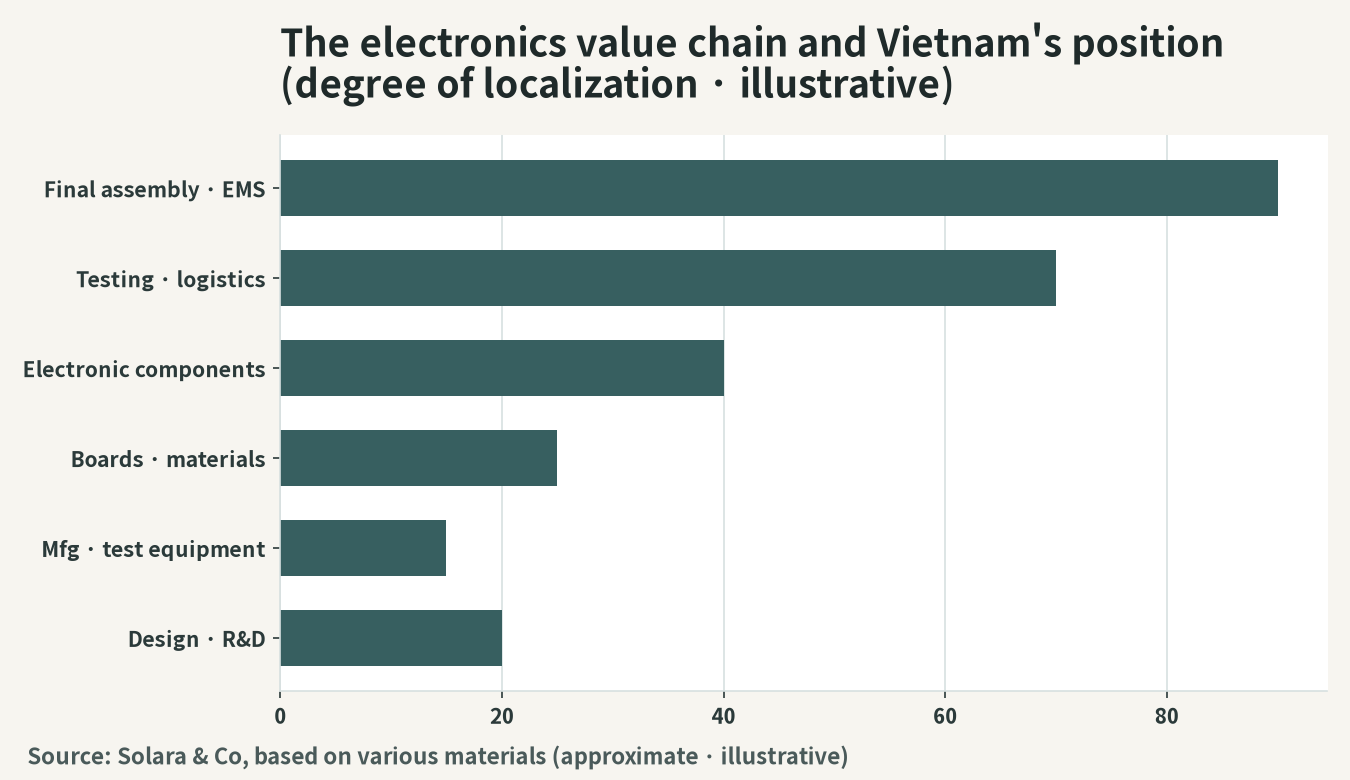
The value chain of electronics and EMS runs from upstream materials and components, through midstream assembly and contract manufacturing, to downstream inspection, logistics, and design. Vietnam, on one hand, has an overwhelming presence in midstream assembly and EMS; on the other, it relies on imports for much of the high-value-added components, materials, and manufacturing equipment upstream. This very "upstream gap" is the opportunity for Japanese companies. Even if the export value is large, as long as much of the value added is attributable to imported parts and materials, the value added that remains domestically is limited. It is precisely for this reason that Vietnam emphasizes the localization of parts and materials as a matter of policy too, and that direction coincides with the entry opportunities of Japanese suppliers.
Supplying Components, Materials, and Manufacturing Equipment
The more the EMS cluster advances, the more local demand is generated for the electronic components (connectors, passive components, sensors), materials (board materials, chemicals, films), and manufacturing and inspection equipment that support it. These fields are domains in which Japanese companies have world-leading competitiveness, and by setting up a supply base close by, they can achieve both shortened lead times and reduced exchange-rate risk. The more finished-goods makers seek to raise the local procurement ratio, the more the value rises of companies that can supply, in the vicinity, the high-quality parts and materials that have until now relied on imports. Not only supply, but whether one can provide local technical support, quality assurance, and short-delivery response as a set, becomes the branch point for being incorporated into the local procurement network.
Expansion into Higher-Value-Added Processes
Not stopping at simple assembly, higher-value-added processes such as precision mounting, inspection and testing, molds, automation (FA), and design support are where Vietnam's industry is heading amid rising wages. Japanese technology and know-how, combined with local talent development, can push this sophistication forward. In particular, demand for capital investment that automates and reduces manpower in processes that have relied on human labor is expected to rise further along with rising wages, and business opportunities are expanding in fields such as industrial robots, image inspection, and production-management systems.
Linkage with Semiconductor Back-End Processes and Data Centers
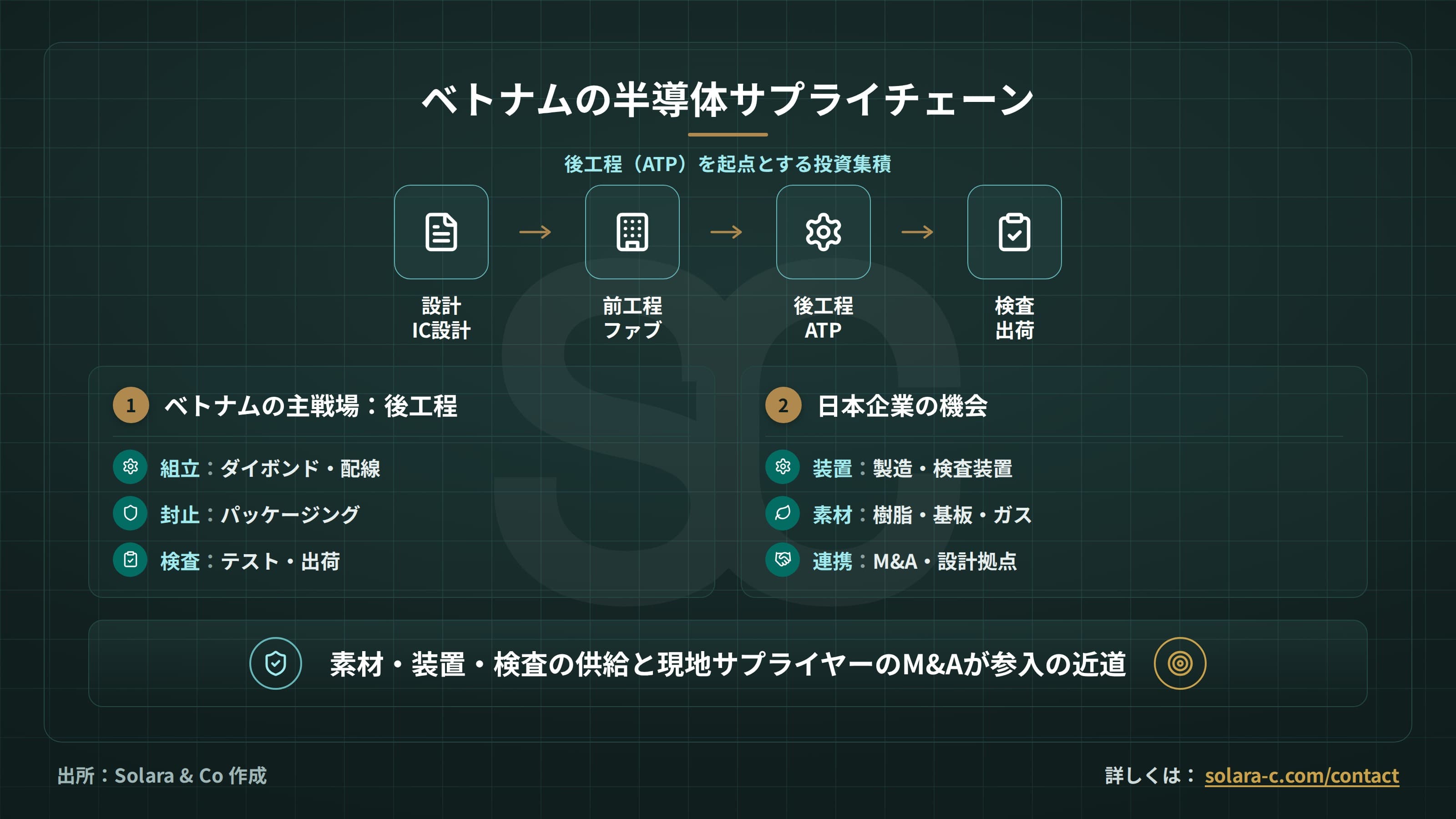
The clustering of the electronics industry also mutually reinforces with semiconductor back-end processes (assembly, test, packaging = ATP) and data-center investment. The skill base for the mounting and inspection of electronic components has high affinity with semiconductor back-end processes, and the expansion of data centers driven by AI demand generates new demand for power, cooling, and mounting materials. As electronics, semiconductors, and digital infrastructure unite and gain depth, the base of related parts, materials, equipment, and services will spread even further.
Investment Opportunities and Risks Seen by Segment
The opportunities of the electronics and EMS industry differ in character by segment. The table below organizes the opportunities and risks of the main segments.
Segment | Main investment opportunity | Risks to note |
|---|---|---|
Finished-goods EMS/ODM | Scale-up of contract manufacturing, becoming an export base | Customer concentration, price competition, rising wages |
Electronic components | Local supply of connectors, passive components, sensors | Quality certification, demand fluctuation |
Materials, boards | Localization of board materials, chemicals, films | Environmental regulation, initial investment |
Manufacturing, inspection equipment | Supply of FA, inspection, and automation equipment | Technical support system, talent |
Design, test | Sophistication of ODM, inspection, and design support | Securing talent, IP protection |
The risks to note have commonalities. First, it is an industry structure with high dependence on certain large customers, and fluctuations in customers' production plans greatly govern the utilization rate. Second, due to rising wages and competition to poach talent, designing treatment that raises retention is indispensable. Third is the protection of intellectual property and response to environmental and labor regulations. These need to be managed through information rooted locally and the selection of trustworthy partners.
The Rules, Costs, and Power to Master in Practical Entry
At the stage of translating a strategy on paper into actual operations, three practical points—taxation, labor, and power—divide success and failure. Here, we concretely organize the regulatory and cost structures that form the premise of location selection and the business plan.
Tax Incentives and Supporting-Industry Policy
Vietnam has prepared corporate income tax incentives for the high-tech field and supporting industries. For projects that meet the requirements, support such as preferential tax rates, reductions or exemptions for a fixed period, and exemption of import duties on equipment and raw materials may be available, and the local production of electronic components and materials is a domain readily eligible for this policy backing. What matters is that whether an incentive is granted is governed by requirement screening such as "high-tech certification" or "inclusion in the supporting-industry list," so before applying, one must confirm whether the target process and product meet the requirements, and build the acquisition of necessary certifications into the investment plan in advance. It is essential to recognize that incentives are not granted automatically, but are something to "go and obtain" through regulatory design and procedure. Because the cultivation of local second- and third-tier suppliers is emphasized as a matter of policy, the more a parts maker is incorporated into the local procurement network, the better positioned it is to enjoy this tailwind.
How to View Wages, Social Insurance, and Total Labor Cost
Labor cost cannot be measured by "base pay" alone. The regional minimum wage is being raised in stages, and on top of this accumulate the employer's contributions for social insurance, health insurance, and unemployment insurance, overtime and night-shift allowances, and housing, commuting, and meal subsidies. The more labor-intensive the process, the higher the sensitivity to the rise of this total labor cost (full cost), and in a wage-rising phase, profitability is squeezed. It is precisely for this reason that not over-relying on simple assembly, but building the shift to automation and manpower reduction into the business plan from the initial stage, determines mid- and long-term competitiveness. In addition, a hard-to-see cost is the high turnover rate, and operational fluctuations—mass hiring in peak season and surplus in the off-season—also impair labor-cost efficiency. Treatment and development design that raises retention, and a workforce plan that absorbs demand fluctuation, are management issues directly tied to profitability.
Stable Power Supply and Decarbonization Response
Electronics and semiconductor processes are sensitive to power quality, and momentary outages or voltage fluctuations directly affect yield. In the north, there are periods when supply and demand tighten in the dry season, so the more power-intensive the process, the more one should evaluate in advance the supply stability by location and the readiness of in-house power generation and an uninterruptible power supply (UPS). In addition, global brands also demand that suppliers raise their renewable-energy ratio, and the institutionalization of direct power purchase agreements (DPPA) and the use of rooftop solar are gaining weight as conditions for maintaining and winning orders. Decarbonization response is no longer merely a cost factor; it is becoming an entry requirement for remaining in the final customer's supply chain. Confirming, at the location-negotiation stage, the available power-supply capacity and the procurability of green power as contractual conditions is the key to avoiding constraints on later expansion or order growth.
Designing Entry and Partnership — Solara's Perspective
Vietnam's electronics and EMS industry, riding the tailwind of China Plus One and FTAs, has grown into the largest industry driving exports. The opportunity for Japanese companies lies in supplying the upstream components, materials, and manufacturing equipment that support it, and in expanding into higher-value-added processes—rather than in midstream assembly itself. The more the cluster gains depth, the more the local demand of the suppliers supporting these rises structurally.
In entering, the design of the entry form divides success and failure. In addition to standalone entry, the option of "buying time"—acquiring factories, talent, transaction networks, and permits all at once through a joint venture or M&A with an existing local electronic-component maker or a leading supplier—is also effective. In that case, because there is large information asymmetry in the target company's finances, quality system, customer base, and off-balance-sheet liabilities, pre-acquisition credit investigation and due diligence are indispensable.
Solara & Co, with bases and human networks on both the Japanese and Vietnamese sides, provides end-to-end support, from market research and the formulation of entry strategy, to the selection of local partners, the execution of M&A and joint ventures, and pre-acquisition credit investigation and due diligence. We help connect the great opportunity of Vietnam's electronics-industry cluster to sure results.