
Toward the world's factory — Vietnam's rise as an export manufacturing hub
Over the past three decades and more, Vietnam has transformed from an agricultural country into an export manufacturing hub that carries part of the role of the "world's factory." Smartphones, electronic components, textiles and apparel, footwear, furniture — products made in Vietnam are exported all over the world, and its total trade volume has now reached a scale exceeding GDP. This shows that the Vietnamese economy is a highly open economy deeply tied to trade and exports. The strength of its links to the world economy is, at one and the same time, both the engine of growth and a source of vulnerability to swings in external demand — yet Vietnam, as an export manufacturing hub, holds growth opportunities more than ample to offset that.
Two structural tailwinds have underpinned this rise as an export manufacturing hub. The first is the restructuring of supply chains (China+1) against the backdrop of US–China confrontation; as the world's manufacturing industry diversifies its production bases, Vietnam has become a leading recipient. The second is a network of FTAs (free trade agreements) reaching a scale among the largest in the world, through which Vietnam has built a position of access to many major markets on favorable terms. This article reads Vietnam's export structure and FTA network, examines where China+1 and supply-chain restructuring stand today, and explains, from a practical standpoint, the strategies and points to watch for foreign and Japanese companies seeking to leverage the export manufacturing hub.
Vietnam's exports in figures
Vietnam's exports have sustained high growth over the long term and have driven economic growth.
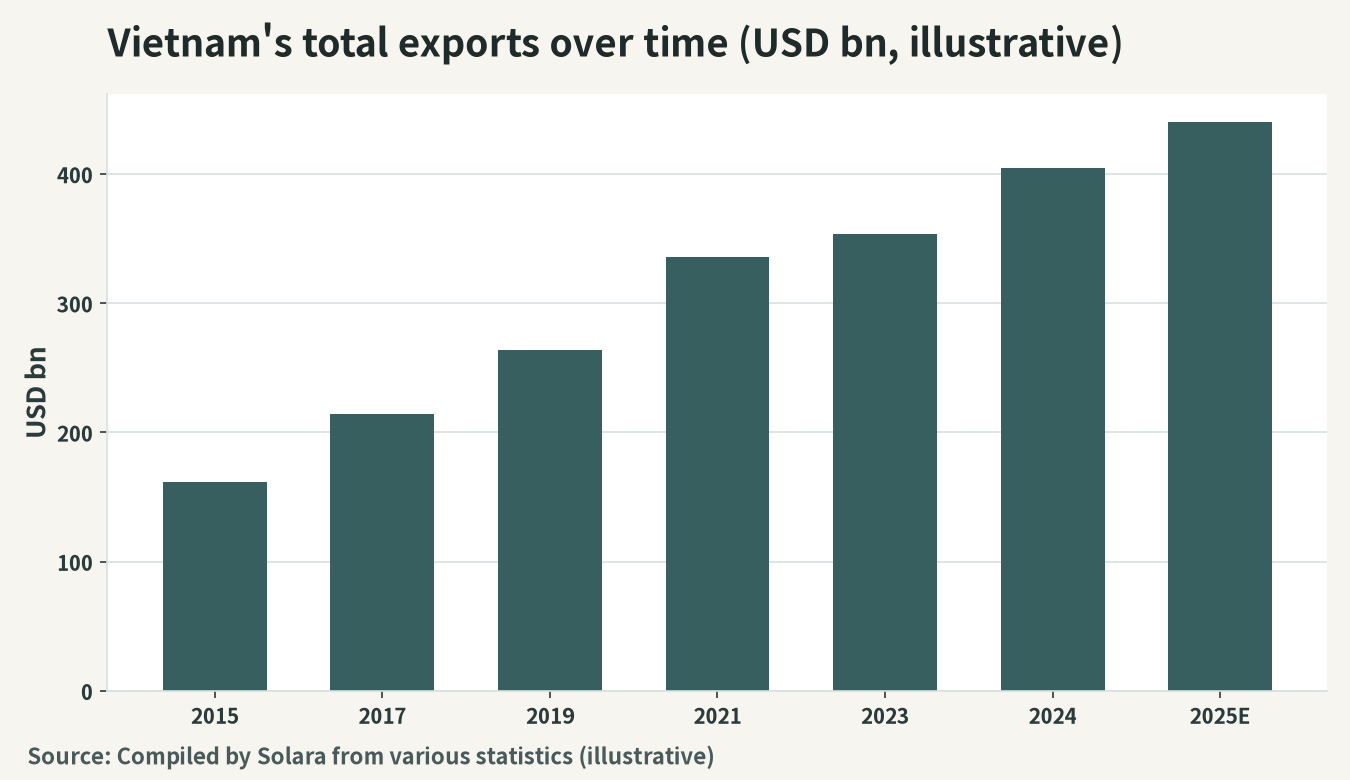
Total export value has reached the order of USD 400 billion a year, and total trade (exports plus imports) amounts to roughly 1.6 times GDP. A country this heavily dependent on trade is rare even globally, and the figures make it plain that external demand is precisely what drives the Vietnamese economy. The largest single export destination is the United States, which in recent years has come to account for about 30% of total exports, followed by China, the EU, ASEAN, Japan, and South Korea. This pronounced surplus structure toward the US is also the spark for the trade risk discussed later.
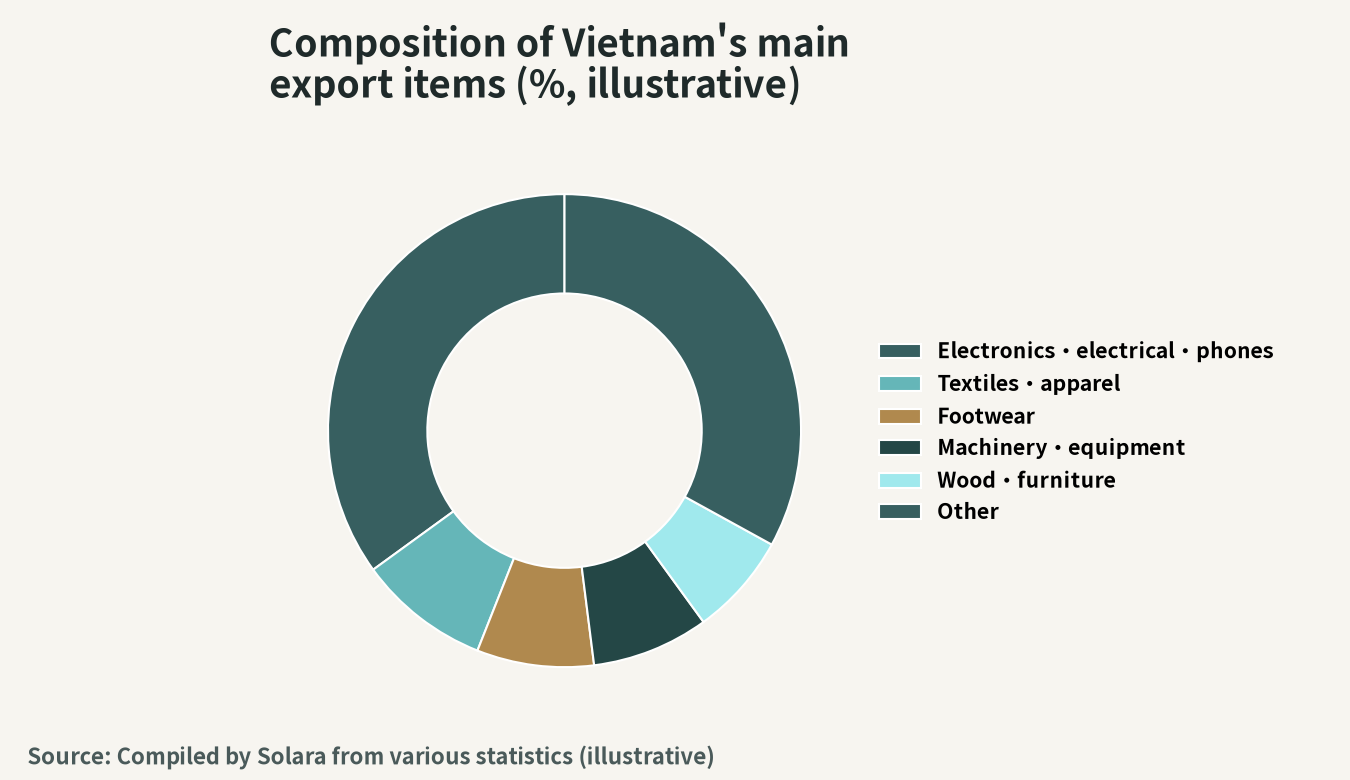
What is noteworthy is that exports have expanded while their item composition has been upgraded — from labor-intensive light industry toward higher-value-added electronics and machinery. Textiles and footwear were once the center of exports, but electronic and electrical products are now the largest export sector, and their share is rising year by year. The upgrading of the export structure shows that Vietnam is evolving from a mere low-cost assembly base into a manufacturing base accompanied by technology. At the same time, export destinations are also diversifying away from dependence on specific countries, and against the backdrop of the FTA network, sales channels have spread to a diverse range of markets — Europe, Asia, and North America.
Foreign investment (FDI) underpinning exports
A large part of Vietnam's exports is carried by foreign companies. The world's manufacturing industry places production bases in Vietnam and exports from there to world markets — this structure is the core of Vietnam's export-led growth. In fact, around 70% of Vietnam's exports are generated by foreign companies, and Korea's Samsung alone, through its local subsidiaries, is said to account for close to 20% of the entire country's exports. This means that while foreign capital is the engine of growth, it also carries the structural fragility of dependence on specific companies and specific items. Vietnam's export competitiveness therefore hinges on whether it can continuously attract high-quality foreign investment (FDI) and broaden its base. Developing the investment environment, expanding infrastructure, and cultivating human resources will determine its standing as an export hub. In recent years, the attraction of investment into high-value-added fields such as semiconductors and electronics has been accelerating, and a move to lift the "quality" of the export hub up a notch is under way.
The FTA network as a weapon
Vietnam's greatest weapon as an export manufacturing hub is a network of FTAs (free trade agreements) reaching a scale among the largest in the world. Vietnam has concluded numerous bilateral and multilateral free trade agreements, allowing it to access much of the world's major markets on favorable terms such as tariff reduction and elimination.
The main FTAs and what they mean
Among the major broad-area FTAs in which Vietnam participates are the CPTPP (in force from 2019) covering the Pacific Rim region, the RCEP (in force from 2022) — a broad-area agreement among ASEAN and neighboring countries — and the EVFTA (EU–Vietnam FTA, in force from 2020), which opens access to the European market. The FTAs Vietnam has signed or brought into force number well over a dozen, and together with bilateral agreements such as the UKVFTA with the United Kingdom, they cover the major markets like a mesh. These agreements make it possible to export products made in Vietnam to partner countries at low or zero tariffs, bringing a major cost advantage to companies that use Vietnam as a production base. Under the EVFTA, for example, about 70% of EU-side tariff lines were eliminated immediately on entry into force, with the remaining items designed to be phased down to zero over seven to ten years — so the tariff advantage widens with each passing year.
Main FTA | Main target markets | What it means for companies |
|---|---|---|
CPTPP | Pacific Rim (Japan, Canada, Australia, Mexico, etc.) | Low-tariff access to a broad market |
RCEP | ASEAN + Japan/China/Korea, Australia, NZ | Integration of the intra-regional supply chain |
EVFTA | EU (European market) | Tariff advantage for exports to Europe |
Intra-ASEAN | Southeast Asian countries | Intra-regional tariff elimination and market integration |
To enjoy the benefits of an FTA to the fullest, an understanding of the "rules of origin" is indispensable. To apply an FTA's preferential tariff, a product must be recognized as "of Vietnamese (or intra-regional) origin" under the agreement, and for that, a certain percentage or more of value-added must be generated within the region, or prescribed processing steps must be undergone. In practice, criteria such as a regional value content (RVC) of 40%, together with "cumulation" rules that let the origin of materials be aggregated within ASEAN and RCEP, hold the key, and whether a product can satisfy them is the watershed for applying the preferential rate. To meet these rules of origin, moves to localize the procurement of parts and materials are advancing, and this is also a factor promoting the clustering of supporting industries in Vietnam.
Where China+1 and supply-chain restructuring stand today
What has accelerated Vietnam's rise as an export manufacturing hub is the China+1 trend. Against the backdrop of US–China confrontation, geopolitical risk, and the demand for supply-chain resilience, the world's manufacturing industry has been advancing a diversification of production bases away from a single concentration on China. Vietnam has become the foremost recipient of this restructuring, thanks to its geographic advantage of bordering China, competitive labor costs, FTA network, and the government's active investment-attraction measures.
Deepening from "assembly" toward "supporting industries"
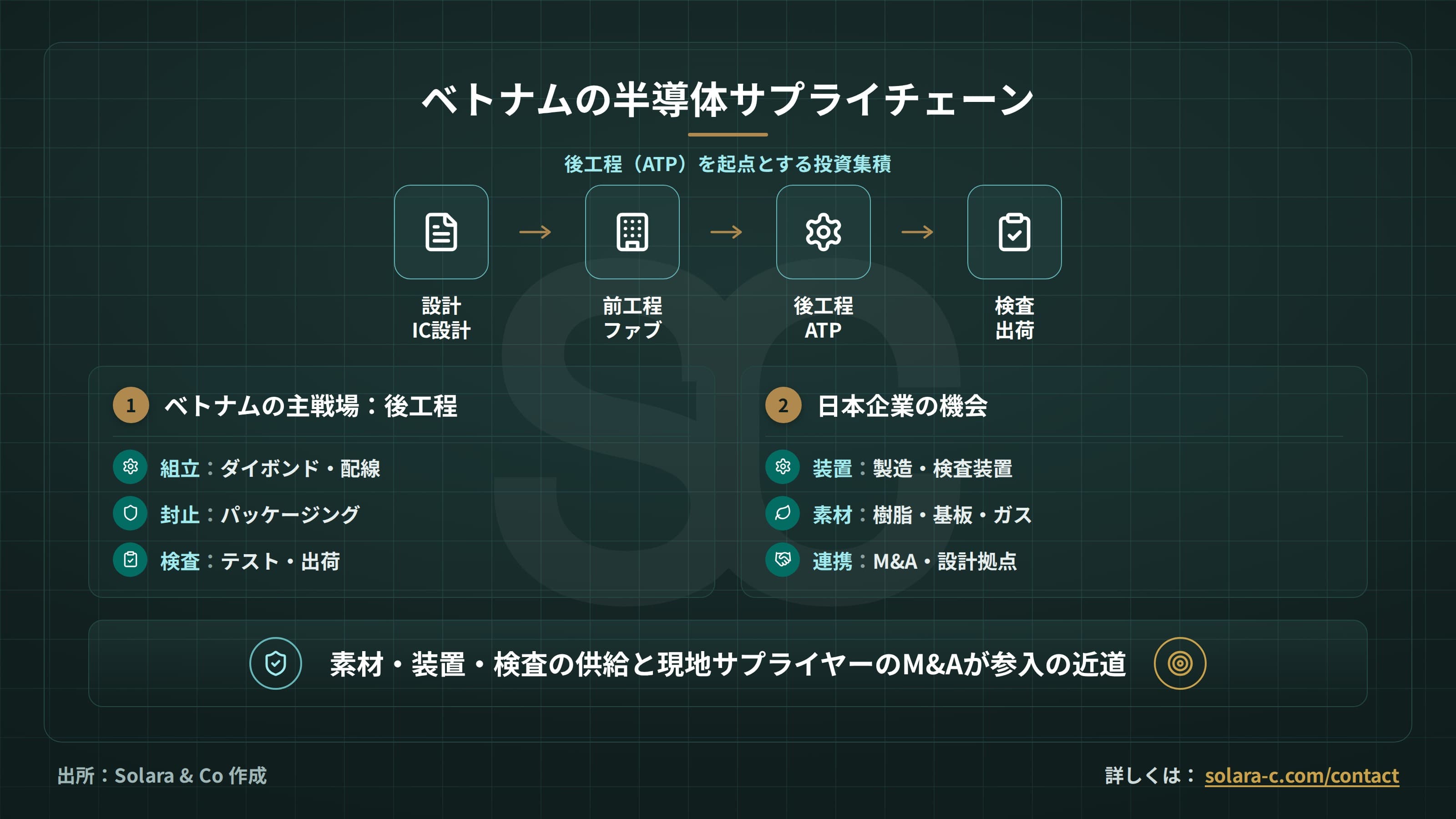
In the early stage of China+1, the center was the relocation of finished-product assembly processes. However, as supply-chain restructuring has progressed, the clustering of "supporting industries" — parts, materials, and components — is also advancing. From the standpoints of complying with rules of origin, shortening procurement lead times, and quality control, a move to procure and produce locally the intermediate goods that had been reliant on imports is spreading. The deepening of supporting industries raises the value-added of Vietnam's manufacturing industry and further strengthens its export competitiveness. For Japanese makers of parts, materials, and equipment, opportunities to participate alongside this clustering of supporting industries are expanding.
That said, Vietnam's supporting industries are still on the way to development. Some high-grade parts and materials still depend on imports, and raising the local content rate is an important issue for both the Vietnamese government and investing companies. This very gap of "localizing procurement" is itself a business opportunity for technically capable mid-tier and small-and-medium suppliers from Japan. A system that sets up a base near finished-product makers and can supply high-quality parts and materials just-in-time holds great value for customers seeking supply-chain resilience.
North and South — how to use Vietnam's two industrial clusters
Vietnam's manufacturing industry holds two clusters that differ in geographic character, and site selection is a point that can make or break the use of the export hub. The North (Bac Ninh, Bac Giang, and Thai Nguyen provinces around Hanoi, the port city of Hai Phong, Hung Yen province, and others) is a major electronics corridor where electronic and electrical makers such as Samsung, Foxconn, and Luxshare cluster. Its proximity by land to the parts-supply belt of southern China, and the ability to procure intermediate goods with short lead times through the border gates at Lao Cai and Lang Son, are major strengths in the context of China+1.
The South (Binh Duong, Dong Nai, and Long An provinces around Ho Chi Minh City, and Ba Ria–Vung Tau province), on the other hand, has a broad industrial base spanning textiles, footwear, furniture, machinery, and food, and enjoys a logistics advantage in being able to make up large container ships bound for the US and Europe directly from the deep-water port of Cai Mep–Thi Vai. The North is electronics-oriented and China-linked, the South is multi-industry and oriented toward exports to the US and Europe — bearing this difference in character in mind, it is important to choose a location according to product characteristics and the start and end points of the supply chain. In selecting an industrial park, one must evaluate not only land prices and wage levels but, in the round, the stability of power supply, access to ports and expressways, proximity to local suppliers, and the smoothness of permitting procedures. A location, once decided, is hard to change, making it a decision that forms the very foundation of an export-hub strategy.
Strategies for Japanese companies to leverage the export hub
Strategies for leveraging Vietnam's export manufacturing hub can be organized into several directions. The first is leveraging it as a production base. As part of China+1, or as a new export base, a company sets up a production base in Vietnam and leverages FTAs to export to world markets. This is the most direct way of using the export hub. The second is supplying parts and materials, taking on a part of the supply chain. The business of supplying parts and materials locally to finished-product makers clustering in Vietnam will see demand expand alongside the deepening of supporting industries.
The third is shortening time through M&A and joint ventures. Building a factory and procurement network from scratch takes time. By acquiring or forming a joint venture with an existing manufacturer or supplier, a company can acquire production equipment, human resources, permits, and business partners all at once, accelerating its entry into the export hub. In fast-growing markets, this "buying time" mindset is effective. As a prerequisite, however, credit investigation and due diligence to assess the target company's finances, permits, off-balance-sheet liabilities, and the quality of its business partners are indispensable.
Points to watch and risks
Vietnam as an export manufacturing hub also has points to watch. The first is rising wages. Alongside economic growth and competition to secure talent, labor costs are on an upward trend; the regional minimum wage is raised almost every year, and in the highest-tier Region I it has reached close to VND 5 million a month. The former advantage of all-out "low cost" is fading, and from here on, competitiveness beyond cost — productivity, quality, and the depth of the supply chain — will be tested. The second is constraints on infrastructure and electricity. Whether the development of power supply and logistics infrastructure can keep pace with rapid industrialization will be an important point in site selection. Indeed, in the summer of 2023 power supply tightened in the North, and temporary operating restrictions arose at industrial parks in provinces such as Bac Giang and Bac Ninh. The government is advancing reinforcement of generation and transmission networks under the Power Development Plan (PDP8), along with the establishment of a direct power purchase agreement (DPPA) scheme for renewable energy, but the stability of the power source remains at the core of location risk.
The third is uncertainty in the trade environment. Protectionist moves around the world, the application of rules of origin, and trade friction can all affect businesses premised on exports. In particular, against the backdrop of a widening trade deficit with Vietnam, the United States has in recent years been tightening origin scrutiny of "transshipment" — the re-export of third-country goods by way of Vietnam — and the risk that products not recognized as of Vietnamese origin will be hit with additional tariffs is becoming real. As long as one enjoys FTA preferences, firming up, in substance, both certificates of origin and the build-up of regional value-added is the greatest safeguard against trade risk. While enjoying the tailwind of FTAs, keeping an eye on changes in the trade environment is indispensable. The fourth is the quality of human resources and suppliers. Securing and retaining excellent local talent and cultivating reliable local suppliers will determine the competitiveness of a manufacturing base. These risks need to be assessed through information rooted in the locality and through investigation of target companies and partners.
Conclusion — Make the FTAs and the depth of the supply network your ally
Vietnam, riding the two tailwinds of China+1 and the FTA network, is consolidating its standing as the world's export manufacturing hub. The export structure has been upgraded from labor-intensive to electronics and machinery, and the clustering of supporting industries is also progressing. For Japanese companies, a diverse range of strategic options is expanding: leveraging it as a production base, supplying parts and materials, and entering through M&A and joint ventures. The key lies in mastering the FTAs' rules of origin and making the depth of the local supply network your ally.
Solara & Co has bases and human networks in both Japan and Vietnam, and provides integrated support — from studying the establishment of a production base and building a supply chain in Vietnam, to market and supplier research, acquiring partners through M&A and joint ventures, pre-acquisition credit investigation and due diligence, and verification of permits and business partners. Capturing the great trend of becoming an export hub while carefully assessing the near-term risks of wages, infrastructure, and the trade environment — achieving both, we believe, is the shortest path to results in Vietnamese manufacturing investment.