
Decoding the Meaning Behind Vietnam's Record-High FDI
Foreign direct investment (FDI) into Vietnam has continued to set new record highs in recent years on a disbursement basis. Even as the global economy is buffeted by geopolitical risk and the reconfiguration of supply chains, Vietnam has drawn in capital as the leading "China+1" candidate, with a wave of investment rolling in, centered on manufacturing. The cluster of projects worth some USD 4.5 billion in private investment that we examine in this article is a symbol of that momentum. What deserves attention is not only the registered (committed) amount, but the fact that the "disbursed amount"—the money behind factories actually being built and jobs actually being created—is holding at a high level. This signals that investment in Vietnam is not a passing expectation but a real business that is putting down roots.
In this article, we lay out the structural backdrop to Vietnam's record-setting FDI, confirm in numbers which sectors and regions the capital is flowing to, and then explain, from a practical standpoint, the investment opportunities Japanese companies should seize and the risks they must not overlook. FDI movements are not merely macro statistics; they are also a leading indicator of which industries will grow in Vietnam from here and where business opportunities will emerge. Reading the flow of capital becomes the starting point for designing your own market-entry strategy.
Why Is FDI Concentrating in Vietnam?
The concentration of investment in Vietnam is not the result of a single factor, but of several tailwinds blowing at the same time.
China+1 and the Reconfiguration of Supply Chains
Against the backdrop of a protracted US–China confrontation, tariff risk, and geopolitical uncertainty, global companies are accelerating "China+1"—dispersing production bases away from an over-reliance on China alone. With its geography adjacent to China, well-developed industrial parks, competitive labor costs, and numerous free trade agreements (FTAs), Vietnam has become the largest recipient of this realignment. A broad range of industries—from labor-intensive to mid-tier technology-intensive, including electronics and electrical equipment, textiles and garments, and machinery components—are choosing Vietnam as their relocation destination.
The FTA Network and Market Access
Vietnam possesses one of the world's foremost FTA networks, including the CPTPP, the EVFTA (EU–Vietnam FTA), and the RCEP, giving it exceptionally favorable conditions as an export base. Because producing in Vietnam allows companies to leverage tariff preferences to access vast markets, the investment appeal for export-oriented manufacturing is substantial. This is also one reason FDI flows disproportionately into manufacturing and processing.
Political Stability and a Consistent Open-Door Policy
The Vietnamese government has placed foreign investment attraction at the core of national strategy and has maintained a consistent open-door policy over the long term. Political stability, the digitalization of administrative procedures, and well-developed preferential tax regimes provide investors with "predictability." On top of this, a young and abundant labor force and rising educational standards underpin Vietnam's appeal as a long-term base. We discuss these structural tailwinds in greater detail in Vietnam Investment: The "Golden Decade" as well.
A Policy Shift from "Quantity" to "Quality"
Vietnam's investment-attraction policy in recent years has been shifting its center of gravity from simply piling up investment volume to raising the "quality" of investment. There is a clear move toward selectively attracting investment not only in labor-intensive assembly processes but also in fields such as research and development, high-value-added components and materials, and high-tech, semiconductor, and green industries. In response to the introduction of the global minimum tax, the design of new incentives to replace conventional tax breaks (subsidies for R&D, human-resource development, and infrastructure) is also advancing. For companies considering entry, this means that whether their business aligns with the policy's priority fields will determine the scale of support they can receive.
FDI's Scale and Direction, Seen in Numbers
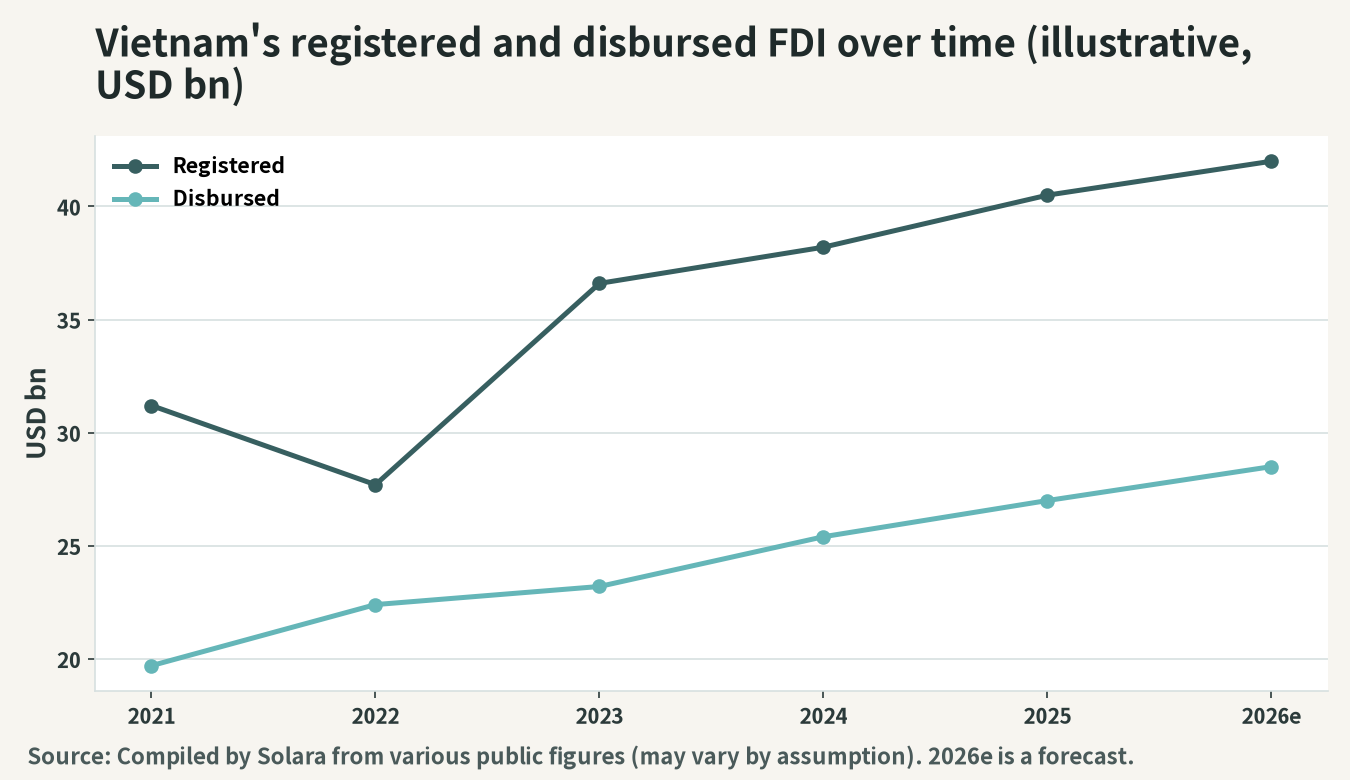
We confirm the contours of FDI through two indicators. First is the trend in registered and disbursed amounts. The narrowing of the gap between the two, and the steady growth in disbursed amounts, demonstrate that investment is becoming tangible.
Second is which sectors the capital is heading toward. Manufacturing and processing accounts for an overwhelming share, with real estate following—a pattern that continues to hold.
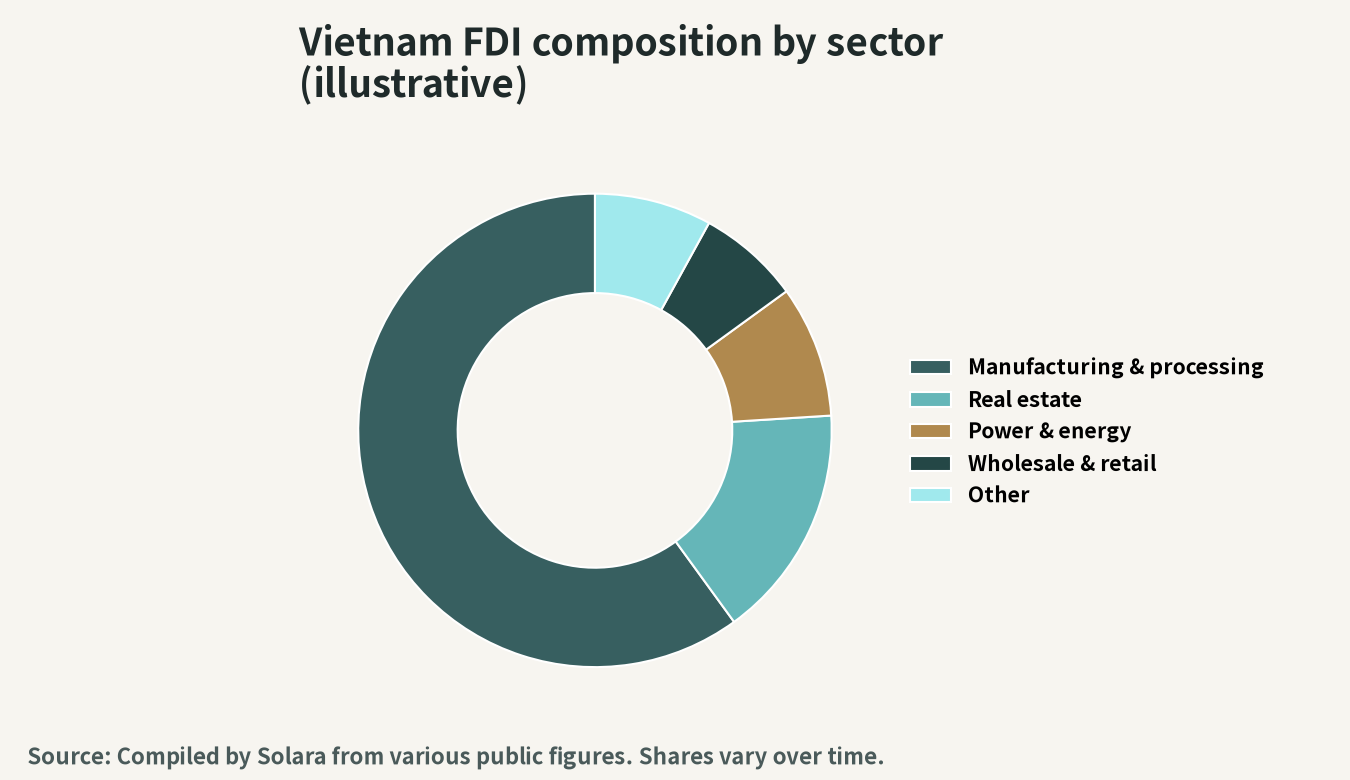
These figures fluctuate depending on the point of aggregation and underlying assumptions, but the direction is clear. Disbursed amounts hold at high levels as they catch up to registered amounts, and the bulk flows into manufacturing and processing—these two points define the underlying tone of Vietnam's FDI. As large private-led investments accumulate, they also induce knock-on investment in related logistics, power, housing, and services.
The Investment Opportunity Reflected in USD 4.5 Billion of Private Investment
The figure of roughly USD 4.5 billion in private investment carries meaning beyond the sheer size of the amount. It is evidence that, beyond government-led attraction efforts, private companies are betting on Vietnam as their own business judgment. Large-scale manufacturing investment is not self-contained; it draws in supporting industries all at once—suppliers of parts and materials, logistics, talent, and peripheral services.
Primary Investment Generating Secondary and Tertiary Opportunities
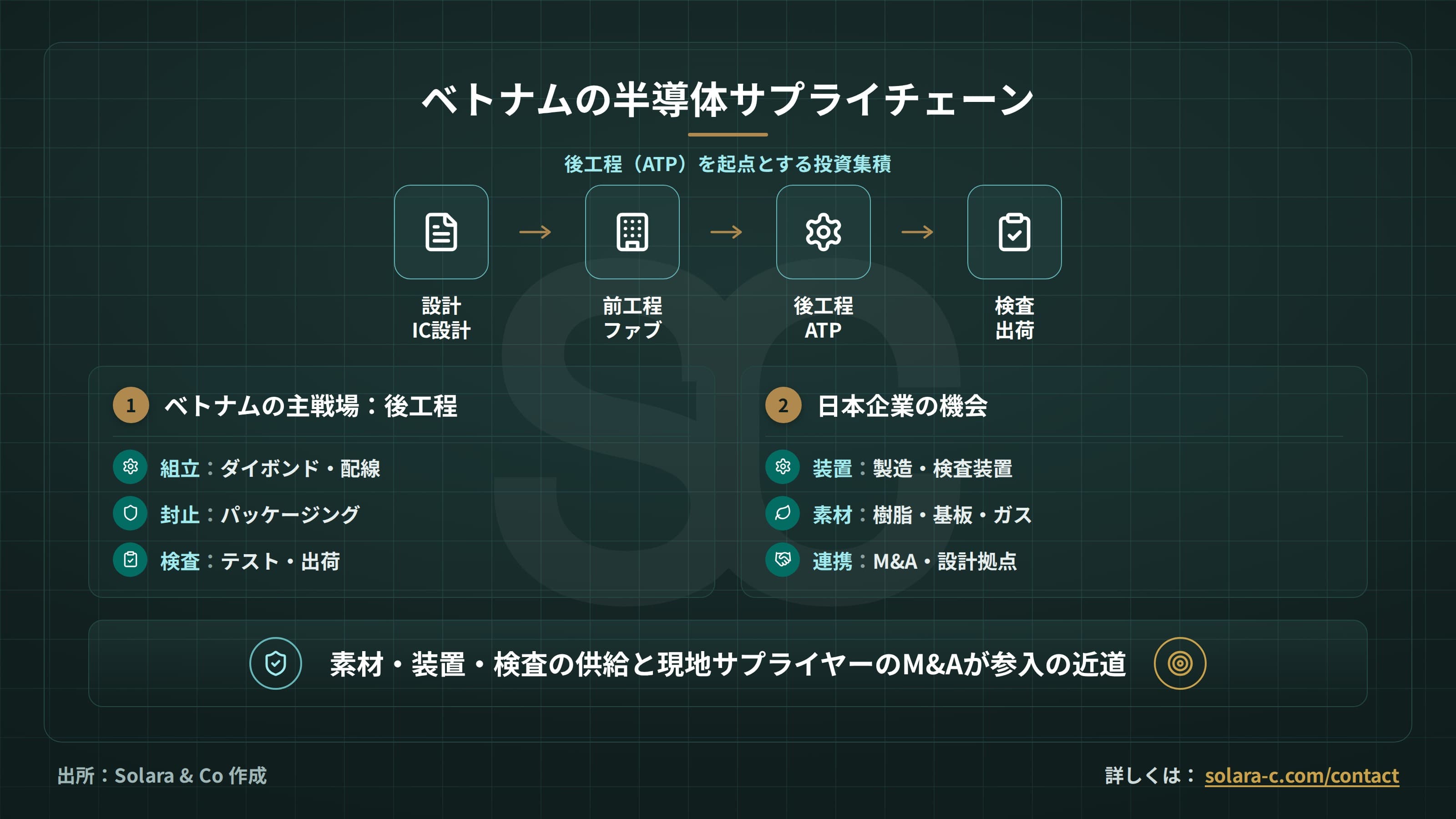
When a large electronic-components plant begins operating, for example, demand arises around it for small and mid-sized suppliers handling processes such as die-making, molding, surface treatment, and inspection. For Japanese parts makers and equipment makers, this is a prime chance for "follow-the-customer investment"—entering in the wake of finished-product manufacturers' relocation. At the same time, taking in leading local suppliers through M&A or joint ventures and incorporating them into the supply chain is also an effective option. We elaborate on supply-chain issues in Vietnam Manufacturing and Supply Chains.
Spillover into Domestic Demand and Services
The concentration of FDI generates employment and income, which in turn lifts domestic demand. Around industrial parks, service demand expands for housing, retail, dining, education, healthcare, and finance. Riding the manufacturing wave while capturing the consumption opportunities that arise downstream of it is also a compelling strategy. We address the expansion of the consumer market in detail in Vietnam Retail Market 2026.
Where Is the Capital Heading? — A Regional Investment Map
FDI is not distributed evenly across the country; it concentrates in specific economic zones. In the north, the corridor stretching from the outskirts of Hanoi to Hai Phong, Bac Ninh, and Bac Giang has become a major cluster for electronics and electrical equipment. This is because its location—a short distance from southern China and offering excellent access to ports and airports—is valued from a supply-chain perspective. In the south, industrial clusters are thick around Ho Chi Minh City, including Binh Duong, Dong Nai, and Long An, with consumer goods, machinery, and logistics forming layered concentrations. In the central region, with Da Nang at its core, both tourism and high-tech are on the rise.
In making investment decisions, discerning these regional differences in industrial agglomeration, talent pools, infrastructure, and preferential conditions becomes the starting point for site selection. Even within the same "entry into Vietnam," the cost structure and ease of procurement differ greatly depending on the combination of the targeted industry and region.
Key Considerations for Japanese Companies
Vietnam is one of Japan's major investment destinations on a cumulative basis, and Japan–Vietnam economic relations are deepening year by year. We lay out the key considerations for Japanese companies seeking to ride this wave.
Investment Approach | Primary Aim | Where Strengths Apply | Points to Watch |
|---|---|---|---|
Greenfield (new build) | Building a base to one's own specifications | Manufacturing and quality control | Start-up period and licensing/permits |
M&A (acquisition) | Acquiring time, permits, and a customer base | Absorbing existing businesses | Grasping finances and off-balance-sheet liabilities |
Joint venture (JV) | Leveraging local knowledge and networks | Sales channels and regulatory response | Partner reliability |
Follow-the-supplier entry | Continuing and expanding existing business | Parts, equipment, materials | Securing standalone profitability |
In fast-growing markets, situations are increasing where the mindset of "buying time" is more effective than building from scratch. That is because acquiring an existing company or forming a joint venture allows you to obtain distribution networks, permits, talent, and a customer base all at once. On the other hand, information asymmetry is large regarding the target company's finances, permits, and off-balance-sheet liabilities, making a pre-acquisition credit check and due diligence indispensable. For a comparison of entry modes, please also see Vietnam Market-Entry Strategy.
The Risks Behind the Overheating
Precisely because investment is concentrating, it is necessary to view the risks with a clear head. First is the rise in talent and wages. In regions where investment concentrates, competition to secure engineers and managers is fierce, and wages are on an upward trend. Second is power and infrastructure constraints. In some regions, power supply and infrastructure development cannot keep pace with rapid industrialization, raising the importance of site selection. Third is the opacity in how administrative procedures and the legal system are applied. Interpretations of preferential tax regimes and permits can differ by region and period, making locally rooted information essential. Fourth is intensifying competition. Because many foreign investors target the same growth fields, share cannot be secured without clear differentiation.
All of these are matters to be managed through "locally rooted information," "selecting a trustworthy partner," and "an exit strategy at the entry stage." The greater the macro tailwind, the more the practical work of shoring up the fundamentals of individual deals determines success or failure. In entries via M&A or joint ventures in particular, grasping the true condition of the target company or partner is decisively important. "Invisible risks"—off-balance-sheet liabilities not reflected in financial statements, ongoing labor or tax disputes, deficiencies in permits, and the credit standing of business partners—not infrequently surface only after the acquisition. It is precisely amid a buoyant market environment that the temptation to skip investigation in the rush to close a deal grows stronger, and that leads to large losses later. A pre-acquisition credit check and due diligence are the surest means of protecting yourself in an overheating market.
How Japanese Companies Can Seize the Opportunity — Solara's Perspective
A phase in which Vietnam's FDI sets new record highs and large private-led investments accumulate is a moment when broad opportunities open up for Japanese companies, spanning manufacturing, parts, and logistics through to domestic-demand services. The key is to reconcile the speed of the judgment to ride the wave with the reliability of the on-the-ground information that supports that judgment.
Solara & Co holds bases and human networks on both the Japanese and Vietnamese sides, and provides integrated support from market research and investment-strategy formulation, to partner acquisition through M&A and joint ventures, to pre-acquisition credit checks and due diligence, to building organizational structures after entry. To reliably turn the momentum that record-high FDI reflects in Vietnam into results for your own company, we accompany you on both fronts—the macro opportunity and the micro execution.