
The Green Transition Shaping the Next Decade of Vietnam's Economy
While achieving rapid economic growth and industrialization, Vietnam also faces major challenges: surging energy demand, the environmental burden on air and water, and the need to respond to climate change. Vietnam has declared on the international stage its goal of carbon neutrality (net-zero emissions) by 2050, and a "green transition"—advancing in unison the shift to renewable energy, the tightening of environmental regulation, and corporate ESG (environmental, social, and governance) compliance together with DX (digitalization)—has begun moving as a key national policy. This is at once a constraint and a vast investment opportunity.
This article organizes the policies and international pressures driving Vietnam's green transition, decodes how the three demands of renewable energy, ESG, and DX connect to one another, and then explains—from a practical standpoint—the investment opportunities Japanese companies should seize and the risks they should keep in mind. The green transition does not stop at the energy sector; it spreads to every domain of manufacturing, logistics, finance, and services, and it is rewriting the very conditions of corporate competition. Whether one can view this change as an opportunity rather than a constraint will determine success or failure over the coming decade. For developments in the energy sector, please also see Vietnam's Energy Transition and GX.
The Three Forces Driving the Green Transition
Vietnam's green transition is accelerating as domestic policy and international demands overlap.
The Nation's Carbon-Neutrality Target
The Vietnamese government has set the long-term goal of carbon neutrality by 2050 and put forward a policy of substantially raising the share of renewable energy in its power mix. Breaking free from coal dependence, shifting to solar, wind (offshore wind in particular), and LNG, and strengthening the transmission and distribution grid are the pillars of the national energy plan. This generates long-term investment demand in the related fields of power generation, transmission, energy storage, and energy efficiency. Blessed by natural conditions—a long coastline and abundant solar irradiance—Vietnam is a country with high solar and wind potential. At the same time, if supply cannot keep pace with rapidly rising electricity demand, the precious investment boom risks being held back by power shortages. Achieving the decarbonization of power sources and the securing of supply capacity at the same time has become the central challenge that holds the key to the green transition's success.
Pressure from International Supply Chains
Vietnam is an export-led economy, and the global companies in its export markets—the EU, Japan, and the United States—have begun to make decarbonization across the entire supply chain, along with attention to human rights and the environment, a condition of doing business. Mechanisms such as the EU's Carbon Border Adjustment Mechanism (CBAM) directly affect the export of carbon-intensive products such as steel, aluminum, and cement, and a slow response rebounds as a real additional cost. For Vietnam's manufacturers and exporters, green compliance is no longer a "nice to have" but is becoming an essential requirement for maintaining market access. This is also a major business opportunity for Japanese companies that can provide environmental technology and energy-saving solutions to support local firms' compliance.
ESG Demands from Investors and Finance
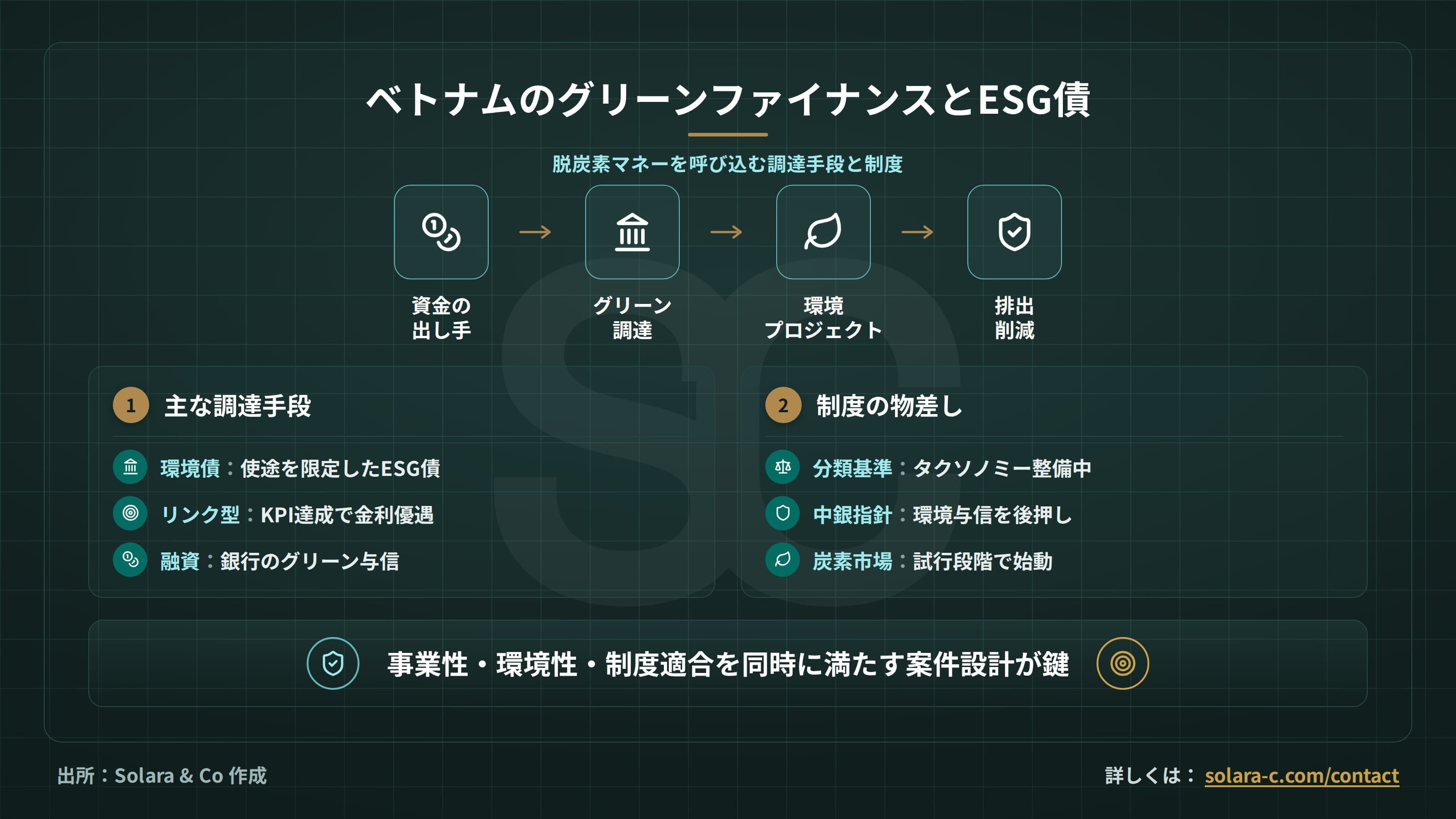
Global institutional investors and financial institutions are incorporating ESG criteria into their investment and lending decisions. Green-finance instruments such as green bonds and sustainability-linked loans are spreading, creating a structure in which the more a company complies with ESG, the more advantageous its access to funding. This is a strong motivation for Vietnamese companies to advance their ESG compliance. International development finance institutions and government-affiliated funds have also set up funding frameworks to support Vietnam's energy transition, and a configuration is taking shape in which public and private capital combine to propel projects. The more those who provide capital emphasize ESG, the more disadvantaged companies that are slow to comply become—on both the cost and the access to funding—and the green transition is changing in character from a "cost" into a "condition of competition."
The Scale of the Green Transition in Figures
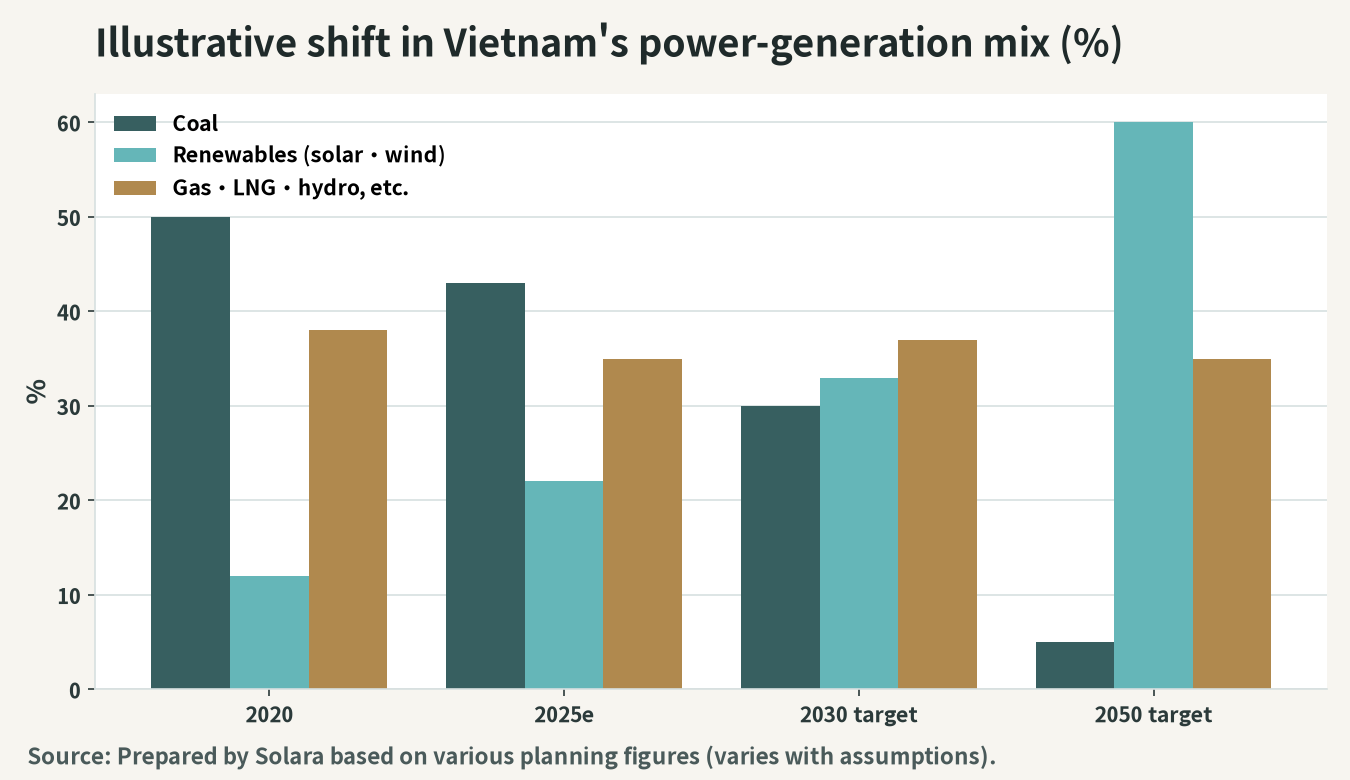
Let us confirm the contours of the green transition through two indicators. First is the plan to raise the share of renewable energy in the power mix. The shift from coal to renewables and gas shows that this is a long-term investment theme.
Second is the breadth of the main fields toward which green investment is heading. Beyond power generation, demand spreads out to energy efficiency, water treatment, waste, green logistics, and DX.
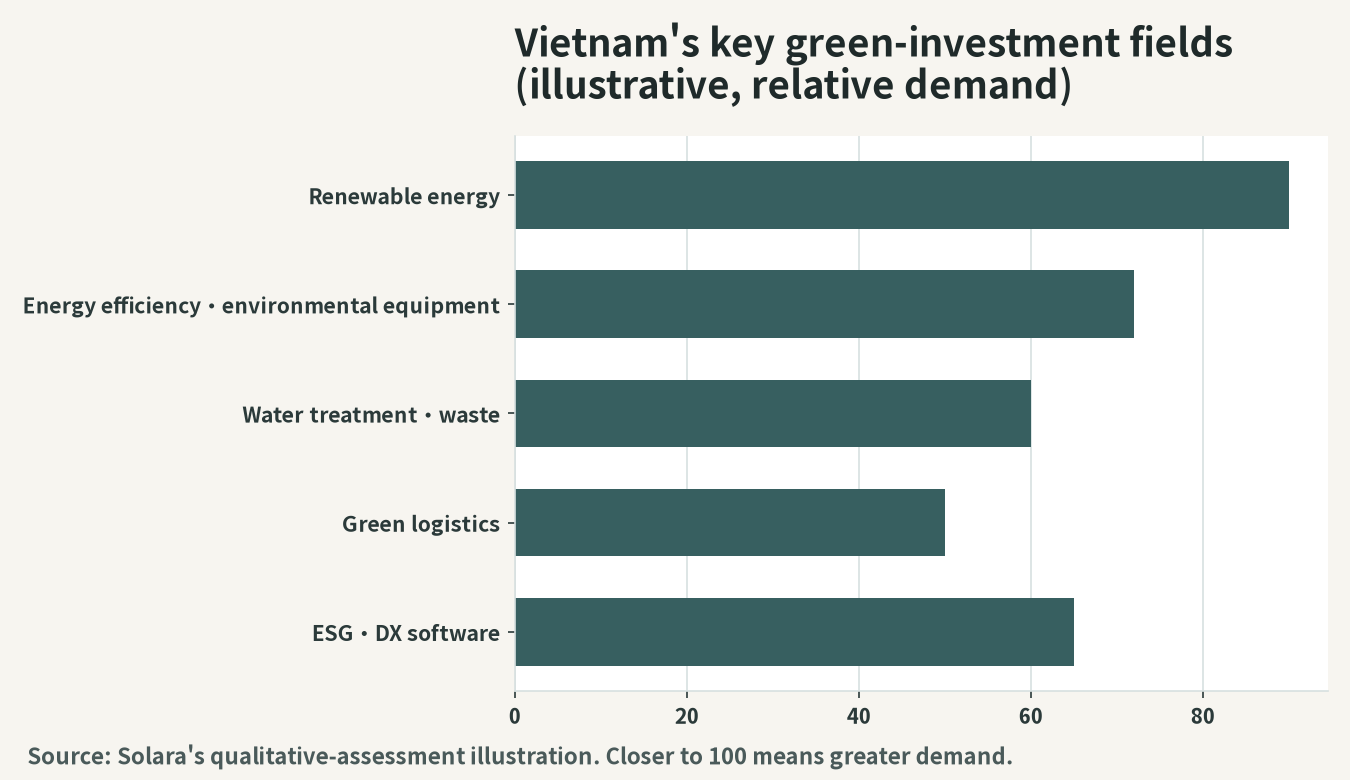
These figures swing depending on the assumptions, but the direction is consistent. With the decarbonization of power sources as the axis, the environmental compliance and digitalization of industry as a whole advance at the same time—this is the keynote of Vietnam's green transition.
Why ESG and DX Are Linked
The green transition links ESG compliance and DX (digitalization) in an inseparable way. This is because "measuring, disclosing, and reducing" environmental burden and emissions is impossible without the collection, visualization, and management of data. Monitoring energy consumption, calculating emissions across the entire supply chain, disclosing ESG information—all of these are achievable only on a digital foundation.
As a result, among Vietnamese companies, DX for productivity improvement and ESG data management for environmental compliance are coming to be advanced within the same system investment. In fields such as smart factories, energy-management systems, supply-chain management, and ESG reporting, demand for software, sensors, and operational know-how is expanding. This intersects, on this point, with Manufacturing Relocation and High-Tech Investment in Vietnam, which deals with the upgrading of the manufacturing industry.
In export-oriented manufacturing in particular, cases are increasing in which major customer firms request the submission of "emissions data across the entire supply chain." Meeting this requires a mechanism for collecting and managing data that includes not only one's own company but also one's business partners, and the more a company can build DX and ESG as an integrated whole, the more it can remain in the global supply chain. Conversely, if a company neglects this investment, the risk of being dropped from transactions even when its price and quality are superior is becoming a reality. The green transition is, in this way, changing the behavior of Vietnamese companies from within.
Investment Opportunities — Where the Business Lies
The expansion of the green transition and of ESG and DX demand creates investment opportunities across a wide range of fields. Let us organize them by overlaying the strengths of Japanese companies.
Field | Nature of demand | Strengths of Japanese companies | Entry approach |
|---|---|---|---|
Renewable energy | Generation, transmission, storage | Technology, EPC, operation | JV, project investment |
Energy-saving and environmental equipment | Factory efficiency | Energy-saving equipment and technology | Equipment supply, services |
Water treatment and waste | Environmental-regulation compliance | Treatment technology and operation | JV, M&A |
Green logistics | Emissions reduction | EVs, efficiency improvement | Partnership, new establishment |
ESG and DX software | Measurement, disclosure, management | System and operational quality | Service entry, partnership |
Japanese companies have strengths in energy-saving and environmental technology, water treatment, energy management, and high-quality engineering and system operation. As Vietnam advances decarbonization and industrial upgrading at the same time, demand for these technologies will expand structurally. A variety of entry routes can be envisioned: direct investment in projects, the supply of equipment and systems, joint ventures with local companies, or the M&A of local companies that possess technology. The experience in energy conservation, pollution control, and a recycling-oriented society that Japan has cultivated over many years is precisely the kind of knowledge that Vietnam—about to face the same challenges—now needs. Being able to provide not only the "sale" of technology but also operation, maintenance, and human-resource development is the source of Japanese companies' differentiation.
Risks to Keep in Mind
Precisely because the opportunity is large, one must look calmly at the risks. First is the volatility of policy and regulation. The feed-in scheme for renewables and the licensing framework can change, swaying a project's profitability. Second is the constraint of the transmission grid and grid connection. Even if generation capacity increases, if the grid cannot keep up, electricity cannot be delivered, so the location and the certainty of grid connection become important. Third is financing and the length of the payback period. Large-scale energy and infrastructure investments require a long time horizon to recover, and the risks of exchange rates, interest rates, and regulation must be factored in. Fourth is the reliability and execution capability of partners.
These must be managed through locally rooted information, the selection of trustworthy partners, an exit strategy from the entry stage, and thorough due diligence in M&A and joint ventures. In large projects especially, prior investigation that assesses the counterparty's finances, track record, and compliance is the key to preventing major losses later. The green field has a high degree of policy dependence, and the details of regulatory design greatly sway profitability, so a system for continuously grasping the latest regulatory developments from reliable local sources is indispensable. Rather than leaping at deals ahead of expectations, making the investment decision only after calmly verifying the three points of regulation, grid, and partner is the premise for delivering results over the long term.
How Japanese Companies Can Seize the Opportunity — Solara's Perspective
Vietnam's green transition is a long-term current that, with the decarbonization of energy as its axis, draws in ESG compliance and DX while repainting the very structure of industry. For Japanese companies, opportunities to leverage their strengths in technology and quality are spreading widely—from renewable energy, energy-saving and environmental equipment, water treatment, and green logistics, all the way to ESG and DX software and operational know-how. The key is to reconcile two things: investment decisions that look ahead to the long-term current, and the soundness of the projects and partners right in front of you.
Solara & Co has bases and human networks in both Japan and Vietnam, and provides seamless support—from market research and the formulation of investment strategy, to the search for local partners and M&A and joint ventures, pre-acquisition credit investigation and due diligence, and the building of structures after market entry. Within the great current of the green transition, identifying the position where your own technology is most effective while carefully assessing the risks at hand—reconciling both of these, we believe, is the shortest path to delivering results in Vietnam's next phase of growth.