
The Wave of Manufacturing Relocation and High-Tech Investment Heading to Vietnam
Global manufacturing is in the midst of a major tectonic shift. The protracted US-China confrontation, tariff risk, geopolitical uncertainty, and the supply-chain fragility laid bare by the pandemic — these forces have converged, prompting global companies to accelerate "China+1," a strategy of diversifying production away from a single-country concentration in China. Vietnam has become the largest recipient of this shift. While the early relocations centered on textiles, garments, and low-value-added assembly, in recent years the quality of the relocation has changed, moving toward higher-value-added high-tech manufacturing such as smartphones, electronic components, and precision equipment.
In this article, we organize the structural drivers propelling manufacturing relocation to Vietnam, decode how the "quality" of relocation has evolved, and then examine — from a practitioner's perspective — the investment opportunities emerging in the supporting tiers of the supply chain, the key considerations in site selection, and the risks that must not be overlooked. For the structure of the supply chain as a whole, please also see Vietnam's Manufacturing Industry and Supply Chain.
The Structural Drivers Behind Manufacturing Relocation
The relocation of production to Vietnam is a structural movement arising from the convergence of multiple factors.
China+1 and Risk Diversification
The exchanges of tariffs and export controls between the US and China have introduced significant risk into supply chains concentrated in China. Global companies are seeking to build a structure less susceptible to the policy shifts of any single country by diversifying procurement and production across multiple nations. Backed by its geography adjacent to South China, its well-developed industrial parks, and its numerous FTAs, Vietnam ranks at the very top among these diversification destinations. What matters is that this is not merely a temporary evacuation but is taking root as a long-term structural change. Once a company has relocated its supply chain and built up local talent and trading networks, it does not easily revert. Investment in Vietnam must be understood as the accumulation of such "irreversible relocations."
Cost Competitiveness and Labor Force
Vietnam possesses competitive labor costs and a young, abundant workforce. As China's labor costs rise, the cost advantage has propelled relocation to Vietnam, primarily in labor-intensive processes. In addition, high literacy rates and improving educational standards are making the transition from unskilled to skilled labor possible. The reality of labor costs is covered in detail in The True Picture of Vietnam's Labor Costs.
Appeal as an Export Base Through FTAs
Thanks to one of the world's foremost FTA networks — CPTPP, EVFTA, and RCEP — products manufactured in Vietnam can be exported to vast markets while harnessing preferential tariff treatment. This has become a decisive reason for export-oriented manufacturers to choose Vietnam. The ability to access the markets of Japan, the EU, and the Pacific Rim nations on favorable terms carries strategic value that goes beyond mere cost reduction. With Vietnam as a starting point, a company can cover multiple economic blocs from a single base, securing markets while diversifying the risk of trade friction.
The "Quality" of Relocation Is Changing — From Low Value-Added to High-Tech
What deserves attention in the relocation of manufacturing to Vietnam is the change in its "quality."
An Upgrade Centered on Electronics and Electrical Machinery
Past relocations were dominated by labor-intensive sectors such as textiles, footwear, and furniture, but in recent years high-tech manufacturing — smartphones, electronic components, displays, and precision equipment — has surged to the leading role. Global electronics manufacturers and their suppliers have established large-scale bases, and Vietnam has grown into one of the world's leading exporters of electronic products. Along with this, the talent in demand has also shifted toward skilled and technical occupations. This upgrading shows that Vietnam is changing its positioning from a "country of cheap labor" to a "manufacturing base equipped with mid-level technology." By taking on not only low-unit-price assembly but also higher-value-added processes, the depth of technology and know-how accumulated locally increases, generating a virtuous cycle that draws in still more advanced investment.
The Buds of R&D and High-Value-Added Processes
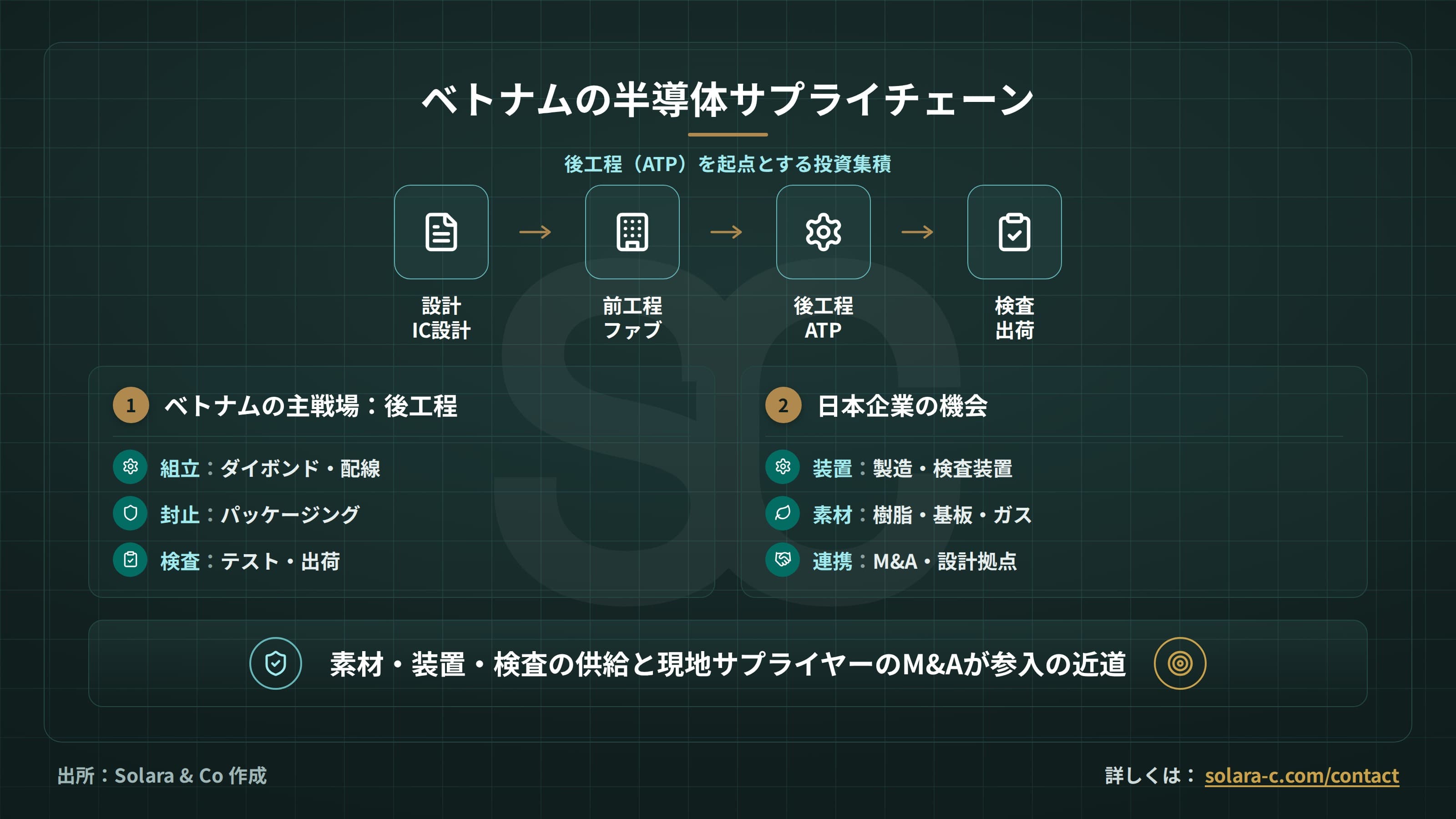
Beyond assembly, moves to conduct research and development and to produce high-value-added components in Vietnam are also beginning to sprout. Groundwork is being laid for the clustering of next-generation industries, including back-end semiconductor processes, data-center-related operations, and EV and electrification components. This movement is closely linked to Vietnam's Semiconductor and Digital Economy Strategy.
The Presence of Manufacturing Seen Through the Numbers
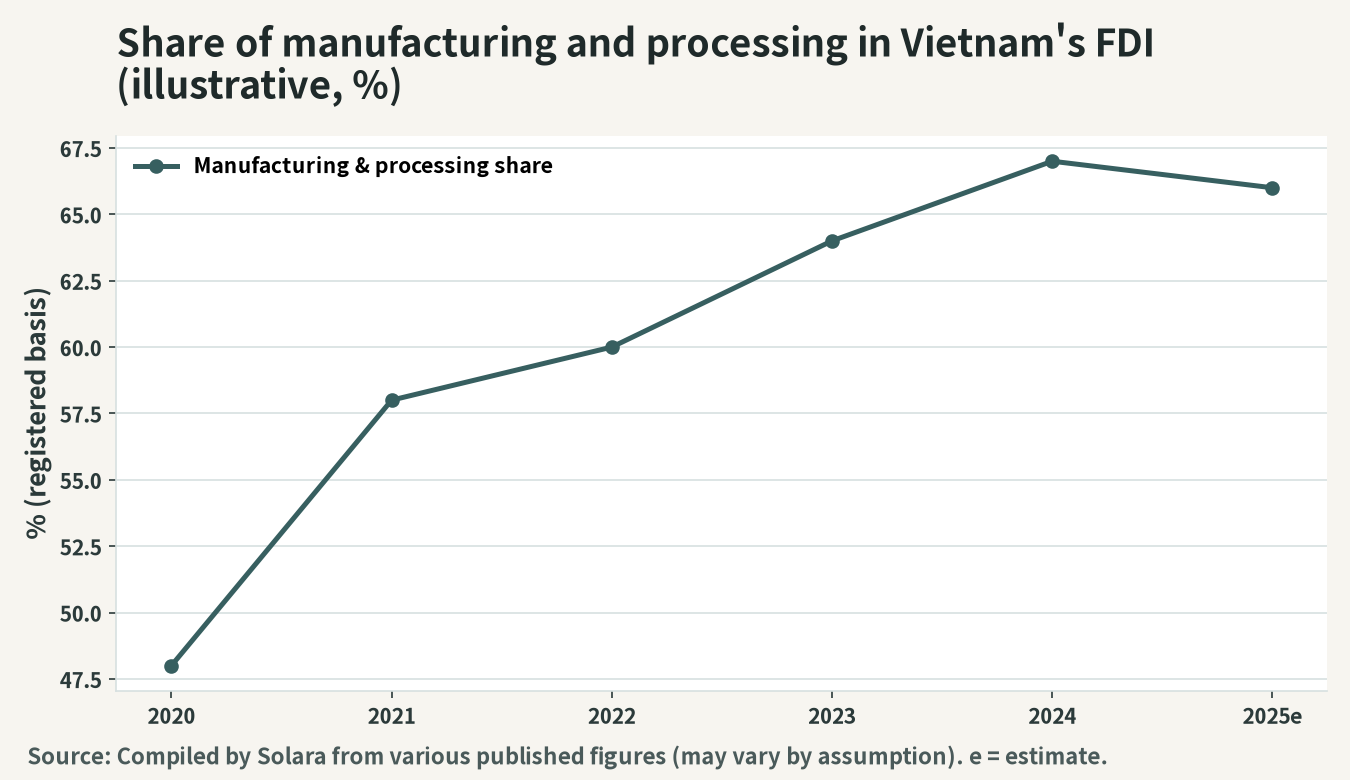
We confirm the outline of manufacturing relocation through two indicators. First, the share of manufacturing in FDI. The picture in which the bulk of foreign investment into Vietnam is directed toward manufacturing and processing continues to hold.
Second, the export composition by major manufactured product category. The picture in which electronics, telephones, and machinery drive Vietnam's exports stands out clearly.
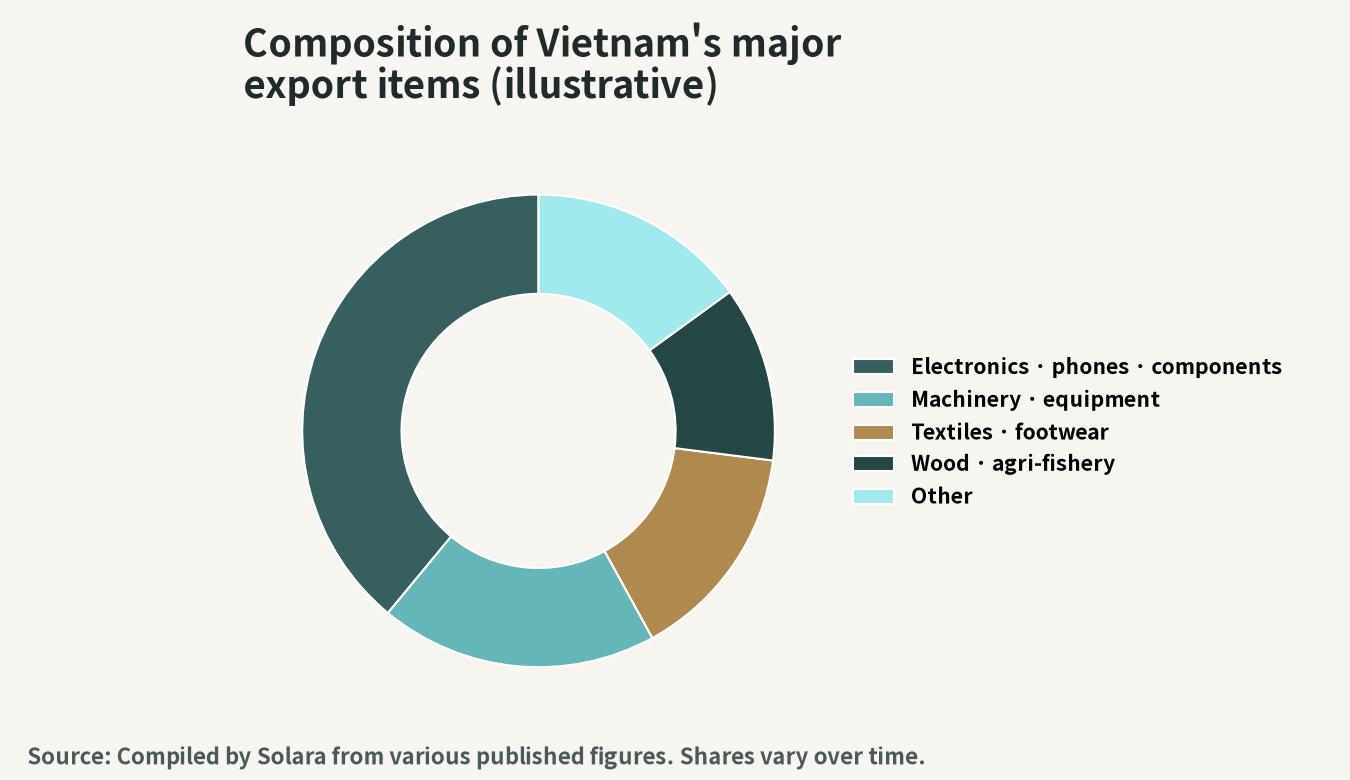
These figures fluctuate depending on assumptions, but the direction is consistent. The bulk of FDI flows into manufacturing, and its export composition is upgrading toward electronics and high-tech — this is the keynote of Vietnamese manufacturing.
Investment Opportunities Emerging in the Supporting Tiers of the Supply Chain
The entry of finished-product manufacturers does not stand alone. Around them arises enormous demand from supporting industries such as components, materials, equipment, and logistics. Herein lies the greatest opportunity for Japanese companies.
Domain | Nature of Opportunity | Strength of Japanese Companies | Entry Approach |
|---|---|---|---|
Parts and components | Following finished-product makers | Precision processing and quality | Follow-on entry / JV |
Materials and raw materials | Raising local procurement rates | High-performance materials | New establishment / M&A |
Production equipment and molds | Capital-equipment investment demand | Equipment and automation | Direct sales / agents |
Inspection and quality assurance | Rising quality requirements | Inspection technology | Service-based entry |
Logistics and warehousing | Supply-chain efficiency | Logistics know-how | JV / alliance |
A long-standing weakness of Vietnamese manufacturing has been the "thinness of supporting industries." Finished-product manufacturers rely on imports for many of their components and materials, and raising the local procurement rate is a national challenge. Conversely, this means it is a major opportunity for Japanese companies able to supply components and materials locally. A strategy of "investing in their wake" — following finished-product makers as they enter — or of taking in leading local suppliers through M&A and joint ventures is effective.
In particular, the finished-product manufacturers, both Japanese and foreign, that have already entered Vietnam are urgently seeking local suppliers able to deliver with stable quality and lead times. For Japan's mid-sized and small component, material, and equipment makers, this is entry under conditions where "existing customers are already on the ground," a prime opportunity to capture demand while keeping risk in check. Beyond the greenfield route of building a factory from scratch, taking in — through M&A — local companies that possess the technology but struggle with capital and sales channels, and then transplanting Japanese quality control to raise their supply capacity: this "buying time" approach is also an effective option in building up supporting industries.
Key Considerations in Site Selection and Choosing a Partner
The success or failure of a manufacturing base is greatly influenced by the selection of site and partner. In the north, the electronics industry clusters from the outskirts of Hanoi through Hai Phong, Bac Ninh, and Bac Giang, valued for its proximity to South China and its port access. In the south, machinery and consumer goods cluster densely in Binh Duong and Dong Nai around Ho Chi Minh City, with strengths on both the domestic-demand and export fronts. The optimal site differs according to the industry targeted, the procurement structure, and the logistics flow.
In choosing a partner, it is essential to assess in advance the financial soundness, technical capability, compliance, and actual trading conditions of the joint-venture counterpart or supplier. Especially in M&A and joint ventures, off-balance-sheet liabilities not reflected in the financial statements, or labor and environmental problems, carry the risk of surfacing after acquisition. Pre-acquisition credit investigation and due diligence are the reliable means of managing such risks.
Risks That Must Not Be Overlooked
Precisely because the opportunity is great, the risks must be viewed with a cool head. First, rising wages and competition for talent. In areas where investment concentrates, securing engineers and managers becomes difficult, and labor costs are rising. Second, constraints on power and infrastructure. There are regions where power supply and infrastructure development cannot keep pace with rapid industrialization, increasing the importance of site selection. Third, the difficulty of procurement stemming from the thinness of supporting industries; raising the local procurement rate requires time and ingenuity. Fourth, compliance with rules of origin. Receiving the benefits of an FTA requires meeting certain value-added and process requirements, which affects supply-chain design.
These must be managed through locally rooted information, the selection of trustworthy partners, an exit strategy considered at the entry stage, and thorough due diligence. In addition, in recent years sustainability requirements such as environment, labor, and human rights have increasingly been demanded by global customers as conditions of doing business. We are entering an era in which supply-chain transparency and decarbonization responses determine the competitiveness of a manufacturing base, and weaving this perspective in at the time of entry leads to the maintenance of long-term business relationships.
How Japanese Companies Can Seize the Opportunity — Solara's Perspective
The relocation of manufacturing to Vietnam continues to gather momentum even now, changing its quality from low-value-added assembly to high-tech manufacturing. The more the clustering of finished-product manufacturers advances, the wider the opportunities open up for Japanese companies' technology and quality to come into play in the supporting tiers of parts, materials, equipment, inspection, and logistics. The key is to reconcile speed in the judgment to ride the wave with certainty in the selection of site and partner. Manufacturing relocation is a large, multi-year investment, and once a base is decided it is not easy to move. For precisely this reason, it is no exaggeration to say that the quality of the initial decision determines competitiveness for the next decade and more.
Solara & Co holds bases and human networks on both the Japanese and Vietnamese sides, providing integrated support from market research and the formulation of entry strategy, to the search for sites and partners, the execution of M&A and joint ventures, pre-acquisition credit investigation and due diligence, and the building of an operating structure after entry. Capturing the great tide of manufacturing relocation while carefully discerning the risks underfoot — we believe that reconciling the two is the shortest path to achieving results in Vietnamese manufacturing.