
Sketching Vietnam's Expanding Pharmaceutical Market
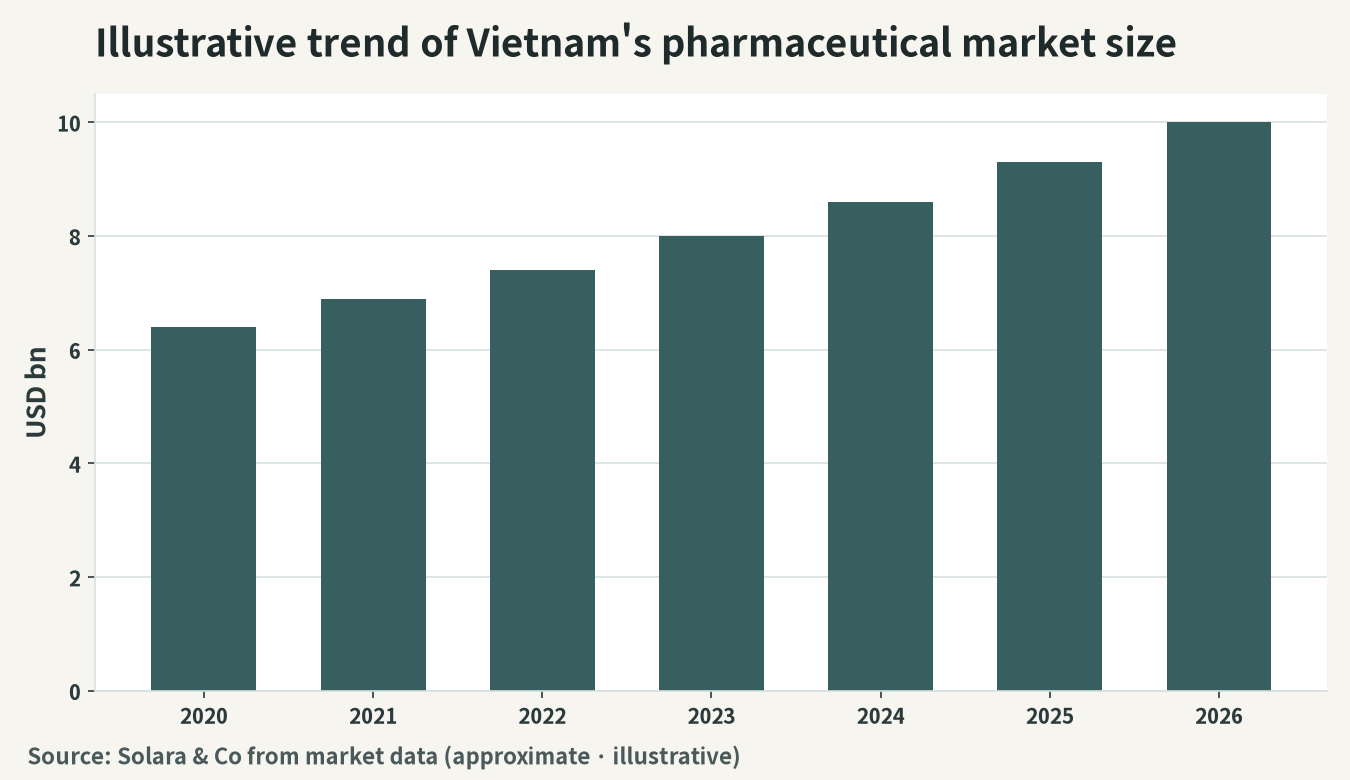
Vietnam's pharmaceutical market is one of the leading growth markets in Southeast Asia. A population of over 100 million, rising incomes, heightened health awareness, and the first signs of an aging society overlap, and demand for pharmaceuticals is expected to keep expanding over the medium to long term. The spread of public health insurance widens access to medicines, and as modern pharmacy chains and hospitals are developed, mainly in urban areas, the "quality" of the market is also steadily advancing. The market is already among the largest in Southeast Asia, and against the backdrop of its potential as a populous nation, growth approaching the double digits is expected to continue.
At the same time, this is a field where regulation is strict, the distribution structure is distinctive, and the difficulty of entry is high. Because pharmaceuticals bear directly on people's lives and health, licensing and quality standards are imposed at every stage of manufacturing, importing, and selling, and there are constraints on the business forms available to foreign capital. It is precisely for this reason that correctly understanding the regulation, distribution, and entry strategy is the premise for achieving results in this promising market. This article organizes the structure of Vietnam's pharmaceutical market and explains, from a practical standpoint, the regulatory environment, the distribution channels, and the entry strategy for foreign capital.
The Drivers Supporting the Market's Growth
The expansion of Vietnam's pharmaceutical market is supported by several structural drivers.
Population, Income, and Health Awareness
In addition to the scale of the population, rising medical spending from the expansion of the middle class is lifting the market. As incomes rise, people spend more on health, and demand for pharmaceuticals expands across a broad spectrum, from self-medication (self-treatment with over-the-counter drugs) to specialized treatment. The increase in lifestyle-related diseases and the growing interest in health and prevention are also lifting demand for pharmaceuticals and health-related products. Per-capita pharmaceutical spending is still low compared with neighboring middle-income countries, and the very process of this gap narrowing as incomes rise represents the market's long-term room to grow. The fact that people's awareness of health, hygiene, and prevention rose a notch further after the pandemic also contributes to lifting demand.
Aging and the Changing Disease Structure
Vietnam still has a young population structure, but aging has begun to progress steadily. Aging generates demand for drugs to treat chronic and lifestyle-related diseases and for long-term medical and healthcare needs. The shift in the disease structure from a focus on infectious diseases to a focus on lifestyle-related diseases is moving the composition of pharmaceutical demand toward higher-value-added areas. Pharmaceuticals that address chronic and serious diseases such as diabetes, cardiovascular disease, and cancer, and treatment areas requiring continuous medication, are expected to become the center of the market's future growth, and they are also a field with a large ripple effect on healthcare as a whole, including diagnosis, treatment, and prevention.
Public Health Insurance and Widening Access
The rising coverage rate of public health insurance widens access to pharmaceuticals and expands the market's base. What insurance reimburses and the mechanism of drug pricing are factors that greatly affect the profitability of a pharmaceutical business, so the trends in the system must be watched closely. As the coverage rate rises toward something close to universal insurance, rural areas and low-income groups that have been distant from medical services join the market as patients, and the base of pharmaceutical demand widens further.
The Regulatory Environment — Understanding the Premise of Entry
In Vietnam, too, pharmaceuticals are one of the most strictly regulated fields. In considering entry, grasping the overall picture of the regulation is the starting point.
Licensing for Manufacturing, Importing, and Selling
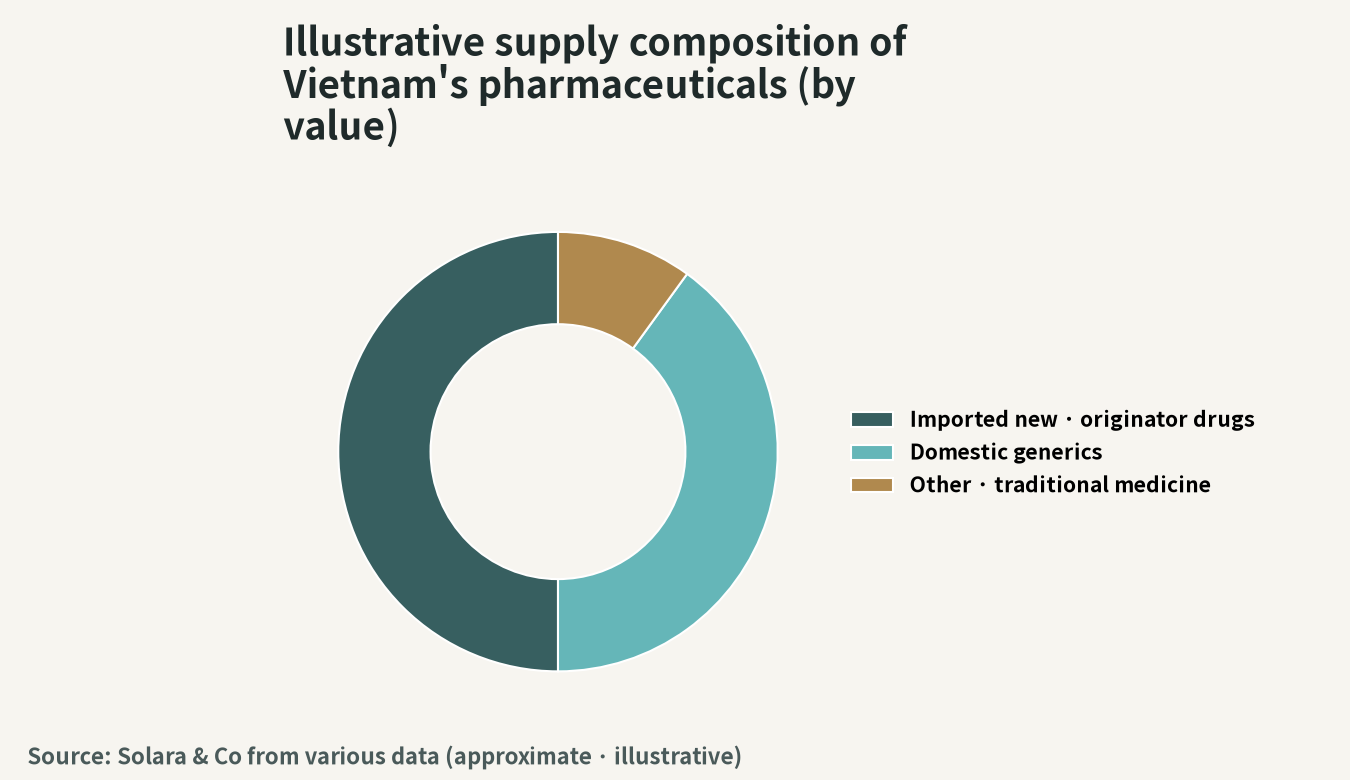
Manufacturing pharmaceuticals requires conformity with quality standards, foremost among them GMP (Good Manufacturing Practice). Imported pharmaceuticals require marketing approval (registration), and obtaining it takes time and procedure. Selling and distributing pharmaceuticals are also subject to licensing, and at each stage they are placed under the authorities' control. Most domestically produced pharmaceuticals are centered on generics; while basic pharmaceuticals whose patents have expired are increasingly produced locally, most new drugs, advanced formulations, and biopharmaceuticals depend on imports. This configuration points to the existence of two distinct strategies: the path of raising price and tender competitiveness through local production, and the path of supplying high-value-added new drugs through imports.
Foreign-Capital Restrictions and Business Form
In the distribution and retail of pharmaceuticals, there are constraints on the entry of foreign capital. The scope of activities a foreign-invested enterprise can perform directly is conditional; for example, the activity of foreign capital directly "distributing (wholesaling and delivering)" pharmaceuticals is subject to restrictions, so cooperation with local enterprises and the choice of an appropriate business form are essential. Accurately discerning what can be done directly and what requires a local partner or a specific license is the core of designing the entry. Advancing into the market without understanding this constraint risks falling into a situation where the business model envisioned cannot stand up in licensing terms.
Strengthening Quality and Safety Regulation
As a countermeasure against counterfeit drugs and poor quality, quality and safety regulation tends to be strengthened. The rising requirements for traceability and quality control can, for Japanese companies whose strength is quality, actually become a tailwind. This is because the more the record-keeping at each stage of manufacturing and selling and the mechanisms guaranteeing product authenticity are put in place, the more readily suppliers of high reliability are chosen.
The Distinctiveness of the Distribution Structure
Pharmaceutical distribution in Vietnam divides broadly into the hospital route and the retail (pharmacy) route, each operating on a different logic.
The Hospital Channel and Tenders
Most prescription pharmaceuticals reach patients through hospitals. At public hospitals, the procurement of pharmaceuticals is often carried out through a tender system, which demands competition on price and quality. In tenders, quality-grade classifications and ceilings on drug prices may be set, so both price competitiveness and quality requirements must be met. To establish a presence in the hospital channel, an understanding of and response to this procurement mechanism, and building relationships with local distributors and hospital networks, are indispensable. Because revisions to reimbursement drug prices and changes to tender rules bear directly on profit, continuously following the trends in the system is essential.
The Modernization of the Pharmacy Channel
Over-the-counter and general-use medicines are sold through the pharmacy channel. Whereas individually owned pharmacies were once the mainstay, in recent years modern pharmacy chains have expanded rapidly, and the modernization of distribution is advancing. Chain formation brings new opportunities for manufacturers in terms of quality control, inventory management, and brand exposure. Of the tens of thousands of pharmacies that exist nationwide, the proportion accounted for by chains still remains only a fraction, but the speed of their expansion is fast, and whether or not a product can be placed on modern distribution increasingly governs the sales of over-the-counter and health-related products. Transactions with a chain's headquarters are an important channel for an entering company, in that they can achieve distribution coverage and brand exposure more efficiently than developing traditional pharmacies one store at a time.
The Cold Chain and Logistics
For products requiring temperature control, such as vaccines and biopharmaceuticals, building a cold chain (low-temperature logistics) becomes the lifeline of quality assurance. Building a logistics network that can deliver as far as rural areas while preserving quality is an important competitive factor accompanying the market's expansion. Given the vast territory and the state of medical-infrastructure development in rural areas, possessing a system that can distribute nationwide while maintaining temperature control is both a barrier to entry in handling high-value-added pharmaceuticals and, at the same time, a robust competitive advantage for the company that manages to build it.
Industrial Policy Driving the Shift to Local Production
The Vietnamese government has consistently rolled out industrial policy aimed at raising the country's domestic pharmaceutical supply capacity. In its strategy for developing the pharmaceutical industry, numerical targets are set to raise the share of domestically produced pharmaceuticals in meeting domestic demand and to raise the self-sufficiency rate for vaccines and active ingredients, and the direction of encouraging technology transfer and the local production of advanced formulations and biopharmaceuticals is clear. This policy—simultaneously breaking away from import dependence and lifting the quality of domestically produced pharmaceuticals—is strengthening the incentive for foreign capital to "make it locally." Beyond a mere matter of tariffs and cost, from the standpoint of national supply security and pharmaceutical security, local production is an argument that carries ever greater weight over the medium to long term.
Preference for Domestic and EU-GMP Products in Tenders
In the tenders of public hospitals, classification into quality groups according to manufacturing standards is established, and the mechanism is built so that products meeting international manufacturing standards such as EU-GMP or PIC/S-GMP can compete in higher groups. At the same time, domestically produced pharmaceuticals that meet certain conditions may enjoy preferential treatment in tenders, so combining local production with high quality certification connects directly to competitiveness in the hospital market. For foreign capital, whether to stand up one's own local plant at the EU-GMP level or to partner with a local company that meets that level becomes the branching point of tender strategy. Rather than competing on price alone, positioning oneself in a higher quality group is what governs sustainable profitability.
Localizing Active Ingredients and the Supply Chain
Vietnam's pharmaceutical industry has long depended on imports for most of its active pharmaceutical ingredients (APIs). This is a weakness that bears directly on exchange-rate volatility and supply-disruption risks, so localizing API sourcing and diversifying the supply chain have become important themes both in policy and in business terms. A system that can complete, to a certain degree domestically, everything from active ingredients to formulation, packaging, and quality testing produces an advantage on both cost competitiveness and supply stability. For Japanese companies whose strength is technology and quality control, transferring technology to a local company or producing jointly leads to a long-term partnership that goes beyond mere sales, while also building a barrier to entry.
Entry Strategy and Investment Opportunities
There are several models for entering the pharmaceutical market. The table below organizes the features of the main entry forms.
Entry Form | Main Features | Points to Note |
|---|---|---|
Import and marketing approval | Import finished products to register and sell | Registration takes time; foreign capital's sales scope is restricted |
Local production (GMP plant) | Tariff avoidance, tender response, cost competitiveness | Capital investment, building a quality system |
Joint venture / alliance | Leverage local licenses and distribution networks | Partner selection, governance |
M&A | Acquire existing registered products, distribution, and talent | Scrutiny of off-book liabilities, licenses, and finances |
Health / OTC / supplements | Adjacent fields with relatively relaxed regulation | Brand building, labeling regulation |
In a fast-growing market, building licenses and a distribution network from scratch takes time. Acquiring an existing local pharmaceutical company or distributor through a joint venture or M&A makes it possible to obtain, all at once, products already approved for marketing, the distribution network, a tender track record, and talent—that is, to "buy time." However, because the information asymmetry concerning licenses, quality systems, and off-book liabilities is especially large in the pharmaceutical field, credit investigation and due diligence before an acquisition are decisively important.
How Japanese Companies Should Enter — Solara's Perspective
Vietnam's pharmaceutical market is a promising market, supported by the structural drivers of population, income, aging, and insurance penetration, and expected to grow over the long term. At the same time, because regulation is strict, the distribution structure is distinctive, and there are constraints on the business forms available to foreign capital, entry demands careful design. For Japanese companies whose strength is quality, safety, and trust, the strengthening of regulation and the rising emphasis on quality are, if anything, a tailwind.
The key is to understand the regulation, distribution, and entry form correctly and to choose an entry point that suits your own strengths. From import and sales, to local production, joint ventures and M&A, through to the health and OTC fields, the options are wide-ranging, and each has its own merits and risks. The selection of a local partner, in particular, and the due diligence at the time of an acquisition or alliance, are what divide success from failure.
Solara & Co, with bases and human networks on both the Japanese and Vietnamese sides, provides seamless support—from market research and organizing the regulatory environment, to formulating the entry strategy, selecting a local partner, executing an M&A or joint venture, and the pre-acquisition credit investigation and due diligence. We help you cross the wall of regulation and turn the growth of Vietnam's pharmaceutical market into solid results.