
Vietnam's Power Demand and the Rise of Renewable Energy
For a fast-growing Vietnam, electricity is the single most important infrastructure underpinning economic growth. Driven by the clustering of manufacturing, urbanization, and rising incomes, power demand continues to grow at a pace that outstrips economic growth itself. How to meet this robust demand reliably, while reconciling it with decarbonization — that is the central challenge of Vietnam's energy policy. A large part of the answer lies in renewable energy, beginning with solar and wind power.
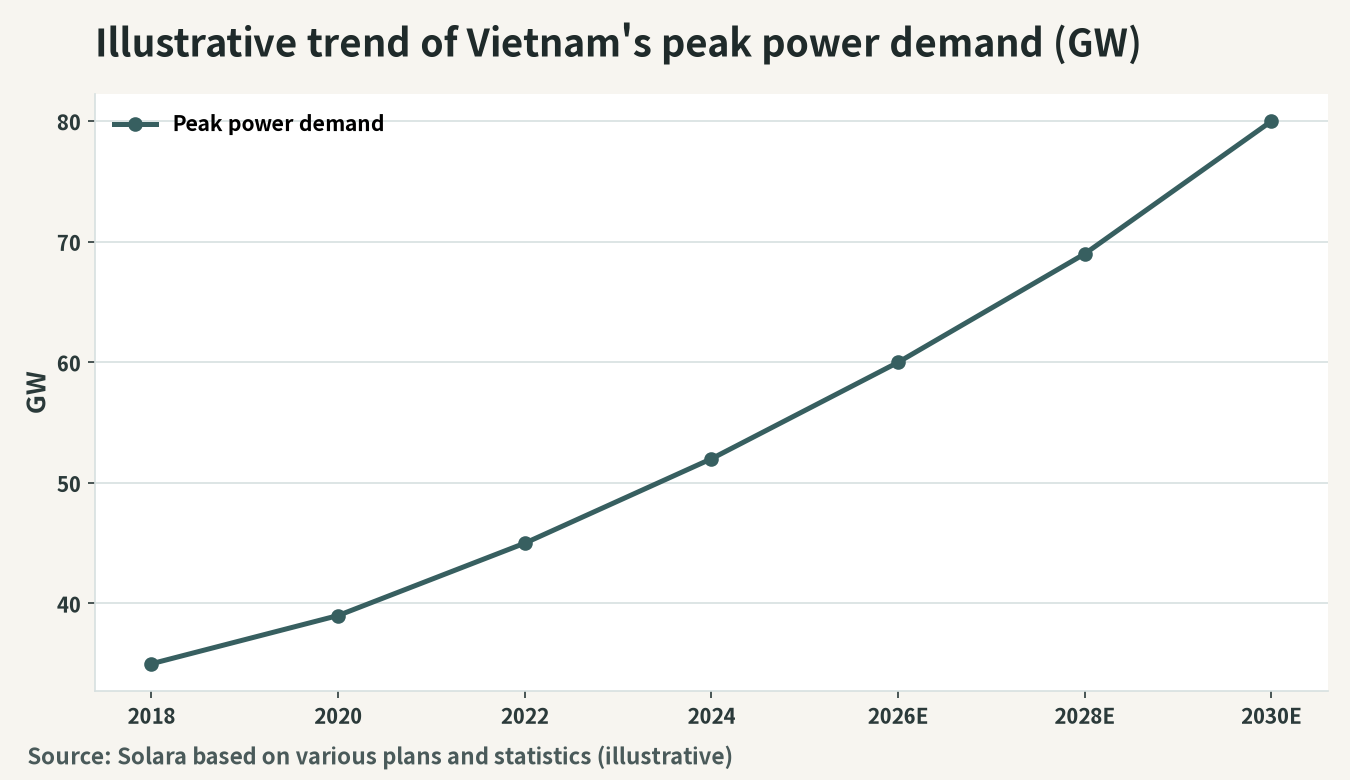
The rise in power demand is especially pronounced in the North, where manufacturing is increasingly concentrated. If supply and grid development fail to keep pace with the surge in demand, power shortages could become a constraint on economic activity. In fact, there have been periods of localized power supply strain during peak-demand seasons, so securing a stable supply is a critical theme tied directly to foreign investors' decisions. Expanding renewable energy is the trump card for closing this supply-demand gap, while at the same time creating a new challenge: how to control its variability.
Vietnam has set carbon neutrality (net-zero greenhouse gas emissions) by 2050 as an international commitment, and has announced a policy of gradually reducing its dependence on coal-fired power while substantially raising the share of renewable energy. This policy is given concrete form in the national power development plan known as "PDP8 (the 8th National Power Development Master Plan)." PDP8 serves as the compass for medium- to long-term investment and development in Vietnam's power sector, and is an indispensable guide for foreign investors seeking to read business opportunities. This article decodes the future vision of Vietnam's power market that PDP8 portrays, and explains — from a practical standpoint — the trends by power source such as solar, wind, offshore wind, and LNG, power market reform, and the investment opportunities and points of caution that foreign and Japanese companies should grasp.
The Future Power Mix Envisioned by PDP8
PDP8 (the 8th National Power Development Master Plan) is a national plan that defines which power sources Vietnam will develop, and in what quantities, toward 2030 and with an eye on 2050. Its core lies in a substantial expansion of renewable energy and the restraint of coal-fired power.
The Direction of Expanding Renewables and Phasing Down Coal
PDP8 clearly sets a direction of greatly increasing the installed capacity of renewable energy centered on solar and wind (onshore and offshore), while restraining the development of new coal-fired power and, over the long term, shrinking its role. This is an ambitious plan that seeks to satisfy three demands at once: energy security (reliable supply), economic viability, and decarbonization.
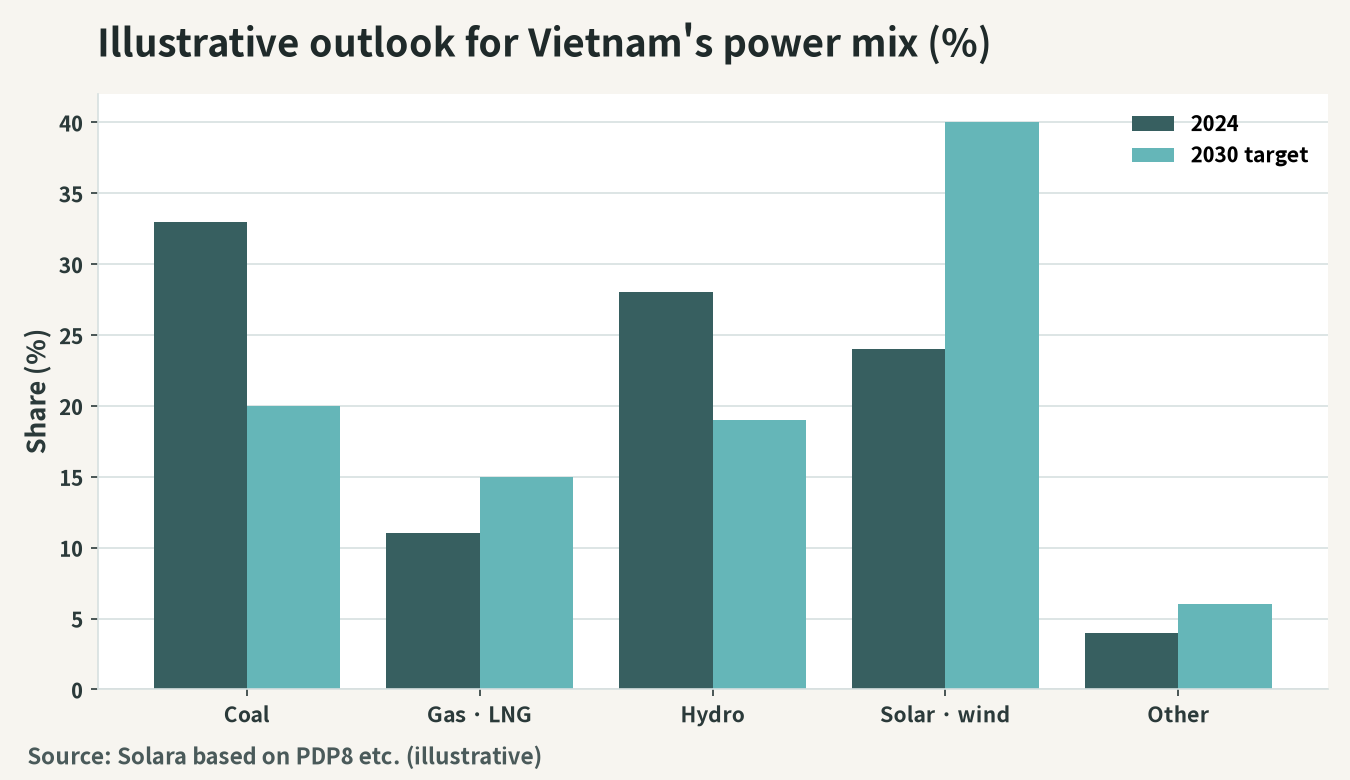
The power mix will shift over a long time horizon, from a structure centered on coal and hydropower to one in which the shares of renewable energy and gas (LNG) grow higher. In particular, the rising share of variable renewable energy such as solar and wind brings new challenges to power system operation — balancing output fluctuations, reinforcing the grid, and storing electricity. PDP8 is designed as a plan that balances generation, transmission, and flexibility, including how to address these challenges.
Trends and Investment Opportunities by Power Source
Vietnam's renewable energy differs in maturity and investment opportunity depending on the power source. The following organizes the picture by major power source.
Solar Power
Vietnam is a country blessed with abundant solar irradiation, particularly in the South, giving it high solar power potential. Under the former feed-in tariff (FIT) scheme, solar power spread rapidly, at one point with installations exceeding what policy had anticipated. Going forward, in addition to large-scale commercial solar, interest is growing in self-consumption rooftop solar installed on factory and warehouse roofs. For manufacturers, adopting renewables on a self-consumption basis is a means of simultaneously curbing electricity costs and meeting ESG and decarbonization requirements. In particular, for multinational companies that demand decarbonization across the entire supply chain, a location where products can be made with renewable electricity is becoming an important criterion in selecting where to invest, and whether renewable electricity can be procured through rooftop solar or a DPPA is beginning to determine the locational competitiveness of factories.
Onshore Wind and Offshore Wind
Wind power is also a field in which Vietnam holds great potential. In particular, against the backdrop of its long coastline and favorable wind conditions, offshore wind is anticipated as a pillar of future growth. While offshore wind can deliver large-scale generation capacity and a high capacity factor, it is a field with enormous upfront investment and high hurdles in technology, construction, and grid interconnection. For overseas wind and engineering companies, including Japanese firms, opportunities are widening to provide technology and capital. Because offshore wind generates not only power equipment but also a broad supply chain and industrial cluster — foundation structures, submarine cables, installation vessels, ports, and maintenance — it is also a field with large spillover effects on the regional economy. However, completing the permitting and institutional framework — sea-area use rights, environmental impact assessment, and securing grid interconnection — is a precondition for genuine deployment.
LNG-Fired Power and Flexibility
The higher the share of renewable energy, the more important "flexibility" becomes — the ability to compensate for its output fluctuations and underpin a stable supply. In PDP8, gas (LNG) fired power, a relatively clean fossil fuel, is positioned as a "bridging" power source that supports the transition away from coal. The development of LNG-fired power plants and receiving terminals represents a large-scale investment opportunity for foreign investors. In addition, investment in flexibility and storage technologies such as batteries and pumped-storage hydropower will grow in importance going forward.
Organizing the Characteristics by Power Source
The following organizes the characteristics and investment considerations of the major power sources.
Power source | Potential | Investment considerations |
|---|---|---|
Solar (commercial) | High (mainly the South) | Grid interconnection, land, purchase terms |
Rooftop solar | Expanding | Self-consumption, use of factory/warehouse roofs |
Onshore wind | High | Wind conditions, land, grid interconnection |
Offshore wind | Very high | Huge investment, technology, permitting, grid |
LNG-fired power | Pillar of the transition period | Terminal development, fuel procurement, contracts |
Storage and flexibility | Expanding ahead | Technology, cost, institutional design |
In this way, solar, wind, LNG, and storage each have different maturity levels and risk-return profiles. Some fields can be expected to recover investment in the short term, while others — like offshore wind — involve huge, long-term capital and high technological hurdles. When investing, it is essential to make judgments grounded in the characteristics of each power source and the current state of Vietnam's institutions and grid.
Power Market Reform and Contractual Considerations
What determines the success or failure of renewable energy investment is the institutional design of the power market. In Vietnam, reform is proceeding step by step, from a structure in which the buyer of electricity is effectively a single entity (the state-owned electric utility) toward one that incorporates more market principles.
Power Purchase Agreements (PPA) and DPPA
The foundation of revenue in a renewable energy project is the power purchase agreement (PPA). To whom, at what price, and for how long electricity can be sold — these conditions determine the project's profitability. Drawing attention in recent years is the "direct power purchase agreement (DPPA)" framework, in which a generation operator and an offtaker (such as a factory) trade electricity directly. If the DPPA is established, manufacturers seeking renewable electricity (particularly multinationals pursuing decarbonization) and generation operators can be linked directly, which is expected to spur renewable energy investment. On the other hand, the shift from FIT (feed-in tariffs) to competitive bidding and market pricing brings price uncertainty for operators, so the stability and predictability of the framework become key to investment decisions.
Points to Note When Investing
Renewable energy investment in Vietnam carries great opportunity along with inherent risks. First is volatility in policy and institutions. Changes to the purchase scheme, plan revisions, and the operation of permitting procedures can significantly affect a project's premises. It is necessary to closely watch the pricing mechanism after FIT ends, as well as developments in PDP8's specific implementing regulations.
Second is grid constraints. In regions where renewable energy has surged, grid capacity may fail to keep up, giving rise to "curtailment" — being forced to limit generation. The siting of power plants and the certainty of grid interconnection greatly affect revenue. Third is the complexity of permitting, land, and contracts. Large-scale LNG and offshore wind projects in particular intertwine permitting, land acquisition, fuel procurement, grid interconnection, and financing in a complex way, requiring a long development period. Fourth is financing and foreign exchange. Because renewable energy and power projects involve large investment amounts and long recovery periods, long-term financing is a prerequisite. When revenue is denominated in local currency while equipment and borrowings are denominated in foreign currency, exchange-rate fluctuations affect profitability. The feasibility of arranging project finance and the design of currency and pricing clauses in contracts determine the success or failure of a project. These risks must be discerned through investigation and due diligence of the target project and partner.
Conclusion — Long-Term Opportunity Lies in the "Transformation of the Power Market"
Under robust power demand and the goal of carbon neutrality by 2050, Vietnam — using PDP8 as its compass — is advancing a major shift from a coal-centered power mix toward renewable energy and LNG. Solar, rooftop solar, onshore wind, offshore wind, LNG, and storage — the maturity and risk of each power source differ, but all are investment opportunities positioned within the long-term tide of the energy transition. For Japanese companies, fields where they can leverage strengths in technology, capital, and operations are widening across a broad value chain spanning generation, transmission, storage, engineering, and operation and maintenance.
Solara & Co holds bases and human networks in both Japan and Vietnam, and provides end-to-end support — from considering investment in Vietnam's energy sector, market and institutional research, acquiring partners through M&A and joint ventures, pre-acquisition credit checks and due diligence, to verification of permitting, contracts, and grid interconnection. Capturing the great tide of the energy transition while carefully discerning institutional shifts and near-term risks — we believe that reconciling the two is the shortest path to achieving results in Vietnam's energy investment.