
Semiconductors and the Digital Economy at the Heart of Vietnam's National Strategy
Vietnam has positioned semiconductors and the digital economy as its next growth engines and is cultivating them as a matter of national strategy. Behind this lie two imperatives: the global restructuring of semiconductor supply chains, and the need for industrial upgrading to escape the "middle-income trap." Moving from labor-intensive assembly and processing toward higher-value-added design, manufacturing, and testing; lifting productivity through digitalization. Whether Vietnam can pull these off will determine whether it can stand at the threshold of the advanced economies.
Amid US–China rivalry and the geopoliticization of supply chains, the semiconductor industry is benefiting from a trend in which nations are gravitating toward "supply networks among friendly countries (friend-shoring)." With its political stability, improving relationship with the United States, deep base of science and engineering talent, and existing electronics-industry cluster, Vietnam is raising its profile within this restructuring. This article organizes the overall picture of Vietnam's semiconductor and digital-economy strategy, reads where the opportunities lie within the value chain, and on that basis explains the investment considerations and risks for Japanese companies from a practical standpoint.
The Overall Picture of Vietnam's Semiconductor Strategy
The Vietnamese government envisions the cultivation of its semiconductor industry as a phased roadmap. The backbone of that roadmap is a pragmatic approach: "building up from existing strengths."
A Pragmatic Path Anchored in Back-End Processes (ATP)
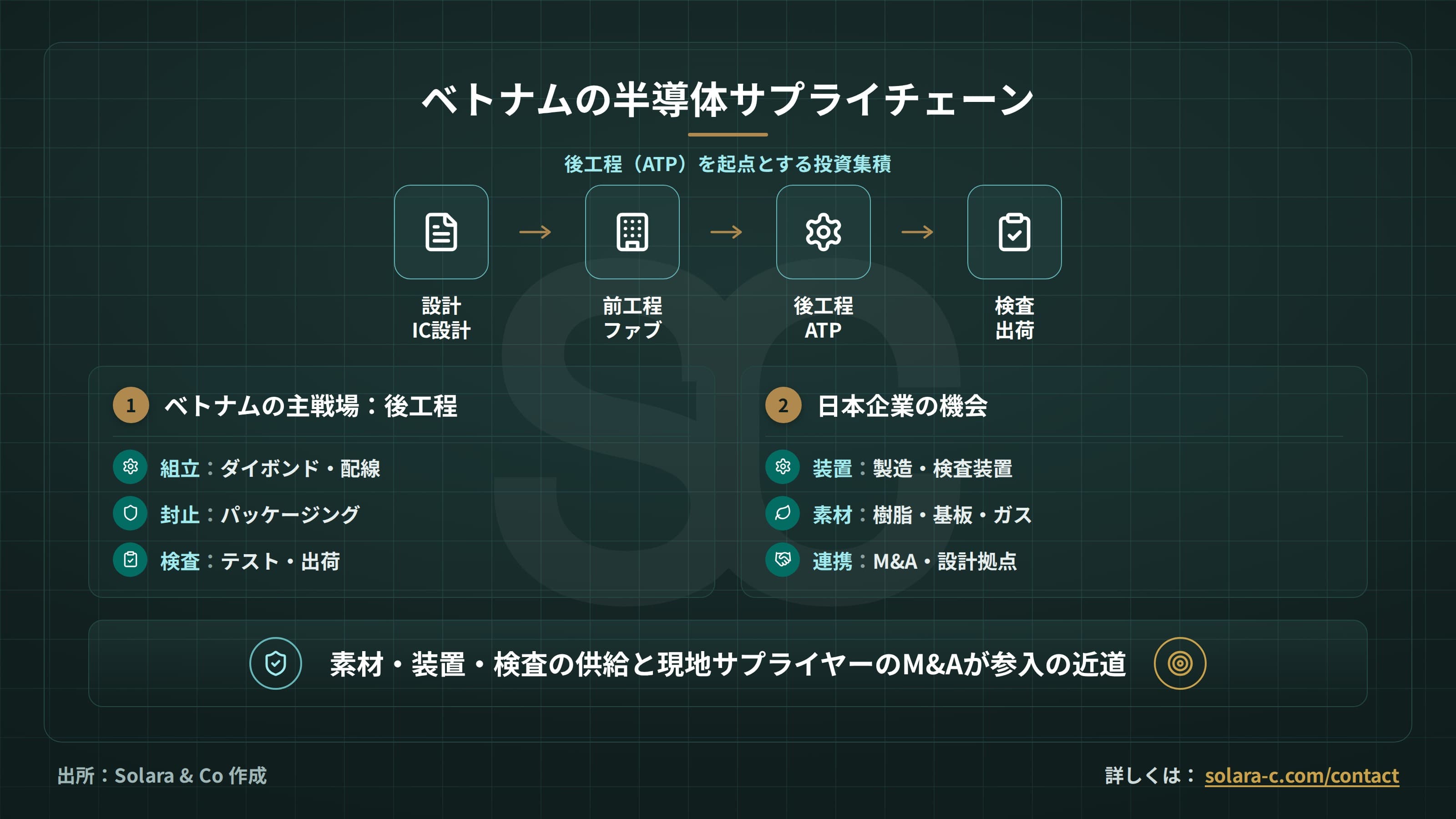
The semiconductor value chain divides broadly into design, front-end processes (fabrication/fab), and back-end processes (assembly, test, and packaging = ATP). Where Vietnam is first demonstrating its strength is in back-end ATP. Compared with front-end processes, which demand enormous capital investment and advanced technology, ATP is easier to launch with a labor force and mid-tier technology, and it is also a natural fit with the existing electronics-industry cluster. Major global semiconductor players and dedicated back-end manufacturers are establishing large-scale bases in Vietnam, and a major ATP cluster is steadily taking shape.
Moving Upstream into Design and Talent Development
At the same time, Vietnam is also pouring effort into the more upstream activities of design (IC design) and talent development. Leading EDA (electronic design automation) vendors and design-service firms are setting up bases, and the design capabilities of local engineers are gradually accumulating. The government has set a target of training semiconductor talent on the order of tens of thousands over the medium term, and is advancing collaboration among universities, vocational training institutions, and industry. Securing both the quantity and quality of talent is precisely the single most important challenge that holds the key to the success or failure of the entire strategy.
The Digital Economy as the Foundation
The semiconductor strategy is also part of a broader digital-economy strategy. Vietnam has set a target of sharply raising the digital economy's share of GDP over the medium term, and is advancing the development of fields such as e-commerce, fintech, cloud, data centers, and AI. The upgrading of manufacturing and the expansion of digital services act as two wheels that drive the nation's productivity forward. In particular, as global cloud providers and data-center operators expand their investment in Vietnam, a virtuous cycle is emerging in which the semiconductor and electronics cluster and the build-out of digital infrastructure reinforce one another. The worldwide surge in AI demand is pushing investment still higher—into the data centers that underpin computing resources, and into the power, cooling, and network infrastructure that supports them.
Japan–Vietnam Cooperation as a Tailwind
The semiconductor and digital fields are also strongly tied to the deepening of Japan–Vietnam relations. Both countries recognize economic security and the strengthening of supply-chain resilience as shared challenges, and cooperation is advancing across talent development, technological collaboration, and supply-chain construction. Japan possesses world-leading competitiveness in semiconductor materials and manufacturing equipment, while Vietnam serves as a base for talent and for assembly and testing—a complementary relationship. This mutual complementarity becomes an advantage that companies from other countries do not have when Japanese firms participate in Vietnam's semiconductor ecosystem.
The Growth of Semiconductors and the Digital Economy in Numbers
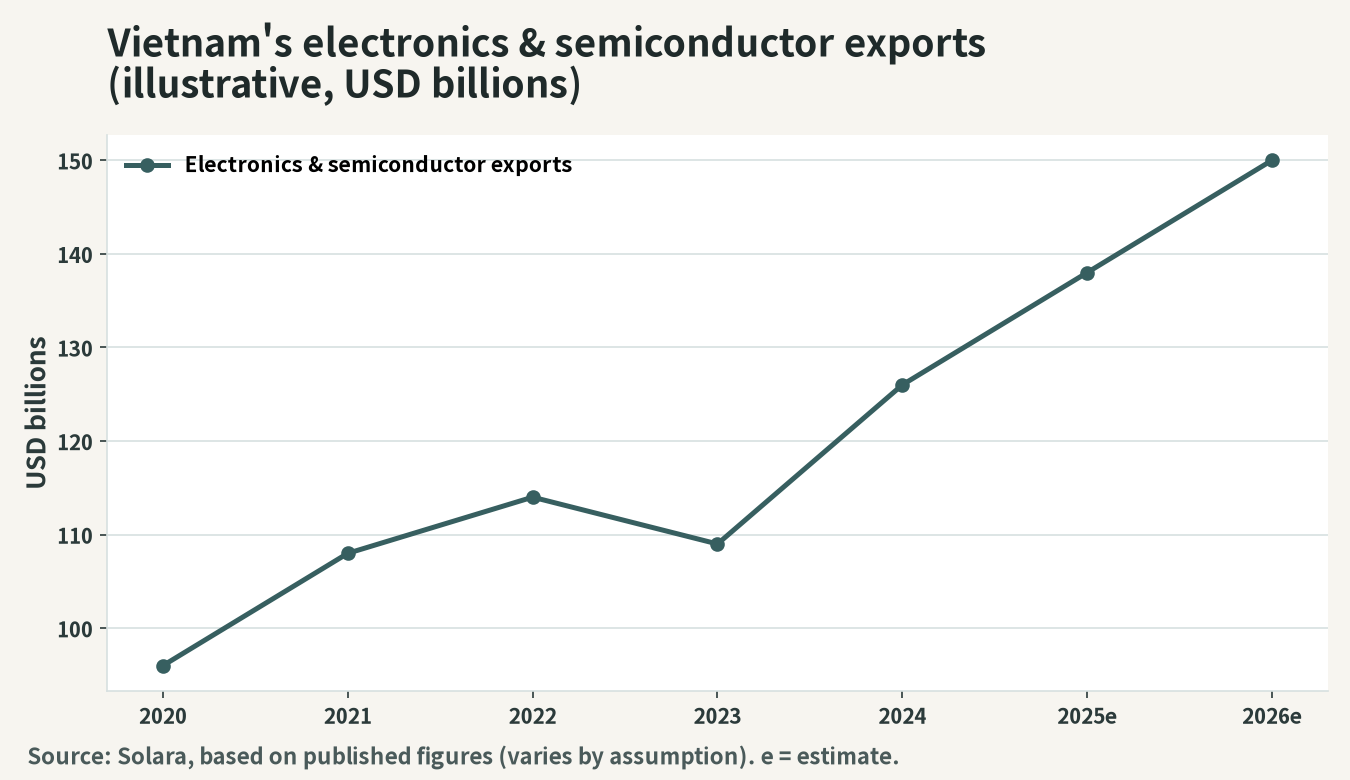
Let us confirm the contours of the strategy through two indicators. First is the expanding trend in semiconductor-related exports and market scale. Electronics and semiconductors are already a leading force driving Vietnam's exports, and their presence grows more pronounced year after year.
Second is an organization of where, within the semiconductor value chain, Vietnam holds its strengths and opportunities.
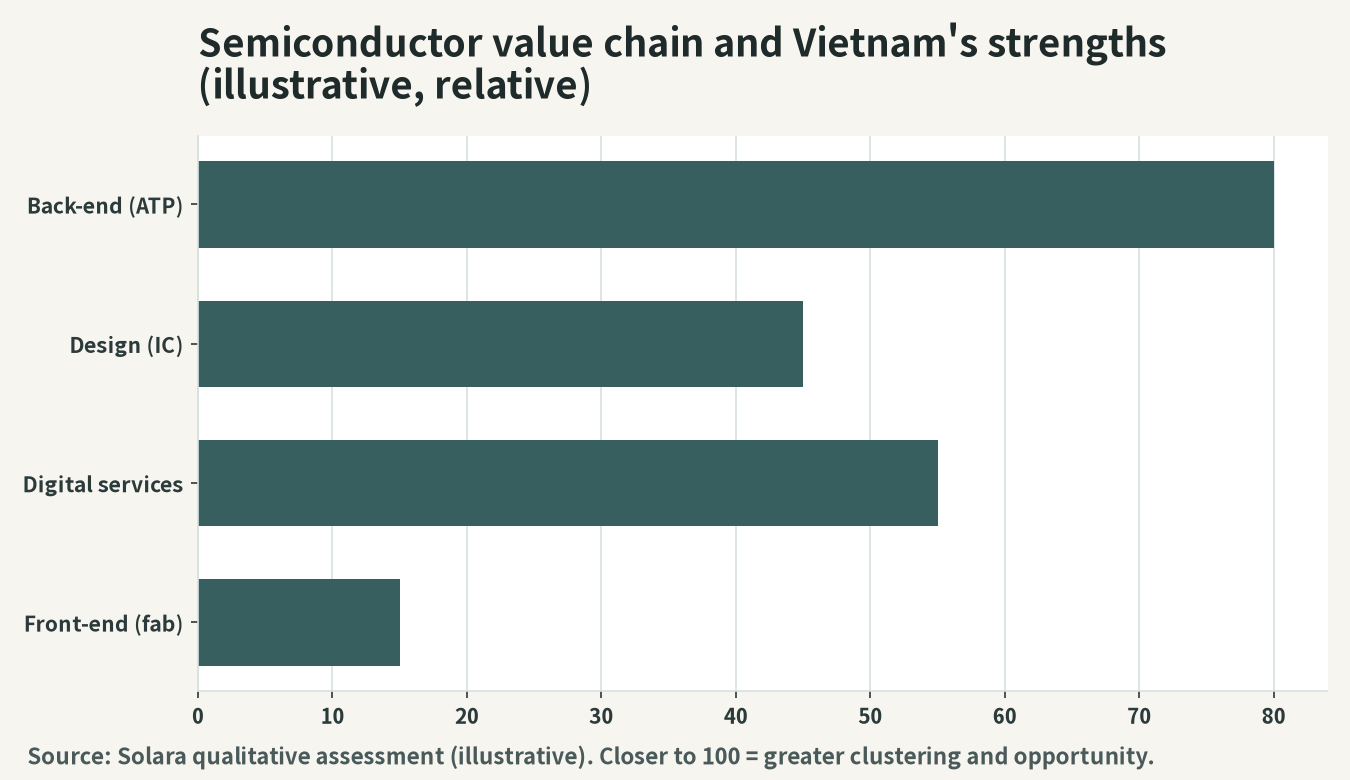
These figures may swing depending on the assumptions, but the direction is consistent. Starting from back-end processes, expanding upstream into design and talent while raising the share of the digital economy as a whole—this is the growth path Vietnam has charted.
Investment Opportunities by Value-Chain Segment
Opportunities in semiconductors and the digital economy differ markedly in character depending on where in the value chain they sit. Below they are organized alongside the strengths of Japanese companies.
Segment | Vietnam's positioning | Main opportunities | Strengths of Japanese companies |
|---|---|---|---|
Back-end (ATP) | Cluster forming | Supply of equipment, materials, machinery | Manufacturing equipment, inspection, materials |
Design (IC design) | Talent-development stage | Design bases, talent utilization | Design outsourcing, IP collaboration |
Manufacturing (front-end) | Medium- to long-term challenge | Early positioning in equipment and materials | Semiconductor materials and equipment |
Digital services | Rapidly expanding | Cloud, DX, data centers | System and operational quality |
Surrounding infrastructure | Still being built out | Power, logistics, talent development | Engineering |
Especially promising for Japanese companies is the supply of semiconductor manufacturing equipment, inspection equipment, and various materials (chemicals, gases, substrate materials, and the like). The more ATP and design clusters advance in Vietnam, the more local demand arises for the equipment, materials, and components that support them. Effective approaches include "follow-on investment" that tracks finished-product manufacturers as they enter the market, and strategies that bring promising local suppliers into the fold through M&A and joint ventures. For an outlook on the semiconductor industry as a whole, please also refer to The Outlook for Vietnam's Semiconductor Industry.
In addition, in the design domain, establishing design centers that leverage Vietnam's abundant science and engineering talent, or partnering with local design firms, becomes a realistic option. Compared with Japan or other Asian bases where labor costs are rising, Vietnam is steadily assembling an environment in which design engineers can be secured over the medium to long term. In the digital-services field, areas where the quality and operational know-how of Japanese companies are valued are expanding—manufacturing DX, smart factories, and data-center operation among them. Designing the point of entry by surveying not just the "point" of semiconductors but the entire ecosystem surrounding it is what leads to maximizing the opportunity.
Investment Considerations — What Must Be Discerned
In making investment decisions in the semiconductor and digital fields, considerations arise that differ from those of ordinary market entry.
Securing and Developing Talent
The competitiveness of this industry resides in people more than in equipment. Securing design engineers, equipment operators, and quality-control personnel is no easy task, and it is a domain of fierce wage inflation and poaching competition. Collaboration with local universities and training institutions, an in-house development structure, and compensation design that raises retention rates will determine long-term competitiveness. Generational technology turnover in semiconductors is rapid, so continual re-education of personnel skills is indispensable. To avoid falling, after entry, into a situation of "can't hire, can't train, can't retain," it is essential to place talent strategy at the core of the investment plan from the pre-entry stage. Grasping the depth of the talent pool in each region and the state of competition for talent with nearby rival bases is also a key consideration, on par with site selection.
Incentive Schemes and the Global Minimum Tax
High-tech fields have long been the object of generous tax-incentive schemes, but with the introduction of the global minimum tax, the effect of conventional-style tax incentives is fading. In their place, the design of new incentives—R&D subsidies, talent-development support, and infrastructure development—is advancing, making it important to discern which forms of support one's own business qualifies for.
Stability of Supply Chains and Power
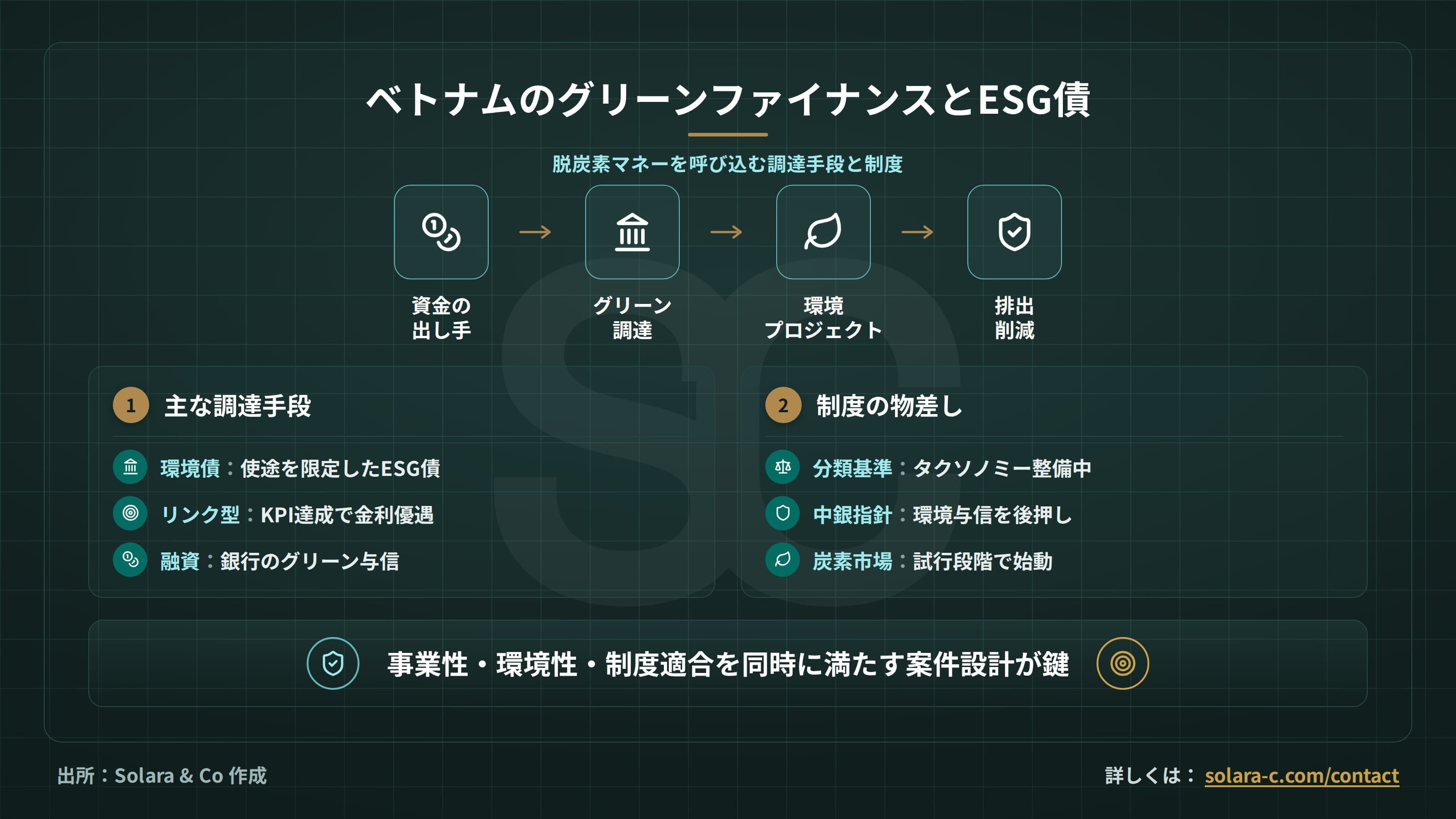
Semiconductors and data centers presuppose stable power, water, and high-quality infrastructure. Regional disparities in power supply and the maturity of infrastructure are decisive factors in site selection. The availability of green power is also growing in importance for meeting the demands of global customers. Trends in the energy transition are covered in Vietnam's Energy Transition and GX.
Risks to Keep in Mind
Precisely because the opportunity is large, the risks must be viewed with a cool head. First is the bottleneck in the quality and quantity of talent. The strategy's targets are ambitious, but development takes time, and whether talent will be supplied as planned remains uncertain. Second is the high intensity of technology and capital. Full-scale entry into front-end processes requires enormous investment and a long time horizon for recovery. Third is geopolitical risk. Semiconductors are subject to the export controls and security policies of various nations, and a policy change can completely transform the business environment. Fourth is intensifying competition. Nations are vying to be the recipient of friend-shoring, and Vietnam is no exception.
These risks must be managed by drawing up an exit strategy at the entry stage, by relying on locally rooted information and the selection of trustworthy partners, and by careful due diligence at the time of M&A and joint ventures. The semiconductor and high-tech fields in particular involve large investment scales and long recovery periods, so errors in early judgments about location, partners, and talent leave a lasting mark. That is exactly why, the more a field has momentum, the more it is worth taking time to verify the facts on the ground.
How Japanese Companies Can Seize the Opportunity — Solara's Perspective
Vietnam's semiconductor and digital-economy strategy is a long-term challenge to raise the productivity of the entire nation, expanding upstream from a starting point in back-end processes. For Japanese companies, opportunities to bring their strengths in technology and quality to bear are spreading across every part of the value chain—the supply of manufacturing equipment, inspection, and materials; the utilization of design bases and talent; and the provision of digital services.
Solara & Co, built on bases and human networks on both the Japanese and Vietnamese sides, provides end-to-end support—from market research and the formulation of investment strategy, through the search for local partners and M&A and joint ventures, pre-acquisition credit investigation and due diligence, to the building of operating structures after entry. Within the great current of national strategy, identifying the position where one's own strengths come most into play while steadily managing the risks underfoot—reconciling these two is, we believe, the shortest path to producing results in Vietnam's growth industries.