
A Top-10 Global Position in Sight — the Rise of Vietnam's Steel Industry
Over the past decade, Vietnam's steel industry has grown remarkably, climbing into the ranks of the world's leading producers of crude steel. Having established itself as the largest steel-producing nation in Southeast Asia, it has now reached a scale at which a top-10 global position is coming into sight. Behind the transformation of a country that once depended heavily on imports into one that produces high-quality steel domestically—some of it even destined for export—lie robust domestic demand, large-scale private investment, and a shift in the very structure of the industry.
Steel is called "the rice of industry"—a foundational material underpinning every sector, from construction, infrastructure, automobiles, and machinery to shipbuilding and home appliances. Domesticating and upgrading its production is an indispensable piece of Vietnam's transformation into a manufacturing nation. Whether a country can supply steel stably on its own is also a barometer of how self-reliant its industry is. This article organizes the supply-and-demand structure underpinning the rise of Vietnam's steel industry, decodes the structural shift that a top-10 position implies, and then, from a practical standpoint, explains the business opportunities and the risks Japanese companies should keep in mind. The movements of the steel industry are also a mirror reflecting the direction of Vietnam's entire economy, from upstream materials to downstream manufacturing.
Structural Factors Pushing Steel Demand Higher
The growth of Vietnam's steel industry is underpinned by solid domestic demand.
Robust Demand from Construction, Infrastructure, and Real Estate
The largest driver of steel demand is construction and infrastructure. The construction of housing, commercial facilities, and factories accompanying rapid urbanization, together with large-scale infrastructure investment such as the North–South high-speed railway, airports, roads, and ports, continues to push up demand for steel (construction steel in particular). In Vietnam, active construction investment continues throughout the year, and during phases of expanding public investment, steel demand rises further still. The expectation that infrastructure development will be prolonged means that demand for construction steel has a long, broad base. The overall picture of infrastructure investment is covered in detail in Infrastructure Development Investment in Vietnam.
Manufacturing Clustering and the Shift Toward High-Grade Steel
The clustering of manufacturing on the back of "China+1" is generating demand for higher-quality steel in fields such as automobiles, machinery, home appliances, and building materials. In particular, the domestication of higher-value-added products—automotive steel sheet, high-grade steel for electrical equipment, and hot-rolled coil (HRC)—has become the focal point of industrial upgrading. Such high-grade steel has traditionally depended on imports, but the shift to domestic production is steadily progressing. What manufacturing seeks is not steel that merely exists in quantity, but high-quality products with thorough dimensional precision, surface quality, and composition control. Whether the industry can meet these demands determines whether Vietnam's steel industry can capture the advanced downstream manufacturing sector. From general-purpose construction steel to high-value-added steel for manufacturing—this change in the demand structure is driving the upgrading of the industry as a whole.
Expansion into Export Markets
Beyond satisfying domestic demand, Vietnamese-made steel is now exported to neighboring countries and beyond. On the back of cost competitiveness, Vietnam is changing its position from a net steel importer to an exporter in certain product categories. While this export capacity signals the industry's maturity, it also invites a new challenge: trade friction in destination markets. If capacity expansion proceeds at a pace exceeding domestic demand, the surplus must be redirected to exports, which can trigger anti-dumping measures by other countries—Vietnam's steel industry is growing while carrying this very tension. How it strikes the balance between supply and demand, and between domestic and export markets, will determine the industry's sustainable growth.
The Scale of the Steel Industry in Numbers
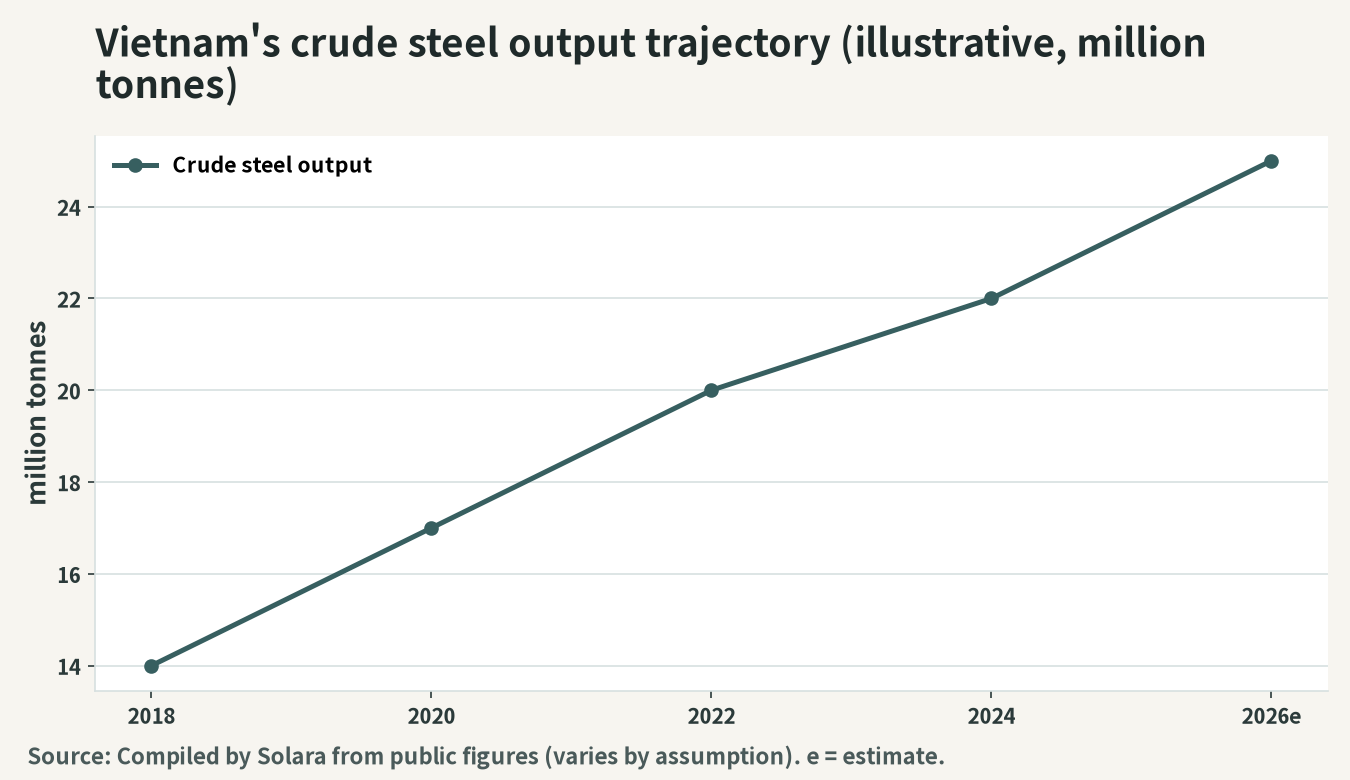
Let us confirm the contours of the steel industry through two indicators. First is the trajectory of crude steel output. It shows the path by which Vietnam rapidly expanded production over the past decade and rose into the ranks of the world's leading nations.
Second is the composition of steel demand by end use. It illustrates a picture in which construction and infrastructure account for the bulk, while the share destined for manufacturing rises.
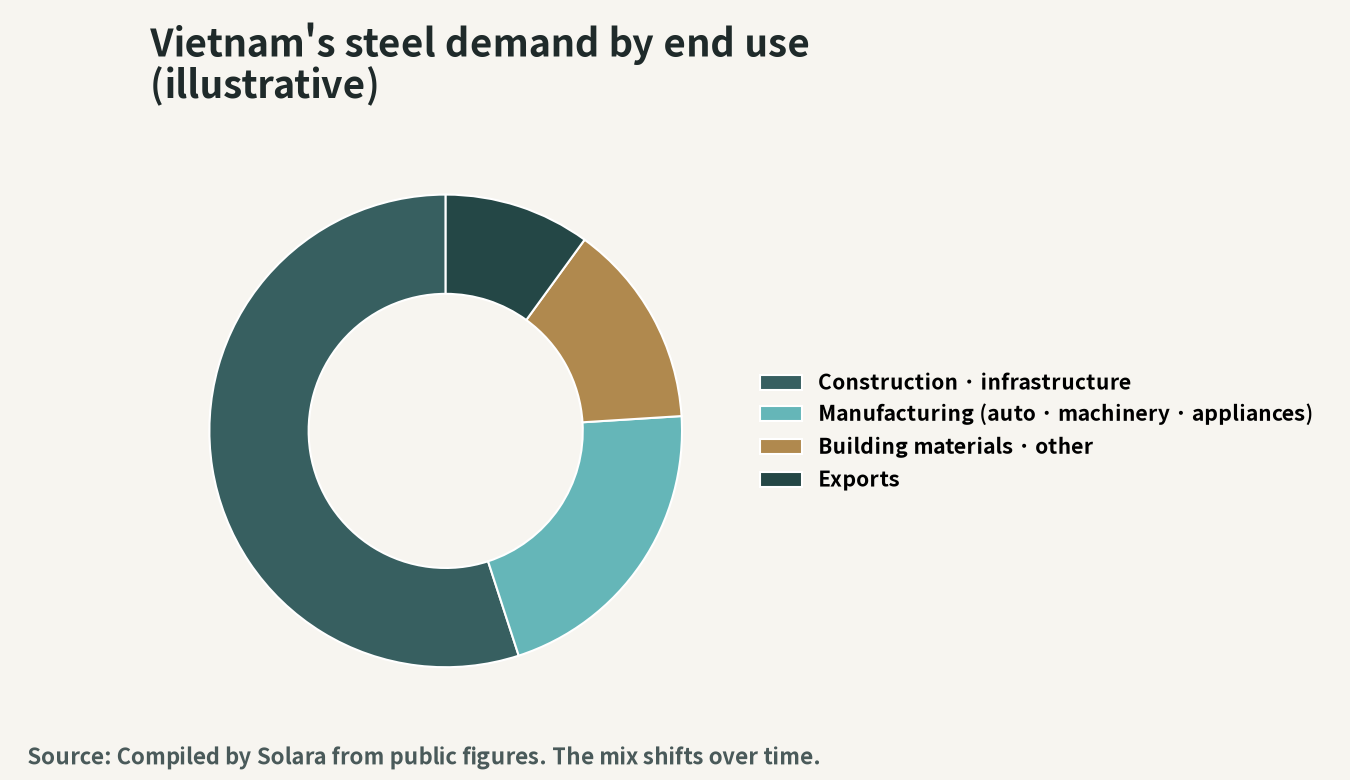
These figures vary depending on the assumptions, but the direction is consistent. Output expands and edges into the world's leading ranks, while its internal composition upgrades from construction steel to high-grade steel for manufacturing—this is the underlying tone of Vietnam's steel industry.
How a Top-10 Position Signifies a Structural Shift
Reaching a top-10 global position is not merely an achievement of "quantity." It is the manifestation of Vietnam's steel industry completing a shift in "quality"—from low-value-added construction steel toward high-value-added products.
Integrated Steelmaking and the Domestication of High-Grade Steel
In Vietnam, large-scale integrated steelworks producing seamlessly from raw materials to finished products have come online, and capacity has expanded substantially. Leading domestic private steel majors have raised their capacity another notch through the expansion of large-scale steelworks and have moved into domesticating hot-rolled coil (HRC), which had depended on imports. HRC is a foundational material for downstream industries such as automobiles, home appliances, and building materials, so its domestication carries the meaning of raising the self-reliance of the entire industry. Being able to procure materials domestically—stably and at competitive prices—also positively influences the investment decisions of manufacturing sectors such as automobiles, home appliances, and machinery, and accelerates the localization of the entire supply chain. This is a movement symbolizing the deepening of the industrial structure, as Vietnam evolves from "a country that assembles" into "a country that makes things from materials up."
A Virtuous Cycle with Downstream Industries
The upgrading of steel and the clustering of manufacturing are generating a mutually reinforcing virtuous cycle. Being able to obtain high-quality steel domestically raises the local-procurement ratio of manufacturing, and the clustering of manufacturing in turn pushes demand for high-grade steel still higher. This virtuous cycle is the driving force lifting Vietnam from a mere assembly base into a manufacturing nation equipped with everything from materials to finished goods. An economy reliant on imported materials is vulnerable to exchange rates, international market conditions, and logistics disruptions, and carries uncertainty in both cost and delivery. Becoming able to supply foundational materials stably at home enhances the resilience of the supply chain and lifts the competitiveness of the entire industry. Self-reliance in steel is also an important step in Vietnam's building of an industrial structure resilient to external shocks. On the movement of manufacturing clustering, please also see Manufacturing Relocation and High-Tech Investment into Vietnam.
Business Opportunities for Japanese Companies
The rise of Vietnam's steel industry generates a diverse range of business opportunities for Japanese companies. Let us organize them by overlaying Japan's strengths.
Field | Nature of opportunity | Strengths of Japanese companies | Entry approach |
|---|---|---|---|
High-grade / special steel | Domestication, quality improvement | Steelmaking technology, quality | Technical tie-up, JV |
Steelmaking equipment / technology | Capacity expansion | Equipment, engineering | Equipment supply, EPC |
Environmental / energy-saving technology | Decarbonization response | Energy-saving, electric-arc-furnace tech | Technology licensing, tie-up |
Processing / distribution (steel) | Downstream demand | Processing, quality control | Market entry, M&A |
Raw materials / auxiliary inputs | Stable procurement | Trading-house functions | Trading, investment |
Japanese steel and engineering companies possess world-class competitiveness in high-grade and special-steel manufacturing technology, energy-saving and environmental technology, and steelmaking equipment. As Vietnam advances the shift from quantity to quality in steel while simultaneously being pressed to respond to decarbonization, demand for these technologies will expand structurally. A diverse range of entry routes can be envisioned—technical tie-ups, joint ventures, equipment supply, and entry into steel processing and distribution. In particular, the "buying time" strategy is also effective: acquiring, via M&A or joint venture, local companies that have the technology but face challenges in capital or quality control, and transplanting Japanese technology into them.
Risks to Keep in Mind
Precisely because the opportunity is large, the risks must be viewed calmly. First is oversupply and price volatility. If each company's capacity build-up exceeds demand, market conditions deteriorate and margins are squeezed. Second is trade friction. Steel is prone to becoming a target of trade friction worldwide, so trade-defense measures such as anti-dumping actions affect exports. Third is the response to decarbonization. Steel is a carbon-intensive industry, so carbon regulations such as the EU's CBAM are directly linked to export competitiveness. Investment in electric-arc furnaces and green steelmaking will become a condition of future competition. Fourth is volatility in raw-material prices and exchange rates, and the reliability of partners.
These must be managed through locally rooted information, the selection of trustworthy partners, an exit strategy set at the entry stage, and thorough due diligence in M&A and joint ventures. Because steel involves large investment scale and large market swings, prior investigation that gauges a counterparty's finances, track record, and compliance is the key to preventing major losses later. Decarbonization, in particular, is a long-term theme that will determine the competitiveness of the steel industry going forward. The transition from blast-furnace-centered production to low-carbon processes such as electric-arc furnaces and hydrogen reduction requires enormous investment and time, and how skillfully a company responds will determine its export competitiveness a decade from now. The energy-saving, electric-arc-furnace, and environmental-countermeasure technologies that Japanese companies hold are important assets supporting this transition, and supporting the decarbonization of Vietnam's steel industry is itself a long-term business opportunity.
How Japanese Companies Can Seize the Opportunity — Solara's Perspective
Vietnam's steel industry, underpinned by robust domestic demand and large-scale investment, has grown to a scale at which a top-10 global position is in sight while completing a structural shift from quantity to quality. For Japanese companies, business opportunities that leverage strengths in technology and quality are spread widely—from high-grade and special-steel technology, steelmaking equipment, and energy-saving and environmental technology to steel processing and distribution. The key is to combine investment decisions grounded in a calm view of market and trade conditions with the soundness of the partner at hand.
Solara & Co has bases and human networks on both the Japanese and Vietnamese sides, and supports the entire process—from market research and the formulation of investment strategy, to the search for local partners and M&A or joint ventures, pre-acquisition credit investigation and due diligence, and the building of structures after entry. Amid the great current of the structural transformation of the steel industry, identifying the position where one's own strengths come to life best, while carefully assessing the risks at hand—this very combination, we believe, is the shortcut to results in Vietnam's foundational-materials industry.