
Vietnam's Textile and Apparel Industry — A Major Exporter's Next Move
Vietnam is one of the world's leading textile and apparel exporters. Centered on garment assembly, the industry has long supported the Vietnamese economy in both employment and foreign-currency earnings. Employing millions of people and ranking among the world's top exporters, the industry is now more than a "cheap sewing base": it is shedding its skin toward the next stage of growth by leveraging free trade agreements (FTAs) and moving up the value chain.
At the same time, the industry carries structural challenges. It depends heavily on imports for much of its upstream materials such as fabric and yarn, ceding a large share of value-added abroad. To fully capture the FTA benefits tied to rules of origin, this upstream weakness must be overcome. On top of that, rising wages, tighter environmental regulation, and the increasingly demanding sustainability standards required by Western brands are forcing change on the traditional thin-margin, high-volume model. This article reviews the current state of Vietnam's textile and apparel industry, unpacks the two keys of FTA utilization and value-added upgrading, and then examines the investment opportunities and risks for Japanese companies from a practical standpoint.
The Structure That Built a Major Exporter
Vietnam's textile and apparel industry developed with garment assembly (CMT = Cut, Make, Trim) at its core. Based on orders from global brands, it harnesses an abundant, diligent workforce to produce large volumes of clothing for export to Western, Japanese, and regional markets — this contract-sewing model is the industry's backbone.
A Pillar of Employment and Exports
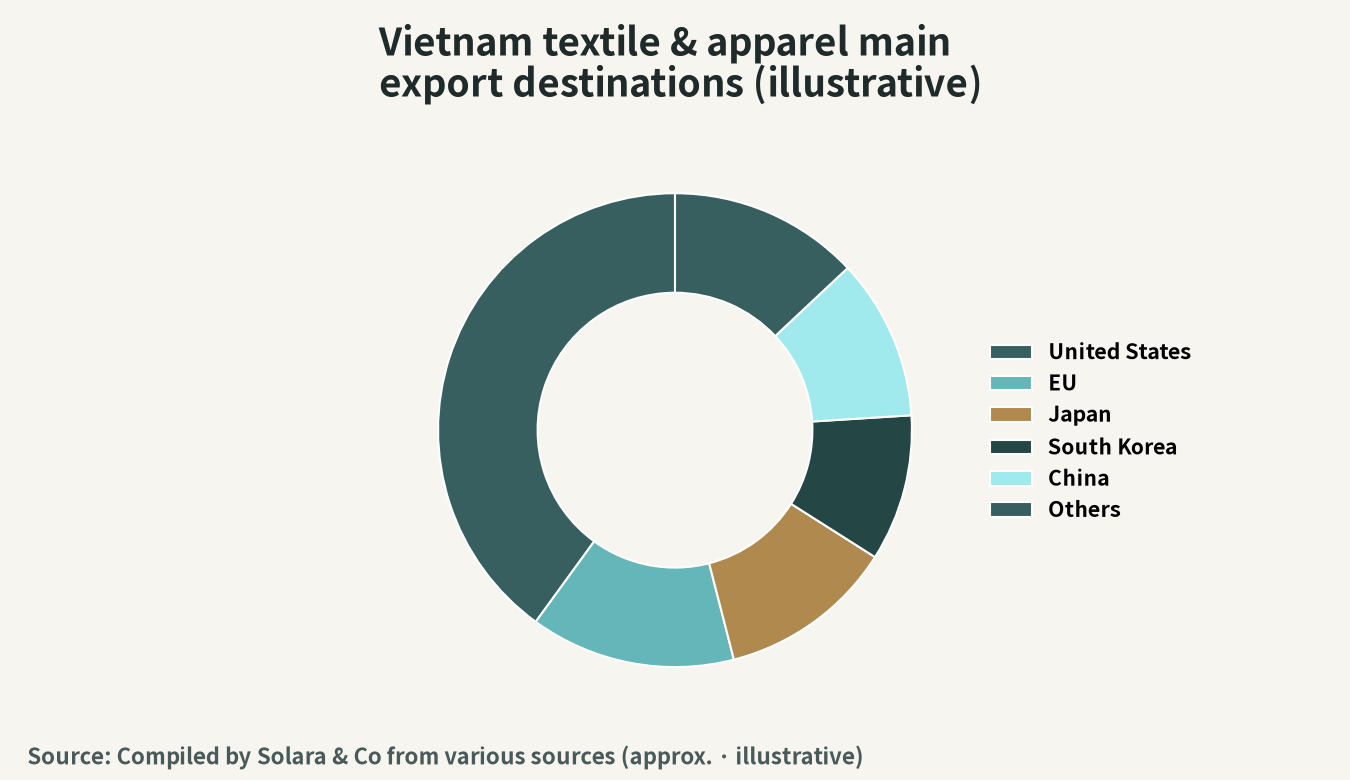
Textiles and apparel stand out among manufacturing industries for their capacity to absorb labor. The sector links rural labor to jobs in cities and industrial parks, lifting incomes and expanding domestic demand. Its export value ranks second only to electronics and remains an important pillar of foreign-currency earnings. Its broad creation of employment opportunities for women, in particular, gives the industry great social significance. Major export destinations are spread across the United States, the EU, Japan, Korea, and China, avoiding excessive dependence on any single market while connecting Vietnam to the world's major consumption centers — a key strength. Production extends across both the southern region around Ho Chi Minh City and the north, forming a deep industrial base ranging from small and mid-sized sewing factories to large integrated production plants. In terms of scale, industry-association estimates put it at thousands of enterprises and a workforce of several million, with export value reaching tens of billions of US dollars in some years — a vast industry. Among destinations, the United States is the single largest export market, said to account for roughly four-tenths of apparel exports. Because demand is concentrated there, a US downturn or a shift in trade policy tends to feed directly into order volumes, and even as markets have diversified, adjusting this dependence on the US remains a challenge for the industry as a whole.
The Limits of the CMT Model
However, contract sewing centered on CMT has a weakness: it concentrates on the thin-margin stages of value-added. The high-value areas — design, materials procurement, and branding — are held by the buyer side, and the margin left for Vietnam is limited. As wages rise, a model that continues to rely solely on low-margin sewing is beginning to show the limits of its sustainability. Price competition with countries that have lower labor costs, such as Bangladesh, is also fierce, and it has become difficult to secure profit with a volume-chasing strategy alone. For the industry to advance to the next stage, a structural shift that raises value-added itself is unavoidable.
The Tailwind of FTA Utilization
The greatest tailwind for Vietnam's textile and apparel industry is its dense network of free trade agreements (FTAs). Through agreements such as the CPTPP, the EVFTA (Vietnam-EU), and RCEP, the industry can secure tariff advantages when exporting to major markets.
The Condition Called Rules of Origin
To enjoy the FTA tariff benefits, however, the rules of origin must be met. For textile products, it is not uncommon to face rules requiring in-region procurement of upstream stages, such as "yarn forward" (from the yarn stage within the region) or "fabric forward" (from the fabric stage within the region). For Vietnam — which has imported large volumes of fabric and yarn from outside the region (particularly from certain countries) — meeting these rules is not easy, and upstream localization becomes a precondition for capturing the tariff benefits. That said, the strictness of the rules differs by agreement. The CPTPP is fundamentally yarn-forward, requiring in-region content from the yarn stage, whereas the EVFTA is built around fabric-forward (in-region content from the fabric stage) but also incorporates flexibilities attuned to real procurement conditions — for example, "cumulation," which treats fabric originating in Korea (a country that also has an FTA with the EU) as in-region. Because the level of upstreaming required and the cost burden vary greatly depending on which agreement and which market you target, designing the supply chain around the rules of each export market is the key to actually capturing the tariff benefits.
A Mechanism That Attracts Upstream Investment
Conversely, these very rules of origin become a powerful incentive that draws investment into the upstream (spinning, weaving, dyeing, fabric). To capture the FTA tariff benefits, momentum emerges to build supply chains that are completed within the region from the fabric stage, and this is where opportunities open up for companies with materials, dyeing, and processing technology. For the global brands on the ordering side, an integrated-production supplier that can satisfy the rules of origin is highly attractive in procurement terms, so producers that hold upstream capacity within the region are better positioned to win orders. In short, the FTA is not merely a matter of tariffs; it functions as a structural incentive that promotes the upstreaming of Vietnam's industry and captures the value-added of the entire supply chain domestically.
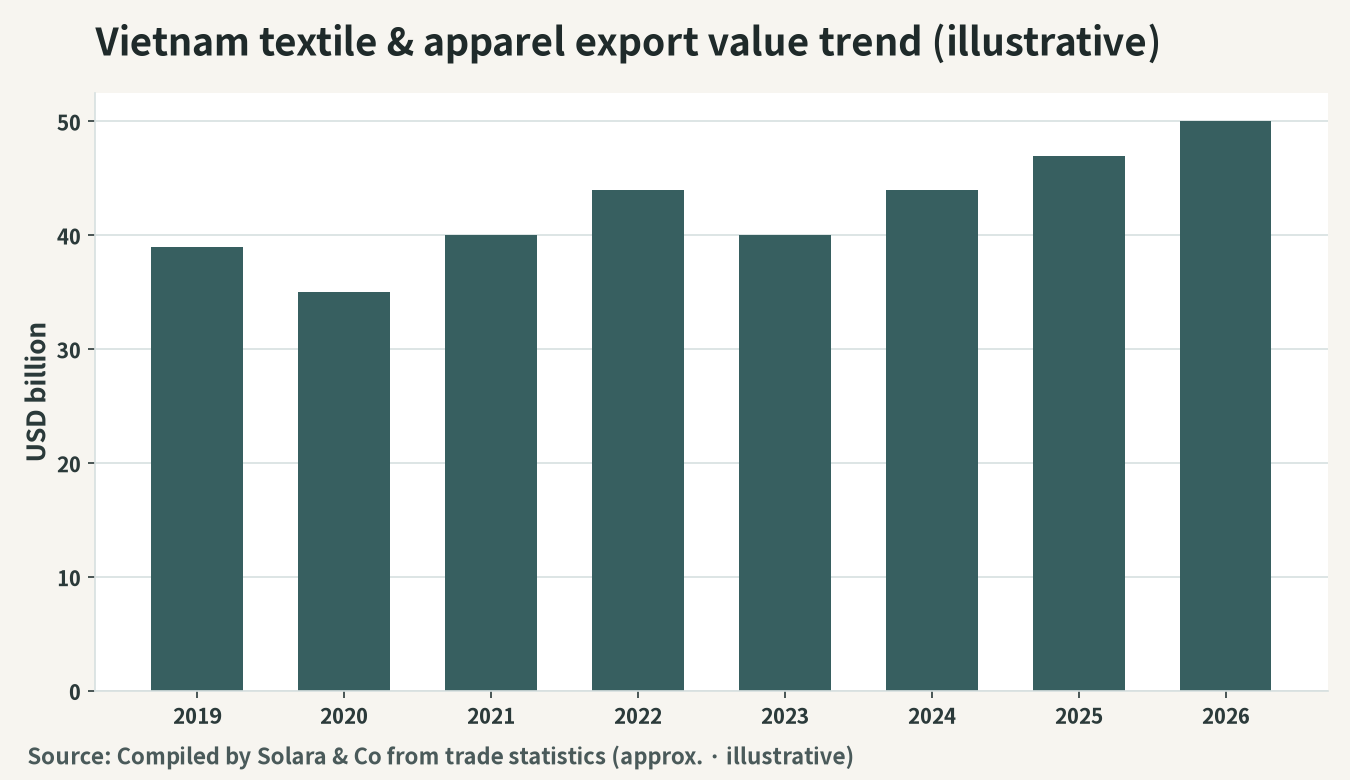
Export destinations are not skewed toward any single market but are dispersed across major consumption centers. The figure below illustrates a rough breakdown of the export-destination mix.
Moving Up the Value Chain
The next growth phase of Vietnam's textile and apparel industry hinges on "value-added upgrading" — expanding the value chain in both upstream and downstream directions.
Expanding Upstream (Materials and Dyeing)
The stages before sewing — spinning, weaving, dyeing, and fabric production — carry high value-added and are also key to meeting the FTA rules of origin. Dyeing and finishing, in particular, are areas that require both technology and environmental management; the entry barriers are high, so once established they become a competitive advantage. Because fabric quality and color-fastness greatly influence the value of the final product, holding the upstream also means holding the initiative on quality. Environmentally conscious dyeing and processing technology also answers the sustainability demands of Western brands. Until now, Vietnam's dyeing and finishing capacity has not kept pace with the scale of its sewing operations, and this has been a bottleneck in the supply chain. Conversely, a company that can establish an advanced dyeing base — including water treatment and effluent management — can become a rare supplier that simultaneously meets both the rules of origin and environmental standards, gaining strong bargaining power.
Downstream (From OEM to ODM and Branding)
There is also movement to expand value-added downstream: from CMT (sewing only) to ODM (which also handles materials procurement and design), and further to building one's own brand. Rather than simply doing as the buyer dictates, possessing the ability to make proposals and an integrated production system raises both margins and transaction stability. At the same time, the scope to develop apparel within Vietnam's own domestic market — aimed at the expanding middle class — is widening. Shifting the center of gravity from an export-only stance to a brand business that captures growing domestic demand also strengthens resilience against currency and overseas-economy fluctuations.
Functional and Sustainable Materials
Fields such as functional fibers, recycled materials, and environmentally conscious production are expected to see expanding global demand. For Japanese companies with strengths in materials and processing technology, combining these with Vietnam's production base makes it possible to supply high-value-added products. Western brands and retailers are increasingly demanding recycled-material ratios, traceability, and attention to labor and the environment as procurement criteria; suppliers that can answer these demands with technology can build transactions a step removed from price competition. The knowledge of high-performance fibers and processing that Japan has accumulated is the core of this differentiation. Fields such as high-performance materials for sports and outdoor use, and nonwovens for medical and industrial applications, are growth markets beyond clothing — promising areas where Vietnam's production base and Japan's technology can link up. These demands are being made increasingly concrete by the EU's recent regulatory tightening. Moves to oblige companies to conduct human-rights and environmental due diligence, and the introduction of a "Digital Product Passport" that attaches electronic information such as material composition and recyclability to each product, are advancing with textiles as a primary target. Traceability and the disclosure of environmental information are shifting from voluntary efforts to conditions for market access; the more a supplier can grasp the entire process from raw material to sewing within the region, the more readily it can turn this change into an opportunity rather than a burden.
Location Strategy — The North-South Division of Roles and the Land Problem for Dyeing
Where to place production sites is a practical issue that determines the success or failure of a textile and apparel investment. In the south, centered on Ho Chi Minh City, industrial clusters such as Binh Duong, Dong Nai, and Long An firmly support sewing and integrated production, with excellent access to ports and logistics networks. In the north, leveraging road and sea links with southern China, areas around Hai Phong and provinces with a traditional spinning-and-weaving base such as Ha Nam and Nam Dinh are raising their presence in both materials procurement and exports. The ease of securing labor, wage levels, land costs, and the stable supply of power and water vary considerably by province, so selecting an entry location cannot be reduced to a simple comparison of land prices.
Dyeing and finishing in particular face a decisive locational constraint in securing water and treating effluent. Out of concern over environmental load, more than a few provinces and industrial parks are cautious about accepting projects that involve dyeing, and parks with adequate effluent-treatment facilities that permit dyeing are limited. Conversely, securing a suitable site that can clear these constraints and equipping it with environmental infrastructure — including water supply, effluent, and sludge treatment — is both a precondition for upstream entry and, at the same time, an entry barrier that rivals cannot easily follow. From the site-selection stage, it is essential to read the province-level licensing stance, how environmental regulations are enforced, and the outlook for power and water resources.
Organizing the Investment Opportunities and Risks
The opportunities in the textile and apparel industry differ in character depending on one's position in the value chain. The table below organizes the opportunities and risks of the main segments.
Segment | Main investment opportunities | Risks to note |
|---|---|---|
Sewing (CMT) | Labor-intensive export base, scale expansion | Rising wages, low margins |
Upstream (spinning, weaving, dyeing) | Meeting FTA rules of origin, localization demand | Environmental regulation, initial investment, water/effluent |
Functional, sustainable materials | Supply of high-value-added materials | Technology, certification, gauging demand |
ODM, branding | Margin improvement via proposal capability and integrated production | Design and marketing talent |
Auxiliary materials, dyes, equipment | Integration into local supply networks | Quality certification, support systems |
There are three common points to watch. First, rising wages and securing labor pose challenges in retention-enhancing treatment and automation/labor-saving. Second, because dyeing and processing handle water, effluent, and chemicals, strict compliance with environmental regulations (effluent and emission standards) is required. Third, conformity with the labor and environmental standards (sustainability) that Western brands demand becomes a condition for continued transactions. These factors must be managed through locally grounded information and the selection of reliable partners.
How Should Japanese Companies Engage — Solara's Perspective
Backed by the FTA tailwind, Vietnam's textile and apparel industry is at a turning point, advancing from a low-margin sewing base toward value-added upgrading in upstream materials and dyeing and in ODM and branding. The strengths of Japanese companies — materials, dyeing, processing, and functional fibers — will demonstrate great value at precisely this juncture where meeting the rules of origin and sustainability demands intersect.
When entering, designing the form of entry is important. In addition to standalone entry, the option of "buying time" through a joint venture or M&A with an existing local sewing or materials maker — acquiring factories, talent, transaction networks, and licenses in one stroke — is also effective. In that case, because there is great information asymmetry around the target company's finances, environmental compliance, business partners, and off-balance-sheet liabilities, pre-acquisition credit investigation and due diligence are indispensable.
Solara & Co holds bases and human networks in both Japan and Vietnam, providing integrated support from market research and entry-strategy formulation, to selecting local partners, executing M&A and joint ventures, and pre-acquisition credit investigation and due diligence. We help turn the opportunity of value-added upgrading in the textile and apparel industry into concrete results.