
Choosing to build a factory in Vietnam
As a destination for the "China Plus One" strategy and as a production base for capturing growing domestic demand, the number of Japanese manufacturers considering establishing a factory in Vietnam is steadily increasing. However, the process "from deciding to enter the market through to operation" is a chain of multiple stages—site selection, industrial park selection, securing land, obtaining permits, and construction—each with its own distinct issues and lead times. Getting the order wrong not infrequently causes delays of several months due to permits being sent back or land-acquisition procedures having to be redone.
This article systematically organizes the factory-establishment process from site to operation, following the practical sequence. For the perspective of dispersing the risk of overconcentration in China, please also see Supply chains and China Plus One. Vietnam's positioning as a production base is explained in detail in Manufacturing relocation to Vietnam.
STEP1 Site selection — Differences between the North, South, and Central regions
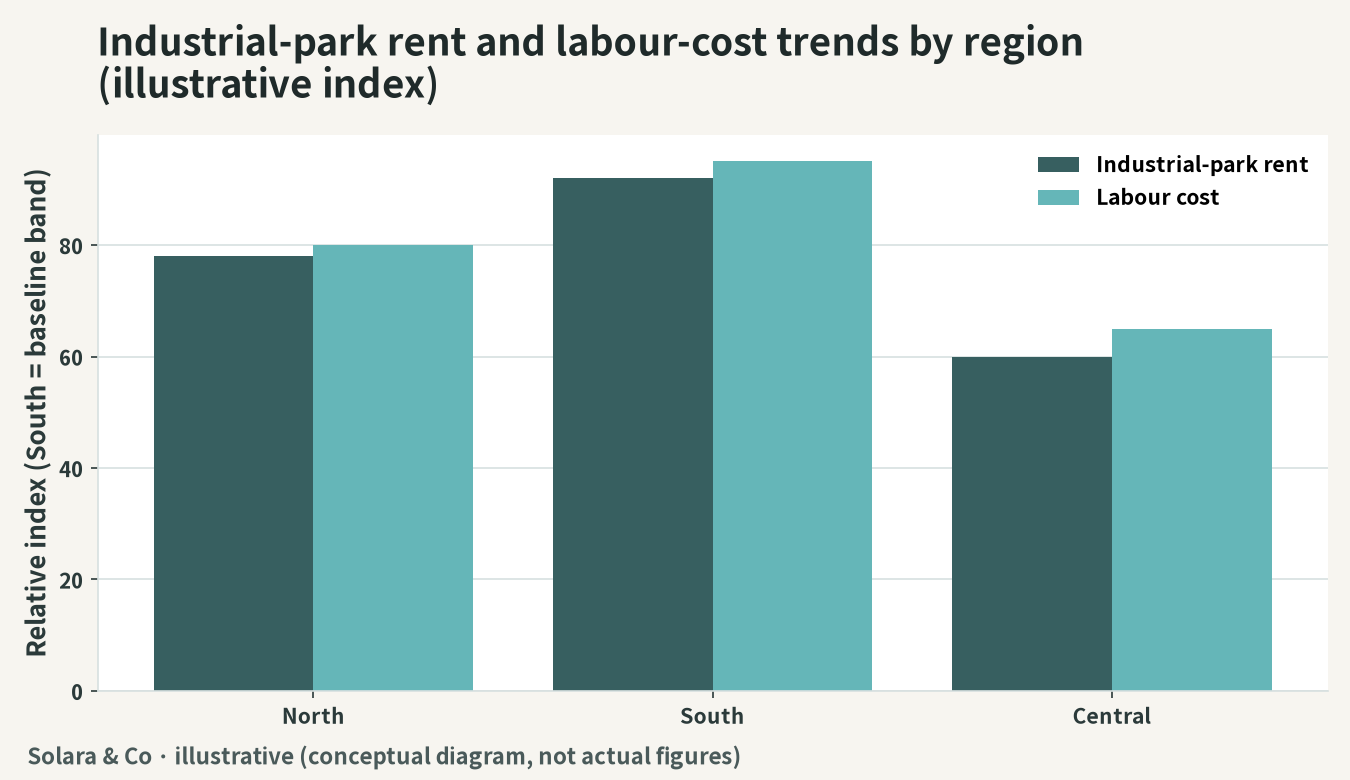
Vietnam stretches long from north to south, and the tendencies in industrial clustering, infrastructure, and labor costs differ greatly by region. Site selection is the most upstream stage of factory establishment and affects every subsequent step.
The North (greater Hanoi)
Hanoi and its surrounding provinces (Bac Ninh, Hai Phong, etc.) have an advanced concentration of electrical, electronics, and automotive-parts industries, and offer excellent overland access from South China. A defining feature is that they are home to Hai Phong Port, making it easy to connect supply chains to China. Large-scale investments such as Samsung's have also fostered the development of supporting industries.
The South (greater Ho Chi Minh City)
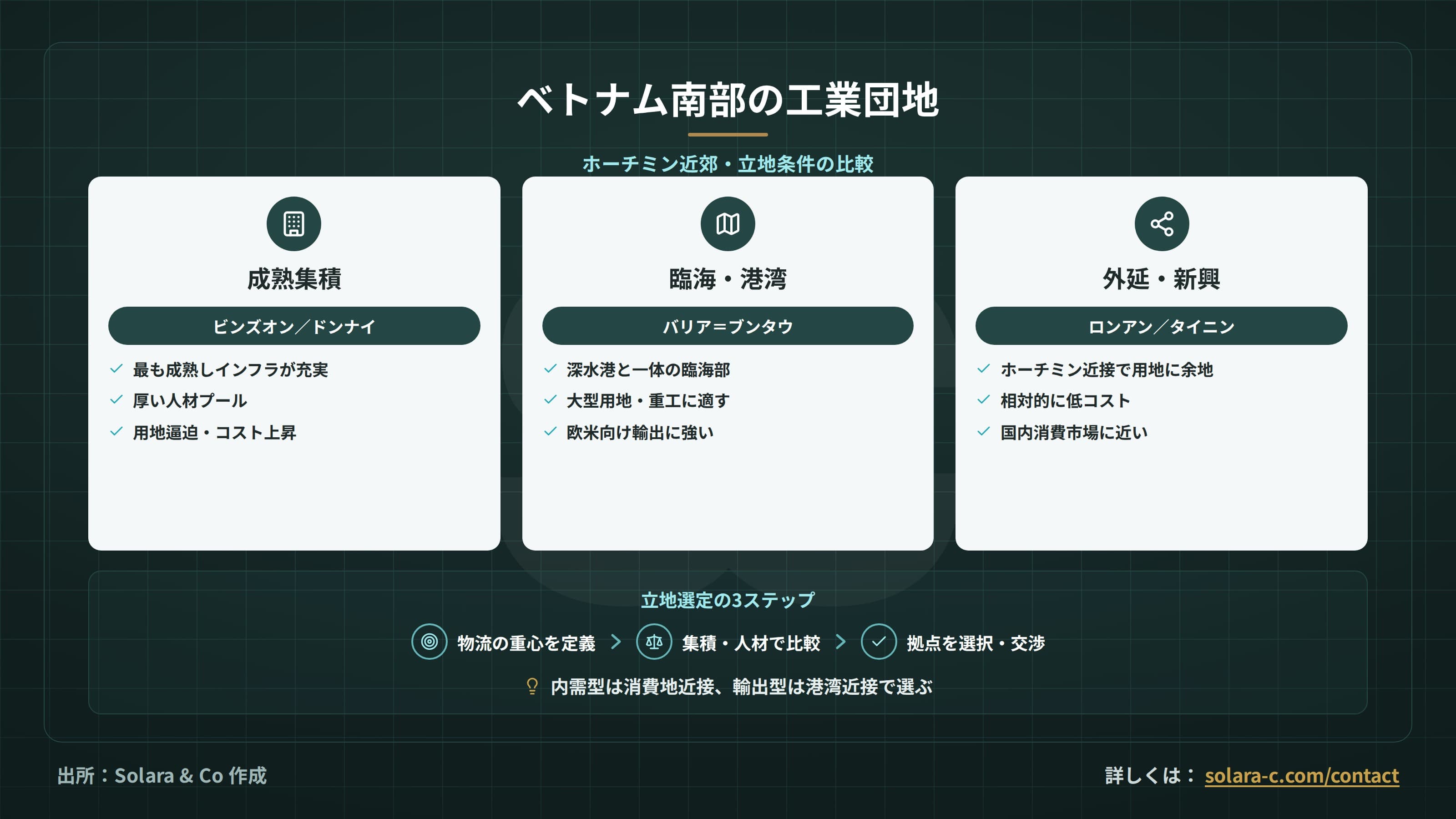
Ho Chi Minh City and its surrounding provinces (Binh Duong, Dong Nai, Long An, etc.) form Vietnam's largest economic zone, with a concentration of consumer goods, food, textiles, and diverse manufacturing industries. The talent pool is deep and the logistics network is mature, but correspondingly, industrial-park rents and labor costs tend to be relatively higher.
The Central region (greater Da Nang)
The Central region, centered on Da Nang, has relatively low labor costs and rents, and the government is also proactive in attracting investment. Workforce retention is said to be comparatively good, while on the other hand, industrial clustering and supporting industries are still developing compared with the North and South. Regional differences in labor costs can be verified in detail in The reality of labor costs in Vietnam.
STEP2 Selecting an industrial park (IP)
In Vietnam, most foreign-invested manufacturers locate within an industrial park (IP). This is because infrastructure inside the park (power, water supply, drainage, telecommunications) is already in place and it is easier to receive support with permit procedures.
Parks are classified by intended use. An EPZ (Export Processing Zone) specializes in production for export and offers generous tariff and tax incentives, but is constrained when it comes to domestic sales. A high-tech park is for advanced industries, characterized by preferential tax treatment and an R&D environment. A general IP suits a dual focus on both domestic sales and exports. It is important to choose the park type starting from where your products will be sold (export or domestic).
When selecting, check the rent and management fees, stability of infrastructure (especially power quality), the lineup of existing tenants (whether suppliers or peers are present), access to ports and trunk roads, and the remaining lease term. For methods of scrutinizing factory land, Due diligence on factory land in Vietnam is a useful reference.
STEP3 Securing land — Land use rights and leasing
In Vietnam, land is owned by the state, so what a foreign company acquires is not ownership but land use rights (LURC: Land Use Rights Certificate). There are broadly two options for securing manufacturing land.
One is leasing an existing factory (a rental factory). Because it keeps the initial investment down and speeds up start-up, it suits companies with small-to-medium production scale or those at the market-validation stage. The other is the method of securing land within an industrial park and building your own facility. This offers a high degree of freedom in equipment layout and suits long-term, large-scale production, but the construction period and initial investment are larger.
The choice is made in light of production scale, the investment payback period, and room for future expansion. Even when leasing, conditions such as the lease term, restoration to original condition, and whether expansion is permitted need to be scrutinized at the contract stage.
Criterion | Rental factory (lease) | Self-build |
|---|---|---|
Initial investment | Small | Large |
Start-up speed | Fast | Slow (construction period) |
Layout freedom | Constrained | High |
Suitable scale | Small-to-medium, validation stage | Large-scale, long-term production |
Expandability | Limited | Flexible, depending on the plan |
STEP4 The permit flow — From IRC and ERC to operation
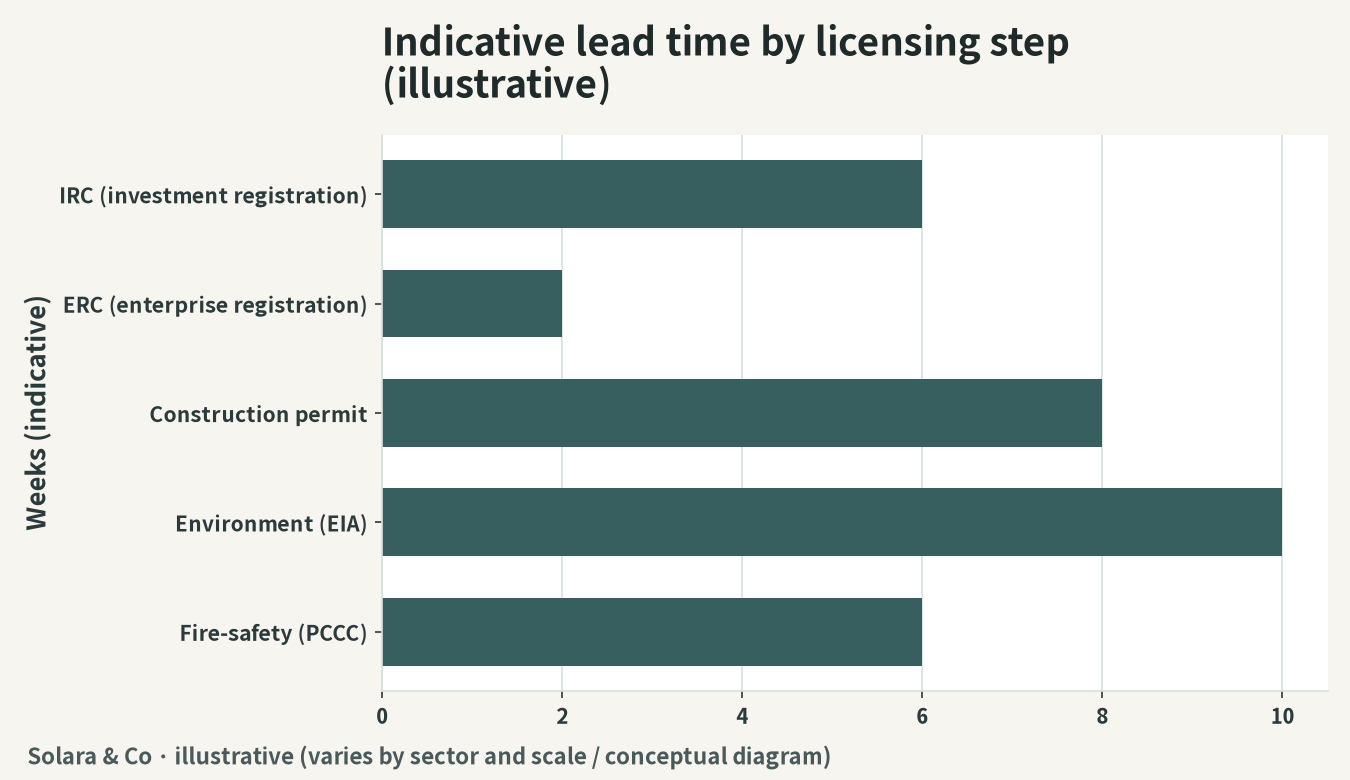
Permits for factory establishment must be obtained in a prescribed order. Mistaking the order or the prerequisites leads to rejections and lengthens the lead time.
The main flow is as follows. First, obtaining the Investment Registration Certificate (IRC), which registers the content of the investment project with the authorities. Second, obtaining the Enterprise Registration Certificate (ERC), by which the legal entity is established. Third, obtaining the construction permit. Prior to this, design review and confirmation of the land's suitability are required. Fourth, environment-related procedures (environmental impact assessment / EIA, etc.) and fire-prevention (PCCC) approval. Fifth, after an inspection following equipment installation, operations begin.
In particular, the requirements for environment and fire-prevention change with industry and scale, and tend to take time to review. If your case falls under a conditional sector (specific regulated industries), additional licenses may be required, so it is safer to confirm in advance via Licensing for conditional investment sectors.
STEP5 Labor, talent, and infrastructure
For a factory to operate, both wheels—talent and infrastructure—are indispensable.
For labor and talent, you must address issues such as recruiting local workers, developing skilled staff, work permits and visas (for managers and engineers), and labor unions and social insurance. Because wage levels and workforce retention differ by region, it is important to weave talent strategy in from the site-selection stage.
For infrastructure, the key points are stable power supply (in manufacturing, power quality directly governs productivity), water supply and drainage treatment, and logistics and port access. For evaluating the logistics network that supports raw-material procurement and finished-goods shipment, Vietnam's logistics and warehouse market, which shows trends in the warehouse and logistics market, is also a useful reference.
Regarding power, against a backdrop of rising demand in recent years, supply stability at peak times and the availability of renewable-energy procurement are increasingly becoming points in site evaluation. For energy-intensive production, you can be more reassured if you also confirm the park's power-receiving capacity, the feasibility of on-site generation, and room for future expansion. For drainage treatment, determine whether the park has shared treatment facilities and whether in-house treatment is necessary, in light of your industry's characteristics. On the logistics side, evaluating not just the distance to the port but the "effective lead time"—such as congestion tendencies on trunk roads and how easily containers can be secured—ties directly into inventory strategy.
STEP6 Cost structure and common pitfalls
The costs of factory establishment consist of land (lease/acquisition cost), construction costs, equipment investment, permit-related costs, and working capital. The range is wide depending on region, park, and industry, so you must build a funding plan based on the total amount—including not only the initial costs but also the running costs after operation begins (labor, power, logistics).
In funding planning, the realistic approach is to anticipate the lead time from obtaining permits through construction, equipment delivery, and trial operation up to mass production, and to secure ample working capital for that period. Because rejected permits or construction delays generate a "waiting-time cost" in which only fixed costs arise ahead of revenue, setting conservative assumptions for the schedule serves as a safety valve for cash flow. Whether preferential tax treatment (specific regions, industries, high-tech fields, etc.) can be applied also greatly affects the payback period, so it is advisable to factor in tax benefits and compare from the site- and park-selection stage.
The pitfalls that recur in the field follow common patterns.
- Mistaking the permit order: advancing to the next stage without meeting prerequisites, then being delayed by a rejection.
- Underestimating environment and fire-prevention: making light of review lead times, pushing back the start of operations.
- Underestimating power and infrastructure: not confirming the park's power quality, then running into trouble after start-up.
- Insufficient scrutiny of land conditions: overlooking the lease term, expandability, and restoration to original condition.
- A naive read on workforce retention: failing to read the region's turnover tendencies, leading to labor shortages in the early start-up phase.
Many of these can be prevented at the upstream stages of site and park selection and permit design. That is precisely why process design before breaking ground determines the success or failure of the entire factory launch.
Solara & Co's support for establishing a factory in Vietnam
Solara & Co provides end-to-end support for Japanese manufacturers establishing a factory in Vietnam, from site selection through to the start of operations. Advisors who understand both the systems and the practical realities on both the Japan and Vietnam sides walk alongside you through everything: site strategy based on comparing the North, South, and Central regions; selecting an industrial park (IP / EPZ / high-tech park); scrutinizing land use rights (LURC) and lease terms; designing and accompanying the application for the permit flow from IRC and ERC through construction permits, environment, and fire-prevention; evaluating labor, infrastructure, and logistics; and funding planning for the overall cost.
Factory establishment is decided by the design done before breaking ground. Please feel free to consult us even from the stage where you are still unsure at the very entrance of site selection. Solara & Co will help you realize the building of your production base in the optimal sequence.