
The Success of a Joint Venture Is 80% Decided by "Choosing the Partner"
As a means of entering Vietnam, a joint venture (JV) with a local company remains a strong option. You can leverage the local partner's sales network, licenses, connections, and land, gaining access to fields that foreign capital acting alone would struggle to enter. At the same time, a JV is often likened to a "marriage": the choice of partner and the terms agreed at the outset govern the future. Most of the JV troubles experienced by Japanese companies have their roots, even before any contract clause, in the stage of partner selection and the alignment of expectations in the first place.
The key to a successful JV is to connect three points into a single line: (1) clarifying the purpose—why a JV at all; (2) discerning a partner that fits that purpose (due diligence); and (3) designing a contract (the JVA) that sets out rules for resolving conflicts of interest. If the order is "we found a partner who seems good, so let's team up," friction will inevitably arise later.
This article explains the practice of selecting a JV partner in Vietnam—from the perspective of discernment through to the key points of the contract—along with the points where Japanese companies tend to stumble.
Why Choose a Joint Venture — Clarifying the Purpose
When a JV Fits and When It Does Not
A JV fits when you want to obtain from a partner management resources your own company lacks—such as a local sales network, licenses, regulatory compliance capacity, or access to land. Conversely, if complete management control and IP protection are the top priorities, a wholly owned (100%) local subsidiary is more suitable. A comparison by entry structure is detailed in Comparison of Vietnam Entry Structures.
Equity Ratio and Foreign-Investment Restrictions
The equity ratio in a JV is constrained not only by bargaining power but also by foreign-investment restrictions that vary by industry. In conditional sectors under WTO commitments or the Investment Law, a cap on foreign equity may be prescribed. Because the equity ratio is directly tied to management leadership, it must be designed from both the regulatory and the purpose angles. For how to read foreign-investment restrictions, see Vietnam's Foreign-Investment Restrictions and Conditional Sectors.
Should You Avoid a 50:50 Split?
If you value managerial parity and split equity 50:50, decision-making is prone to deadlock when opinions diverge. On the other hand, if regulatory caps or the outcome of negotiations leave you as a minority shareholder, it is important to design for substantive influence through special-resolution matters, veto rights, and director-nomination rights. The essence of leadership lies not in the equity figure but in using governance to define "what can be decided unilaterally and what requires the partner's consent."
Three Perspectives for Discerning a Partner
Discerning a JV partner means evaluating three perspectives in three dimensions: "capability," "soundness," and "compatibility."
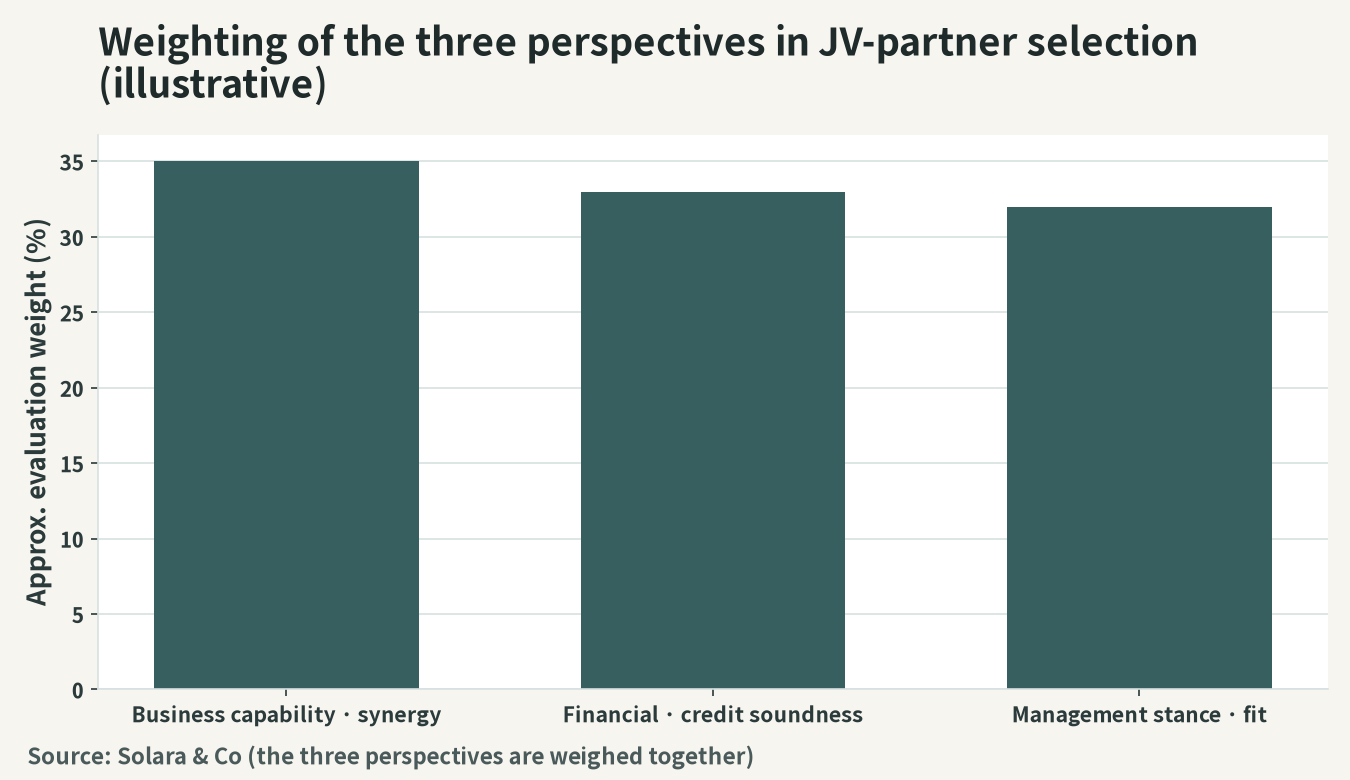
Perspective 1: Business Capability and Synergy
Confirm whether the partner actually possesses the management resources that serve the JV's purpose (sales network, production capacity, licenses, brand, personnel). "Saying they have it" and "it actually functioning" are two different things. Verify the existence of their track record, customer base, facilities, and key persons through primary information. The claim "we have a sales network" warrants particular caution: unless you confirm concretely which customers they sell to, in what volume, through which channels, and whether those transactions are ongoing, you will end up with a partner that is all signboard and no substance. Synergy is not an abstract expectation; it can only be verified once it has been broken down into a concrete division of roles—who provides what, and how, after the JV is formed.
Perspective 2: Financial and Credit Soundness
Investigate the candidate partner's financial condition, off-balance-sheet liabilities, status of tax and social-insurance payments, and whether any disputes exist. In Vietnam, the transparency of financial information is limited and financial statements often do not reflect reality, so combining a credit investigation with financial DD is indispensable. A JV partner's financial instability rebounds, after you have invested, in the form of capital-increase burdens or joint liability. The key points of financial DD are covered in Vietnam Financial Due Diligence.
Perspective 3: Management Stance and Compatibility
The most important factor, one that does not appear in the numbers, is alignment in management philosophy, decision-making style, integrity, and long-term outlook. A partner oriented toward short-term profit and a Japanese company aiming to build a business over the long term will, before long, clash. Discern compatibility and reliability through multiple meetings, third-party reputation, and the reputation of past alliances. In particular, if the partner has previously teamed up with another foreign company, confirming how that alliance ended and why they parted is the best clue to the partner's stance. Whether it was dissolved amicably without trouble or descended into a dispute is a mirror reflecting the future relationship with your own company.
Differences in Speed and Decision-Making Culture
The cautious decision-making of Japanese companies—through consensus and circulated approval (ringi)—and the speed of Vietnamese companies, where the owner decides on the spot, frequently generate friction. It is not a matter of which is right; understanding the difference in the two sides' decision-making processes, and agreeing at the outset on how the JV company will make decisions, is what prevents clashes in day-to-day operations.
Items to Confirm in Partner DD
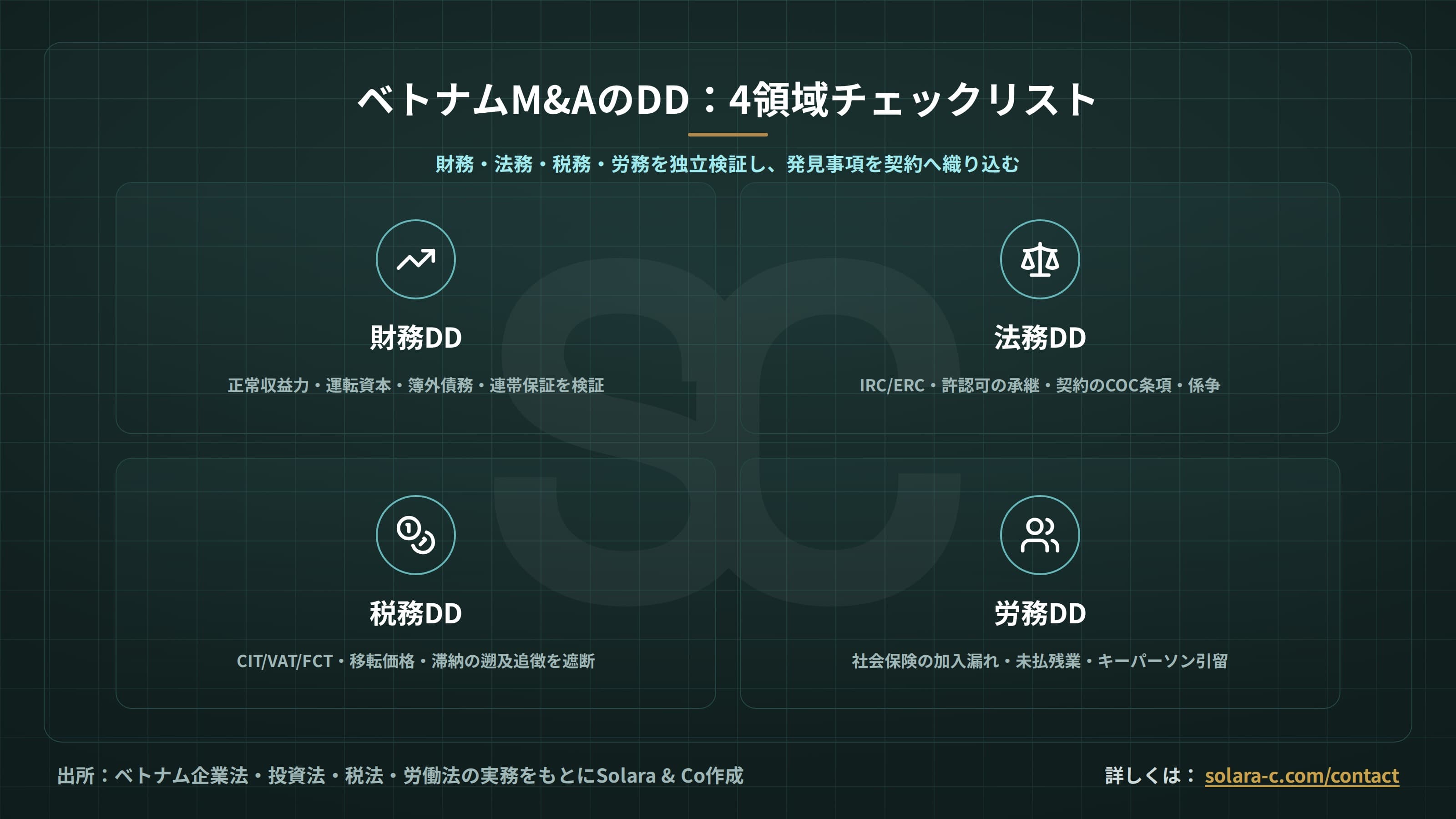
Once candidates have been narrowed down, you enter full-fledged due diligence (DD). DD for a JV follows that of an acquisition, with the added perspective of looking ahead to "the relationship after teaming up."
Area | Main items to confirm | Risk |
|---|---|---|
Entity・shareholders | Registration・beneficial owner・affiliates | Gap between nominal and actual |
Finance | Financials・off-balance debt・working capital | Capital-increase burden after investing |
Tax・labor | Actual tax and social-insurance payments | Joint liability for arrears |
Licenses | Scope・validity of business under the IRC/ERC | Deficiencies in licenses |
Disputes・reputation | Litigation・partner reputation・compliance | Disputes・reputational damage |
Management | Key persons・succession・integrity | Person-dependence・defection |
Beneficial Owners and Related-Party Transactions
Vietnamese companies have strong owner control, so the registered nominal holder on the surface and the substantive controller can differ. Identifying the ultimate beneficial owner (UBO) and confirming whether there are transactions with affiliates (diversion of funds, transfer of profits) is the key to preventing an outflow of funds after the JV is formed.
Key-Person Dependence
At Vietnamese mid-sized companies, it is not uncommon for the business to depend heavily on the owner or a specific key person. If the business cannot run once that individual leaves, you need to build retention measures into the contract for the post-JV period.
Key Points in Designing the Joint Venture Agreement (JVA)
The understanding gained from DD only acquires the power to govern the relationship once it has been incorporated into the joint venture agreement and the articles of association.
Management Leadership and Governance
Clearly define director-nomination rights, the management of the legal representative and the company seal, and the resolution requirements for important matters (special-resolution matters). In Vietnam, the legal representative and the company seal are directly tied to actual managerial authority, so if this point is left ambiguous you will lose leadership. Who becomes the legal representative, and who manages the company seal, bank accounts, and accounting books, are important issues to be negotiated separately from the equity ratio. By designing day-to-day operational authority separately from authority over important matters such as capital increases, asset disposals, and changes to the business scope, you can build substantive governance that is not bound by the equity ratio. The key points of subsidiary control are covered in Governance of Vietnam Subsidiaries.
Designing for Deadlock and Exit
The most important yet most easily neglected aspect of a JV is the rules for resolving situations where interests conflict and decision-making is deadlocked, and the exit clauses for dissolving the relationship. Buyout rights (put/call options), restrictions on share transfers, non-competition, and dispute resolution (seat of arbitration, governing law) should all be set out before you team up. Deciding at the very start "how to part ways if things do not work out" is the condition for a healthy JV.
Profit Distribution and Additional Investment
Define the dividend policy, the burden-sharing rules when additional investment becomes necessary, and the treatment of dilution. If these are ambiguous, conflict will surface after the business gets on track or at the point where additional investment is needed. In Vietnam in particular, the policy can diverge between a partner who, even when profits arise, prefers reinvestment over dividends, and a Japanese company that prioritizes recovering its investment through dividends, so it is important to lock down the dividend policy in writing in advance.
Intellectual Property and Technology Transfer
When a Japanese company provides technology, know-how, or a brand to the JV, clearly define the ownership of that intellectual property, the scope and term of the license, and its treatment upon dissolution of the JV. If you let technology flow out free of charge and without limit, there is a risk that the partner will rise up as a competitor after the JV is dissolved. Designing the technology-transfer agreement as a separate document from the JVA, and managing consideration and governance separately, is a practical way to protect IP.
Where Joint Ventures Fail
The causes of a JV collapsing or becoming a hollow shell are concentrated in particular stages.
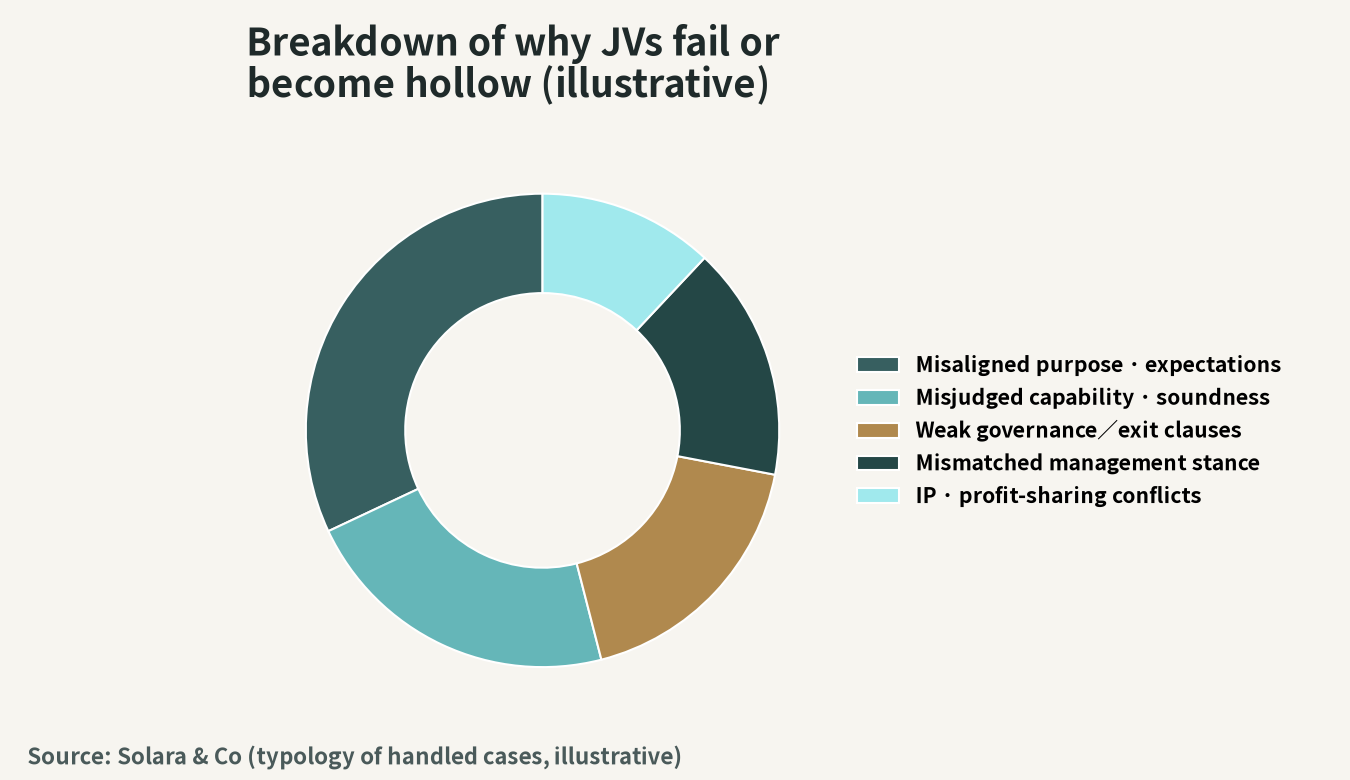
The largest factor is insufficient alignment of purpose and expectations, followed by misjudging the partner's capability and soundness, deficiencies in governance / exit clauses, and then mismatch in management stance. All of these can be greatly reduced through partner selection and contract design before teaming up.
"Team Up First and Think Later" Is the Biggest Risk
A pattern repeatedly seen in Japanese companies' JV failures is forming a JV with an introduced partner or an existing business contact without sufficient DD or exit design. While the relationship is good, problems do not surface; but the moment the business environment changes and interests conflict, the issues that were never locked down erupt all at once. A good relationship should instead be seen as a prime opportunity to design the contract and the exit calmly.
Solara & Co's Support for JV Partner Selection
The success of a JV hinges on whether you can connect the following sequence into a single line: clarifying "why team up," discerning a partner that fits that purpose through the three perspectives of "capability, soundness, and compatibility," and incorporating into the contract the rules for resolving conflicts of interest and the exit. In the reverse order—finding a partner who seems good and only then thinking about the purpose—the JV will, before long, hit a wall.
Leveraging networks on both the Japanese and Vietnamese sides, Solara & Co provides integrated support, from organizing the JV's purpose, to searching for candidate partners, credit investigation, and financial DD, to discerning management stance, and designing the JVA and articles of association (governance, deadlock, exit). To realize a JV that is not one you "regret after teaming up" but one where you "decide even how to part ways and can therefore team up with peace of mind," we support you starting from the very first step of organizing the JV's purpose together.