
Vietnam, an agricultural export powerhouse, and the opportunity that is the Japanese market
Vietnam is one of the world's leading exporters of agricultural and food products. With rice, coffee, seafood, fruit, cashews and more, it commands a solid presence in global markets. Backed by a warm climate, abundant water resources and a diligent workforce, the country has built integrated supply capacity spanning production, processing and export. For Japan, Vietnam is an attractive sourcing destination and partner that combines geographic proximity with stable supply capacity.
At the same time, exporting food to the Japanese market carries distinctively high hurdles in quality, standards and regulation. From the practical perspective of Japanese companies, this article organizes the full picture of Vietnam's agricultural and food exports — the practicalities of exporting to Japan, quality and standards, Japan's import regulations, the cold chain and logistics, the value chain and trade flows, certification, risk, and finally the forms of market entry and partnership. Read alongside Vietnam's Supply Chain and the China Plus One Strategy, it becomes easier to grasp the strategic significance of sourcing from Vietnam.
A bird's-eye view of Vietnam's main export items
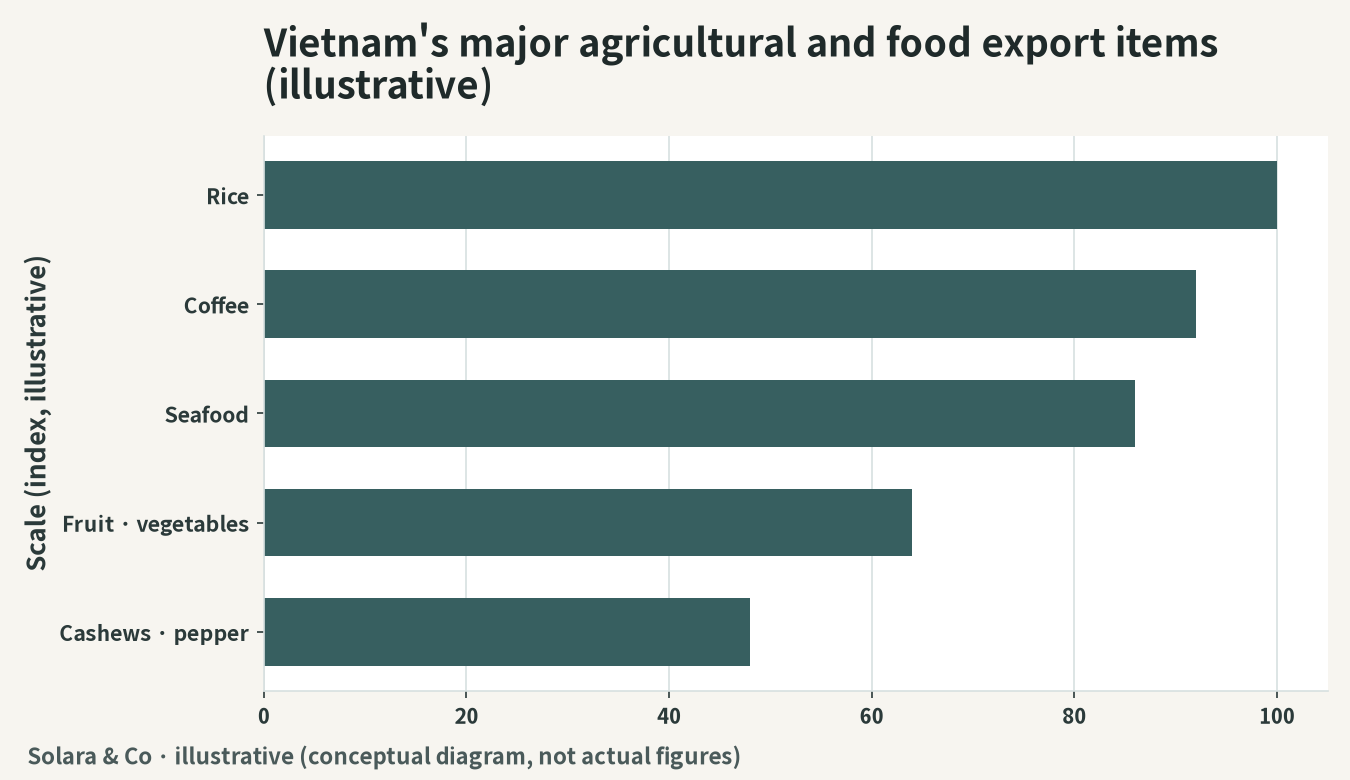
Vietnam's agricultural and food exports do not depend on a single item but are built on multiple pillars. Here is an overview of the representative items.
- Rice: Among the world's largest export volumes, supplied mainly to Asian and African markets. In recent years a shift toward high-quality, branded rice has been advancing.
- Coffee: A leading global producer and exporter, centered on the Robusta variety. Expansion into instant and more highly processed products is also progressing.
- Seafood: Aquaculture and processing of shrimp and pangasius (catfish) are thriving, making it one of the main export items to Japan.
- Fruit: Mango, dragon fruit, lychee, banana and more. Freshness management and quarantine compliance are the keys to export.
- Cashews, pepper, etc.: Some items lead global markets in processed exports.
The scale of the main items is illustrated as a conceptual diagram. The rough picture is that rice, coffee and seafood form the large pillars, followed by fruit and nuts.
The practicalities of exporting to Japan — what is different
The Japanese market is one of the most demanding in the world in terms of quality, safety and labeling. Beyond price, quality stability, standards compliance and traceability are the prerequisites of any transaction. When exporting from Vietnam to Japan, most practical stumbling blocks arise not in production itself but in the process of "aligning the supply system with Japan's required standards."
Specifically, these are compliance with pesticide residue standards, the sanitation management system, lot-by-lot uniformity of quality, stable delivery times and volumes, and appropriate labeling and documentation. These are not cleared once and finished; they must be continuously maintained and improved. Japanese importers and trading companies seek suppliers with such a "system that can be sustained," and that is precisely where Japanese companies have room to get involved.
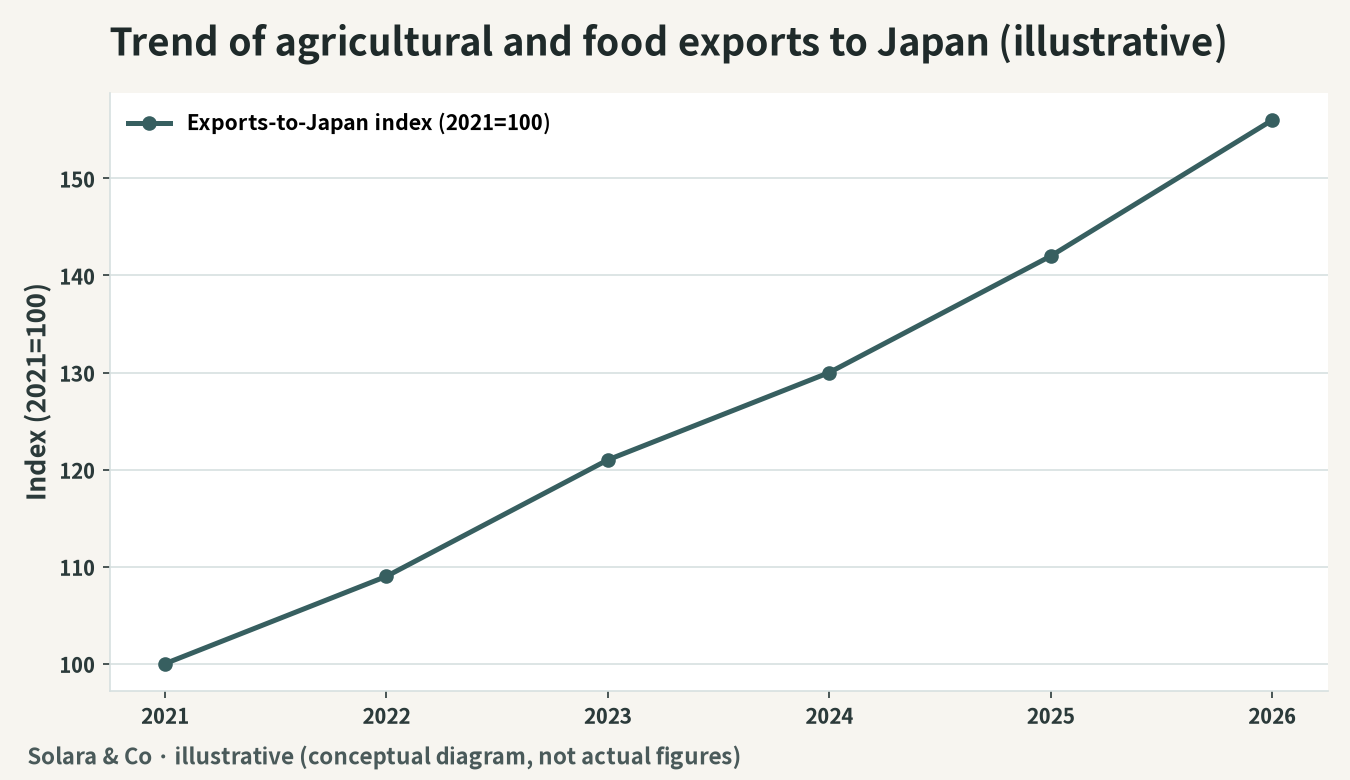
On the demand side, Japan's interest in Vietnamese food products remains firm, underpinned by sourcing diversification and quality improvement. The growth in exports to Japan is illustrated as a conceptual diagram.
Quality and standards — pesticide residues, HACCP, GAP, traceability
The quality and standards demanded by the Japanese market can be organized into roughly four axes.
Pesticide residue standards
Japan sets pesticide residue standards (the Positive List system) for each food, and produce exceeding the standards cannot be distributed. The exporting side must establish management of the pesticides used, recording of cultivation history, and a pre-shipment inspection system.
HACCP (sanitation management)
In processing and seafood, operating a sanitation management system based on hazard analysis (HACCP) is a prerequisite. A system that identifies hazards at each process step and continuously monitors control points is the foundation of trust from Japanese importers.
GAP (Good Agricultural Practices)
GAP (Good Agricultural Practices) — managing safety, the environment and labor at the cultivation stage — is a framework that demonstrates the reliability of a production area. International certifications such as GLOBALG.A.P. are valued in dealings with Japanese buyers.
Traceability
Traceability — the ability to trace produce back to the field and lot — enables identifying causes and conducting recalls when problems occur, serving as the foundation that protects brand and safety. Digitizing records determines a production area's competitiveness.
Mastering Japan's import regulations
When importing food into Japan, multiple regulations are layered together. Below we organize the points that must always be checked in practice.
Regulation / procedure | Competent authority / framework | Practical key point |
|---|---|---|
Food Sanitation Act | Ministry of Health, Labour and Welfare · Quarantine Stations | Import notification required. Compliance with standards on pesticide residues, additives and microorganisms is a prerequisite |
Quarantine (plant, animal) | Ministry of Agriculture, Forestry and Fisheries | Fruit and fresh produce are subject to pest quarantine. Conditions differ by item and production area |
Pesticide residue standards | Positive List system | Exceeding standards bars distribution. Assured through cultivation history and pre-shipment inspection |
Food labeling | Food Labeling Act | Proper labeling of ingredients, origin, allergens, expiry and nutrition is mandatory |
Tariffs, origin | Customs · EPA/FTA | Using an EPA may allow tariff preferences. Preparing certificates of origin is a prerequisite |
These conditions differ in fine detail by item; for fresh fruit in particular, clearing quarantine conditions determines whether export is possible at all. Checking the overall regulatory framework and the forms of foreign-capital involvement in Vietnam's Foreign Investment Regulations makes it easier to consider plans that extend to establishing a processing base.
The cold chain and logistics
In the export of fresh and frozen goods, an uninterrupted cold chain of temperature control is decisive for quality. Whether temperature and time can be managed at each stage — harvest, processing, storage, transport, customs clearance and delivery — determines freshness and loss. While Vietnam's logistics infrastructure continues to improve, the last mile from production areas to ports and airports, and refrigerated storage capacity, still leave room for improvement.
In practice, the discussion points are securing pre-cooling, cold storage and reefer containers, shortening customs lead times, and choosing appropriately between air and sea freight. For fruit and seafood, where freshness is everything, even a slight temperature deviation or customs delay severely damages product value; transport design must therefore be regarded not as mere cost optimization but as part of quality assurance. The current state of the logistics network can be supplemented at Vietnam's Logistics and Warehouse Market, and domestic channel design at Vietnam's Distribution and Retail Channels.
The value chain and trade flows — who to partner with
Vietnam's agricultural and food value chain is composed of the flow of sourcing (cultivation, aquaculture), processing and export. How a Japanese company gets involved changes dramatically depending on which stage it enters.
In terms of trade flows, trading companies, importers and OEMs are the main players. The common structure is that Japanese general and specialized trading companies handle importing and domestic sales, while local processors take on OEM and private-brand supply. Japanese companies, depending on their objectives, choose their point of involvement — whether to engage from the upstream of sourcing to build in quality, or to partner at the processing and export stage. Considering the perspective of connecting raw-material sourcing with product development alongside an example of a finished product such as Vietnam's Confectionery Market 2026 makes it easier to design an integrated, end-to-end approach.
Assessing certification and risk
Certification — a source of added value
International certifications such as organic certification and GLOBALG.A.P. are sources of added value and differentiation in the Japanese market. Obtaining certification takes time and money, but in a quality-oriented market like Japan, returns commensurate with the investment can be expected.
Risk — three axes to face head-on
First is quality risk. Exceeding pesticide residue standards, sanitation incidents and lot-to-lot variation lead directly to suspended transactions and brand damage. Second is exchange-rate risk. Export transactions are exposed to currency fluctuations that affect profitability. Third is climate risk. Erratic weather, pests and natural disasters destabilize yield and quality. These are managed by checking suppliers' systems and securing multiple production areas and sourcing sources.
Choosing the form of entry or partnership
The path for foreign capital to engage in Vietnam's agricultural and food exports is chosen according to objectives.
- Sourcing (buyer): Procuring from local producers and processors and importing to Japan. The lightest form of involvement, with quality management secured through contracts and audits.
- Joint venture (JV): Forming a joint venture with a local company to jointly operate sourcing, processing and quality management.
- Establishing a processing base: Building a processing base in-house or via a JV, building in quality internally and optimizing it to Japan-bound standards.
Whatever the form, credit investigation and due diligence to assess the counterpart's production capacity, quality system, finances, transaction realities and compliance are the prerequisites for preventing later trouble. Keeping abreast of trends in the final consumer market at Entering Vietnam's Food and Beverage Market lets you design strategy from both the export and domestic-sales angles.
Solara & Co's support for agricultural and food exports
Solara & Co supports Japanese companies in sourcing and exporting Vietnamese agricultural and food products end to end, from production-area assessment to executing partnerships. For each item — rice, coffee, seafood, fruit, cashews — we organize supply capacity, the state of compliance with quality and standards, and the realities of the cold chain and logistics, to assess whether a counterpart can be aligned to the Japanese market's required level.
We also verify, from a practical standpoint, compliance with Japan's import regulations such as the Food Sanitation Act, quarantine, residue standards and labeling, as well as the state of HACCP, GAP, traceability, and organic and GLOBALG.A.P. certification. In choosing among sourcing, joint venture or establishing a processing base, we conduct credit investigation and due diligence to verify candidates' production capacity, finances, transaction realities and compliance, and assist all the way to designing the management of exchange-rate, climate and quality risks. When considering sourcing or exporting agricultural and food products from Vietnam, please consult Solara & Co.