
Vietnam's Banking and Finance Sector, Supporting a Growth Economy
Vietnam's banking and finance sector is the core industry that supports, on the funding side, a real economy that continues to grow at a high rate. As the economy grows, funding demand—corporate capital investment and working capital, household mortgages and consumer loans—expands, and the role of the banks and financial institutions that supply it becomes all the more important. Against the backdrop of a population exceeding 100 million, an expanding middle class, and robust investment demand, Vietnam's financial market draws attention as a market with growth potential among the highest in Southeast Asia. The fact that there is large "untapped room"—since the use of bank accounts and credit has not yet run its full course—is also a factor that promises long-term growth.
Vietnam's financial sector has a dynamic structure: state-owned commercial banks form the axis, private commercial banks drive growth, and new players such as fintech, electronic payments, and consumer finance are rapidly rising. At the same time, three major currents—financial inclusion (expanding access to banking services), digitalization, and the advance of foreign-capital entry—are reshaping the sector's face. This article reads the structure and growth drivers of Vietnam's banking and finance sector, and explains from a practical standpoint the rise of digital finance, the issues of foreign-capital entry, and the investment opportunities and points of caution that Japanese companies should grasp.
The Structure and Growth of the Banking Sector
Vietnam's banking sector is broadly composed of state-owned commercial banks, in which the government is the principal shareholder, and private joint-stock commercial banks. While the major state-owned banks occupy the core of the market, nimble private banks drive growth in the retail (individual) and digital fields.
Credit Expansion, the Engine of Growth
The greatest engine supporting the banking sector's growth is the expansion of credit (lending). Along with economic growth, outstanding loans to corporations and individuals have continued to grow at a high rate.
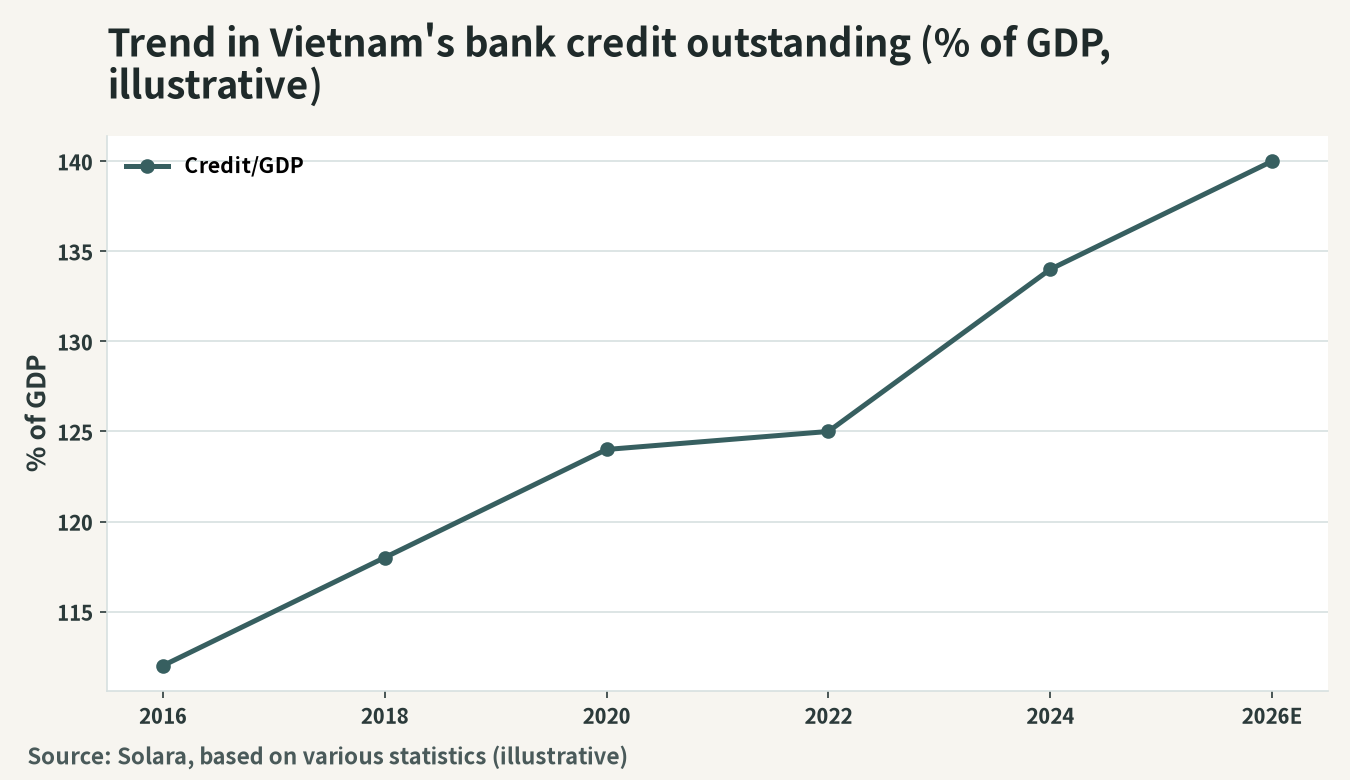
The ratio of loans to the size of the economy (the deepening of credit) continues to rise, which indicates that the degree to which finance supports economic growth is increasing. In particular, retail finance such as mortgages, auto loans, and consumer loans is a field with large growth room alongside the expanding middle class. On the other hand, rapid credit expansion also entails risk-management challenges such as the management of non-performing loans (NPLs) and the concentration of lending in real estate. Whether the sector can continue to grow while maintaining soundness will determine its sustainability. The central bank (the State Bank of Vietnam) is pursuing policy management that strikes a balance with soundness, managing credit growth while encouraging conformity with international standards on capital-adequacy regulation.
The Rise of Digital Finance and Fintech
Indispensable to any discussion of Vietnam's financial sector is the explosive rise of digital finance and fintech. Against the backdrop of a young, smartphone-saturated, digitally affinitive population, electronic payments, mobile banking, and digital wallets are spreading rapidly.
Financial Inclusion and Going Cashless
Previously, in Vietnam many people did not hold bank accounts, and it was a cash-centered economy. However, the spread of fintech originating from smartphones has drawn such people into financial services all at once, rapidly advancing "financial inclusion." QR-code payments, electronic wallets, and mobile remittances are permeating daily life, and going cashless is accelerating. The government, too, has set out a policy of reducing cash dependence and advancing the digitalization of payments, backing this trend.
The Finance of Data and Platforms
The advance of digital finance does not stop at improving the convenience of payments. The accumulation of payment and transaction data raises the accuracy of credit assessment and makes possible small loans (microfinance) to individuals and micro-enterprises that previously could not obtain financing. "Embedded finance"—in which digital platforms such as e-commerce, ride-hailing, and food delivery incorporate financial services such as payments, lending, and insurance—is also spreading. The fusion of finance and digital platforms is generating new growth domains. The advance of such digital finance is, for traditional banks, both a competitive pressure and, at the same time, an opportunity to take in new customer segments and technology through partnerships and equity stakes. The relationship in which banks and fintech compete while collaborating is adding depth to Vietnam's financial ecosystem. For foreign capital, this opens yet another entry route: not only traditional banking and insurance, but also investment in and partnership with these emerging digital-finance players.
The Growth of Retail Finance and Consumer Finance
In Vietnam's financial sector, the field with especially large growth room is retail finance (finance for individuals). Banks, which previously centered on corporate lending, are now—aiming to diversify revenue sources and disperse risk—broadening their footing toward financial services for individuals such as mortgages, auto loans, credit cards, and consumer loans. The expanding middle class, urbanization, and the permeation of a "consume now, pay later" consumption style are lifting this field.
Consumer finance bears the role of providing credit even to segments without bank accounts or credit histories, and has supported the purchase of durable consumer goods such as home appliances, motorbikes, and smartphones. In recent years, "buy now, pay later (BNPL)" services spreading at e-commerce and retail points of sale have also risen, and the fusion of digital and retail finance is advancing.
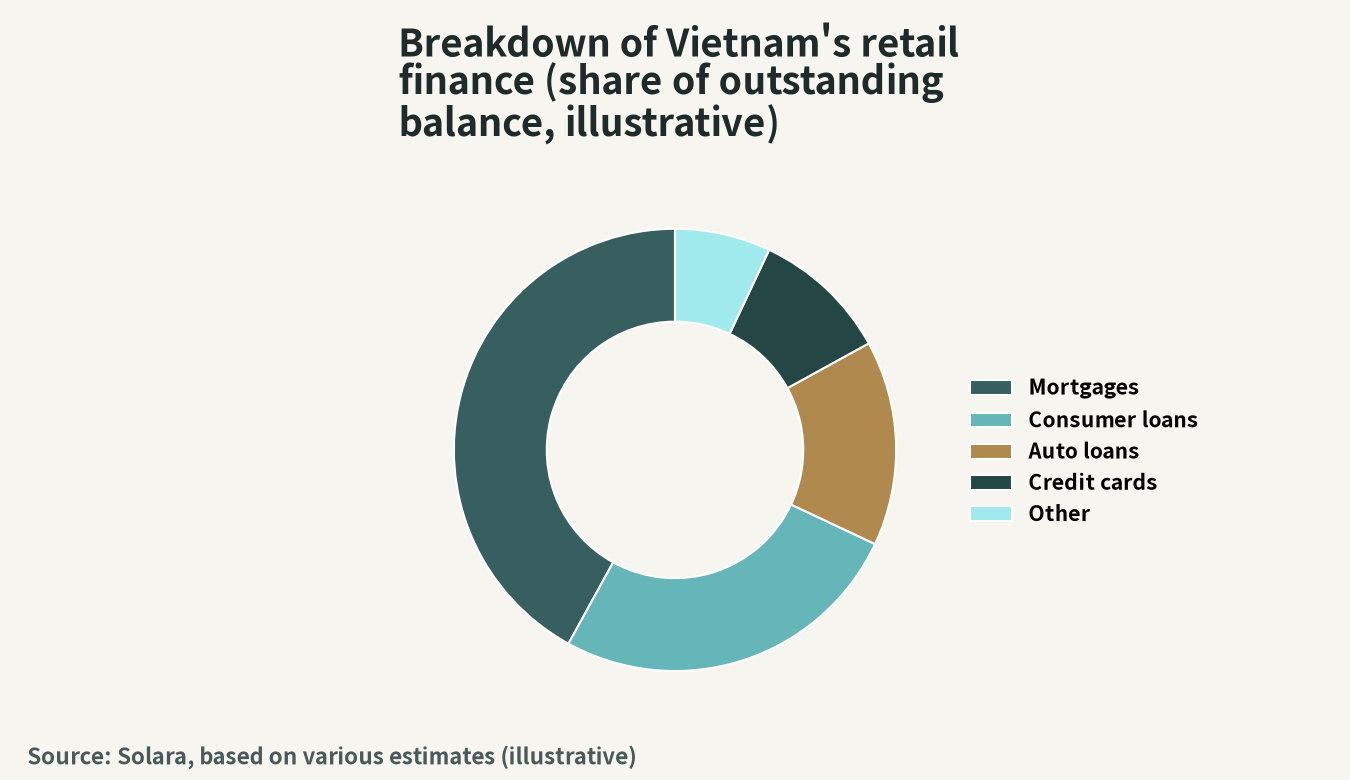
The expansion of retail finance is, on one hand, a high earning opportunity for banks and consumer-finance companies; on the other, skill in credit management sharply divides earnings and risk. In a market where the establishment of income verification is still developing, the accuracy of data-based credit models and the building of a collection system become the source of competitiveness. For foreign capital, including Japanese companies, the path to entering this growth field through equity stakes in or acquisitions of consumer-finance companies is open.
The Issues and Opportunities of Foreign-Capital Entry
Vietnam's growing financial market is an attractive investment target for foreign capital. Foreign-capital entry has several routes and issues.
Entry form | Overview | Main issue |
|---|---|---|
Equity stake in a bank | Strategic stake / capital tie-up with a local bank | Cap on the foreign-ownership ratio |
Consumer finance | Acquisition of / stake in a retail-finance company | Growth potential and risk management |
Fintech | Investment in payment / lending startups | State of regulatory development |
Insurance, securities | Entry into life/non-life insurance, securities, asset management | Middle-class expansion, licensing |
The greatest issue is the cap on the foreign-ownership ratio of banks. In Vietnam, a cap is set on the foreign-ownership ratio of banks, so entry in a form where foreign capital takes the lead in management is constrained. For this reason, foreign-capital entry centers on forms such as strategic stakes, capital tie-ups, and joint ventures. On the other hand, in peripheral domains such as consumer finance, fintech, insurance, securities, and asset management, there are fields without restrictions as strict as those on banks, and opportunities to enter the growth market are expanding. Japanese financial institutions, too, have advanced entry in these fields through equity stakes in or acquisitions of local companies.
Middle-Class Expansion Broadens the Base of Financial Products
The expansion of the middle class broadens the base not only of bank lending but also of financial products such as insurance, securities, and asset management. As incomes rise and interest in wealth-building grows, demand for life insurance, non-life insurance, mutual funds, and asset-management services begins to rise. These fields are still in the early stages of penetration—a frontier with large long-term growth room. Life insurance, in particular, is a typical field where demand rises along with rising incomes, both as a complement to the social-security system and as a means of wealth-building and inheritance planning. For Japanese companies with expertise in insurance and asset management, entry through partnership or joint venture with a local partner is a promising option with large long-term fruit.
Points of Caution When Investing
Although the financial sector has high growth potential, investment carries its own inherent risks and points of caution. First is credit risk and asset quality. Behind rapid credit expansion, the accumulation of non-performing loans and the concentration of lending in a particular sector (especially real estate) can become risks. In investing in a financial institution, it is indispensable to assess the quality of the loan portfolio and the adequacy of provisions and capital.
Second is the trend of regulation and supervision. The foreign-ownership ratio, capital-adequacy regulation, and the regulatory framework for fintech govern the premises of the business. Especially in the rapidly growing fintech field, regulation is still developing, and changes in the rules affect the business environment. Third is governance and transparency. At financial institutions in emerging markets, governance issues such as related-party transactions and the quality of disclosure may remain. These risks need to be assessed through investigation and due diligence of the target financial institution and partner. Owing to the nature of the financial business, grasping off-balance-sheet credit risk and contingent liabilities calls for especially careful due diligence. Not just surface financial figures, but probing into the actual state down to the quality of borrowers and contingent obligations such as guarantees and derivatives, is decisively important in investing in a financial institution.
Conclusion — The Business Opportunity Lies in "the Deepening and Digitalization of Finance"
Vietnam's banking and finance sector, while supporting a high-growth real economy, is rapidly reshaping its face amid three currents: the deepening of credit, the rise of digital finance, and the advance of financial inclusion. Although equity stakes in banks are constrained by the foreign-ownership ratio, peripheral domains such as consumer finance, fintech, insurance, securities, and asset management present abundant investment opportunities against the backdrop of middle-class expansion and digitalization.
Solara & Co, with bases and human networks on both the Japanese and Vietnamese sides, provides end-to-end support, from the consideration of investment in and partnership with Vietnam's financial field, to market and institutional research, partner acquisition through M&A and joint ventures, pre-acquisition credit investigation and due diligence, and confirmation of permits and regulations. Grasping the major current of the deepening and digitalization of finance while carefully assessing the risks of credit, regulation, and governance—we believe that achieving both is the shortcut to results in Vietnamese financial investment.