
Gen Z steps into the lead role of Vietnamese consumption
The most noteworthy shift in Vietnam's consumer market today is the rise of Generation Z (roughly those born between the late 1990s and the early 2010s). Raised alongside digital technology, treating social media as their gateway to information and consuming while connected to the wider world, this generation is stepping into the lead role of Vietnamese consumption. In a population of more than 100 million with a heavy weighting toward the young, Gen Z and the Millennials who precede them form an overwhelming volume zone that drives consumer trends. In contrast to aging markets such as Japan, Vietnam's consumer market enjoys "youth" itself as a structural strength, and the purchasing power of this young generation will rise further still as incomes climb.
Gen Z consumption operates on a different logic from older generations. They weigh not only price and function, but what a brand embodies, how it is talked about on social media, and how it feels as an experience. Whether or not you can win their hearts will determine your long-term share of the Vietnamese market. This article reads the characteristics of Vietnam's Gen Z consumers and the structure of digital consumption, the rise of social commerce and live commerce, shifts in consumer trends, and the strategies and considerations that foreign and Japanese companies need in order to capture this generation, all from a practitioner's perspective.
Characteristics of Gen Z consumers
Understanding Vietnam's Gen Z is the starting point for reading the consumer market to come. They display several striking characteristics.
Digital natives and social-media-driven purchasing
Gen Z are "digital natives," raised surrounded by the internet and smartphones from birth. Their purchasing behavior originates on social media. Discovering a product, verifying its reputation, and deciding to buy it are not uncommonly completed entirely on social media and video platforms. The messages of influencers and KOLs (Key Opinion Leaders) sway purchasing more than television commercials do. The decisive difference is that the flow of information is no longer one-directional from company to consumer, but spreads through horizontal connections among consumers themselves. Because both good and bad reputations spread instantly, brands must maintain consistent quality and honest communication.
A focus on brand value and experience
Gen Z increasingly tend to consume out of empathy with the values and worldview a brand embodies, not merely its price or function. Concern for the environment, social messaging, design quality, and whether a brand lets them express "who they are" — these elements become important axes in brand selection. At the same time, they prize experience (experiential consumption) over the ownership of things. Spending on experiences such as cafés, entertainment, travel, and "fan activity" (oshikatsu) accounts for a large share of their consumption.
Balancing price sensitivity with "smart consumption"
On the other hand, Gen Z are brand-oriented and at the same time an extremely price-sensitive generation that pursues "smart consumption." They instantly compare prices and reviews on social media and e-commerce, and skillfully exploit coupons, campaigns, and the limited-time prices of live commerce. In other words, they hold a seemingly contradictory duality: they spend without hesitation on brands they empathize with, yet are unforgiving of prices that fail to convince. Brands must answer this generation's discerning judgment on both fronts — the articulation of value and the design of price. Chosen for neither low price alone nor brand image alone — that difficulty, and that fascination, is the essence of Vietnam's Gen Z market.
The structure of digital consumption — social commerce and live commerce
What characterizes digital consumption in Vietnam is the explosive rise of social commerce and live commerce. On social media and video platforms, content and purchasing have merged into one, and the consumer behavior of "watch, enjoy, and buy on the spot" is taking hold.
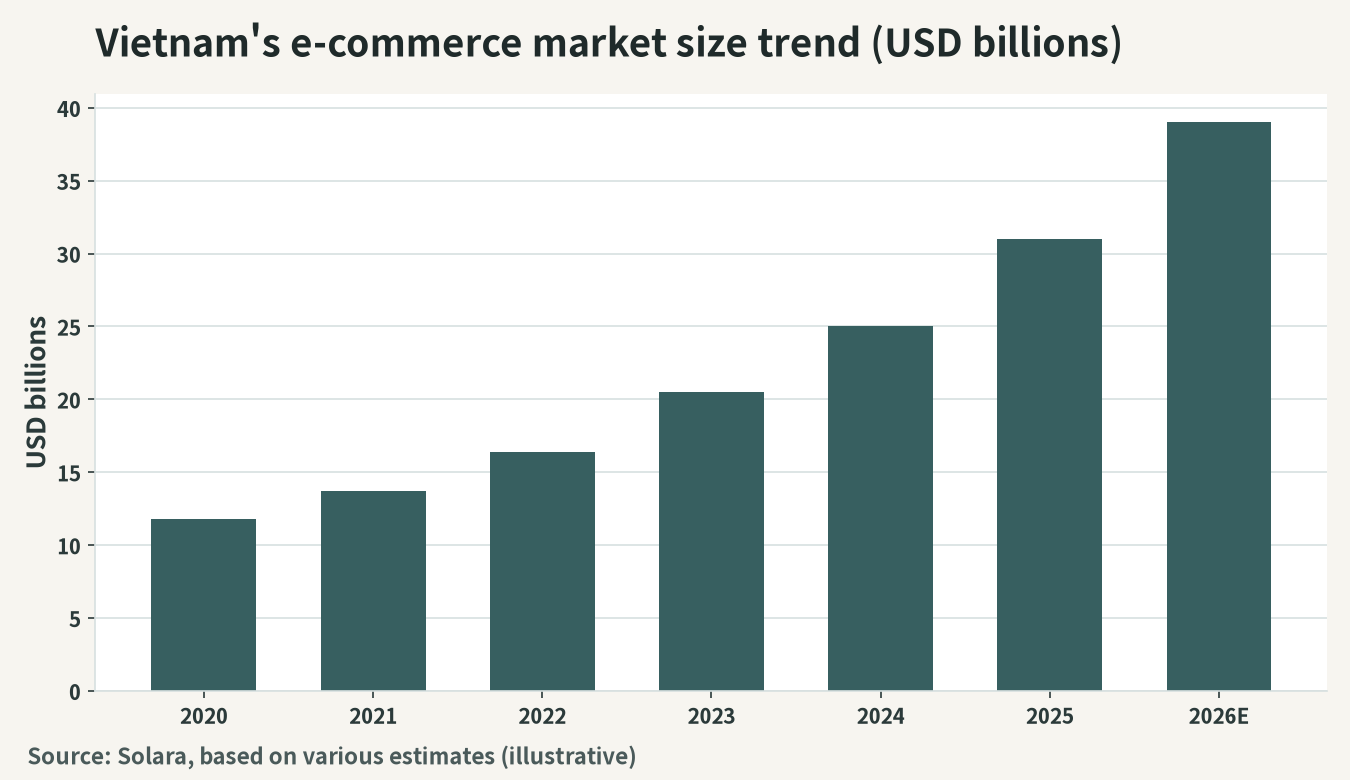
Vietnam's e-commerce market continues to expand at one of the fastest growth rates in Southeast Asia, and the driving force is Gen Z and the Millennials. Various surveys estimate that the country's B2C e-commerce market keeps growing at a high rate of around 20% a year, and that the online-shopping population has reached a scale of roughly 60 million people. With internet penetration approaching 80% of the population, purchasing that begins from a smartphone has become a given, and the digitalization of consumption is permeating not only urban areas but also provincial cities and rural regions. Among younger people whose wages are rising in particular, growth in disposable income combines with a high frequency of purchasing to push up both the value per order and the number of purchases.
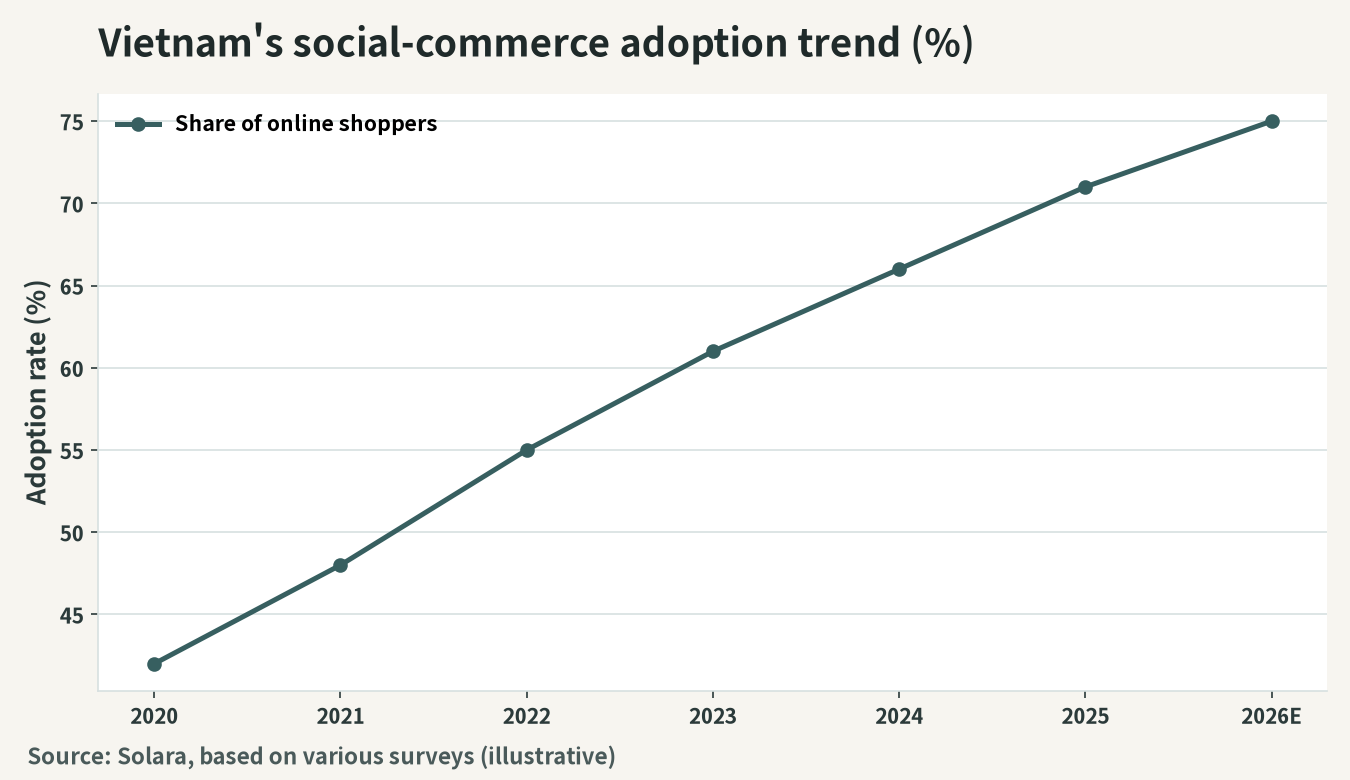
Especially distinctive is the large presence of "social commerce," in which e-commerce has fused with social media and video. Not only dedicated e-commerce apps, but also social media feeds and live video streams have become direct purchasing channels, and the boundary between content and purchasing is disappearing. In live commerce, a streamer introduces products in real time, viewers ask questions via comments, and buy on the spot — an experience that fuses entertainment with shopping has been born. For Gen Z, shopping is not merely consumer behavior but part of the time spent enjoying content. This shift compels brands to pivot from the conventional store- and advertising-centered marketing to digital marketing built around content, community, and influencers.
Mobile payments and a seamless purchasing experience
Underpinning social commerce is the spread of mobile payments such as e-wallets and QR-code payments. Discover a product on social media, pay for it on the spot with a smartphone, and complete the process through to delivery — this seamless purchasing experience encourages impulse buying and pushes up the frequency and total volume of consumption. An ecosystem in which payments, logistics, and content are unified forms the foundation of Vietnam's digital consumption.
The platform and payment landscape
In reading Vietnam's digital consumption, it is essential to grasp the balance of power among the major platforms. In general e-commerce, Shopee holds the leading position, followed by Lazada, while the name that has most dramatically raised its presence in recent years is TikTok Shop, armed with video and live streaming. Its design — completing a purchase as an extension of watching content — sits extremely well with Gen Z's behavior, and it has rapidly climbed into the ranks of the major channels. On the payments side, e-wallets led by MoMo, together with ZaloPay and VNPay, have spread widely, with user numbers reaching the tens of millions. In Vietnam, where credit-card ownership is relatively low, these mobile payments and QR codes underpin digital consumption as the principal means of payment in place of cash. For foreign brands, beyond building their own e-commerce storefront, how they plant their flag on these platforms and which payment methods they support becomes a practical issue that determines their reach to Gen Z. Because fee structures, logistics networks, and promotion rules differ from platform to platform, channel selection must be designed according to product characteristics and the target segment.
Consumer trends led by Gen Z
Gen Z's values appear as concrete consumer trends. The main trends are organized below.
Trend | Description | Related categories |
|---|---|---|
Health and wellness orientation | Spending on health, beauty, and self-investment | Food, cosmetics, fitness |
Experiential consumption | Valuing experiences over things | Cafés, travel, entertainment, fan activity |
Sustainability | Concern for the environment and society | Apparel, daily goods, food |
Premiumization | Preferring value and quality over price | Cosmetics, food, home appliances |
Convenience and immediacy | Delivery, quick commerce | E-commerce, dining out, retail |
What these trends share is a logic of consumption that cannot be explained by "price" alone. Gen Z spend generously on what fits their values, what is worth talking about on social media, and what satisfies as an experience. The quality, safety, trust, and design that are the strengths of Japanese brands sit well with this generation's quality- and premium-orientation, and if articulated appropriately can win deep empathy.
Strategies for Japanese companies to capture Gen Z
Succeeding in Vietnam's Gen Z market requires a shift away from conventional thinking. First is marketing centered on digital and social media. Rather than television-commercial or in-store-centered methods, a content-driven approach built around social media, video, influencers, and live commerce is indispensable. Partnership with local KOLs and communities spreads brand awareness and trust at a stroke. That said, when engaging influencers, it is important to assess not only follower count but the relationship of trust with that community and the affinity with the brand. This is because it is the depth of empathy, rather than the size of the numbers, that leads to purchasing. Micro-influencers and niche communities can sometimes produce higher effectiveness in particular categories.
Second is localization. Gen Z's sensibilities, trends, humor, and values differ from those in Japan. Rather than importing a home-country success story as is, what is tested is the ability to translate it into messaging, design, and experiences that resonate with local Gen Z. Third is consistency of brand story. Gen Z are sensitive to a brand's gap between word and deed. If you raise the banner of sustainability or social messaging, the honesty to back it up in substance is required. Consistently conveying the brand's core value in the local context — rather than superficially chasing trends — is what leads to long-term support. Whether you can build a continuous relationship with fans, rather than ending with one-off buzz, will determine sustained growth in the Gen Z market.
Considerations for investment and market entry
The Gen Z consumer market is attractive, but there are points to bear in mind. First is the speed at which trends change. Trends that originate on social media cycle through birth and death quickly, so an eye for distinguishing a passing fad from a structural change is needed. Second is the intensity of competition. In the digital space, domestic and foreign brands are compared instantly and reputations are made visible, so product strength and the quality of brand experience determine sales more than ever. Third are regulations concerning consumer protection, advertising, and data. Institutional development around digital marketing and data handling is advancing rapidly — including the Decree on e-commerce (Decree 85/2021) and the Personal Data Protection Decree (PDPD, Decree 13/2023) that took effect in 2023 — and the collection and cross-border transfer of personal data, as well as the display of influencer advertising, demand a careful response grounded in local law. Fourth is the reputational risk that accompanies the use of KOLs. It is not rare for a scandal or inappropriate remark by an engaged spokesperson to spill over onto the brand, so risk management from the contract- and operations-design stage is indispensable. These must be overcome through market research grounded in the local market and the selection of trustworthy partners.
Conclusion — toward a brand chosen for "value and experience"
Vietnam's Gen Z is a new generation that grew up alongside digital technology and chooses consumption by a brand's values and experience, not merely price or function. As they step into the lead role of consumption through social commerce and live commerce, what brands need is digital marketing built around social media, content, and influencers, together with a consistent brand story that resonates with local Gen Z. The quality, trust, and design of Japanese brands sit well with this generation's quality-orientation, and if articulated appropriately can win deep empathy.
Solara & Co holds bases and human networks on both the Japanese and Vietnamese sides, and provides end-to-end support — from the consideration of entry into Vietnam's consumer-goods, retail, and service sectors, to market research on consumers including Gen Z, to securing partners through M&A and joint ventures, to pre-acquisition credit investigation and due diligence. Capturing the great current of generational change while carefully assessing the practicalities and risks at hand — that balance, we believe, is the shortest path to results in the Vietnamese consumer market.