
The Digital Economy and AI Future Vietnam Is Drawing
Vietnam places the digital economy at the center of its national strategy as its next growth engine. A demographic that is young, at ease with smartphones, and shows little resistance to new technology. A digital infrastructure being built out at rapid speed. And the challenge facing the economy as a whole—upgrading manufacturing and raising productivity. These factors overlap, positioning the digital economy and AI (artificial intelligence) as the decisive means by which Vietnam can clear the "middle-income trap" and advance to the threshold of the developed world.
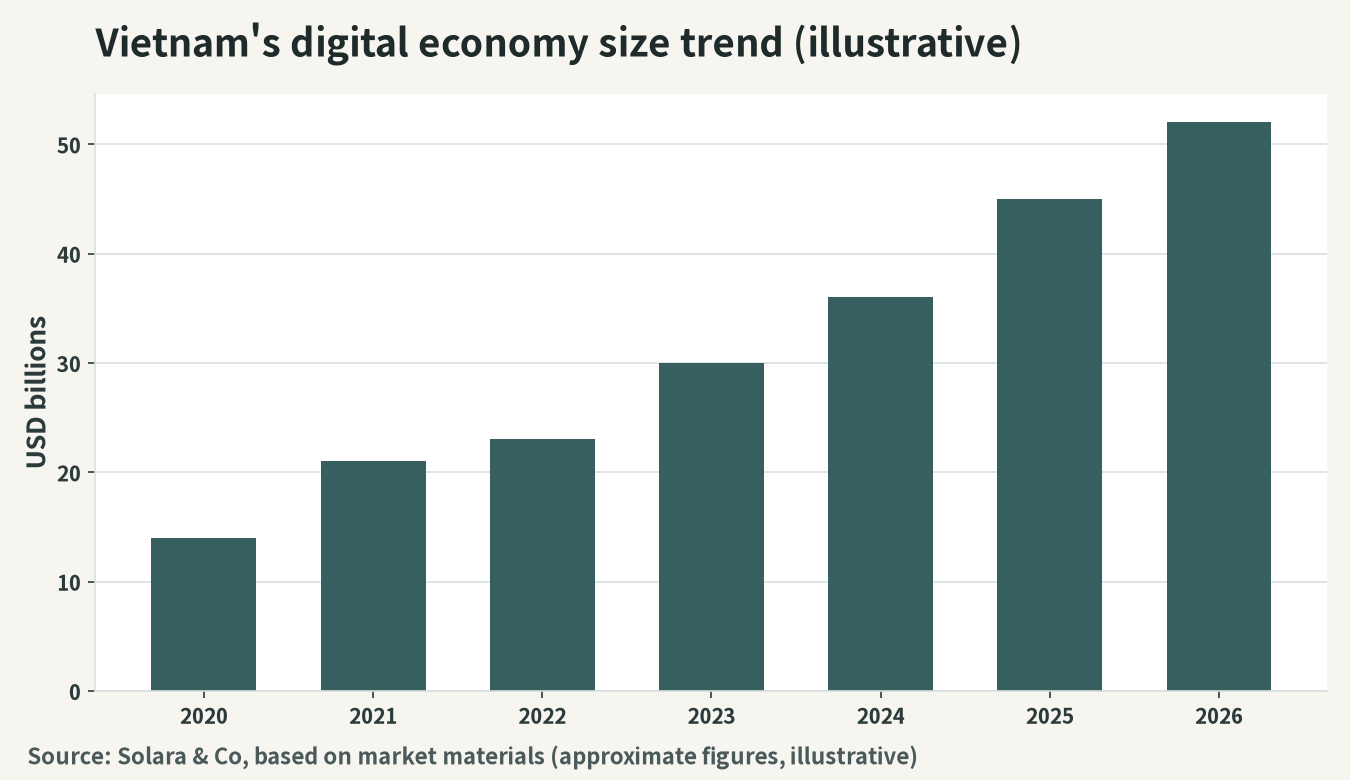
The government has set a target to substantially raise the share of the digital economy in gross domestic product (GDP) over the medium term, and is accelerating the cultivation of fields such as e-commerce, fintech, cloud, data centers, and AI. With a population of roughly 100 million, Vietnam's digital economy—measured by gross merchandise value (GMV)—shows one of the highest growth rates in Southeast Asia and is expected to keep expanding toward the middle of the 2020s. This article organizes the growth fields of Vietnam's digital economy and AI, the investment opportunity in each, the forms of engagement available to Japanese companies, and the risks to keep in mind, all from a practical standpoint.
The Foundations Supporting Digital-Economy Growth
Behind the rapid growth of Vietnam's digital economy lie several structural strengths.
A Young, Digitally Native Population
Vietnam is a society with a young average age—in the early thirties—and high penetration of smartphones and the internet. Internet usage is said to reach roughly 80% of the population, and social media, video, mobile payments, and online services are deeply embedded in daily life. This provides fertile ground for new digital services to be adopted rapidly, and the fact that the majority of the population uses the internet and that there is a thick layer of people whose lives are completed mobile-first produces a "scale effect" by which new services spread all at once. The thickness of this "digitally native consumer base" is what supports the explosive growth of e-commerce and fintech. In rural areas, too, the build-out of 4G and fiber networks and the falling price of smartphones are progressing, and the digitalization of consumption is spreading laterally from the cities to the countryside.
Strong Government Backing
The government has set "digital transformation (DX)" as a national priority and is advancing e-government, digital payments, and the build-out of digital infrastructure. The National Digital Transformation Program sets a quantitative target of raising the digital economy to 20% of GDP (by 2025) and 30% of GDP (by 2030), serving as a clear signal that concentrates investment and policy resources in related fields. On fronts such as developing the legal and regulatory framework, supporting startups, and training talent, policies that back the growth of the digital economy are being rolled out one after another. The full mandating of e-invoicing and the expansion of online public services lower transaction costs for the private sector, and the state's direction-setting is an important inducement that draws in private investment.
Abundant IT Talent
Vietnam puts effort into science and engineering education and produces a large number of IT professionals. Universities and colleges supply tens of thousands of IT professionals each year, and with a strong track record as an offshore base for software development, IT companies worldwide have established development centers in Vietnam. It also has a long track record in offshore development for the Japanese market, and the thick layer of engineers—including Japanese-speaking talent—means a particularly accessible environment for Japanese companies. At the same time, supply has not kept pace with rapidly growing demand; senior engineers and specialists in the AI and data fields are chronically in short supply, and raising the quality of this talent base has become the single most important challenge supporting the growth of AI, software, and digital services.
Decoding the Growth Fields
Within the digital economy, we organize the fields where growth is especially marked and the investment opportunity is large.
E-commerce and Digital Consumption
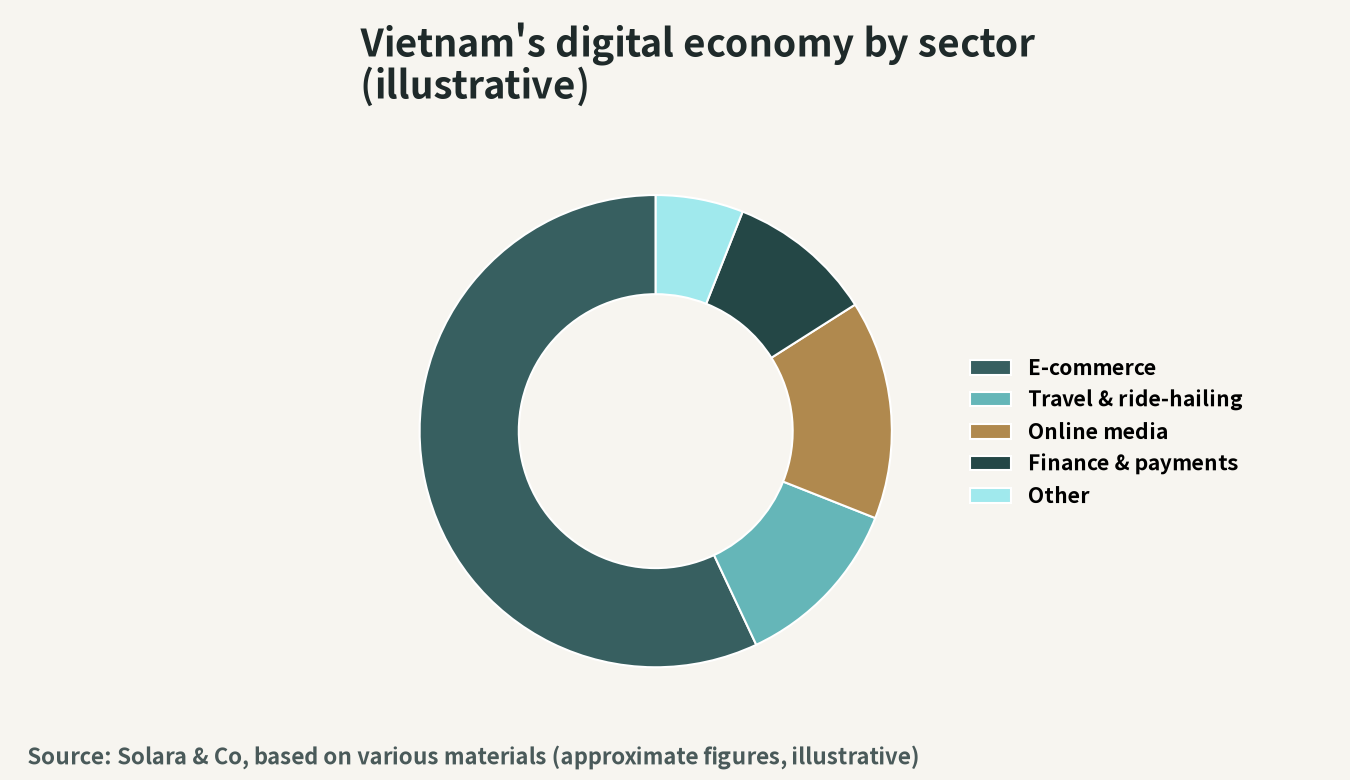
E-commerce is the largest driver of Vietnam's digital economy. Live commerce and social commerce—combining social media with video—have moved into the center of consumer behavior, shifting the gateway to purchasing from the store to the smartphone screen. In tandem, peripheral services such as digital advertising, logistics (last-mile delivery), and payments are also expanding. While large local platforms and international e-commerce services compete fiercely, the "behind-the-scenes functions that support the e-commerce ecosystem"—delivery, warehousing, payments, and merchant onboarding support—still have much room for development, and this is where solid business opportunities are opening up. While cash on delivery (COD) remains deeply entrenched, the digitalization of payments and greater efficiency in returns and logistics networks are becoming the next axis of competition, opening up opportunities in building out fulfillment and cross-border e-commerce infrastructure.
Fintech and Digital Payments
Fintech such as e-wallets, QR-code payments, digital remittance, and online lending is spreading rapidly. In Vietnam, where the unbanked segment was once large, mobile-originated financial services are spreading in a "leapfrog" that vaults over the traditional banks. E-wallets such as MoMo, ZaloPay, and VNPay, the spread of interoperable QR standards, and the trial of small-value payments through telecom carriers (mobile money) have expanded financial inclusion explosively. As the next stage beyond payments, the reach of fintech is broadening into areas such as digital lending, insurance (insurtech), asset management, and financial services for small and medium-sized enterprises. At the same time, finance is a regulated industry that presupposes obtaining licenses, oversight by the central bank (the State Bank of Vietnam), and compliance with the regulatory sandbox, so partnering with local financial institutions and fintech companies holds the key to business design.
Cloud and Data Centers
Against a backdrop of rising corporate DX and AI demand, investment in cloud services and data centers is expanding. Global cloud providers and data-center operators are advancing investment into Vietnam, while large local players such as Viettel, VNG, FPT, and CMC are also accelerating the construction of large-scale facilities. The Cybersecurity Law and regulations requiring domestic storage of data, together with the decree on personal data protection that took effect in 2023 (Decree 13), require companies to store and manage data properly within the country, further bolstering demand for domestic data centers. Because data centers in the AI era require enormous power and advanced cooling, under the power mix envisaged by the eighth Power Development Plan (PDP8), a stable power supply and the availability of green power become decisive factors in site selection. Strengthening of international communications infrastructure—such as adding more submarine cables—is also progressing, and Vietnam is steadily raising its standing as one corner of Southeast Asia's digital hub.
AI Implementation and Industrial Application
AI sits at the very front line of Vietnam's digital strategy. Industrial application of AI is spreading across a wide range of domains: quality inspection and predictive maintenance in manufacturing, demand forecasting and customer service in retail, credit assessment and fraud detection in finance, and efficiency gains in administrative services. The government has rolled out a National AI Strategy looking toward 2030, setting the goal of becoming one of the leading AI hubs within the ASEAN region. The global rise of generative AI is a major turning point for Vietnam as well. With international companies entering the semiconductor and AI-infrastructure space in succession, and beyond the development of AI models themselves, new demand is being created at each layer of the AI economy: implementation support that embeds AI into corporate operations, data preparation and annotation, and the compute infrastructure (data centers) that runs AI. Backed by abundant IT talent, the link between manufacturing DX and AI is expected to deepen further going forward.
Digital Talent and Reskilling
Underpinning these growth fields is the market for talent supply and reskilling. Digitalization and the spread of AI are rapidly raising demand for new occupations—not only software developers but also data engineers, AI implementation specialists, cybersecurity professionals, and digital marketers. With supply unable to keep up with the rise in demand, the shortage of job-ready talent and wage inflation have become one of the greatest constraints for companies entering the market. In response, investment opportunities are opening up in the business of "creating" talent: reforming university curricula, in-house corporate training, online education (EdTech), and talent-development programs in the semiconductor and AI fields. For Japanese companies too, a perspective that not only locks in talent for oneself but also partners with local educational institutions and training providers to cultivate talent jointly over the long term will determine retention rates and competitiveness.
Organizing Investment Opportunities and Risks
The table below organizes the investment opportunities and risks across the main fields of the digital economy and AI.
Field | Main investment opportunities | Risks to keep in mind |
|---|---|---|
E-commerce | Logistics, payments, advertising, merchant onboarding support | Intensifying competition, monetization |
Fintech | Payments, lending, insurance, remittance | Financial regulation, licensing |
Cloud, data centers | Infrastructure build-out, operations, power | Massive investment, power and cooling |
AI, software | Development bases, industrial application, contract work | Securing talent, IP and data protection |
Digital talent, education | Training, education, reskilling | Gauging demand, retention |
The risks to keep in mind are common across fields. First, regulation concerning data protection, cybersecurity, and content, where compliance with requirements for domestic data storage (data localization) and protection of personal data is needed. Second, securing and retaining talent, where competition to acquire IT and AI professionals is fierce and wage inflation and poaching become challenges. Third, intensifying competition and the difficulty of monetization, where the race to acquire users runs ahead and the establishment of a sustainable revenue model is called into question. In addition, because regulation is updated frequently across fields, an arrangement to continuously track changes in how the authorities operate and in licensing requirements is also indispensable. These need to be managed through information rooted in the local market and the selection of trustworthy partners.
How Should Japanese Companies Engage?
For Japanese companies, there are multiple entry points to engaging with Vietnam's digital economy and AI. First, leveraging Vietnam as a base for AI and software development. The offshore/nearshore model—making use of abundant, relatively low-cost IT talent to carry out development and operations in Vietnam—already has many track records. Second, deploying one's own digital services and products in the Vietnamese market. Business opportunities in growth markets such as fintech, SaaS, and e-commerce platforms are expanding greatly. Third, investing in, partnering with, or pursuing M&A with local digital companies and startups. In fast-growing fields, taking an equity stake in promising local companies makes it possible to absorb technology, market, and talent all at once.
In any of these forms, the selection of a local partner and the due diligence at the time of investment or acquisition decide success or failure. The digital field grows fast, but changes in technology, talent, and regulation are also intense; because the information asymmetry regarding the target company's true state (technical capability, customer base, profitability, data-management framework) is large, scrutiny at the entry stage is indispensable. In particular, how data is handled, whether licenses are in place, who owns the intellectual property, and the continuity of key personnel are the points most easily overlooked in due diligence in the digital field—and yet the ones that most determine value.
Capturing Vietnam's Digital Growth — Solara's Perspective
Vietnam's digital economy and AI, supported by the three foundations of a young population, government backing, and abundant IT talent, continue to grow powerfully in fields such as e-commerce, fintech, cloud and data centers, and AI. Japanese companies can take part in this growth in diverse forms—leveraging Vietnam as a development base, deploying digital services to the market, and investing in or partnering with local companies.
The key is to correctly identify the growth fields, understand the regulatory environment, and choose trustworthy local partners. Precisely because this is a fast-changing field, information rooted in the local market and thorough due diligence at the time of investment, partnership, or M&A become the premise for capturing opportunity while keeping risk in check.
Solara & Co has bases and human networks on both the Japanese and Vietnamese sides, and provides end-to-end support—from market research and the drafting of entry strategy, to the selection of local partners and startups, the execution of investment, M&A, and joint ventures, and pre-acquisition credit investigation and due diligence. We help connect the great opportunity of Vietnam's digital growth to reliable results.