
The country where the smartphone becomes the wallet — an overview of Vietnam's fintech market
Vietnam is drawing attention as a market with particularly large fintech upside, even within Southeast Asia. With a population of over 100 million and a young age structure, smartphone penetration is among the highest in the world. At the same time, ownership of traditional bank accounts still has room to rise, and the shift from cash to digital payments is underway right now. The rapid expansion of e-commerce and the rise of live commerce have driven the digitization of payments, credit, and data all at once, and the structural shift in which "the smartphone becomes the wallet" is enveloping the entire market.
This article organizes Vietnam's fintech market from a practical perspective in the following order: growth drivers, major segments, payment-market trends, credit and alternative data, the regulatory environment, opportunities and challenges, and finally the forms of foreign entry and partnership. Read together with Vietnam EC Market 2026, the foundation of consumption digitization makes the backdrop of fintech demand easier to grasp.
Four drivers pushing the market upward
The expansion of Vietnamese fintech is not a passing boom; it is supported by multiple engines — population, devices, financial inclusion, and e-commerce.
A young population and smartphone penetration
The median age of the population is young, and a digitally native generation forms the core of consumption. Many users connect to services directly from a smartphone without going through a PC — "mobile first" is the premise. Social media, video, messaging, and payments are consolidated into a single device, making the distance to financial services extremely short.
Room for bank-account ownership to rise
Ownership of traditional bank accounts and credit cards remains low compared with developed countries. This is at once a weakness and an enormous opening for financial inclusion. The "leapfrog" phenomenon — in which the unbanked skip the bank and jump straight to mobile payments and e-wallets — has become a catalyst for market expansion.
Cashless policy and e-commerce
The government has set the realization of a cashless society as a policy goal, promoting the standardization of QR-code payments and the digitization of accounts. Combined with the spread of e-commerce, food delivery, and ride-hailing apps, everyday payments are moving online. A virtuous cycle is forming: as payments increase, transaction data accumulates, and that data becomes the foundation for the next financial services such as credit and insurance.
A map of the major segments
"Fintech" may sound simple, but the field is multilayered. In Vietnam the following segments coexist and expand while overlapping with one another.
- Digital payments / e-wallets: E-wallets such as MoMo, ZaloPay, and VNPay and QR-code payments are the core of the market. They bundle remittance, top-up, utility-bill payment, and in-store payment into a single app and serve as the user's gateway.
- BNPL / credit / lending: Buy Now Pay Later and small online loans complement the purchasing power of the cardless segment.
- Digital banking: Branchless digital banks, or the digital subsidiaries of existing banks, complete everything from account opening to remittance within an app.
- Insurtech: Selling small, short-term micro-insurance online, widening the base of insurance.
- Crypto assets: While interest in holding and trading at the individual level is high, the legal positioning remains limited, and it is not officially recognized as a means of payment. It is often discussed in the context of speculation and remittance, and is an area where the direction of regulation must be watched closely.
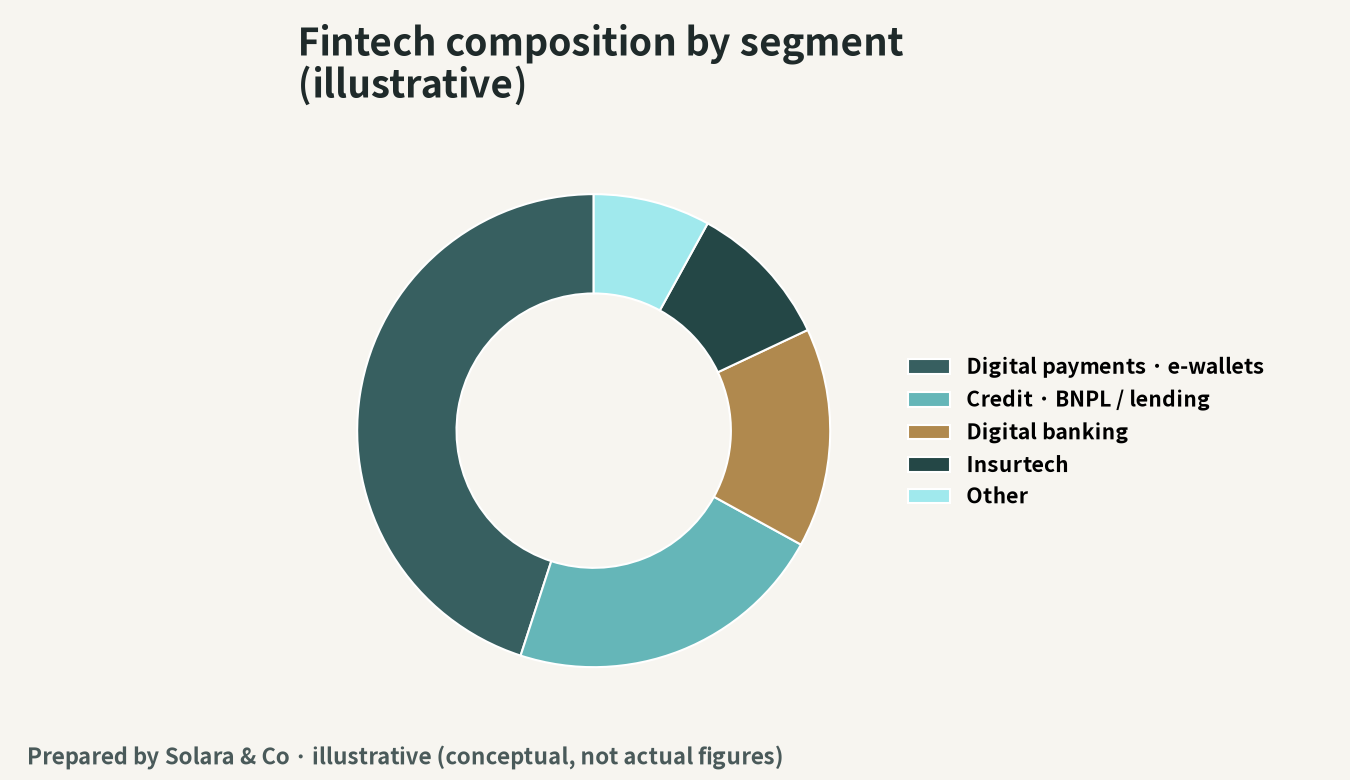
The composition of each segment is shown in a conceptual diagram. The market's rough shape is a structure in which payments occupy the overwhelming gateway, followed by credit, banking, and insurance.
Payment-market trends — the battle to control the gateway
Vietnamese fintech first took off from payments. E-wallets and QR-code payments span from street stalls and small shops to large stores, rapidly replacing cash. Starting from the payment app, users circulate to peripheral services such as remittance, top-up, ticket purchases, and investment, and the super-app shift is advancing.
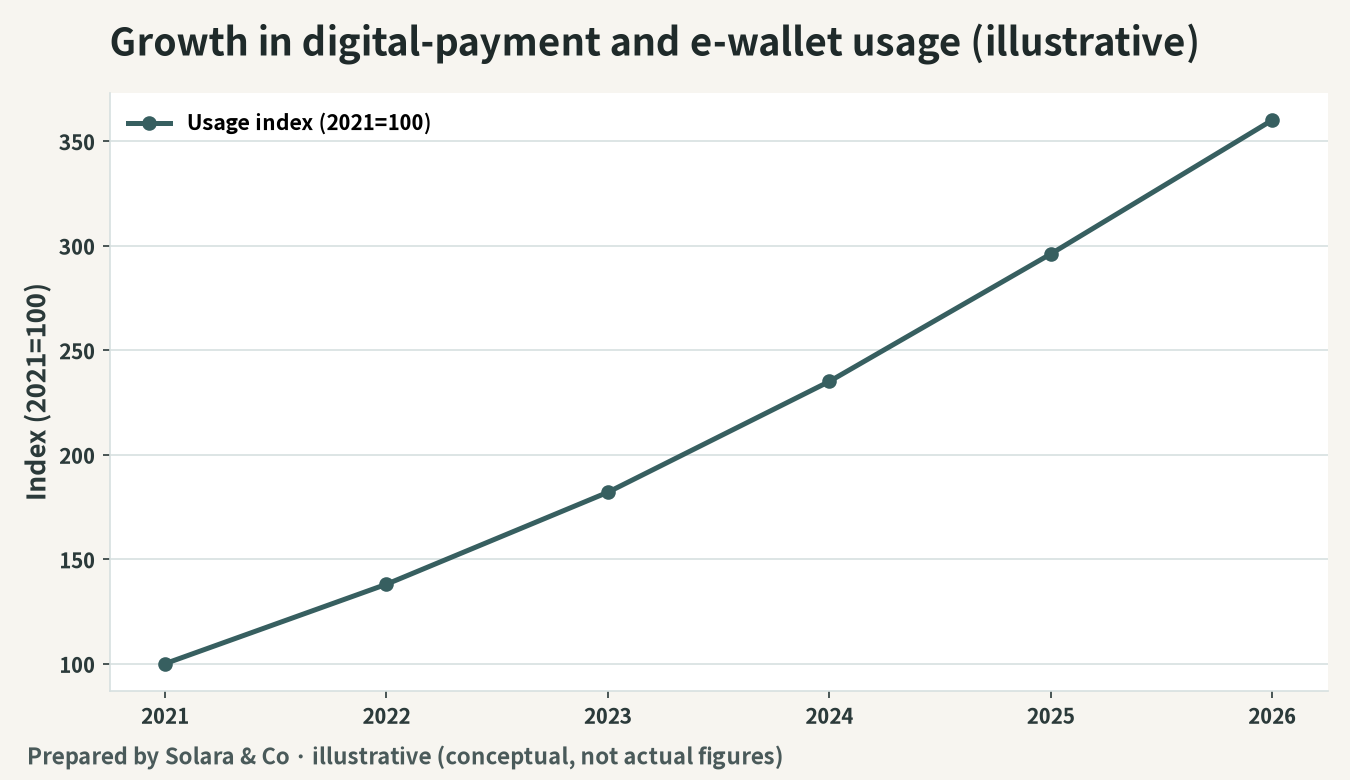
This "battle to control the gateway" is fiercely competitive, and each company pours heavy spending into fee reductions, cashback, and merchant acquisition. While the number of users and transaction volume grow, monetization remains a major challenge. Because payments alone tend to be thin-margin, how to connect to high-value-added services such as credit, insurance, advertising, and data becomes each company's lifeline. The direction in which e-wallet usage expands is shown through a conceptual-diagram illustration.
Credit and alternative data
In a market with low card ownership, it is difficult to measure the creditworthiness of individuals and micro-businesses using traditional credit information alone. This is why credit using alternative data — payment history, EC purchases, telecom, ride-hailing, utility-bill payments — is drawing attention. A model that estimates a credit score from daily transactions and connects it to small BNPL or lending is spreading.
Because this area can make the most of the data accumulated by payment platforms, the expansion from payments to credit has become the center of each company's growth strategy. However, the use of data is subject to personal-data-protection discipline, and the transparency of credit decisions and the management of default risk are at issue. For operating companies, the stance of carefully assessing what data a local partner handles and on what basis is indispensable.
The regulatory environment — reading the SBV and the sandbox
Fintech is an industry close to regulation. In Vietnam, the central bank — the State Bank of Vietnam (SBV) — is responsible for supervising payments, e-wallets, and banking operations. Below we organize the main issues.
Regulatory area | Competent authority / framework | Key practical points |
|---|---|---|
E-wallets | SBV (payment-intermediary license) | A license for intermediary payment services is mandatory. Identity verification (eKYC) and segregated management of funds are required |
Lending | Finance- and consumer-protection-related regulation | Discipline on caps on interest rates, collection, and disclosure for online loans. Beware the risk of operating without a license |
Digital banking | Law on credit institutions, SBV supervision | A banking license or partnership is the premise. Deposit protection and capital-adequacy regulation apply |
Crypto assets | Legal positioning not established | Cannot be used as a means of payment. The treatment of holding and trading is fluid; watch legislative developments |
Foreign-ownership ratio | Investment law, sector-specific caps | Payment and finance may have caps on the foreign-ownership ratio, so partnership design is important |
What stands out is the framework of the regulatory sandbox. It is a mechanism for providing new financial services experimentally within a limited scope, allowing the regulator to refine rules while observing reality, and for fintech operators it becomes a path to commercialization. On the other hand, the caps on the foreign-ownership ratio and license requirements differ by sector and govern the design of the entry form. The specifics of sectors requiring a license can be checked in Conditional Business Sectors and Licensing in Vietnam, and the overall picture of foreign-investment regulation in Vietnam's Foreign Investment Regulation.
Opportunities and challenges — monetization, fraud, regulatory uncertainty
The opportunity in Vietnamese fintech is clear. The room for financial inclusion, a young population, and EC-linked demand are spreading across the areas of payments, credit, and insurance. For Japanese companies, know-how in payments, data, and credit, the discipline of risk management, and knowledge of financial-adjacent businesses such as insurance and leasing are strengths that can build a complementary relationship with local players.
On the other hand, the challenges must also be faced squarely. First is monetization. Competition to acquire users is fierce, and payments alone remain thin-margin. Second is fraud and chargebacks. The expansion of digital transactions demands the sophistication of measures against impersonation, unauthorized use, and money laundering (AML). Third is regulatory uncertainty. The treatment of crypto assets, lending regulation, and the operation of data protection are fluid, and business design requires the ability to read the direction of regulation. For understanding the ecosystem that underpins startup collaboration, Vietnam's Startup Ecosystem is a useful reference.
Choosing the form of entry and partnership
There is more than one path for foreign capital to engage with Vietnamese fintech. In practice, the following options are used selectively according to purpose and regulatory constraints.
- Capital alliance / equity investment: Invest in a leading e-wallet or digital-finance operator to take in growth and a local network. Mind the cap on the foreign-ownership ratio.
- Joint venture (JV): Form a JV with a local company that holds a license or a customer base, achieving both regulatory compliance and speed.
- Business alliance / technology provision: Provide payment and credit systems and risk-management know-how, monetizing through revenue share.
- M&A: Acquire a business that holds a license, users, and data, accelerating launch with a "buy time" mindset.
In any form, credit investigation to carefully assess the counterparty's finances, transaction reality, compliance, and the presence of a license is the premise for preventing later trouble. For the issues of offshore development that leverages technical talent, see Vietnam IT Offshore Development Guide, and as an adjacent, heavily regulated area, it is worth also grasping Entering Vietnam's Healthcare Market so you can draw a map of the entire digital business.
Solara & Co's support for fintech entry
Solara & Co provides end-to-end support for Japanese companies' entry into Vietnamese fintech, from understanding the market to executing partnerships. For each segment of payments, credit, digital banking, and insurtech, we organize the market size and competitive environment, the structure of monetization, and the regulatory and license requirements, and help verify entry hypotheses.
In choosing a form such as partnership, equity investment, JV, or M&A, we propose the optimal design taking into account the foreign-ownership ratio and license constraints, and conduct the credit investigation and due diligence to confirm the candidate's finances, transaction reality, and compliance. Even for "hard-to-read" issues such as the regulatory sandbox, SBV developments, and the operation of data protection, we organize them based on locally rooted information in a form that aids management decisions. When you are considering entering Vietnam's fintech market, please consult Solara & Co.