
Introduction: Why Vietnam's restaurant and F&B market is drawing attention now
Vietnam's restaurant and F&B (food-service) market has grown into one of the most vibrant dining scenes in all of Southeast Asia. A population of roughly 100 million, an average age in the early thirties, and a middle class expanding above all in the cities have together pushed up spending on dining out and ready-made meals. While a traditional eating-out culture of street stalls and casual eateries is firmly rooted in everyday life, modern formats such as café chains, quick service, and delivery are rapidly thickening in number—so that opportunity and competition are rising at the same time. This article systematically organizes the market's structure, its segments, the modes of entry, and practical issues such as licensing and procurement, from the perspective of Japanese companies.
For Japanese restaurant and food businesses, Vietnam is a rare market where three tailwinds overlap: "the population is growing, dining out is growing, and incomes are rising." That said, taste preferences, price sensibilities, location practices, and hygiene regulations differ greatly from Japan, and this is not a market that can be won on brand strength alone. What separates success from failure is how deeply a company can localize into the realities of local life, and whether it can design steady, painstaking operations.
Market size and drivers: a young population, eating-out culture, urbanization, and rising incomes
Vietnam's eating-out market, having recovered from the pandemic, is once again on an expansionary track. The specific figures vary by research firm, but it is positioned as one of the few consumption categories to have sustained growth from the high single digits to nearly double digits. The factors driving the market can broadly be sorted into four.
First is the young population. Urban residents in their twenties and thirties dine out and use cafés frequently, and they are a highly sensitive segment toward new formats and brands. Second is the depth of the eating-out culture itself: the habits of having breakfast at a street stall and lunch at a casual eatery are widely entrenched, so eating out is not "something for special occasions" but a part of daily life. Third is urbanization: the concentration of population in major cities such as Ho Chi Minh City, Hanoi, and Da Nang continually creates room to open outlets in commercial facilities and roadside locations. Fourth is rising incomes: with GDP per capita reaching the 4,000-dollar range, demand for higher-priced formats and premium-oriented offerings is being nurtured.
These do not act in isolation but interact with one another. For example, in districts where urbanization and rising incomes overlap, low-priced QSR and high-priced cafés and restaurants grow at the same time—so a polarization of formats advances. The market's growth is attractive, but because the winning format differs by district and customer base, an attitude of reading the market by "points" rather than by "areas" is indispensable. The overall movement of the market is also linked to the growth of Vietnam's retail and consumer market, and grasping it together with structural changes in consumer goods and retail raises the resolution of one's view.
Major segments: café, QSR, casual/full-service, and delivery
Vietnam's F&B market is divided into several format segments, each with its own profit structure and competitive environment. Cafés form the thickest layer, a fierce battlefield densely packed with everything from major local chains to individually run street-front shops. Because coffee consumption is deeply rooted in daily life, demand is stable, but it is also an area where differentiation is highly difficult. QSR (quick service), centered on fried chicken, burgers, noodles, and the like, competes on turnover and location, and is a segment where foreign brands have a strong presence.
Casual/full-service restaurants have a high per-customer spend and can differentiate through brand experience and service, but the burden of labor and property costs is heavy, so the skill of location selection and operations governs profitability. And delivery has grown to a scale that can now be called an independent format in its own right—impossible to ignore whether as a storeless ghost kitchen or as a channel that lifts the sales of existing outlets.
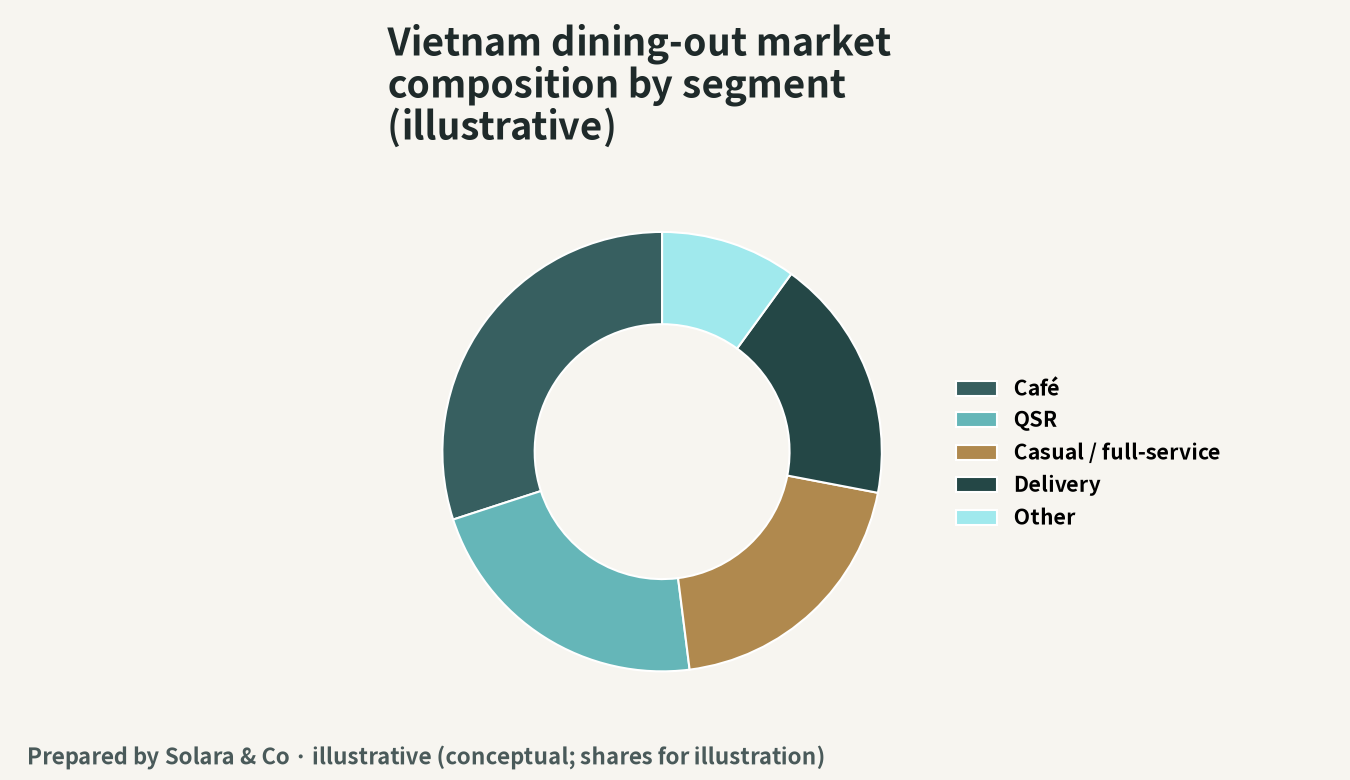
As the conceptual diagram above shows, the market has cafés and QSR supporting the quantitative base, while delivery is trending toward a rising share of the mix. When considering entry, a Japanese company should first determine whether its strength lies with "the segment chosen for price" or "the segment chosen for turnover and convenience," and then narrow down to a single format on that basis—this is the starting point for making the most of limited management resources.
Choosing the mode of entry: direct operation, franchise, joint venture, license
Modes of entry into Vietnam's F&B market can broadly be organized into four: direct operation, franchise (FC), joint venture (JV), and license. Each strikes a different balance among initial investment, management burden, speed, and brand control, and the choice is made according to a company's own capacity and on-the-ground knowledge.
Mode of entry | Initial investment | Management burden | Speed | Brand control |
|---|---|---|---|---|
Direct operation | High | High | Slow | Strong |
Franchise | Medium | Medium | Fast | Medium |
Joint venture | Medium–High | Medium–High | Medium | Medium–Strong |
License | Low | Low | Fast | Weak |
Direct operation lets a company run outlets itself and so capture profit and brand to the maximum, but the burden of holding staff, property, and licenses in-house is heavy and launch takes time. Franchise borrows the capital and operating capability of a local partner to expand across areas, but the challenge is how to secure control over quality and service. Joint venture lets a company take in local distribution power, property-securing ability, and administrative know-how, but partner selection and governance design determine success or failure. License is a lightweight form, granting brand or recipes; investment is small but control becomes weak.
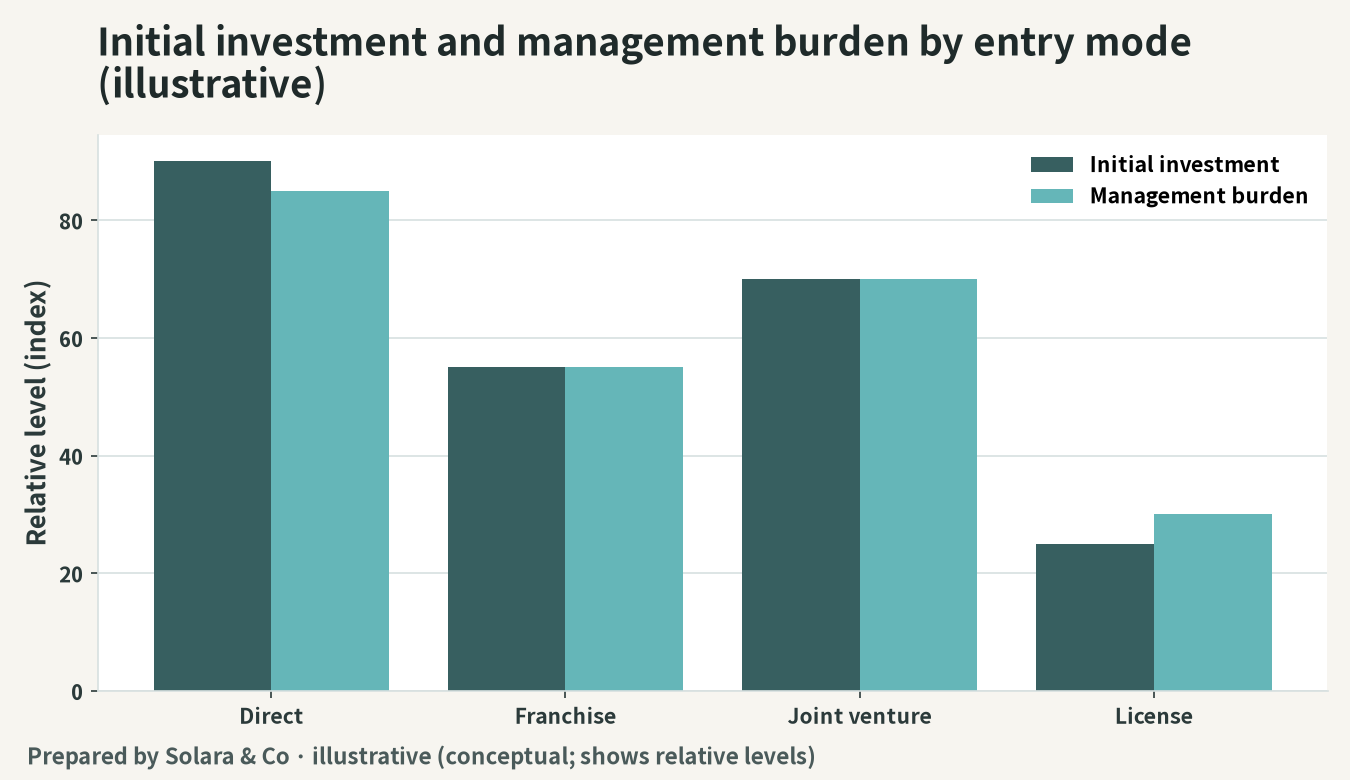
The conceptual diagram above shows the relative magnitudes of initial investment and management burden for each mode. For many Japanese companies, a realistic two-stage approach is to first launch a flagship outlet under direct operation to build the brand and operational template, and then expand across areas via franchise or joint venture afterward. Designing capital commitment and control cannot be separated from understanding the foreign investment regulations that apply after entry.
Location, property, food hygiene, and licensing
It is often said that the fate of an F&B business is "half decided by location." In Vietnam, the main options are tenant spaces in commercial facilities, roadside street-front shops, and the lower floors of office buildings, but upward pressure on rents and the opacity of contracting practices trouble Japanese companies. The lease term, rent-revision clauses, restoration obligations, the permissibility of subletting, and the like must be scrutinized in advance; proceeding on the basis of verbal agreement leads to trouble later.
On the licensing side, in addition to a business license, the conformity and registration concerning food safety (food hygiene) specific to the restaurant business are required. Specifically, the issues include facilities and equipment meeting food-hygiene conditions, health checks and hygiene training for staff, traceability of raw materials, and conformity with labeling and storage standards. Because these require lead time, it is important to weave them correctly into the outlet-opening schedule. Whether a license is required, and the procedures involved, change by format, and when the serving of alcohol is involved the requirements increase. Whether a business falls under a conditional sector is best confirmed safely through the framework of conditional sectors and licensing.
Ingredient procurement, the cold chain, and localization
To maintain stable quality, the design of ingredient procurement and the cold chain is indispensable. In Vietnam, the distribution network for fresh produce differs in maturity by region, so securing chilled and frozen ingredients stably at a consistent quality is not easy. Relying too much on imported ingredients swells costs and foreign-exchange risk, while leaning too heavily on local procurement gives rise to variability in quality. A realistic solution is a procurement design that uses multiple suppliers in combination and includes temperature management across storage and delivery. Implementing the cold chain is also closely tied to insights into the logistics and warehouse market discussed later.
Localization, too, cannot be avoided. As for taste, there are regional differences—southern Vietnam leans sweet, the north lighter—and adjustments toward local palates such as herbs, lime, and fish sauce sway how well a brand is received. As for price, one must coolly verify, against the brand's positioning, "whether it is affordable to the local sense of income." As for the menu, rather than bringing over Japan's flagship items as is, it is effective to think in terms of adding sizes, combinations, and seasonal products that sell locally. The delicate balance of retaining "Japaneseness" while blending into local life is the very core of localization.
Leveraging delivery/apps, and staffing and operations
In discussing Vietnam's dining out, the presence of delivery apps is decisive. Platforms such as GrabFood and ShopeeFood have become everyday infrastructure for urban youth, and have come to occupy a non-negligible share of an outlet's sales mix. To master these, one must operate as an integrated whole—from menu design on the app, optimization of photos and prices, pricing that factors in commissions, operations during peak hours, all the way to review responses. It is not rare for delivery-only menus or set designs to generate a revenue source distinct from in-store sales.
Staffing and operations are the lifeline of a store-based business. In Vietnam, turnover among food-service staff is high, so recruitment and retention, hygiene and service training, and shift management are constant challenges. The key to overcoming the wall of multi-outlet expansion is standardized manuals, the development of local managers, and how to reconcile the head office's brand standards with local business customs. The shift from person-dependent operation to a reproducible mechanism—whether this transition can be made determines whether the success of the first outlet can be carried over to the second and third. Designing the overall sales channels is most effective when advanced together with an understanding of distribution and retail channels.
Common failures and how to avoid them
Finally, let us list the typical failures Japanese companies tend to fall into. First is overconfidence in location: looking only at heavy foot traffic, choosing a high-rent space, and then struggling because it cannot be recouped through per-customer spend and turnover. Second is insufficient localization: bringing over Japan's tastes and menu as is, which does not match local preferences and price sensibilities and so stalls. Third is disregard for licensing: misjudging the lead time of food-safety and business procedures, which delays opening.
Fourth is person-dependent operations: the first outlet succeeds through the effort of founding members, but because mechanization was neglected, quality collapses upon multi-outlet expansion. Fifth is overlooking delivery commissions: even as platform-routed sales rise, running on a pricing design under which the commission burden leaves no profit. All of these can be avoided through prior market understanding and the design of unit economics that leave a profit. To understand the foundations of agricultural and food procurement, the perspective of agricultural and food exports is also useful.
Solara & Co's support for entering the restaurant and F&B market
As an M&A and market-entry advisory connecting Japan and Vietnam, Solara & Co provides end-to-end support for entry into the restaurant and F&B field. We accompany you at each practical phase: from determining the format through market and segment research, to designing the mode of entry—direct operation, franchise, joint venture, or license—evaluating location and property, licensing procedures including food safety, building ingredient procurement and the cold chain, and on to leveraging delivery and designing staffing and operations.
In particular, in selecting local partners or acquisition candidates, due diligence spanning finance, legal, labor, and food safety, together with the design of post-merger integration (PMI), greatly influences the outcome. From both sides—"offensive differentiation" such as taste and brand, and "defensive implementation" such as hygiene, procurement, and operations—we guide your company's entry into Vietnam to success. When you are considering entering the F&B market, please consult Solara & Co.