
The Great Wave of Infrastructure Investment Underpinning Growth
For a Vietnam that continues to deliver rapid economic growth and industrialization, building out infrastructure is the single greatest challenge and, at the same time, the single greatest investment theme. High annual economic growth, the clustering of manufacturing, and the advance of urbanization are simultaneously driving up demand for infrastructure—roads, railways, ports, airports, electricity, and water and sewerage. If supply fails to keep pace with demand, rising logistics costs and power shortages could become a brake on growth. That is precisely why the government has placed massive infrastructure investment at the center of its national strategy, drawing on public-private partnerships (PPP) and official development assistance (ODA).
This great wave of infrastructure investment means a major business opportunity for the Japanese construction, engineering, trading-house, railway, and power-related companies that have handled large-scale infrastructure around the world for many years. This article organizes the background and the flagship projects driving Vietnam's infrastructure investment, decodes the public-private partnership (PPP) framework, and then explains, from a practitioner's perspective, the business opportunities for Japanese companies along with the risks to keep in mind. For the macro growth scenario, please also see Vietnam Investment: The "Golden Decade".
Why Massive Infrastructure Investment Is Needed
Vietnam's infrastructure investment is positioned as an "inevitability" for sustaining growth.
The Pace of Economic Growth and Urbanization
Vietnam continues to post high economic growth, and the concentration of population into cities—Hanoi and Ho Chi Minh City foremost among them—keeps advancing. Urbanization explosively raises demand for urban infrastructure such as transport, housing, water and sewerage, electricity, and waste treatment. Existing infrastructure has not kept up with this pace, and chronic traffic congestion and strained power supply are constraining the productivity of cities.
Manufacturing Clusters and Logistics Bottlenecks
The clustering of manufacturing against the backdrop of China+1 is rapidly increasing the logistics volume of raw materials, components, and finished goods. The capacity of logistics infrastructure—ports, airports, trunk roads, and railways—directly governs the competitiveness of manufacturing. Resolving logistics bottlenecks is a precondition for Vietnam to cement its position as the "world's factory." We cover the clustering of manufacturing in detail in Manufacturing Relocation and High-Tech Investment into Vietnam.
The Surge in Electricity Demand
Industrialization, digitalization, and the expansion of data centers continue to push up electricity demand. It is not only the reinforcement of generating capacity but the strengthening of the transmission and distribution grid and a stable supply that form the foundation for every investment. The development of power infrastructure is being advanced as one with the green transition. The stability of electricity supply is a decisive factor governing manufacturers' decisions on whether to enter the market, and outages or voltage fluctuations are fatal for precision manufacturing, semiconductors, and data centers. In addition to generation, transmission, and storage, investment in introducing renewable energy and in the grid reinforcement that supports it will become the central theme going forward. For details, please also refer to Vietnam's Green Transition and ESG.
The Big Picture of the Flagship Infrastructure Projects
In Vietnam, nation-scale mega-projects are advancing in parallel. We organize the representative fields below.
Field | Main projects | Nature of investment | Room for Japanese involvement |
|---|---|---|---|
Railways | North–South high-speed rail, urban rail | Mega-scale, long-term | Rolling stock, signaling, construction, operation |
Airports | New airports, expansion of existing airports | Large-scale, PPP | Construction, equipment, operation |
Roads | North–South expressway network | Nationwide network build-out | Construction, civil works, machinery |
Ports & logistics | Deep-water ports, logistics hubs | Export foundation | Port equipment, operation, logistics |
Power | Generation, transmission & distribution grid | Stable supply | Generation, transmission, EPC |
Urban infrastructure | Urban rail, water & sewerage | Urban productivity | Equipment, civil works, operation |
The most emblematic of these is the high-speed rail concept connecting north and south. This plan to link Hanoi and Ho Chi Minh City over a length of more than 1,500 km is one of the largest infrastructure undertakings in Vietnam's history, generating an enormous volume of orders spanning rolling stock, signaling systems, track, station construction, and operation. The construction of new international airports and the expansion of existing ones, the urban rail (metro) networks of Hanoi and Ho Chi Minh City, the development of deep-water ports, and the expressway network running the length of the country are all advancing in parallel. Each of these is a multi-billion-dollar undertaking, telling us that Vietnam's infrastructure market is not a matter of "one-off projects" but a "long-term flow of orders."
These projects all require huge sums of capital and long construction periods, and they call for players equipped with technical capability, financial strength, and operational know-how. Fields such as railways, airports, ports, and power are also areas in which Japan has long been involved through ODA and private investment, a stage where the trust and track record it has built up can come into play. In fact, a not-insignificant portion of Vietnam's key infrastructure has been developed through Japan's technical cooperation and yen loans, and the relationship of trust between Japan and Vietnam is itself the foundation of Japanese companies' competitive advantage.
The Scale of Infrastructure Investment in Figures
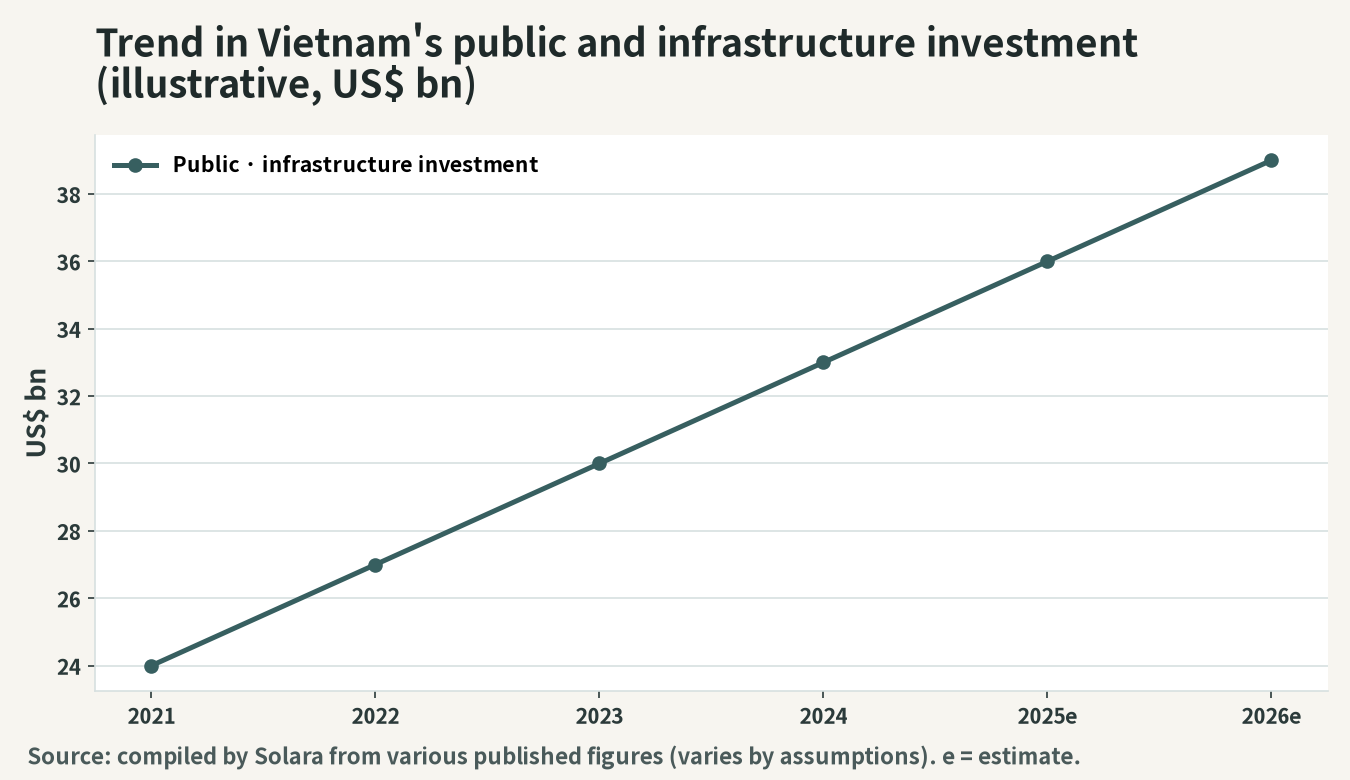
We confirm the contours of infrastructure investment through two indicators. First is the trend in public and infrastructure investment. One can see the government's policy of keeping infrastructure investment at a high level to sustain growth.
Second is an illustration of the allocation by field toward which infrastructure investment is directed. It shows a structure in which capital is channeled into a wide range of fields, centered on transport and power.
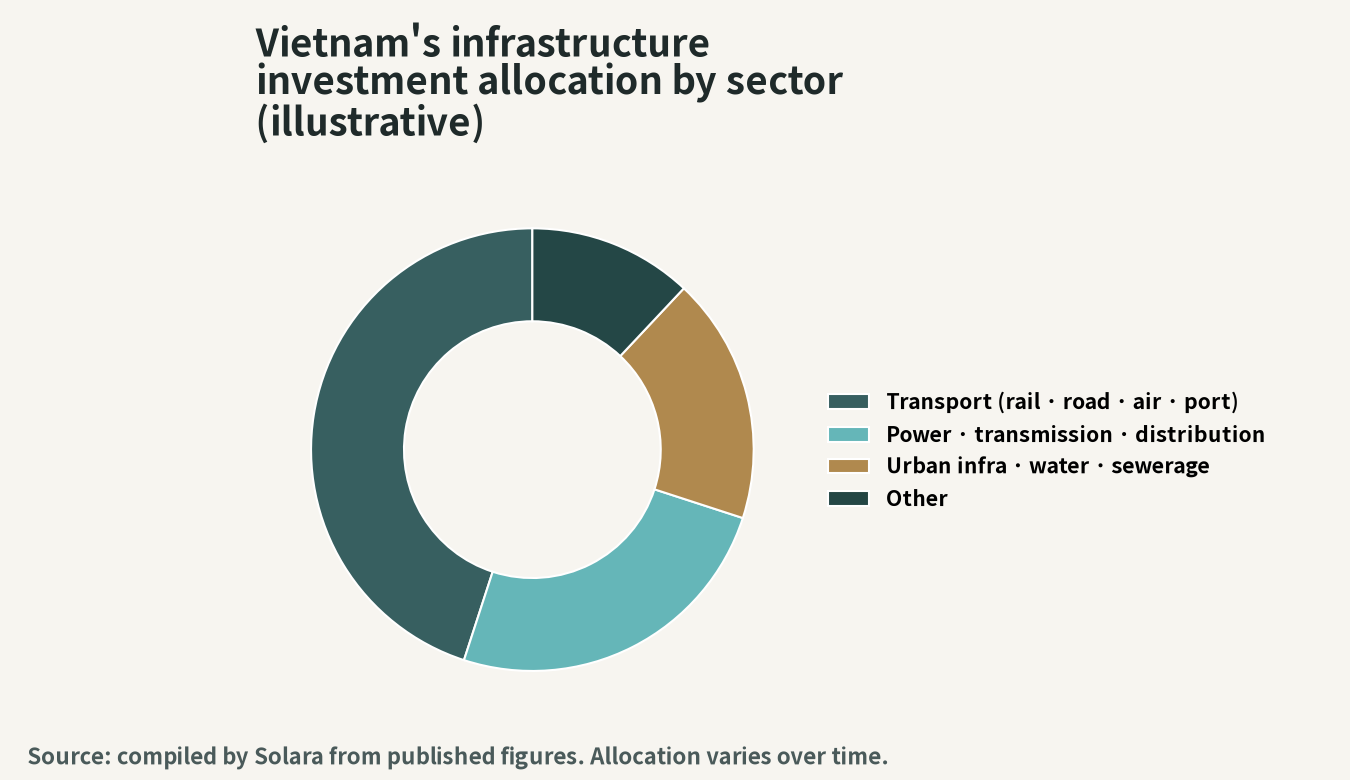
These figures swing depending on the assumptions, but the direction is consistent. The government keeps public investment at a high level as an engine of growth, and capital is allocated with a focus on transport and power—this is the keynote of Vietnam's infrastructure investment.
The Public-Private Partnership (PPP) Framework
Massive infrastructure demand cannot be covered by the government's finances alone. What therefore becomes important is the public-private partnership (PPP), which harnesses private capital and know-how. Vietnam has built up its legal framework for PPP and has worked to construct a structure that draws in private investment.
The Mechanism and Significance of PPP
PPP is a mechanism in which the private sector invests capital to build and operate infrastructure—through schemes such as BOT (build-operate-transfer), BTO, and concessions—and recovers its investment from toll and fee revenues and the like. For the government, it allows infrastructure to be developed while holding down the fiscal burden; for the private side, stable long-term revenues can be expected, but it bears demand risk and fee-collection risk.
Opportunities for Japanese Companies to Participate
Japanese companies can participate in PPP projects in a variety of forms: equity investment, construction and civil works, the supply of equipment and machinery, and operation and maintenance (O&M). In particular, long-term operational know-how and engineering capability that prioritizes quality and safety are well-suited to PPP, which looks at the entire life cycle, so Japanese companies' strengths come into play. The common form is for trading houses, construction firms, manufacturers, and operators to join together in a consortium, sharing risks and roles. On the other hand, it is not unusual for a PPP to have a contract period spanning several decades, so how long-term risks—fee revisions, demand fluctuations, exchange rates, and regulatory changes—are written into the contract will govern the success or failure of the undertaking. Designing the revenue structure, the risk-sharing, and even the exit (project sale or transfer) with precision at the entry stage is the precondition for participating in a PPP.
Business Opportunities for Japanese Companies — Where the Winning Chances Lie
Vietnam's infrastructure investment creates a wide range of business opportunities for Japanese companies. First is the construction and civil works of large-scale infrastructure such as railways, airports, ports, and roads. Second is the supply of machinery and equipment such as rolling stock, signaling, power equipment, water-treatment equipment, and construction machinery. Third is services such as operation and maintenance (O&M) and consulting. Fourth is participation through direct equity investment in PPP projects. These are often realized not in isolation but in the form of multiple Japanese companies cooperating at each stage of design, procurement, construction, and operation, so the business opportunity spreads across the entire supply chain.
In addition, around the large-scale projects, opportunities also arise for cooperation and M&A with local construction, materials, logistics, and service firms. There are not a few situations in which, by taking in a strong local company, one can quickly acquire permits, networks, and construction capability. Because infrastructure investment spreads as a "plane" rather than a "point," beyond the core large-scale projects there is also wide room to enter the secondary demand that arises around them—materials supply, logistics, maintenance, and peripheral development (real estate and commercial facilities).
Risks to Keep in Mind
Precisely because the opportunity is large, one must view the risks with a cool head. First is the opacity of permits and administrative procedures. Large-scale projects involve many ministries and local governments, so procedural delays and divergences in interpretation affect schedules and profitability. Second is land acquisition and resident resettlement. If these run into difficulty, there is a risk that the project will be substantially delayed. Third is financing and demand risk. In a PPP, if the assumed demand or fee revenue is not achieved, recovering the investment becomes difficult. Fourth is the reliability and construction quality of partners and subcontractors.
These need to be managed through information rooted in the locality, the selection of reliable partners, an exit strategy at the entry stage, and prior investigation (due diligence) that assesses the financial standing, track record, and compliance of the contracting counterpart. In long-term infrastructure undertakings in particular, the initial selection of partners and the design of the contract determine the success or failure of the entire project.
How Japanese Companies Can Seize the Opportunity — Solara's Perspective
Vietnam's infrastructure investment is underpinned by structural inevitabilities—economic growth, urbanization, manufacturing clusters, and electricity demand—and will continue at a high level over the long term. In every field, whether railways, airports, ports, roads, power, or urban infrastructure, business opportunities are opening up where Japanese companies' technology, quality, operational know-how, and financial strength can come into play. The key is to understand the public-private partnership framework correctly, to settle in for the long haul of the undertaking, and to firm up the soundness of the partners and contracts at hand.
Solara & Co has bases and human networks on both the Japanese and Vietnamese sides, and provides seamless support—from market research and the formulation of business strategy, to the search for local partners and the formation of consortia, M&A and joint ventures, credit investigation and due diligence on contracting counterparts, and the building of an organization after market entry. Within the great current of infrastructure investment, identifying the position where one's own strengths come into play most, while carefully assessing the risks at hand—we believe that reconciling these two is the shortest path to producing results in Vietnam's infrastructure market.