
"Money that should be transferable cannot be transferred" — the starting point of Vietnam's remittance rules
It is not uncommon for a Japanese company that has set up a local subsidiary in Vietnam to face, several years in, the situation that "the money just won't transfer" when it finally tries to pay a dividend to the parent in Japan. The cause is not a shortage of funds, but that the account design and documentation have failed to keep up with Vietnam's distinctive foreign-exchange management rules.
The Vietnamese dong (VND) is not a freely convertible currency like the yen or the dollar. Cross-border movement of funds can only take place within the foreign-exchange framework administered by the State Bank of Vietnam (SBV), and the gateway to that framework is bank accounts classified by purpose. Get the initial account design wrong, and obstacles arise at every juncture — from paying in capital, to dividends, to recovering capital on exit.
From a practical perspective, this article systematically organizes the basic framework of Vietnam's foreign-exchange management (the distinction between capital and current transactions), the types of accounts including the Direct Investment Capital Account (DICA), the remittance practicalities of capital and current transactions respectively, the tax procedures that are prerequisites for profit remittance, and the key points of account opening and governance.
The basic framework of FX management: capital transactions and current transactions
The key to understanding Vietnam's remittance rules is that every external transaction is classified as either a "capital transaction" or a "current transaction." This classification rests on the Ordinance on Foreign Exchange and is operated through the SBV's body of Circulars.
The premise that VND is a managed currency
External dealings in VND are under the SBV's control, and price display, contracts and settlement within Vietnam are in principle required to be denominated in VND. Since free settlement in foreign currency is not a given, the starting point of every cross-border remittance is always proving, with documentary evidence, "what transaction the remittance is based on." Attempt to remit with an ambiguous purpose, and it will be stopped at the bank stage.
Why capital and current transactions are separated
Capital transactions are those in which the principal of the investment itself moves — capital contributions, borrowings, capital increases and decreases, dividends, capital recovery. Because these are directly tied to the inflow and outflow of capital to and from the Vietnamese economy, the SBV manages them strictly through accounts, registration and procedures. Current transactions, by contrast, are those accompanying day-to-day business activity — import/export payments, service consideration, royalties, travel expenses. With documentation in order, they can be remitted relatively freely, yet consistency between purpose and paperwork remains indispensable. This dichotomy determines which account to use and how far the procedures extend.
Types of investment accounts: DICA, IICA and current-transaction accounts
In Vietnam, the account to be used differs according to the nature of the foreign investor's funds. The most important is the Direct Investment Capital Account (DICA), the gateway for an FDI company's capital flows.
Direct Investment Capital Account (DICA)
The DICA (Direct Investment Capital Account) is a dedicated account through which a foreign direct investment company (FDI company) pays in capital, remits dividends and profits abroad, and recovers capital. External remittances relating to capital transactions must in principle pass through this DICA. What matters is the principle of "one company, one currency, one DICA": a company conducting capital transactions in foreign currency maintains, in principle, one DICA per currency. Opening the DICA at incorporation and the flow of the first capital contribution should be considered together with the steps in The Practicalities of Incorporating a Subsidiary in Vietnam.
Indirect Investment Capital Account (IICA) and current-transaction accounts
For portfolio investment (indirect investment) — investing in shares or bonds without participating in management — an IICA (Indirect Investment Capital Account) is opened and used, denominated in VND. This is a separate stream from the DICA of direct investment. Furthermore, settlement of day-to-day current transactions such as import/export payments and service consideration uses an ordinary business account (a settlement account for current transactions). Clarifying the division of roles from the outset — capital flows through the DICA, everyday business settlement through the current account — prevents later confusion.
The practicalities of capital transactions: everything goes through the DICA
Capital transactions arise at each milestone of the lifecycle, from contribution to exit, and every one of them passes through the DICA. Keeping this consistent is the single biggest point for ensuring that future dividends and capital recovery are not held up.
Capital contributions and parent-to-subsidiary loans from abroad
A foreign investor's capital contribution is paid into the DICA by the deadline set in the Investment Registration Certificate (IRC) or Enterprise Registration Certificate (ERC) — generally within 90 days of incorporation. Where funding needs are met by a loan from the parent rather than by capital contribution, the rules on overseas borrowing (external debt) come into play. Medium- to long-term external borrowing with a repayment period over one year must be registered with the SBV as medium/long-term external debt; short-term borrowing within one year is said to require no registration, but is subject to requirements such as use-of-funds and balance management, and receipt and repayment of the loan also pass through the DICA.
Capital increase/decrease, dividends, capital recovery and exit
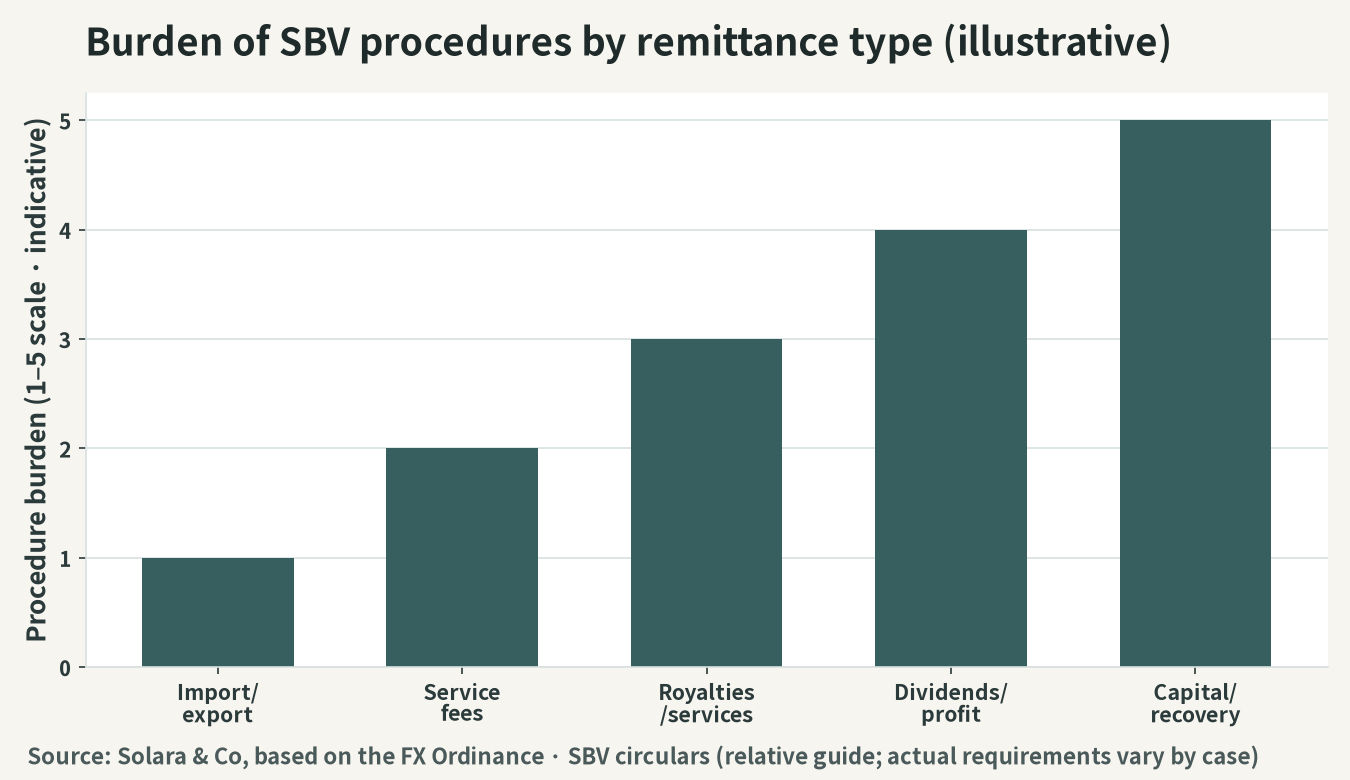
Capital increases and decreases, the overseas remittance of dividends and profits, and remittances accompanying the recovery of capital principal and exit at the end of operations are all carried out through the DICA. In particular, capital recovery on exit or liquidation is premised on tax settlement and the clearing of liabilities being complete; if the history of fund movements through the DICA is not consistent, one tends to get stuck on the final remittance. The crucial thing is not to break the chain of records from the very first contribution; from the standpoint of Designing Subsidiary Governance too, managing records of capital flows is important.
The practicalities of current transactions: relatively free with documentation in order
Current transactions, where the supporting evidence — contracts, invoices, tax documents — is in order, can be remitted more flexibly than capital transactions. However, "relatively free" is not "unconditional"; for each purpose, attention to the intersection with tax is required.
Import/export payments and service consideration
Settlement of import/export payments and payment of service consideration abroad can be remitted through a bank as a current transaction once documentation such as sales contracts, service contracts, invoices and customs documents is in order. Because the bank verifies the existence and purpose of the transaction with documentation each time, having the consistency between contract and invoice, and the match of amount and currency, prepared in advance makes the process smooth.
Royalties, technical-assistance fees and the intersection with tax
The overseas remittance of service consideration such as royalties, technical-assistance fees and management-guidance fees is closely entangled with the withholding obligation for Foreign Contractor Tax (FCT). Unless the prescribed tax is withheld and paid before remitting, it cannot be sent lawfully. Moreover, intra-group service transactions are also subject to transfer-pricing rules, which question the reasonableness of the consideration and its documentation. The design of service consideration is a point to be examined together with Transfer Pricing in Vietnam.
Procedures for profit remittance: completed tax payment is the premise
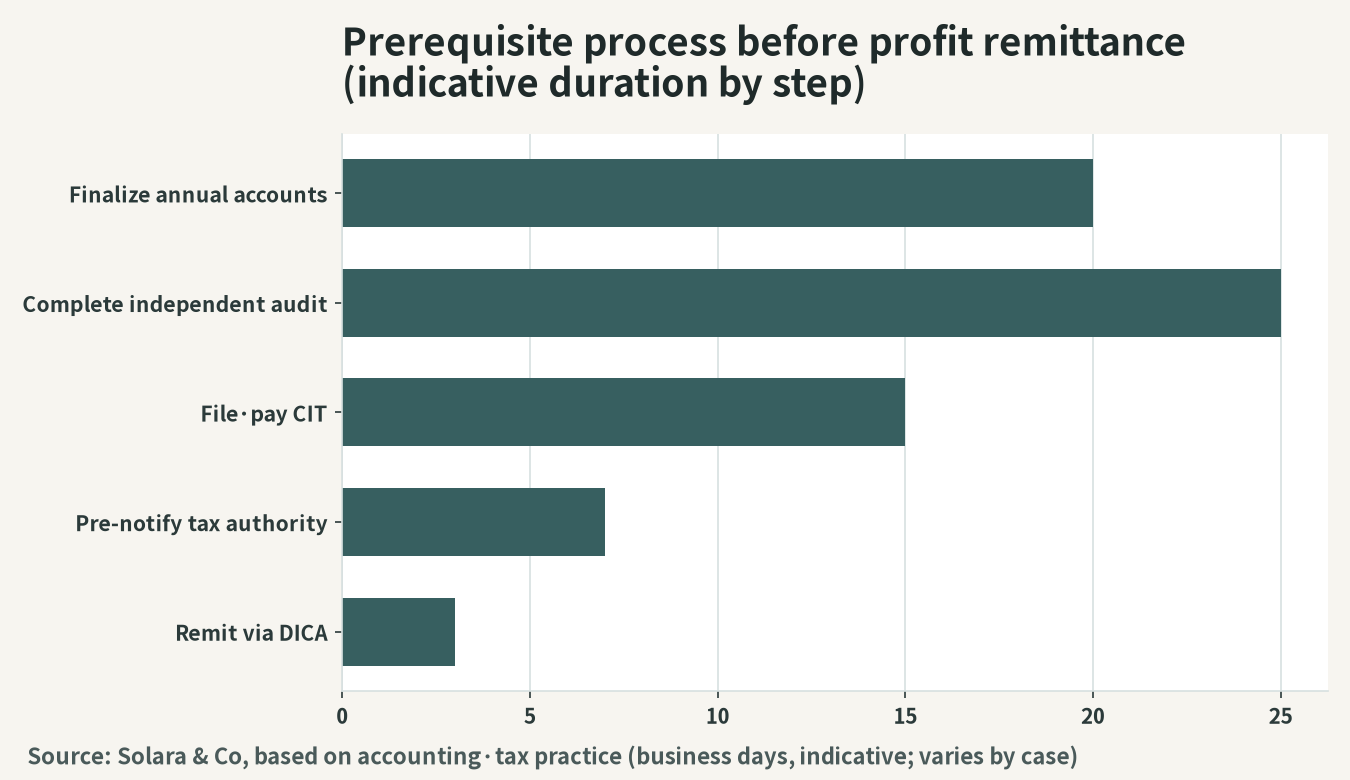
The overseas remittance of dividends and profits is the procedure with the heaviest "preconditions" even among capital transactions. Having a profit alone is not enough to remit; proof that the profit has been properly handled for tax is required.
Three premises: audit, filing and payment
As premises for profit remittance, first the financial statements for the year must have been independently audited, the final corporate income tax (CIT) return must have been filed, and tax payment must be complete. Where there is an accumulated loss or unpaid tax, dividends and profits cannot, in principle, be remitted. The quality of the accounts and audit directly determines whether remittance is possible.
Annual prior notification and withholding
When remitting profits abroad, one first notifies the tax authority in the prescribed form for each fiscal year, then remits through the DICA. Because the tax treatment of dividends and the need for withholding differ by recipient, the remittance scheme needs to be confirmed in advance. Since the tax status of personnel costs such as salaries and social insurance also affects the soundness of the accounts, building a comprehensive tax review including The Practicalities of Payroll and Social Insurance into a pre-remittance checklist is the safe course.
The practicalities of account opening and governance
Finally, let us organize how to open these accounts and how to control them afterward. An account is not finished once opened; it is also the starting point of the internal controls that prevent fraudulent remittances.
Opening procedures and required documents after obtaining the ERC
Account opening proceeds after obtaining the ERC (Enterprise Registration Certificate). Generally, a set of documents demonstrating the company's establishment and representative authority is required — the ERC, articles of incorporation, identity documents of the legal representative, the company seal, and resolutions of the board of directors / members' meeting. The choice of bank is also a practical issue: one weighs the balance of convenience and cost between local banks strong in domestic procedures and Japanese banks strong in Japanese-language support and communication with the home country.
Bank authority and internal control
After opening an account, designing bank authority — who can approve remittances up to what amount — is important. A state in which a single staff member can complete everything from initiating to approving is a breeding ground for fraud, so multi-tier approval by amount band (matrix approval) and segregation of authority in online banking are established. Control of remittance accounts is a core issue of The Practicalities of Internal Control and Fraud Prevention, and designing it from the early stage of entry leads to later peace of mind. Incidentally, estimating account opening at entry and the scale of initial funds together with The Big Picture of Costs of Entering Vietnam keeps the funding plan free of strain.
Comparison of the DICA and the current-transaction account
The DICA for capital flows and the current-transaction account for everyday settlement differ in purpose, the transactions for which they are mandatory, and the main procedures. The differences are organized as follows.
Comparison item | Direct Investment Capital Account (DICA) | Current-transaction settlement account |
|---|---|---|
Main use | Capital contribution · dividend/profit remittance · capital recovery · receipt and repayment of external borrowing | Import/export payments · service consideration · everyday business settlement |
Transaction class | Capital transaction | Current transaction |
Necessity of passing through | In principle mandatory for external remittance of capital transactions | Used for settlement of current transactions |
Currency and number | In principle "one company, one currency, one DICA" | Multiple allowed as operationally needed |
Main premises / documents | IRC/ERC · SBV registration (external borrowing) · audit/tax payment (profit remittance) | Contracts · invoices · customs/tax documents |
Main applicable rules | Ordinance on Foreign Exchange · FDI account Circulars · external debt management | General FX · Foreign Contractor Tax (FCT) · transfer pricing |
Solara & Co's end-to-end support — from account design to executing remittances
Vietnam's remittance rules boil down to two principles: "capital transactions go through the DICA and satisfy the premises of registration and tax payment," and "current transactions assemble the documentation and prepare for the intersection with tax." The stumble surfaces at the moment of remittance, but the cause almost always lies in deficiencies in account design, documentation and tax handling months earlier.
Solara & Co, with bases and human networks in both Japan and Vietnam, provides end-to-end support: designing the DICA and current accounts and selecting banks; SBV registration of capital contributions and external borrowing; arranging the audit, filing and tax payment toward dividend and profit remittance; handling the Foreign Contractor Tax and transfer pricing that accompany royalties and service consideration; and building out remittance authority and internal controls. We work alongside you, from the early stage of entry, to build a structure that "transfers the money that should be transferable, reliably and lawfully."