
Why Fraud Occurs at Distant Overseas Subsidiaries
Much of the fraud that occurs at a Vietnamese subsidiary happens not because some particular "bad person" is present, but because head office has left in place a structure in which fraud is easy to commit. A Vietnamese base—physically far from head office and where the day-to-day transactions and flows of money are hard to see—is, structurally, a high-fraud-risk environment.
The reasons compound one another. First, head office's gaze does not easily reach, and supervision slackens under the banner of "leaving local matters to the locals." Second, language and business-custom barriers mean head office cannot directly verify the contents of Vietnamese-language contracts, vouchers, and accounting books. Third, the cash-based business custom is deeply rooted, and small-lot cash settlements and rebates become a breeding ground. And the single largest factor is that the seal (company chop), bank-transfer authority, and the legal representative's authority are concentrated in one person. If the same individual holds approval, execution, and bookkeeping, mutual checks do not function.
This article organizes the types of fraud that easily occur at a Vietnamese subsidiary, the pillars of internal control that put COSO thinking into practice, the issues peculiar to Vietnam, the transplanting of controls after M&A, and the response when fraud comes to light—all from a practical standpoint.
Typical Types of Fraud That Easily Occur at a Vietnamese Subsidiary
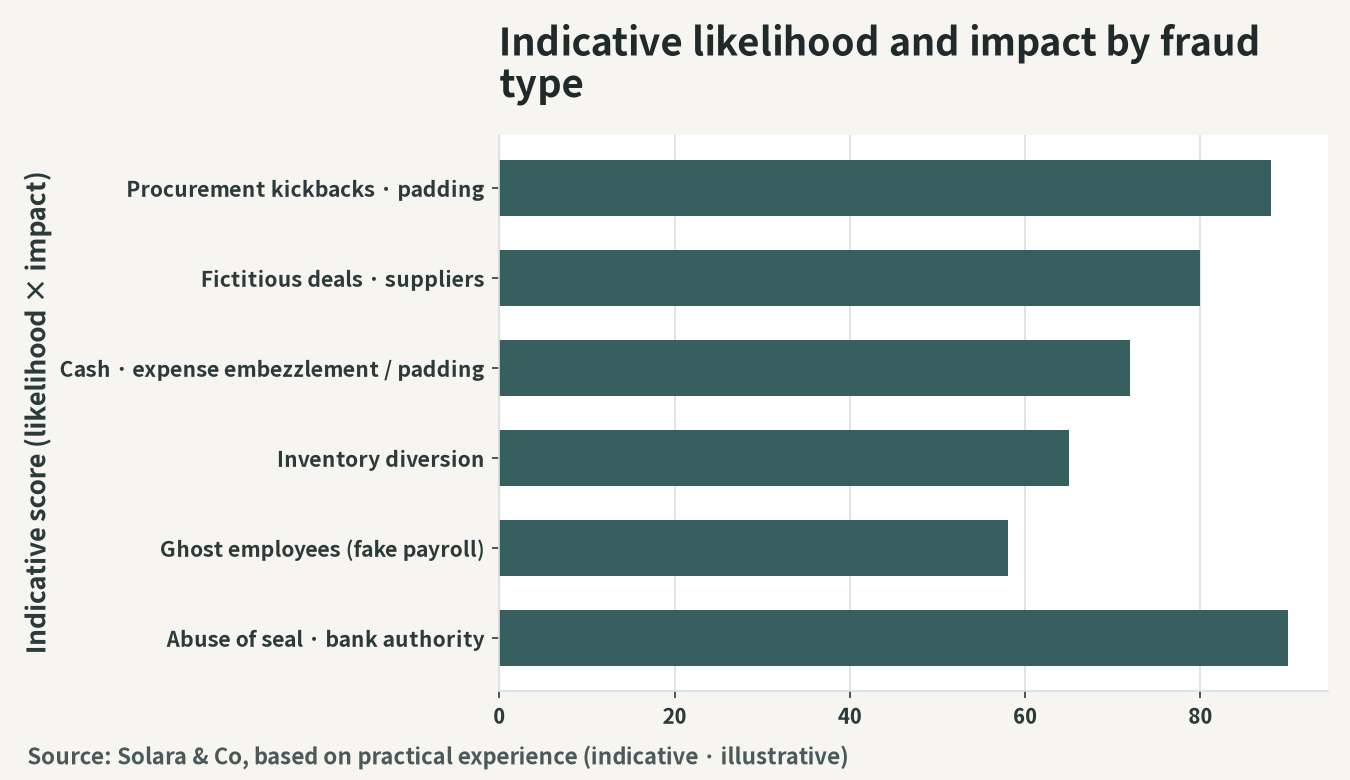
"Where fraud occurs" is determined to a certain degree, because it concentrates at the contact points where money, goods, and authority move. We organize the representative types together with the signs that tend to appear (red flags) and the basic control measures.
Around Purchasing and Payment
The area where the amounts most easily grow large is purchasing. Typical examples are kickbacks from suppliers, inflated orders, fictitious orders to phantom suppliers, and the private taking of rebates. Signs appear such as orders concentrating on a particular vendor, the absence of competitive quotes, and unit prices higher than the market.
Around Cash, Inventory, and Labor Costs
There are forms such as embezzlement of petty cash, inflated expense reimbursements, the diversion of inventory, and "ghost employees (fictitious labor costs)"—paying wages to employees who do not actually exist. They manifest in forms such as cash balances that do not match, inventory discrepancies becoming chronic, and retirees remaining on the payroll ledger.
Type of fraud | Main signs (red flags) | Basic control measure |
|---|---|---|
Purchasing kickbacks・inflated orders | Concentration on one vendor, no competitive quotes, high unit price | Mandatory competitive quotes, separate approval of vendor selection |
Fictitious transactions・phantom suppliers | New vendor of unclear substance, vague address・contact | Vetting at counterparty registration, separate acceptance and payment |
Embezzlement/inflation of petty cash・expenses | Cash balance mismatch, reimbursement without vouchers | Set cash ceilings, attach vouchers and superior approval |
Diversion of inventory | Chronic inventory discrepancies, nighttime removal | Periodic physical inventory, reconcile in/out records |
Ghost employees (fictitious labor costs) | Retirees still on payroll, duplicate transfer accounts | Match HR ledger against payroll, verify transfer destinations |
Misuse of seal・bank authority | No seal-impression record, remittance on single approval | Separate seal-application, dual sign at the bank |
Pillar of Internal Control ① Segregation of Duties and Approval・Authorization Powers
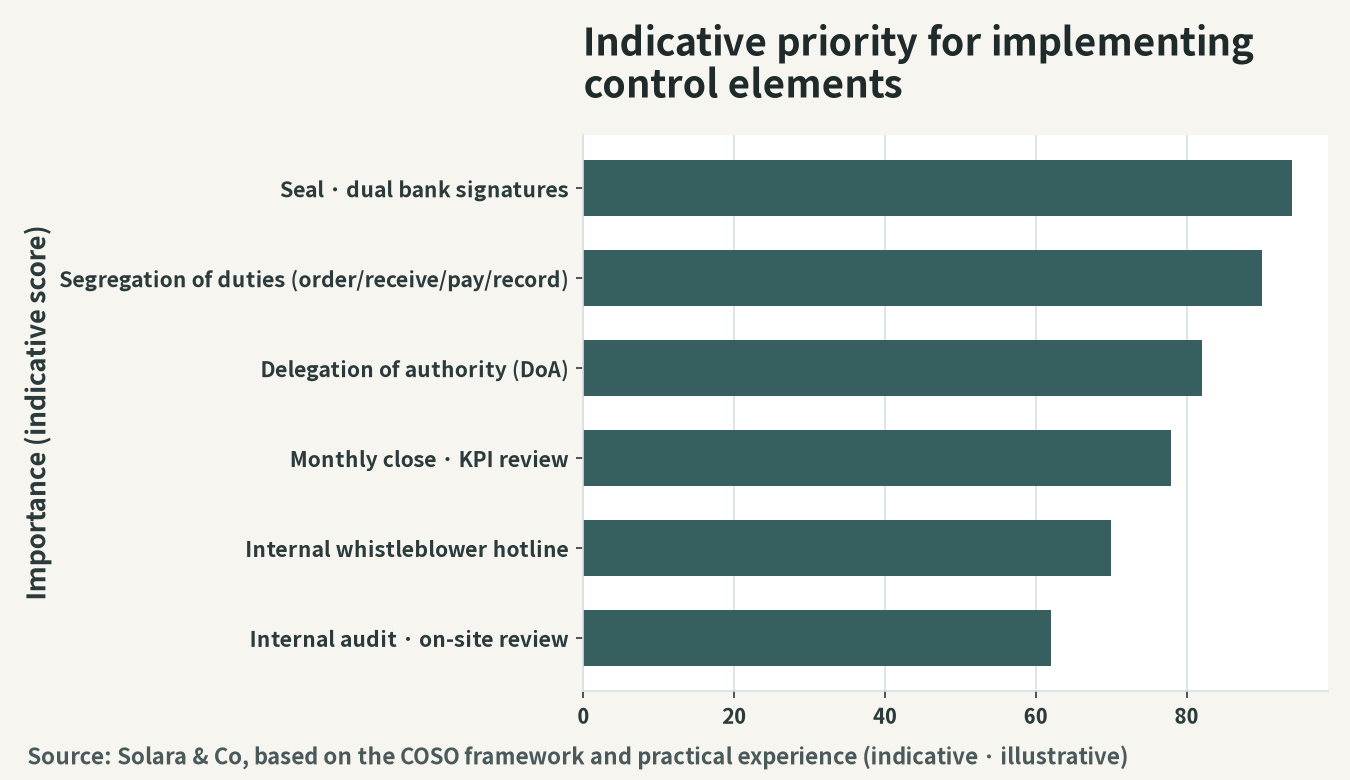
The starting point of anti-fraud measures is not to concentrate authority in one person. In the COSO internal-control framework, too, the core of control activities lies in segregation of duties.
Segregation of Duties (SoD) — Separating Ordering・Acceptance・Payment・Bookkeeping
For the same transaction, separate "the person who orders," "the person who receives and inspects the goods," "the person who pays," and "the person who records in the books." If one person doubles up on several, they can approve a fictitious order or embezzlement themselves and conceal it in the books. Even when a small base has limited personnel, the principle is to separate, at minimum, "execution" from "approval・bookkeeping."
Delegation of Authority Regulation (DoA) — Approval by Amount Threshold
Put in place a delegation of authority regulation that stipulates who can approve up to how much. Raise the approver level by each amount threshold, mandate competitive quotes above a certain amount, and make head-office approval mandatory for high-value matters. The condition for effectiveness is that the regulation is documented and built into the ERP approval workflow.
Pillar of Internal Control ② Controls over Seals・Bank Accounts
In Vietnam, control over seals and bank authority is the lifeline of anti-fraud measures. If this collapses, no matter how many other controls you build, funds will be siphoned off.
Custody of the Seal (Company Chop) and Separation of Seal-Use Approval
For the seal, separate "the person who keeps it" from "the person who approves its use," and on each use operate a seal ledger that records the target document, the applicant, and the reason. A state in which accounting or the legal representative monopolizes the seal and the same person both applies and approves leads directly to the risk of contracts being concluded without authorization.
Bank Accounts Use Multi-Approval (Dual Sign)
Make it so that remittances cannot be executed by a single person, and build dual sign (multi-approval)—requiring two or more approvers—into the bank-side settings. For internet-banking authority too, separate the person who initiates from the person who approves, and enforce ceilings・approval stages by system. Locking down the exit of funds with two or more people is the most cost-effective control. Procedures for overseas remittance and dividends are designed together with Banking Practice and Fund Remittance in Vietnam.
Pillar of Internal Control ③ Monthly Review・Internal Audit・Whistleblowing
Controls are not finished once built; a mechanism to keep them running is required. The dividing line is whether head office can "make the subsidiary visible" through numbers.
Discipline of the Monthly Close and Monitoring of Outliers
Establish the discipline of a monthly close that closes on a fixed date each month, so that head office monitors KPIs such as budget-actual variance, gross margin, inventory turnover, and cash balance at fixed points. Once you embed the practice of digging into accounts that show outliers month-on-month or year-on-year, fraud surfaces early. For the building of the accounting foundation, please also refer to Vietnamese Accounting Standards (VAS) and IFRS Response.
Internal Audit・On-Site Inspection and Whistleblowing (Hotline)
Through periodic internal audits・on-site inspections by head office or a third party, verify vouchers・inventory・the substance of counterparties on a sampling basis. Together with this, put in place a whistleblowing (hotline) system through which employees can report anonymously, and make clear the prohibition on retaliation. Because much fraud is discovered through reports from inside, the reporting channel is the cheapest and most effective means of detection.
Issues Peculiar to Vietnam
Merely applying general internal-control theory as is is insufficient; one must weave in the circumstances specific to Vietnam.
The Weight of the Seal System and the Concentration of Authority in the Legal Representative
In Vietnam, the seal and the signature of the legal representative carry decisive meaning in contracts and bank procedures. When authority concentrates in the legal representative and that person also holds the seal and bank authority, it becomes an "emperor with no clothes" state that head office's governance cannot reach. Loosening the concentration—by appointing multiple legal representatives or by codifying authority in regulations—is effective. The institutional design of the subsidiary is dealt with in detail in Governance Structure of a Vietnamese Subsidiary.
Cash Business Customs and Over-Reliance on Personal Relationships (Connections)
In fields where the practice of cash settlement and rebates remains, managing cash ceilings and shifting to electronic settlement is effective. Also, when hiring and purchasing lean on the connections・personal relationships of local staff, collusion with vendors becomes a breeding ground. A state of relying single-handedly on a particular local staff member for purchasing・accounting・banking—personalization itself is the risk, and it is mitigated by separation of duties and periodic rotation. For purchasing controls, Procurement・Supplier Management in Vietnam is also a useful reference.
Transplanting Controls After M&A (PMI) and the Connection with DD
When you acquire and own a Vietnamese company through M&A, weakness in controls becomes your own risk the moment you buy. Rather, it is important to see through the presence or absence of fraud・off-book liabilities from the pre-acquisition stage.
Detecting Fraud・Off-Book Liabilities in Pre-Acquisition Due Diligence
Through financial・legal due diligence, surface related-party transactions, expenses with thin grounds, uncollectible receivables, off-book guarantees・liabilities, and tax risks. The very absence of controls becomes material for post-acquisition price negotiation・an object of representations and warranties. For details, please refer to Key Points of Legal Due Diligence in Vietnam.
Transplanting Controls in PMI
After closing, taking 100 days as a guide, transplant the delegation of authority regulation・segregation of duties・controls over the seal and bank authority・the monthly close and KPI reporting. The top priority is to replace the seal and bank authority that the former management・legal representative held, placing them under the acquirer's control.
The Response When Fraud Comes to Light
Fraud that slips through controls cannot be reduced to zero. You need to decide in advance how to act when it is discovered. Preparedness for business continuity also links with Crisis Management and BCP in Vietnam.
Investigation・Preservation of Evidence・Remediation
First, secure access to the seal・system authorities・related accounts, and ensure you have vouchers and data. Make the finding of fact based on evidence, not emotion, and after identifying the amount of damage・the method・those involved, rebuild the controls that had collapsed (segregation of duties・approval・monitoring) to prevent recurrence.
Procedures Under Labor Law and Discipline
Under Vietnam's Labor Law, disciplinary dismissal requires grounds in the work rules, the prescribed disciplinary procedure, and the securing of evidence and an opportunity to explain. Getting the procedure wrong carries a reversal risk in which the very person who committed the fraud contests it as wrongful dismissal, so putting work rules in place and adhering to due process is indispensable.
Solara & Co's End-to-End Support — Accompanying You from Control Design to the Response When Fraud Comes to Light
Fraud at a Vietnamese subsidiary arises from the structure of concentrated authority and head office's lack of visibility. Turned around, if you reliably run the basics—segregation of duties・the delegation of authority regulation・controls over the seal and bank authority・monthly review and internal audit—in a way that fits the local reality, the majority can be deterred.
Solara & Co, with bases and human networks on both the Japanese and Vietnamese sides, provides end-to-end support: from a current-state diagnosis of internal control and the design of the delegation of authority regulation・segregation of duties, to the dual-signing of the seal・bank authority, the building of a mechanism for monthly KPI reporting and head-office review, internal audit・on-site inspection, and the introduction of a whistleblowing system. From pre-M&A due diligence to post-acquisition PMI control transplantation, and to investigation・remediation・Labor Law response when fraud comes to light, we accompany you all the way to making the subsidiary's governance function on the ground.