
Introduction: Why Vietnam's logistics and warehouse market has become a strategic theme
Vietnam's logistics and warehouse market has entered a phase of structural growth, driven by the concentration of manufacturing, the expansion of e-commerce (EC), and the relocation of production under the China+1 trend. As global supply chains intensify their efforts to disperse the risk of "over-concentration in China," Vietnam is raising its profile as a destination for production and exports. Behind that shift, competitiveness in logistics and warehousing — the question of "where to store goods and how to move them" — has become a critical theme shaping companies' market-entry strategies. This article offers a practical overview, from the perspective of Japanese companies, covering everything from market drivers, infrastructure, warehouse types, the cold chain, and the use of 3PLs to base-location strategy and regulation.
Logistics tends to be regarded as the "behind-the-scenes" work of manufacturing or retail, but in Vietnam it is, rather, a front line that determines the success or failure of a business. This is a market where logistics costs as a share of GDP have been pointed out to sit at a higher level than in developed countries, so how this layer is designed bears directly on profit and lead time. The choice of warehouse location and type, securing the cold chain, and partner selection are decisions that "take effect" after entering the market.
Market drivers: manufacturing concentration, EC expansion, China+1
The factors driving Vietnam's logistics market can be broadly organized into three. The first is the concentration of manufacturing. Factories for electronics, textiles and garments, furniture, and machinery parts cluster in industrial parks in the north and south, generating demand in both procurement logistics for raw materials and export logistics for finished goods. As factories increase, warehousing, distribution, and customs functions become necessary around them, and logistics demand grows in step with the expansion of manufacturing.
The second is the expansion of EC. Against a backdrop of smartphone penetration and a young population, online purchasing in Vietnam is expanding rapidly, pushing up demand for last-mile delivery and fulfillment warehouses. Movements in the EC market are linked to the structural changes in the Vietnam EC market, and the need for same-day and next-day delivery in urban areas is gradually reshaping warehouse-location strategy. The third is China+1: against a backdrop of geopolitical risk and rising costs, the shift of production functions to Vietnam continues, lifting demand for large warehouses, bonded warehouses, and 3PLs. Reading this alongside the perspective in China+1 in the supply chain deepens one's understanding of the broader picture of supply-chain realignment.
These three are not independent but mutually reinforcing. When manufacturing concentrates, imports and exports rise; when EC grows, the domestic distribution network thickens; and as China+1 advances, both accelerate further — this virtuous cycle has elevated the logistics and warehouse market into a medium-to-long-term growth theme.
The logistics-cost challenge: a high share of GDP and structural bottlenecks
In discussing Vietnam's logistics, one cannot avoid the high share of logistics costs in GDP. Generally, Vietnam's logistics costs have been pointed out to sit at a level above those of developed countries when measured as a share of GDP. Behind this lie structural bottlenecks such as a transport structure overly reliant on roads, weak connectivity linking ports to the interior, cumbersome customs and documentation procedures, and a shortage of warehousing and cold chain.
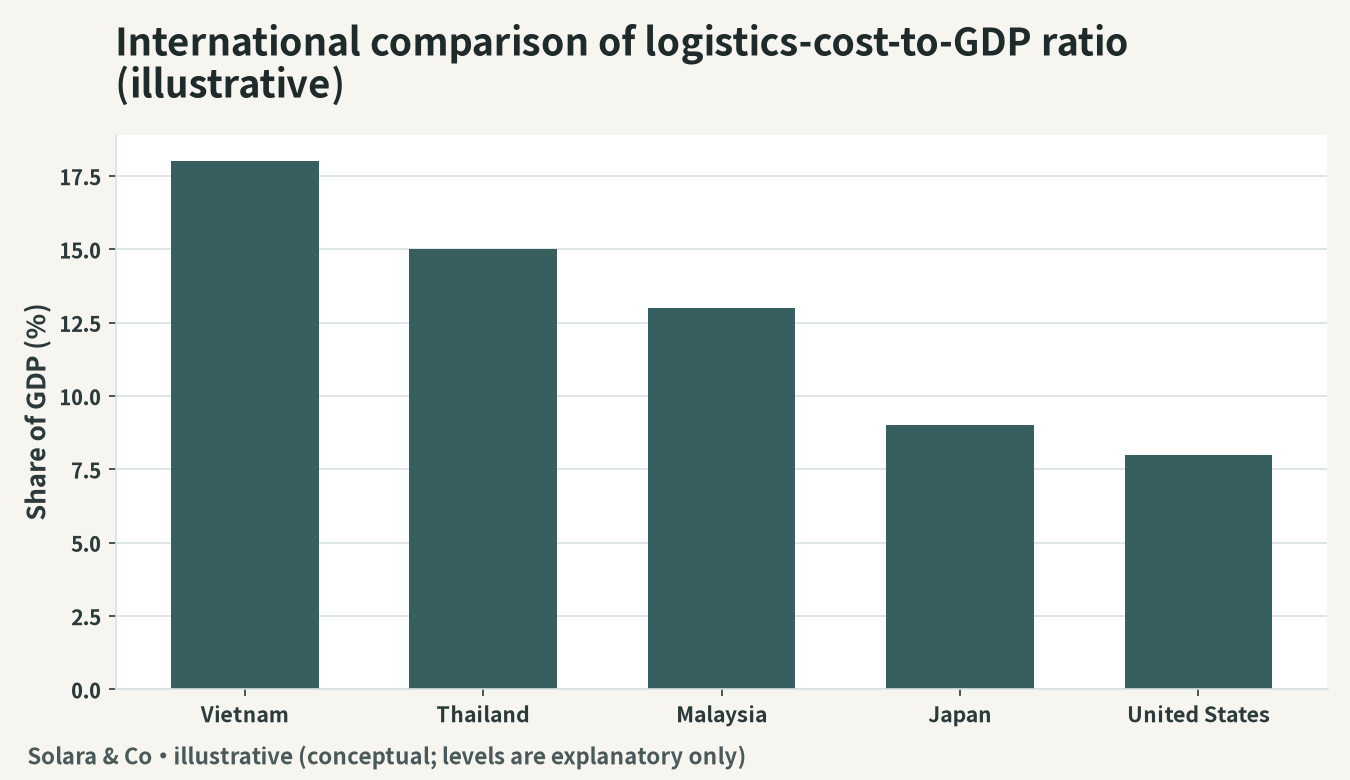
The conceptual diagram above is an illustration comparing logistics costs as a share of GDP internationally. While Vietnam shows an improving trend, it is said to remain at a relatively high level — which, conversely, means there is ample room such that "optimizing logistics can become a competitive advantage." This ratio is expected to decline gradually as infrastructure investment progresses, but for the time being, corporate efforts to contain costs through base placement, mode selection, and inventory design will continue to shape profit. It is important to grasp the overall picture of infrastructure development together with the trends in infrastructure investment.
Infrastructure: ports, expressways, airports
The foundation of logistics strategy is an understanding of hard infrastructure. In ports, Hai Phong in the north and the Cai Mep - Thi Vai deep-water port in the south are the principal import/export gateways, where the capacity to receive large vessels and the expansion of terminals shape logistics efficiency. How factories and warehouses are connected to ports becomes the starting point in designing lead time and cost.
For expressways, the trunk line running north-south is advancing toward completion, increasingly functioning as an artery linking the major industrial zones to ports and cities. At the same time, dependence on road transport remains high, and there are still sections where congestion and gridlock become bottlenecks. Airports are important for high-value-added, small, and time-sensitive cargo, with major airports in the north and south serving as hubs for air freight. These infrastructures are improving year by year, but because the state of development varies by region, base selection must be carried out on the premise of the infrastructure's "current position."
Warehouse types and the cold chain market
Even when we say "warehouse," the specifications required differ greatly depending on the use. The main types are as follows.
- General warehouse: centered on ambient-temperature storage, accommodating a wide range of cargo such as manufacturing components and everyday goods.
- Bonded warehouse: can store import/export cargo with duties unpaid, used as a base with processing and re-export in view.
- Hazardous-goods warehouse: for cargo requiring special storage standards such as chemicals, with strict requirements for permits and safety management.
- Cold chain (refrigerated/frozen) warehouse: indispensable for fresh food, pharmaceuticals, refrigerated EC goods, and the like, requiring management by temperature band.
Especially noteworthy is the cold chain market. Against a backdrop of the sophistication of fresh-food distribution, the expansion of refrigerated and frozen handling in EC, and the need for pharmaceutical quality management, demand is growing structurally. On the other hand, the capacity of refrigerated and frozen warehouses and of temperature-controlled delivery has not kept pace with demand — a textbook field where shortage creates opportunity.
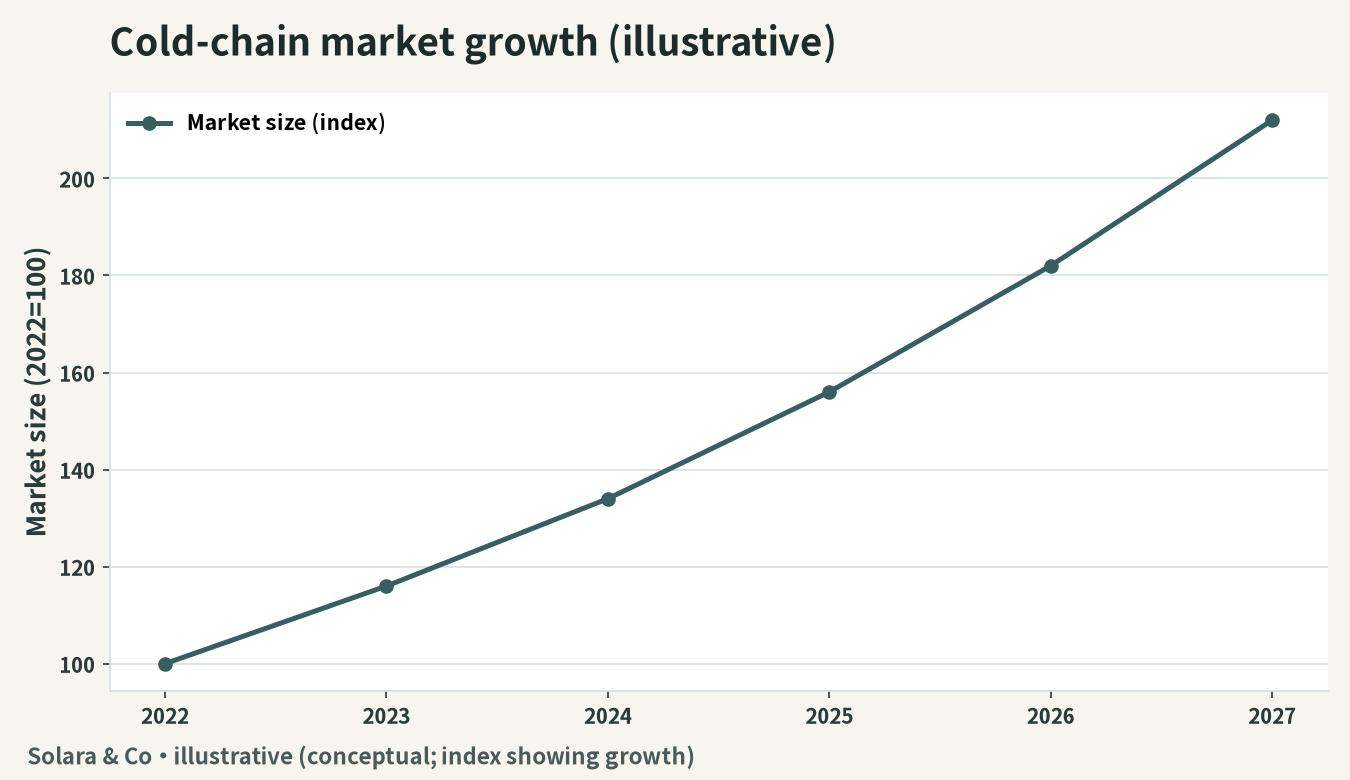
The conceptual diagram above depicts an image of the cold chain market expanding over the medium term. Precisely because it is a field where supply is short, there is ample room to differentiate through the quality of temperature management, making it a good opportunity for Japanese companies involved in food, pharmaceuticals, and EC to enter or form alliances. Regarding the procurement base for fresh and food products, this connects with agricultural and food exports, while the demand side of dining and prepared-food is tied to the points in F&B market entry.
Leveraging 3PLs and forwarders, and base-location strategy
Holding all logistics functions in-house is a heavy choice in terms of both initial investment and operational burden. The realistic option, then, is to leverage 3PLs (third-party logistics) and forwarders. A 3PL takes on warehouse storage, inventory management, distribution, and distribution processing as a package, while a forwarder handles the arrangement of international transport and customs clearance. By using these selectively, a company can contain fixed costs while taking in specialized know-how. In selection, it is essential to carefully assess the coverage area, temperature-band capability, system integration, customs track record, and the credit and compliance framework.
Base-location strategy must take into account Vietnam's distinctive geography. Vietnam is long and narrow from north to south, with two poles of economic activity: the north (the Hanoi - Hai Phong area) and the south (the Ho Chi Minh City area). The north's strengths are its proximity to South China and its electronics concentration; the south's strengths are the depth of its consumer market and its existing logistics concentration. Covering the whole country from a single base is often unrealistic, so the core of the design is how to place the distribution network and inventory, with the two bases of north and south as the axis. The placement of production sites is also closely related to the trends in manufacturing relocation, calling for a perspective that optimizes factory, warehouse, and port as a whole.
Evaluation axis | North (Hanoi - Hai Phong area) | South (Ho Chi Minh City area) |
|---|---|---|
Strengths | Proximity to South China, electronic-parts concentration | Deep consumer market, logistics concentration |
Principal port | Hai Phong | Cai Mep - Thi Vai |
Suited functions | Export manufacturing, procurement logistics | Domestic distribution, consumer-goods logistics |
Points to note | Road congestion, seasonal factors | Rising rents, securing land |
Regulation, foreign investment, and common pitfalls
Foreign entry into the logistics and warehouse business requires checking the regulations for each line of business. For each function such as warehousing, transport, and forwarding, foreign equity ratios and permit requirements may differ, and there are areas where a joint venture or alliance should be taken as the premise. Acquiring land-use rights, building warehouses within industrial parks, and obtaining permits for special warehouses such as bonded and hazardous-goods facilities all require lead time, so early verification is indispensable. The framework for investment and permits is a point that should be firmly grasped at the early stage of entry design.
Common pitfalls in practice include, first, errors in base selection — cases where inland land is chosen solely for its low price, only to struggle with port connectivity and distribution costs. Second is underestimating the cold chain — cases where storage and delivery capacity for temperature-controlled cargo cannot be secured, leading to quality incidents. Third is lopsided dependence on a partner — cases where over-reliance on a single 3PL leads to a loss of bargaining power and visibility. These can be avoided through a prior understanding of the market and infrastructure and through base and partner design across multiple scenarios.
Solara & Co's support for logistics and warehouse strategy
As an M&A and market-entry advisory connecting Japan and Vietnam, Solara & Co provides end-to-end support for the design of logistics and warehouse strategy. We accompany you at each practical stage, from evaluating candidate base locations through market and infrastructure research, to selecting warehouse types — general, bonded, hazardous-goods, and cold chain — comparing and selecting 3PLs and forwarders, designing a distribution network grounded in the two poles of north and south, and verifying foreign-investment regulations and permits.
In particular, in the selection of logistics partners or acquisition and alliance candidates, due diligence spanning finance, legal, and compliance, together with post-alliance operational design, greatly influences the outcome. We support the building of your logistics competitiveness in Vietnam from both sides: the "defensive design" of cost optimization and the "offensive differentiation" of the cold chain and base-location strategy. When you are considering building a logistics and warehouse strategy, please consult Solara & Co.