
"Can Work" and "Can Reside" Are Separate Procedures — Grasp It from the Whole Picture
When a Japanese company sends an expatriate or engineer to Vietnam, to have them work lawfully on-site requires obtaining two different permits. One is the work permit (Giấy phép lao động / Work Permit, hereafter WP), which grants the "qualification to work"; the other is the visa or Temporary Residence Card (thẻ tạm trú / Temporary Residence Card, hereafter TRC), which grants the "qualification to reside." With a WP but no residence qualification, one cannot stay; with a visa but no WP, one cannot work. The two are separate procedures, and the order of obtaining them also matters.
The legal basis is Decree 152/2020, which governs the employment of foreign workers, and Decree 70/2023, which partially simplifies its procedures. This article divides the whole flow — from prior approval of need, to document preparation, WP application and issuance, and obtaining the visa and TRC — into five steps, and organizes it from the standpoint of expatriate practice: standard timelines, required documents, renewal, exemptions, and penalties. For issues at the establishment stage, please also see the practice of establishing a subsidiary in Vietnam; for labor matters in general after hiring, please also see the practice of Vietnamese labor law.
Step 1: Prior Explanation and Approval of the Need for Foreign Labor
As a stage before the WP application, there is first a procedure to explain to the authorities "why it is necessary to employ a foreigner" and obtain approval. Skipping this means the WP application itself will not be accepted.
Reporting the Need at Least 30 Days Before Hiring
The employer must, in principle, report the need to use foreign labor for that position to the provincial People's Committee or the delegated Department of Labor, Invalids and Social Affairs (DOLISA) at least 30 days before the intended date of hiring the foreigner, and obtain approval (authorization of the receiving need). The company is required to show concretely, in line with the job content, the reason it cannot be filled by a Vietnamese.
Determining the Position Category
The positions a foreigner can take are organized into the categories of manager, executive, expert, and technical worker. Because the requirements for the proof documents later change depending on which category one applies under, it is important to correctly define the position at the outset. For example, even for the same "engineer," the proof of degree and years of experience required differs depending on whether one applies as an expert or as a technical worker. Applying under a position that diverges from reality leads to rejection in examination and a redo, so choosing the category in alignment with the job description (JD) is the key point in practice.
Step 2: Document Preparation — Legalization and Translation Are the Biggest Bottleneck
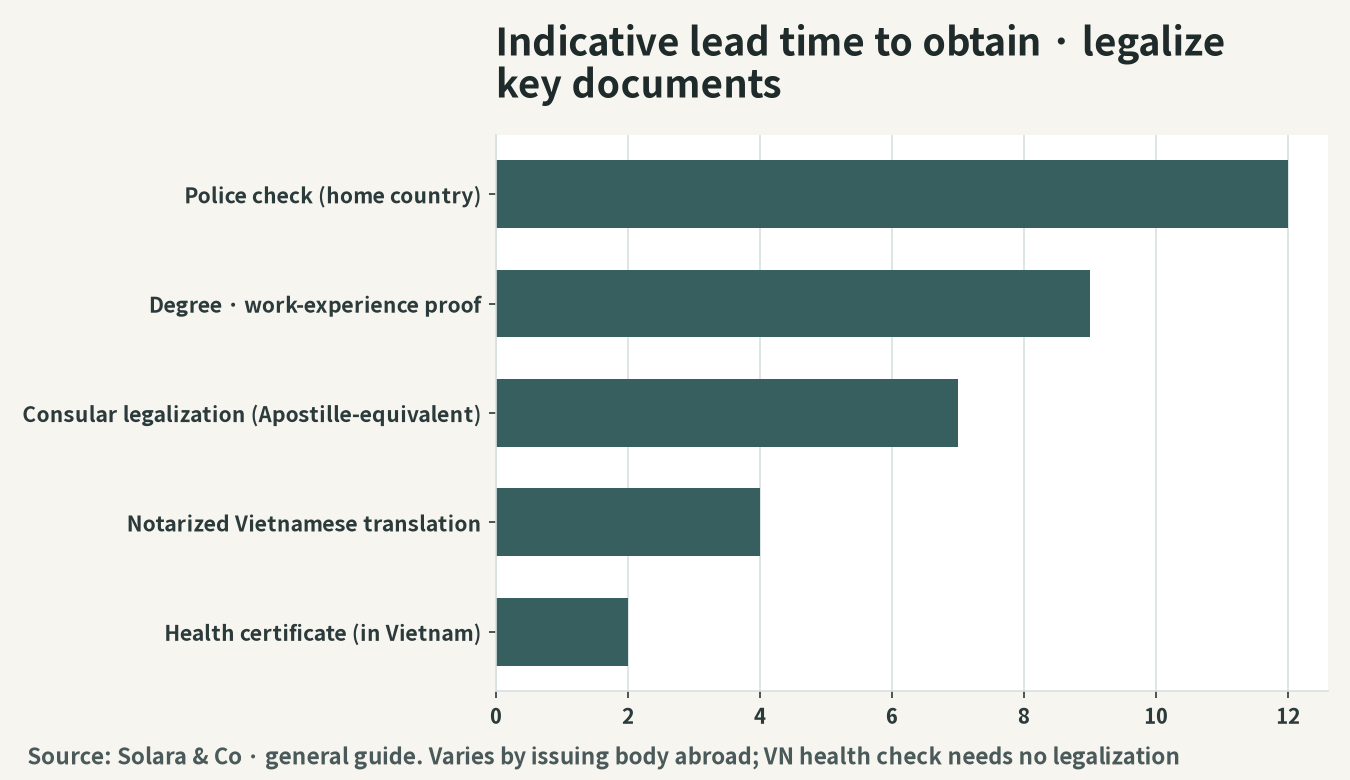
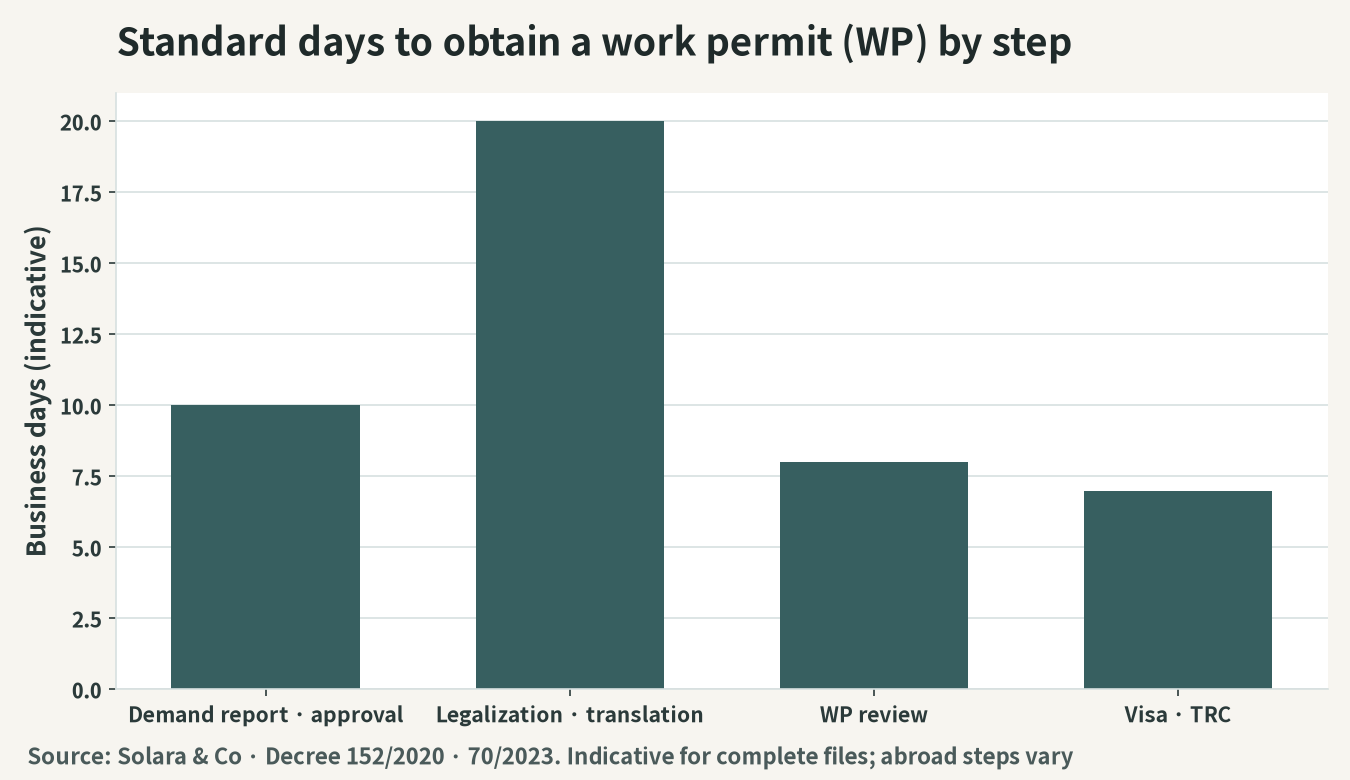
Among the documents needed for the WP application, those issued abroad take time for legalization and translation. In practice, this is the hardest stage to predict in the whole process.
Proof Requirements by Category
The main required documents are a criminal record certificate (certificate of no criminal record), a health certificate, and proof backing the degree and work experience. The content of proof differs by position category: for an expert, a university degree or higher plus, in principle, three or more years of practical experience in the relevant field; for a technical worker, a certain training history plus three or more years of experience are the benchmarks. Work experience is backed by certificates from former employers and the like.
Consular Legalization and Notarized Vietnamese Translation
Documents issued abroad — the criminal record certificate, degree, and work-experience proof — must be notarized in the home country, undergo consular legalization (certification equivalent to an apostille), and further have a notarized Vietnamese translation attached. The health certificate does not require legalization if the examination is taken at a designated medical institution within Vietnam. Because the home-country issuance and legalization schedule overlaps with the translation process, this is the stage to begin with top priority, working backward from the start date.
Steps 3 and 4: Applying for and Issuing the Work Permit
Once the need approval and documents are in place, one proceeds to the WP application itself.
Application to DOLISA and Standard Examination Days
The WP is applied for at DOLISA or a delegated authority. If the documents are in order, a standard examination time of roughly 5 to 10 working days is one benchmark. A defect in the stated content or improper formatting of legalized documents leads to a return, and each time the count restarts, so checking consistency before submission is essential.
The Effect of the Issued WP — Up to Two Years
The issued WP has a validity period of up to two years. The WP specifies the position, place of work, and employer for which one may work, and work beyond that scope (working for another legal entity, changing the place of work, etc.) in principle requires a new procedure. Where a transfer within the group is anticipated, the design must be premised on this specificity.
Step 5: Obtaining the Visa and Temporary Residence Card (TRC)
The WP is merely the "qualification to work"; the residence qualification is obtained separately. Using the WP as the basis, one proceeds to a work visa or TRC.
Distinguishing the LD Visa and the TRC
A foreigner who has obtained a WP can obtain an LD (labor) visa for the purpose of working, or the more stable TRC. The TRC is issued for up to two years in line with the WP's validity period, and during its validity one can enter and exit without a visa, so for long-term expatriates the TRC is practically chosen. Note that for short-term commercial purposes not accompanied by work, a DN (commercial) visa is used, but this is a residence qualification of a different nature from those premised on a WP.
The Difference Between the Visa, WP, and TRC
Organizing the positioning, validity period, and basis of each gives the following.
Category | Main target/purpose | Benchmark validity period | Basis/premise |
|---|---|---|---|
Work permit (WP) | A foreigner's qualification to work | Up to 2 years | Decrees 152/2020, 70/2023 |
Temporary Residence Card (TRC) | Long-term residence of a WP holder | Per the WP, up to 2 years | Premised on a WP or exemption confirmation |
LD (labor) visa | Residence for the purpose of working | Up to 2 years | Premised on a WP or exemption confirmation |
DN (commercial) visa | Commercial/business trips (no work) | Up to 12 months | An inviting company, no accompanying work |
Renewal of the Work Permit and Deadline Management
The WP cannot be renewed indefinitely. Mismanaging deadlines causes the work qualification itself to lapse.
Extension in Principle Only Once
Under Decree 70/2023, the extension (renewal) of a WP is, in principle, limited to once, and the validity period after extension is also up to two years. If one continues to have a person work after using up the extension, a new WP must be obtained rather than a renewal. The extension must be applied for within a prescribed period before the validity expires, and retroactive action after lapse is not possible.
Centralized Deadline Management
Because the WP, TRC, and visa have interlinked validity periods, managing each expatriate's expiry date in a single list and beginning preparation for renewal or re-acquisition by working backward is indispensable. Because it is also linked to payroll and social-insurance procedures, building a management system together with the practice of Vietnam's payroll and social insurance is the realistic approach.
Work Permit Exemption (WP Exemption) and Exemption Confirmation
A foreigner who meets certain requirements is exempt from the WP, but note that "exemption ≠ no procedure needed."
Main Grounds for Exemption
Representative grounds for exemption include short-term work of less than 30 days and no more than three times a year; experts and managers of an intra-corporate transfer in the 11 sectors committed under the WTO; and capital contributors of a limited liability company or legal representatives of a joint-stock company who contribute a certain amount or more. Whether one qualifies depends on the form in which the expatriate involved in company management is dispatched.
Even Exemption Requires an "Exemption Confirmation"
Even when one qualifies for exemption, in many cases an "exemption confirmation letter for the work permit" must be obtained in advance from DOLISA or an equivalent authority. Having a person work without obtaining the confirmation letter risks being treated, formally, as unauthorized work. The exemption confirmation letter also serves as the basis for obtaining the residence qualification (visa, TRC), so even an exemption should be regarded as not allowing the procedure to be omitted. In addition, even if one initially qualifies for exemption, a change in the days of stay, ownership ratio, or duties may take one out of the exemption requirements midway. Even when dispatching on the premise of exemption, one must continuously monitor the state of meeting the requirements and be prepared to switch promptly to obtaining a WP the moment one falls outside.
Penalties and Compliance Risk
Working without a WP, visa, or TRC carries risk to both the individual and the company.
Removal of the Individual, Fines for the Company
A foreigner who works without authorization can be subject to deportation or restrictions on re-entry. The employer side is also subject to an administrative penalty (fine) for having an unauthorized foreigner work, and in malicious or repeated cases it also affects business licenses and external credibility. In particular, "premature work" — having an expatriate, whose start date comes first, engage in work without waiting for the WP or TRC to be issued — is a typical risk prone to occur on-site. Even if formally one is merely residing, if labor is in fact provided, it may be assessed as unauthorized work. The more expatriate turnover and project-based short-term work increase, the higher the risk of expiry and procedural omissions, so it is important to manage the work qualification in an integrated way together with the issues of Vietnam's HR recruitment and retention and the expatriate's personal income tax (PIT).
Solara & Co's Integrated Support — Arranging the Qualification by Working Backward from the Start Date
Vietnam's work qualification is made up of a continuous chain of stages — need approval → document legalization and translation → WP application and issuance → visa and TRC acquisition — and further has many points prone to stumbling, such as extension being in principle only once and exemption still requiring a confirmation procedure. What causes delays in practice is not the examination itself but the consular legalization and notarized translation of home-country documents, and assembling the experience proof corresponding to the position category.
Solara & Co holds bases and human networks in both Japan and Vietnam, providing integrated support from designing the position category and the need report, arranging the legalization and translation of home-country documents, the WP application to DOLISA, and the visa and TRC acquisition, to deadline management for renewal and re-acquisition. Working backward from the expatriate's office-location strategy and start schedule, we accompany you in a launch that seamlessly connects "can work" and "can reside."