
Acquiring Real Estate or a Factory Begins with "Confirming the Rights"
When acquiring factory land or business-use real estate in Vietnam, the first fundamental question a Japanese company faces is "what am I actually buying?" Under Vietnam's Constitution, all land is owned by the entire people (managed by the state), and what an enterprise or individual can acquire is not the land itself but the land use rights (LUR). If you try to buy a factory or land with the Japanese sense of "ownership," you misread the premises—the nature of the rights, the remaining term, use restrictions, and transferability—and run into serious problems after acquisition.
Due diligence (DD) for acquiring real estate or a factory is, before it is an investigation of finances or business, the work of confirming from primary sources whether the rights you intend to acquire are legally valid, transferable, and suited to your intended use. In particular, the consistency between what is recorded on the land use right certificate (the so-called "red book") and the actual situation, the use classification (whether it is industrial land or not), the remaining term of use, and the presence of mortgages or seizures all govern the acquisition scheme itself.
This article organizes, from a practical standpoint, the DD for acquiring a factory or business-use real estate in Vietnam, with the confirmation of land use rights as the axis, extending to buildings, the environment, permits, and tax. Including the point that the focus of confirmation shifts between a share acquisition (buying the whole company) and an asset acquisition (buying just the land and factory), it explains where deals are prone to fall apart.
Grasping the Basic Structure of Land Use Rights (LUR)
The Premise of "Use Rights," Not "Ownership"
Under Vietnam's Land Law (including the new Land Law that took effect in 2024), the ways a foreign-invested enterprise (FIE) can use land are mainly organized into: (1) leasing land from the state (annual payment / lump-sum payment), (2) subleasing from the developer of an industrial park or economic zone, and (3) receiving an assignment of land use rights where qualified. In the manufacturing-sector entry of Japanese companies, by far the most common case is using a leased plot within an industrial park, in which case what you acquire is "land use rights with a lease term."
The Remaining Term of Use and the Form of Rent Payment
Land use rights always have a term of use, and for industrial use the cap is usually 50 years (up to 70 years in some regions or under some conditions). What matters is the remaining term at the time of acquisition. If the project's investment horizon exceeds the remaining term, the plan to recover the capital investment collapses. In addition, whether the rent was paid as a "lump sum" or "annually" changes the extent to which those land use rights can be assigned or mortgaged. Generally, lump-sum-prepaid land use rights have a higher degree of freedom for assignment, capital contribution, and mortgage.
Confirming the Land Use Right Certificate (the Red Book)
The official document evidencing the existence and content of the land use rights is the certificate of land use rights and ownership of housing and other assets (commonly called the red book). In DD, against both the original and the public records, you cross-check: (1) whether the registered holder matches the seller, (2) whether the parcel number, area, and use classification match reality, (3) the recorded term of use and form of payment, and (4) the presence of any mortgage or dispute annotations. You must not rely solely on a copy or the seller's explanation. In Vietnam especially, it is not uncommon for the area and boundaries on the red book to deviate from the on-site survey and fence positions, for the land to have been subdivided into multiple red books, or for family-name and company-name holdings to be mixed; you need to combine an on-site survey with a registry inquiry to establish the actual state.
Changes Under the 2024 New Land Law
The new Land Law that took effect in August 2024 revised the annual revision of the land price table, the framework for use changes and expropriation compensation, and the provisions on foreign-invested enterprises' access to land. Because the basis for calculating rent and the additional burden upon a use change may differ from before, it is important to estimate investment recovery on the premise of the latest land prices and rules applicable at the time of acquisition. Applying the terms of past transaction cases as they are will lead you to misread the cost premises.
Confirmation Items Specific to Factories and Buildings
Construction Permits and Completion Inspection
For factories and warehouses built on the land, you confirm whether they were built in accordance with a construction permit and have passed a completion inspection (acceptance). Portions extended without a permit, or buildings lacking a notification of a use change, later become risks of a remediation order, demolition, or an obstacle to permit renewal. Confirming on-site the consistency between the drawings (the approved drawings) and the current state is indispensable.
Issues Specific to Acquisition Within an Industrial Park
When acquiring a factory within an industrial park, the land use rights are tied to a sublease contract with the developer. Scrutinize the sublease's remaining term, assignment clauses, management fees (infrastructure usage charges), and restoration obligations, and confirm whether the rights can be transferred without the developer's consent. Whether the park's infrastructure (power supply capacity, drainage and wastewater treatment, water supply) can withstand the production-increase plan is also decisive for manufacturing.
Environmental Compliance
In acquiring an existing factory, the status of having obtained an environmental impact assessment (EIA) or environmental permit, the legality of wastewater and waste treatment, and the history of soil and groundwater contamination are grave off-book risks. Inheriting the previous owner's contamination means bearing the risk of remediation costs or an operational suspension. For industries with a high pollution load, such as chemicals, plating, and dyeing, environmental DD by a specialist should be regarded as mandatory. Under the Law on Environmental Protection, the classification of the environmental license is set according to the target industry and scale, and if there is a history of operating without a permit or exceeding the permit conditions, the buyer ends up bearing the burden of remediation and additional investment.
Inspection Records for Fire Safety and Occupational Safety
In a factory acquisition, passing the fire-safety inspection (PCCC), the safety certification of equipment and electrical systems, and occupational-safety records are also subjects of confirmation. In Vietnam, a fire-safety inspection can be a prerequisite for the operating permit, so if you acquire a factory that was operating without one or with it expired, restarting operations requires remediation work and re-inspection, generating an unforeseen period of shutdown and cost.
Share Acquisition or Asset Acquisition — The Scheme Changes the Focus of DD
Between a share acquisition that buys "the whole company" and an asset acquisition that buys "just the land and building," the locus of risk and the focus of DD differ greatly.
Comparison axis | Share acquisition (whole company) | Asset acquisition (land and factory only) |
|---|---|---|
Object acquired | All shares and all assets/liabilities of the target | Specific land use rights, building, equipment |
Succession of off-book liabilities | In principle, all succeed (tax arrears, disputes, guarantees) | Easier to select and cut off |
Transfer of land use rights | The registration stays with the company (IRC/ERC change) | Assignment procedure and condition satisfaction required |
Permits | Easier to continue | Often need to be re-obtained |
Weight of procedures | M&A approval, transfer of registration | Assignment approval, registration, various transfers |
Focus of DD | Finance, tax, labor, disputes + land | Land rights, building, environment, transferability |
In a Share Acquisition, Look at "All the Risks the Company Carries"
A share acquisition has the advantage that permits and contractual relationships are easier to continue, but in principle you succeed to all of the target's off-book liabilities (tax arrears, unpaid social insurance, joint guarantees, disputes). In addition to whether the land use rights are validly held in the company's name, cross-cutting DD across finance, law, and tax is indispensable. The key points of financial and legal DD are detailed in Financial Due Diligence in Vietnam and Legal Due Diligence in Vietnam.
In an Asset Acquisition, Look at "Whether the Rights Can Be Transferred"
An asset acquisition makes it easier to cut off risk, but assigning the land use rights requires satisfying the eligibility requirements for assignment, such as the form of payment, use, and remaining term, accompanied by the approval of the developer or authorities and an update of the registration. Unless you confirm at the entrance "whether the seller holds rights it can sell" and "whether the buyer is eligible to acquire," you may find after signing that the transfer is impossible.
The Main Documents to Confirm in Real-Estate and Factory DD
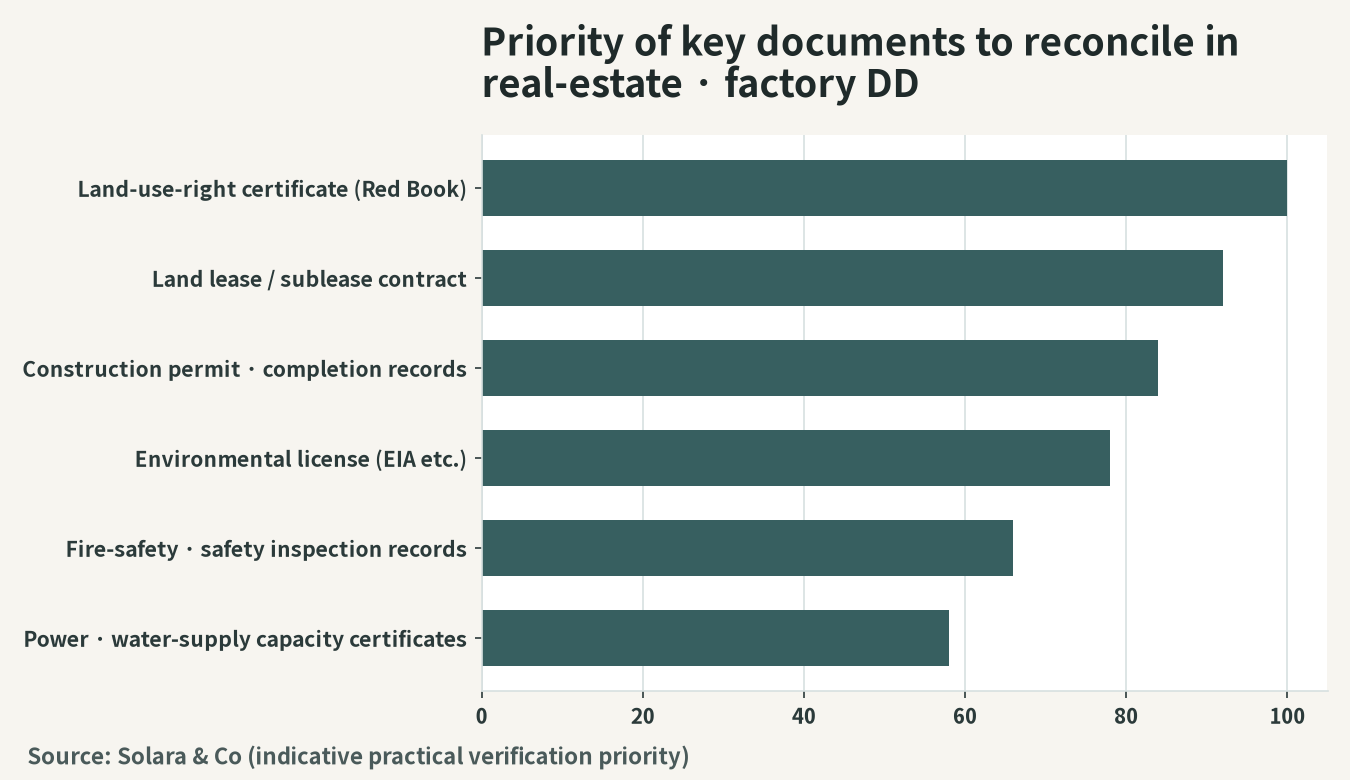
The rights relationships of land and buildings are corroborated by primary sources, not by the parties' explanations. In DD practice, you generally obtain and cross-check the following groups of documents.
Documents on the Rights Relationship
The land use right certificate (red book), the land lease contract or industrial-park sublease contract, evidence of rent payment, records of mortgage creation, and the land planning map and cadastral map. From these you fix the registered holder, area, use, term, and collateral.
Documents on the Building and Operations
The construction permit, the approved drawings, completion-inspection and acceptance records, the environmental permit (EIA, etc.), fire and safety inspection records, and the power and water supply/drainage contracts and capacity certificates. From these you confirm the building's legality and operational continuity.
The Transaction Price and the Impact on Tax
Defects in the Rights Translate into Price
Defects revealed by DD—a short remaining term, use nonconformity, an unregistered extension, environmental risk, the existence of a mortgage—are built into the contract as price-reduction factors, or as representations and warranties, indemnification clauses, and conditions precedent (CP). For risks that cannot be pinned down, the standard approach is to share the risk through escrow or indemnification rather than fixing the price.
Transfer Costs and Tax
The transfer of land use rights and real estate involves multiple taxes and fees, including the registration fee, transfer income tax, and value-added tax (VAT). Because the tax relationships change with the scheme (shares or assets), it is important to estimate the transfer costs in advance together with a tax adviser. The credit-side pitfalls latent in real estate and factories are also addressed in Credit Risk in Vietnamese Corporate Acquisitions.
Where Acquisition Deals Fall Apart
The causes that break or prolong real-estate and factory acquisitions concentrate on particular issues. When the cases in which Solara & Co has been involved are categorized, the main causes of failure show a clear distribution.
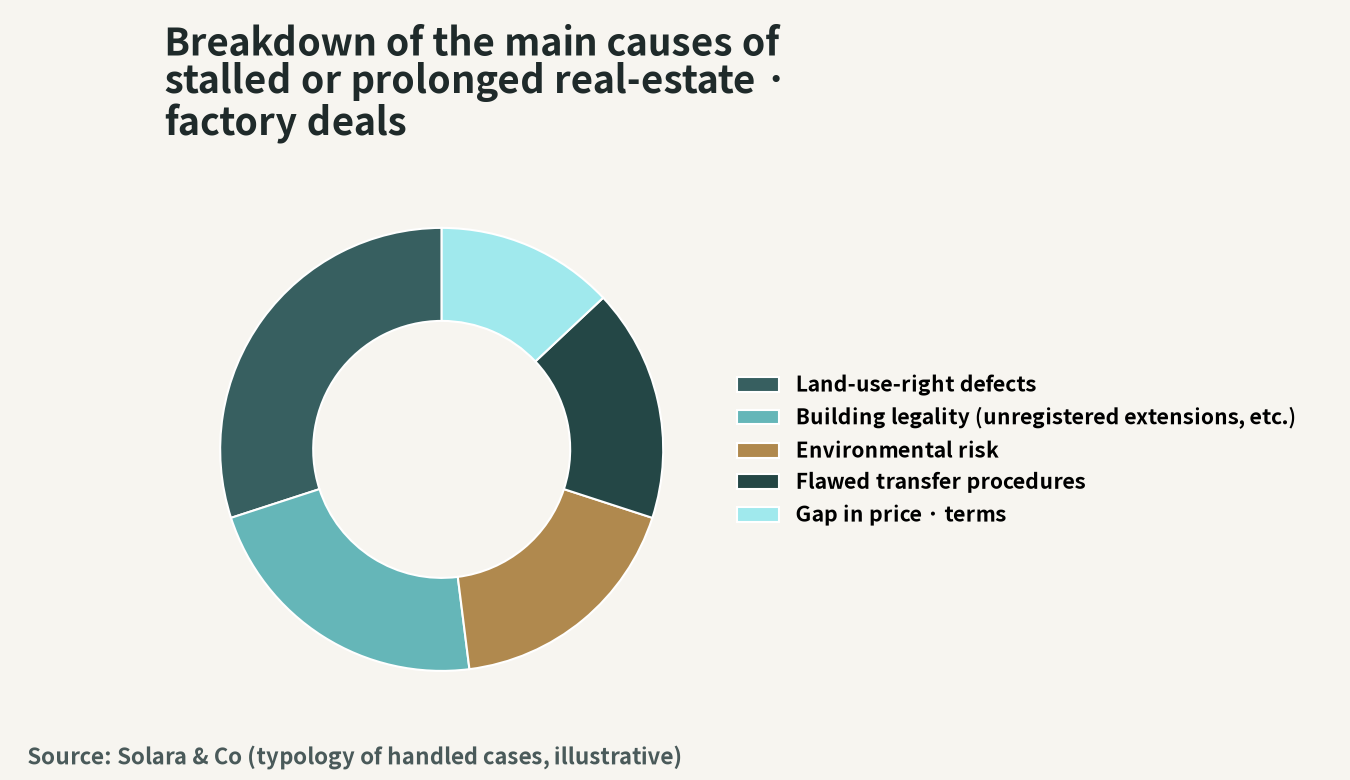
The biggest factor is defects in the land use rights (registration mismatch, insufficient remaining term, use nonconformity), followed by the legality of the building, such as unregistered extensions, environmental risk, and deficiencies in the transfer procedures. All of these can be avoided or mitigated if the primary sources are confirmed at an early stage of the acquisition. For the entire process including the choice of acquisition scheme, please refer to The Full Process of M&A in Vietnam.
Solara & Co's Support for Real-Estate and Factory DD
Acquiring a factory or business-use real estate in Vietnam begins with discerning from primary sources "what you are buying"—that is, the nature, term, and transferability of the land use rights you will acquire. Connecting in a single line the cross-checking of the red book's records against reality, the confirmation of industrial-park sublease conditions, the scrutiny of the building's legality and environmental risk, and the scheme design of share acquisition versus asset acquisition is the key to preventing post-acquisition trouble.
With bases on both the Japanese and Vietnamese sides, Solara & Co provides integrated support—from rights DD on the land, building, and environment, to financial, legal, and tax DD, price negotiation, contract design, and the transfer procedures. To prevent at the entrance situations such as "the land I thought I could buy turned out to be non-transferable" or "an environmental remediation order arrived after acquisition," we begin by accompanying you in the first step of confirming together the rights relationship of the acquisition target.