
Market Overview: Why Vietnam's Healthcare Market, and Why Now
Vietnam's healthcare market has drawn attention throughout the 2020s as one of the most growth-promising fields in all of Asia. A population of roughly 100 million, combined with rising GDP per capita, an expanding middle class centered on urban areas, and a heightened health consciousness among the people, has caused spending on medical care and healthcare to trend upward at a pace that generally outstrips economic growth. The key to reading the market's structural shift lies in the fact that a public mindset long premised on "keeping medical costs down" is changing toward "paying for high-quality medical care."
Another important point is the fact that Vietnam is approaching the threshold of an aging society. Vietnam remains a young country, but with a falling birth rate and lengthening average life expectancy, the share of the elderly population is expected to rise steadily over the next 10 to 20 years. Coupled with an increase in lifestyle-related diseases (diabetes, hypertension, cardiovascular disease), this points to expanding medium- to long-term demand in fields such as chronic-disease management, screening and preventive medicine, and elderly care. For Japanese companies, this means that multiple points of entry exist where they can leverage their own strengths—spanning medical devices, pharmaceuticals, diagnostics, digital health, and elderly care. The long-term growth scenario for the market as a whole is also consistent with the structural trends laid out in Vietnam's Golden Decade (2026–35).
The Segment Structure of the Healthcare Market
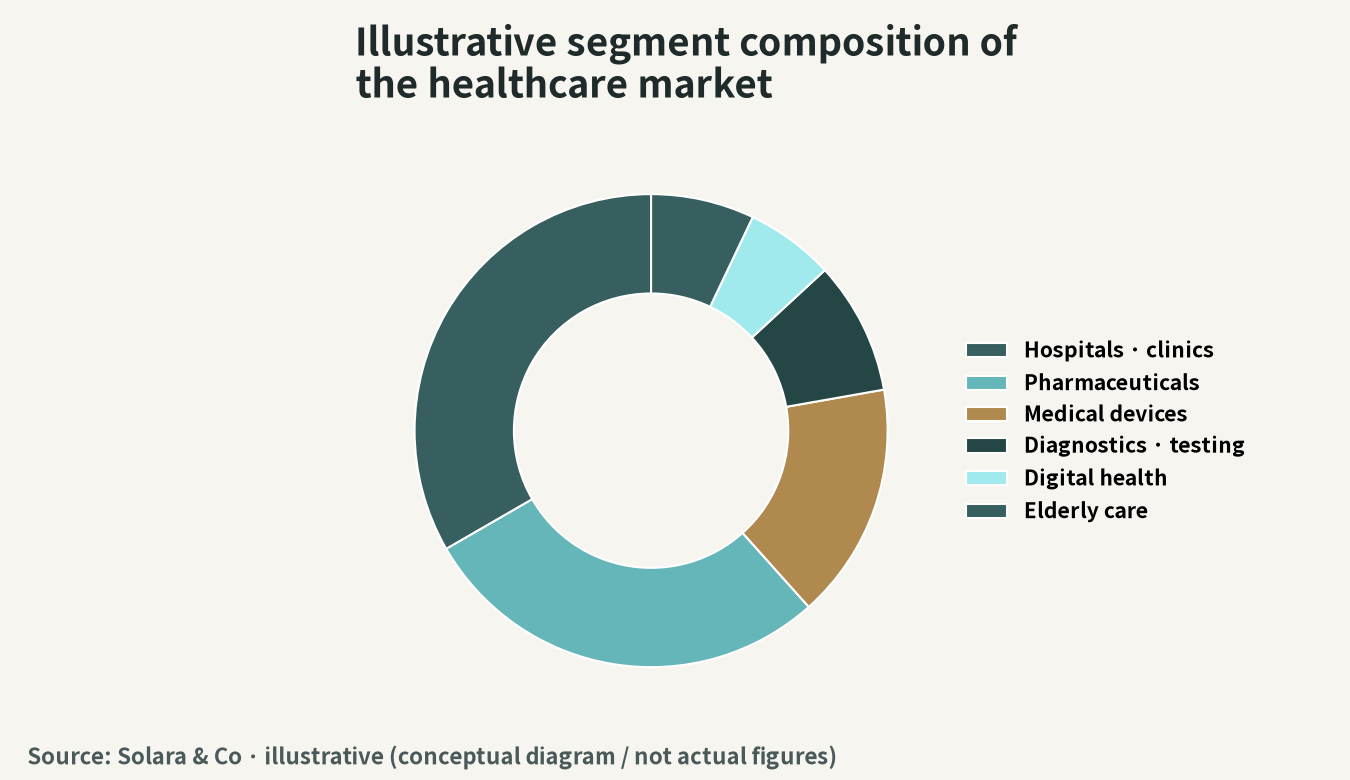
Vietnam's healthcare market is not a single monolith; in practical terms, it is best understood as an aggregate of multiple segments with differing characteristics. Broadly divided, there are six fields: hospitals and clinics (public and private care provision), pharmaceuticals (originator drugs, generics, OTC), medical devices (diagnostic imaging, testing equipment, consumables, in-vitro diagnostics), diagnostics and testing (labs, screening services), digital health (telemedicine, appointment booking, electronic medical records, health apps), and elderly and nursing care.
Public healthcare remains the center of supply, but in urban areas the concentration of patients at large hospitals and long wait times are chronic problems, and as an alternative outlet, private hospitals and clinics are gaining presence. Pharmaceuticals are growing solidly against a backdrop of population increase and a shifting disease structure, forming a two-tier structure in which the domestic production of generics coexists with the import of originator and specialty drugs. Medical devices see vigorous replacement and new-installation demand, and because import dependence is high, this is a field with ample room for foreign entrants. The composition of each segment is illustrated in the conceptual diagram below.
The weight of regulation, the capital required, the payback period, and the character of the local partner sought differ greatly from segment to segment. Accordingly, the first step in considering entry is not to think vaguely about "getting into healthcare," but to define concretely: in which segment, to which customers (public hospitals, private hospitals, pharmacies, consumers), and what value to deliver.
The Drivers Underpinning Growth
The factors driving market growth exist on both the demand side and the social-structure side. Rising incomes and an expanding middle class are thickening the stratum of people who choose, at their own expense, high-quality medical care, screening, and preventive services. The growing number of urban residents who spend beyond the scope covered by health insurance—on comprehensive medical checkups, vaccinations, dental care, cosmetic medicine, and supplements—is a tailwind for private medicine and the self-care market.
Second is heightened health consciousness. Having lived through the experience of a novel infectious disease, interest in prevention, screening, and hygiene has risen another notch, and home-use medical devices, online health consultations, and health management via wearables are working their way into daily life. Third is the structural increase in medical costs, in which demand for chronic-disease management and advanced medical care spurs investment in the care-delivery system. And fourth is the threshold of aging mentioned above, which is preparing promising future markets—such as nursing care, rehabilitation, and home-based medical care—that are still immature at present. These drivers reinforce one another, steadily broadening the market's base.
The Regulatory Environment: Registration, Import Permits, Foreign-Ownership Rules, and Pricing
Healthcare is a heavily regulated field in Vietnam as well, and understanding the regulations governs the business plan itself. Pharmaceuticals require registration (marketing authorization) on a product-by-product basis before they can be distributed, and because they pass through document review, quality requirements, and confirmation of GMP compliance, a commensurate lead time must be anticipated. For medical devices, the weight of the registration and import procedures changes according to the risk classification (Class A through D), with higher-risk products subject to stricter review. Importing also requires compliance with import permits, customs clearance, and labeling and language requirements.
From the standpoint of foreign-ownership rules, the provision of medical care (operating hospitals and clinics) falls under a conditional sector, with multiple permits and licenses stacked on top of one another—minimum capital, facility and personnel requirements, and an operating license. Understanding this point together with Conditional Sectors and Obtaining Licenses—which organizes the overall picture of the licenses required when foreign capital enters—and with The Basics of Foreign-Investment Regulation will raise the precision of the plan. In addition, procurement for public hospitals is fundamentally by tender, with a comprehensive evaluation that includes price, quality, and after-sales service. A sense of the estimated lead time from registration of pharmaceuticals and medical devices to the start of sales is shown in the following conceptual diagram.
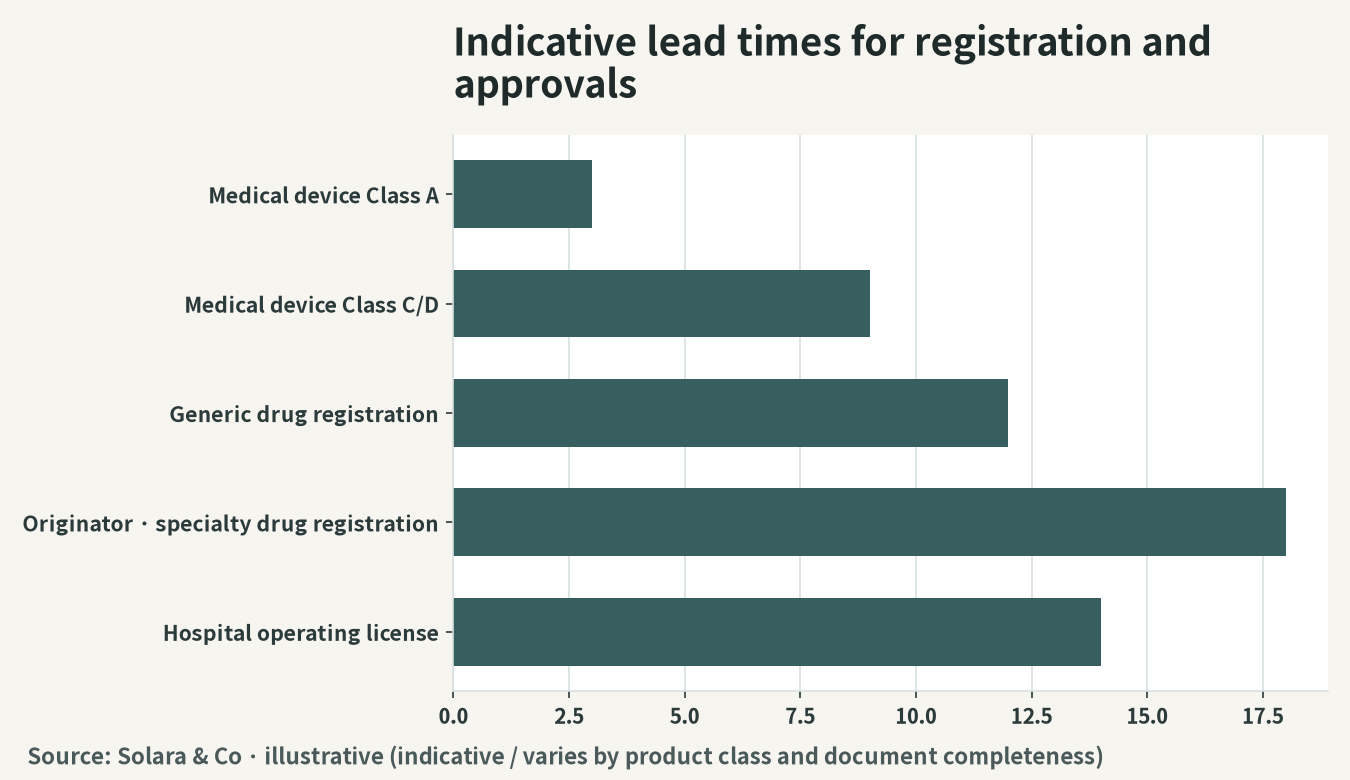
Lead times vary greatly with the product category, the completeness of the documentation, and whether additional inquiries arise. What matters is not to estimate these periods optimistically, but to factor them correctly into the cash flow and launch timing of the business plan.
The Distribution Structure: Distributors and the Hospital Channel
In the healthcare business in Vietnam, "making and bringing in" a product and "delivering and selling" it are difficulties of a different kind. For pharmaceuticals, the role of the local distributor—who holds the import, wholesale, and pharmacy network—is large, and whether or not the registration title, import license, and a logistics network including the cold chain are in place becomes the core of partner selection. The pharmacy channel is, by sheer number, predominantly small-scale and fragmented, but in recent years, with the rise of chain pharmacies, modernization is gradually advancing.
For medical devices and diagnostics, the purchasing process differs by customer channel—public hospital versus private hospital. Public hospitals are swayed by tenders and budget cycles, whereas private hospitals make management decisions quickly but tend to be exacting about return on investment. In either case, the after-sales structure—including installation, maintenance, training, and the supply of consumables—often becomes the deciding factor in winning orders, and what is tested is not mere product sales but the proposal capability that bundles in continuous support. Leading local distributors have strengths in particular specialties, regions, or channels, so rather than a uniform nationwide approach, the mindset of capturing the field through combinations is effective.
Opportunities and Challenges
Seen from the opportunity side, the promising areas are clear. First are private hospitals and clinics, where demand for high-quality medical care that captures the urban middle class's quality orientation is expanding. Second is screening and preventive medicine, where comprehensive medical checkups and health-examination services are growing from both corporate welfare and individual demand. Third are medical devices, with vigorous replacement and new-installation demand spanning diagnostic imaging, testing, in-vitro diagnostics, and consumables. Fourth is digital health and telemedicine, a field with ample room for diffusion—alongside the development of the institutional framework—as a means of closing geographic gaps in medical access.
Meanwhile, the challenges are also concrete. The complexity of regulation and the long registration lead times are directly tied to planning and cash flow. Securing and retaining medical personnel (physicians, nurses, clinical technicians), responding to local business customs and public procurement, and reconciling quality with price are all unavoidable. Organizing the relationship between entry difficulty and opportunity for the major segments gives the following.
Segment | Entry difficulty (estimate) | Weight of regulation | Main opportunity |
|---|---|---|---|
Private hospitals & clinics | High | High (conditional sector, many licenses) | Quality-oriented middle-class demand |
Pharmaceuticals | Medium–high | High (product registration, GMP) | Domestic production, import of specialty drugs |
Medical devices | Medium | Medium (varies by risk class) | Replacement, new-installation, maintenance demand |
Diagnostics & screening | Medium | Medium | Preventive medicine, corporate health checks |
Digital health | Medium | Medium (framework still developing) | Telemedicine, redressing medical-access gaps |
Elderly & nursing care | Medium | Low–medium | Medium- to long-term aging demand |
In addition, for digital health, which handles software and data, personal information and data protection, as well as the safeguarding of proprietary technology and brands, are also important points. On the protection of technology, trademarks, and know-how, see Intellectual Property Protection; and for business designs involving payments or online billing, the overview in Vietnam's Fintech Market is also a useful reference.
How to Choose the Form of Entry
The form of entry into healthcare is designed according to the segment and risk tolerance. Import and sales agency (registering pharmaceuticals or medical devices and rolling them out via a local distributor) makes it easier to keep initial investment down, but how the registration title and the initiative over the channel are positioned becomes the point at issue. A joint venture (JV) can accelerate regulatory response and market development by teaming up with a local partner that holds the licenses, connections, and channels, but the design of governance and decision-making determines success or failure. Direct investment and a local subsidiary suit cases where you want to control operations yourself—such as private hospitals, diagnostic labs, or manufacturing—though the difficulty of licensing and securing personnel becomes higher. M&A and capital participation is a strong option for taking in existing licenses, channels, personnel, and brands, and for buying time. With any form, it is important to consider both a realistic schedule that factors in the regulatory lead time and an exit design for the event of withdrawal or downsizing.
Solara & Co's Support for Entering the Healthcare Market
Solara & Co, as an M&A and market-entry advisory bridging Japan and Vietnam, supports entry into the healthcare field end to end. Specifically, we accompany you in line with local realities—from segment selection and market and competitor research; the organizing of pharmaceutical and medical-device registration and of foreign-ownership and licensing schemes; the search for and evaluation of local distributors, hospital channels, and JV partners; financial, tax, legal, and regulatory due diligence in M&A; the design of pricing and tender strategy; through to support for building the organization, personnel, and governance after entry. Our role is to factor in, from the planning stage, the distinctive difficulties of regulatory complexity and registration lead time, so as to minimize the "unexpected." When you are considering entering Vietnam's healthcare market, please do not hesitate to consult us.